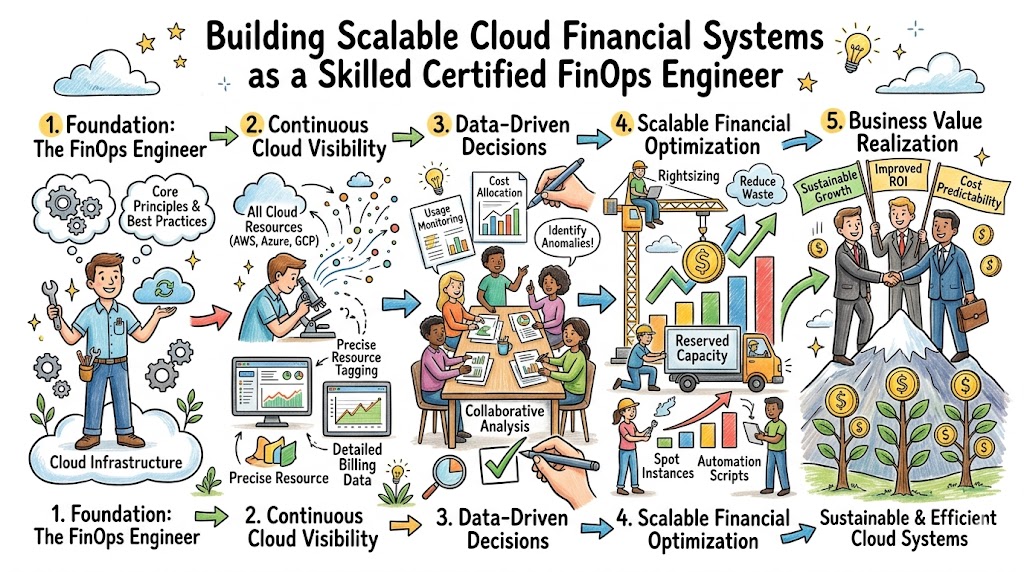
The cloud computing landscape has shifted from simple migration to complex cost management and value realization. This guide explores the Certified FinOps Engineer program, designed for professionals who want to master the intersection of finance and cloud engineering. As organizations struggle with runaway cloud bills, FinOpsSchool provides the technical framework necessary to bridge the gap between engineering teams and procurement departments. This comprehensive roadmap helps SREs, DevOps specialists, and engineering managers understand how to integrate financial accountability into the modern software development lifecycle. By mastering these principles, you ensure that cloud infrastructure remains both performant and economically sustainable for the long term.
What is the Certified FinOps Engineer?
The Certified FinOps Engineer represents a shift from traditional infrastructure management toward a culture of financial accountability. It exists because technical efficiency alone no longer guarantees business success in the cloud. This program emphasizes real-world applications where engineers must optimize resource usage while maintaining high availability. Instead of focusing solely on theoretical cost models, it focuses on production-ready strategies like rightsizing, automation, and unit economics. It aligns perfectly with modern enterprise practices where cloud spend is a primary operational concern for leadership teams.
Who Should Pursue Certified FinOps Engineer?
System administrators, SREs, and cloud architects benefit most from this certification because they directly influence resource consumption. Security professionals also find value here as they balance compliance costs with protection layers. Managers and technical leaders need this credential to justify departmental budgets and demonstrate ROI to stakeholders. While beginners can enter the field, experienced engineers will find it helps them transition into higher-level strategic roles. Its relevance is significant globally, particularly in India’s booming tech hubs where cloud cost optimization has become a critical business priority.
Why Certified FinOps Engineer is Valuable and Beyond
The demand for cloud financial management is growing as enterprise adoption of multi-cloud environments increases. This certification ensures professionals remain relevant even as specific tools or providers change over time. Organizations are moving away from reactive cost-cutting toward proactive cloud financial engineering. By earning this credential, you demonstrate a commitment to operational excellence that directly impacts a company’s bottom line. It offers a high return on investment by positioning you as a rare professional who understands both code and capital.
Certified FinOps Engineer Certification Overview
The program is delivered via the official portal and is hosted on the primary website. It utilizes a rigorous assessment approach that evaluates a candidate’s ability to implement FinOps phases: Inform, Optimize, and Operate. The structure focuses on practical ownership where engineers learn to tag resources, analyze billing data, and automate cost-saving measures. It moves beyond basic cloud knowledge to address the cultural shifts required for successful FinOps implementation. Candidates gain a clear understanding of how to collaborate with finance teams without sacrificing engineering speed.
Certified FinOps Engineer Certification Tracks & Levels
The certification journey begins with foundation levels that introduce core vocabulary and basic cloud economics. Professional levels dive deeper into technical execution, such as building automated scaling policies and complex dashboarding. Advanced levels focus on architectural design for cost and organizational change management. Specialization tracks allow engineers to focus on specific domains like DevOps integration or SRE-focused cost observability. These levels are designed to align with career progression from an individual contributor to a strategic lead.
Complete Certified FinOps Engineer Certification Table
| Track | Level | Who it’s for | Prerequisites | Skills Covered | Recommended Order |
| Core FinOps | Foundation | Beginners, Managers | Basic Cloud Knowledge | Vocabulary, Lifecycle | First |
| Engineering | Professional | SRE, DevOps | Cloud Certifications | Automation, Rightsizing | Second |
| Architecture | Advanced | Solutions Architects | Professional Level | Design for Cost, Policy | Third |
| Analytics | Specialist | Data Engineers | SQL/BI Tools | Cost Visibility, Tagging | Optional |
Detailed Guide for Each Certified FinOps Engineer Certification
Certified FinOps Engineer – Foundation
What it is
This certification validates a professional’s understanding of the basic FinOps principles and the fundamental cloud billing models. It ensures a common language exists between engineering and finance departments.
Who should take it
It is suitable for junior cloud engineers, project managers, and finance professionals who interact with technical teams. No deep coding experience is required for this level.
Skills you’ll gain
- Understanding of cloud pricing models like On-Demand and Reserved Instances.
- Knowledge of the three FinOps phases.
- Ability to interpret basic cloud billing reports.
Real-world projects you should be able to do
- Create a basic resource tagging policy for a startup.
- Generate a monthly cloud spend report for a specific department.
Preparation plan
- 7–14 Days: Review official documentation and terminology.
- 30 Days: Complete foundational practice exams and watch video modules.
- 60 Days: Not required for this level unless new to cloud.
Common mistakes
- Ignoring the cultural aspect of FinOps in favor of just numbers.
- Confusing FinOps with traditional IT asset management.
Best next certification after this
- Same-track: Certified FinOps Professional.
- Cross-track: Cloud Associate certifications.
- Leadership: FinOps Practitioner.
Choose Your Learning Path
DevOps Path
The DevOps path focuses on integrating cost feedback loops directly into the CI/CD pipeline. Engineers learn to treat “cost” as a performance metric similar to latency or error rates. This path involves automating the teardown of non-production environments and implementing “shift-left” cost practices. Professionals here ensure that developers see the cost impact of their code changes before deployment.
DevSecOps Path
In this path, the focus is on the intersection of security compliance and cost efficiency. Engineers learn how to manage the costs of security tools and data retention policies without compromising safety. It involves optimizing log storage costs and ensuring that security scanners do not cause unnecessary compute spikes. This role is vital for maintaining a lean yet secure infrastructure.
SRE Path
The Site Reliability Engineering path emphasizes the balance between reliability and cost. SREs use FinOps to define Service Level Objectives that include financial constraints. This path covers advanced topics like rightsizing based on performance metrics and managing the costs of high-availability architectures. It ensures that the system is not “over-engineered” at an unsustainable price point.
AIOps Path
This track utilizes machine learning to predict cloud spend and detect anomalies automatically. Professionals learn to implement AI-driven tools that suggest optimizations based on historical usage patterns. It focuses on reducing the manual effort required to manage thousands of cloud resources. This path is ideal for those looking to scale FinOps across massive enterprise environments.
MLOps Path
The MLOps path specifically addresses the high costs associated with training and deploying machine learning models. Engineers learn how to optimize GPU utilization and manage expensive data egress fees. It involves implementing specialized scheduling for batch processing and model inference. This ensures that AI initiatives remain financially viable for the business.
DataOps Path
DataOps professionals focus on the cost of data storage, processing, and warehousing in the cloud. This path covers optimizing SQL queries to reduce compute costs and choosing the right storage tiers for big data. Engineers learn to manage the lifecycle of data to prevent “dark data” from inflating monthly bills. It is a critical role for companies relying on heavy data analytics.
FinOps Path
This is the pure specialization path for those wanting to become dedicated FinOps practitioners. It covers the entire breadth of the framework, from executive reporting to technical automation. Professionals learn to negotiate with cloud vendors for enterprise discount programs. They act as the primary bridge between the CFO’s office and the engineering department.
Role → Recommended Certified FinOps Engineer Certifications
| Role | Recommended Certifications |
| DevOps Engineer | Professional FinOps Engineer |
| SRE | Advanced FinOps Practitioner |
| Platform Engineer | FinOps Architecture Specialist |
| Cloud Engineer | Foundation + Professional Levels |
| Security Engineer | FinOps Security Integration |
| Data Engineer | DataOps Cost Specialist |
| FinOps Practitioner | All Core FinOps Levels |
| Engineering Manager | FinOps Foundation for Leaders |
Next Certifications to Take After Certified FinOps Engineer
Same Track Progression
Once you master the engineering side, moving into advanced FinOps architecture is the logical step. This involves designing complex, multi-tenant cloud environments with built-in cost guardrails. You will focus on policy as code and global enterprise scaling. Deepening your knowledge in specific cloud provider cost tools like AWS Cost Explorer or Azure Cost Management is also recommended.
Cross-Track Expansion
Broadening your skills into SRE or Platform Engineering adds technical depth to your financial knowledge. Understanding how Kubernetes clusters manage resources allows you to apply FinOps at the container level. You might also explore data science certifications to better analyze large-scale billing datasets. This makes you a more versatile asset in a cross-functional team.
Leadership & Management Track
If you prefer the business side, transitioning into technical management or a FinOps Director role is a viable path. This requires soft skills like negotiation, stakeholder management, and organizational change. You will focus more on the “Operate” phase, driving cultural adoption across the entire company. This track often leads to executive-level influence over cloud strategy.
Training & Certification Support Providers for Certified FinOps Engineer
DevOpsSchool
This provider offers extensive resources for engineers looking to master the technical side of cloud financial management. They focus on hands-on labs that simulate real-world production environments where cost is a primary constraint. Their instructors bring years of industry experience to help students understand complex billing structures.
Cotocus
This organization provides specialized coaching for professionals who want to integrate FinOps into their existing DevOps workflows. They emphasize the use of open-source tools for cost observability and reporting. Their curriculum is designed to be practical and immediately applicable to current enterprise projects.
Scmgalaxy
Known for a vast community and deep technical articles, this provider helps engineers stay updated on the latest FinOps trends. They offer comprehensive guides on automation and scripting for cloud cost reduction. Their focus is on building a strong community of practitioners who share best practices.
BestDevOps
This platform focuses on high-quality video content and structured learning paths for cloud professionals. They break down complex FinOps concepts into digestible modules for busy engineers. Their training is recognized for being clear and focused on the most relevant industry tools.
devsecopsschool.com
This provider focuses on the intersection of security and financial operations. They teach students how to maintain a secure cloud environment while keeping costs under control. Their courses are essential for professionals working in highly regulated industries like finance or healthcare.
sreschool.com
Focusing on reliability, this site teaches how to build systems that are both stable and cost-effective. They emphasize the use of performance metrics to drive financial decisions. Their labs include scenarios where students must optimize clusters for both speed and budget.
aiopsschool.com
This platform explores the future of FinOps through artificial intelligence and machine learning. They provide training on how to use AI to predict and manage cloud spending. It is the go-to resource for engineers looking to automate the “Optimize” phase of FinOps.
dataopsschool.com
Specializing in data infrastructure, this provider covers the unique financial challenges of big data in the cloud. They teach students how to optimize data pipelines and storage for maximum cost efficiency. Their training is vital for data architects and engineers.
finopsschool.com
As the primary host for the certification, this site offers the most direct path to earning your credential. They provide the official curriculum and assessment tools needed to succeed. Their resources are the benchmark for anyone entering the FinOps field.
Frequently Asked Questions
- How difficult is the Certified FinOps Engineer exam for a beginner?The exam is moderate in difficulty because it requires a mix of financial understanding and technical cloud knowledge. Beginners should spend extra time learning cloud billing models.
- How much time is required to prepare for the professional level?Most professionals find that 30 to 60 days of consistent study is sufficient. This includes hands-on practice with cloud cost management tools.
- Are there any specific prerequisites before I can take the test?While not mandatory, having a basic cloud certification from AWS or Azure is highly recommended. It provides the necessary context for cloud resource management.
- What is the return on investment for this specific certification?Professionals often see a significant salary increase or access to more senior roles. Companies value the ability to save thousands of dollars on cloud spend.
- Is there a specific sequence I should follow for the tracks?Starting with the Foundation level is always best to build a solid vocabulary. Afterward, you should choose a track that matches your current job role.
- Does this certification expire after a certain period?Most cloud-related certifications require renewal every two to three years to stay current. This ensures you are up to date with the latest cloud provider updates.
- How does this credential help me in a management role?It gives you the data-driven evidence needed to support your budget requests. You can speak confidently to both engineers and finance directors.
- Are there hands-on labs included in the training programs?Yes, reputable providers include labs where you must identify and fix cost-inefficiencies. This practical experience is crucial for passing the exam.
- Can I pass the exam using only free online resources?While possible, official training programs provide a structured path that covers all exam domains. They often include practice questions that reflect the actual test.
- Is the certification recognized by major global tech companies?Yes, as cloud costs rise, major enterprises are actively looking for certified FinOps professionals. It is becoming a standard requirement for cloud engineering roles.
- What is the main difference between FinOps and cost optimization?FinOps is a cultural practice involving the whole company, while optimization is a specific technical task. This certification covers the entire cultural framework.
- Do I need to be good at math to succeed in FinOps?You need a basic understanding of percentages and data analysis. However, most of the complex math is handled by cloud tools and automation scripts.
FAQs on Certified FinOps Engineer
- What specific cloud platforms are covered in the Certified FinOps Engineer curriculum?The certification is largely platform-agnostic, focusing on universal principles applicable to AWS, Azure, and Google Cloud.
- Does the program cover container-level cost management for Kubernetes?Yes, it includes sections on managing shared costs and resource allocation within containerized environments.
- How does this certification address multi-cloud financial strategies?It teaches you how to normalize data across different providers to create a unified view of spending.
- Is there a focus on automated remediation in the professional track?Correct, the professional level emphasizes building scripts and policies that automatically shut down wasted resources.
- Does the exam test knowledge of third-party cost management tools?It focuses on the principles of using tools rather than specific proprietary software products.
- How is the “Inform” phase of the FinOps lifecycle tested?Candidates must demonstrate the ability to create visibility through tagging, mapping, and allocation of cloud costs.
- Are negotiation tactics with cloud vendors part of the curriculum?The advanced tracks cover enterprise discount programs and how to commit to usage for lower pricing.
- What is the weightage of “Unit Economics” in the final assessment?Unit economics is a core pillar, as it helps engineers move from “total spend” to “cost per customer.”
Final Thoughts: Is Certified FinOps Engineer Worth It?
The transition to the cloud was once about speed; today, it is about sustainability. Earning a Certified FinOps Engineer credential proves that you understand the true cost of innovation. Organizations are no longer satisfied with engineers who only know how to build; they want engineers who know how to build efficiently. This certification bridges the gap between the server room and the boardroom, making you an indispensable part of the modern enterprise. If you want to move beyond routine maintenance and into a role where you influence company strategy and profitability, this is a logical and practical investment in your future. It provides the tools to manage complexity and the credentials to prove your value in a competitive market.
