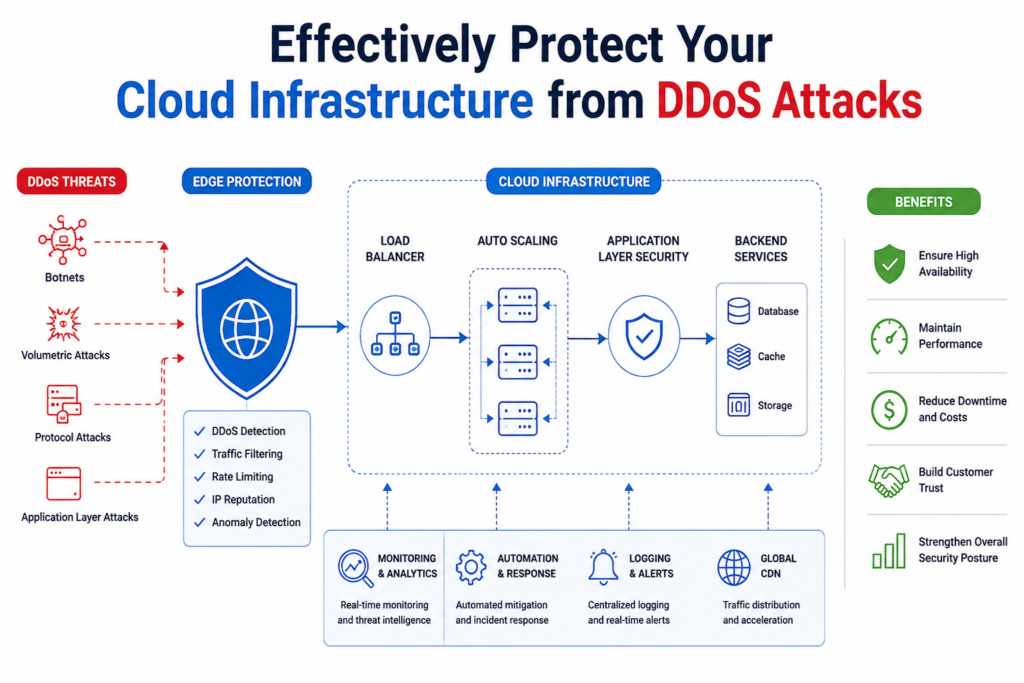
Cloud computing has transformed the way organizations build, deploy, and scale applications. Businesses now rely on cloud infrastructure to host websites, run enterprise applications, manage databases, deliver digital services, and support global customers. However, as cloud adoption grows, cyber threats continue to evolve. Among these threats, Distributed Denial of Service (DDoS) attacks remain one of the most disruptive and damaging challenges for modern organizations.
A DDoS attack attempts to overwhelm a target system, application, or network with massive amounts of malicious traffic. The objective is simple: make services unavailable to legitimate users. Attackers use large networks of compromised devices, often called botnets, to generate enormous traffic volumes that can exhaust bandwidth, consume computing resources, and disrupt business operations.
Organizations operating in cloud environments face unique challenges because cloud services are internet-facing by design. While cloud platforms provide scalability and resilience, poorly configured environments can still become vulnerable to large-scale attacks. Therefore, protecting cloud infrastructure from DDoS attacks requires a combination of architecture design, operational discipline, security controls, monitoring strategies, and continuous improvement.
Professionals seeking to strengthen their cloud security knowledge often explore educational resources from Cloudopsnow, which focuses on modern cloud operations, infrastructure management, automation, reliability engineering, and cloud security practices. Understanding DDoS defense mechanisms is an essential skill because organizations increasingly depend on cloud-based systems to deliver uninterrupted services to customers around the world.
Understanding DDoS Attacks in Cloud Environments
A Distributed Denial of Service attack occurs when attackers coordinate thousands or even millions of devices to send traffic toward a target simultaneously. Unlike a simple denial-of-service attack that originates from a single source, DDoS attacks come from multiple distributed systems, making detection and mitigation more difficult. Attackers often compromise computers, servers, IoT devices, routers, and mobile devices to create botnets capable of generating enormous traffic volumes.
Cloud environments present attractive targets because they host critical business applications, customer-facing services, APIs, and data processing systems. When attackers successfully overwhelm cloud resources, organizations may experience service outages, financial losses, reduced customer trust, and operational disruption. In some cases, companies may also incur additional cloud costs because cloud resources automatically scale in response to traffic spikes, including malicious traffic.
DDoS attacks have become increasingly sophisticated. Modern attackers combine multiple attack methods simultaneously, targeting different layers of infrastructure. Consequently, organizations must adopt layered defense strategies that address network traffic, application behavior, infrastructure scalability, and operational readiness. Effective protection depends on understanding how these attacks work and how cloud architectures can absorb or mitigate them.
Why Cloud Infrastructure Remains a Prime Target
Cloud platforms host some of the most valuable digital assets in modern business environments. E-commerce applications, banking platforms, healthcare systems, SaaS solutions, streaming services, and enterprise applications all rely on cloud infrastructure. Because these services are accessible over the internet, attackers view them as highly visible and potentially profitable targets.
Attackers often launch DDoS attacks for various reasons. Some seek financial gain through extortion. Others attempt to damage a company’s reputation by causing service outages. Competitors, hacktivist groups, or politically motivated actors may also conduct attacks to disrupt operations or attract attention. In other situations, DDoS attacks serve as distractions while attackers attempt data theft or other malicious activities.
Cloud-native architectures improve resilience but do not eliminate risk. Organizations frequently assume that moving workloads to the cloud automatically protects them from all attacks. Unfortunately, security remains a shared responsibility. Cloud providers secure the underlying infrastructure, but customers remain responsible for securing applications, configurations, access controls, and operational processes. Therefore, comprehensive DDoS protection requires collaboration between cloud services and customer-managed security practices.
Types of DDoS Attacks That Affect Cloud Systems
Understanding attack categories helps operations teams design effective defenses. Different attacks target different components of infrastructure and require specific mitigation strategies.
Volumetric Attacks
Volumetric attacks focus on consuming available network bandwidth. Attackers generate massive traffic floods designed to overwhelm network capacity and prevent legitimate traffic from reaching applications. These attacks often involve UDP floods, amplification attacks, and large-scale botnet activity. Because cloud environments rely heavily on network connectivity, volumetric attacks can significantly affect service availability.
Protocol Attacks
Protocol-based attacks exploit weaknesses in networking protocols and connection management mechanisms. Examples include SYN floods, fragmented packet attacks, and connection exhaustion techniques. These attacks target load balancers, firewalls, servers, and networking equipment by consuming processing resources rather than pure bandwidth. As a result, infrastructure components become overloaded and unable to process legitimate requests efficiently.
Application Layer Attacks
Application layer attacks target specific applications and services rather than network infrastructure. Attackers send seemingly legitimate requests to web servers, APIs, login pages, or search functions. Because these requests often resemble normal user activity, detection becomes more difficult. Application layer attacks can consume CPU resources, database connections, and application processing capacity while remaining relatively low in traffic volume.
Core Principles of DDoS Protection in the Cloud
Effective protection starts with architectural design rather than reactive mitigation alone. Organizations should build environments capable of handling unexpected traffic surges while maintaining visibility into infrastructure behavior.
Scalability represents the first principle. Cloud systems should distribute workloads across multiple resources, regions, and availability zones whenever possible. Redundancy ensures that no single failure point can disrupt critical services. Monitoring provides continuous visibility into traffic patterns, resource utilization, and security events. Automation enables rapid responses when attack indicators appear.
Another important principle involves minimizing the attack surface. Public-facing systems should expose only necessary services. Unused ports, unnecessary endpoints, and poorly protected APIs create additional opportunities for attackers. By reducing exposure, organizations limit potential attack vectors and simplify security management efforts.
Finally, resilience should guide every architectural decision. Security teams should assume attacks will occur eventually. Therefore, infrastructure must continue functioning during adverse conditions rather than depending solely on attack prevention mechanisms.
Key Operational Concepts You Must Know
Operations professionals responsible for cloud infrastructure must understand several foundational concepts that directly influence DDoS resilience and overall system availability.
Traffic Baselines
Every environment exhibits normal traffic patterns. Teams should establish traffic baselines that define expected user behavior, request volumes, geographic distribution, and resource consumption. Without baseline measurements, identifying abnormal activity becomes significantly more challenging. Continuous analysis helps distinguish legitimate growth from potential attack activity.
Elastic Scaling
Cloud platforms offer dynamic scaling capabilities that automatically adjust resource allocation based on demand. Properly configured auto-scaling mechanisms help absorb traffic spikes and maintain availability during attacks. However, teams must balance scalability with cost controls because malicious traffic can trigger excessive resource provisioning.
Load Distribution
Load balancing distributes incoming requests across multiple servers, instances, or regions. Effective load distribution prevents individual resources from becoming overwhelmed. Furthermore, geographically distributed architectures improve resilience by enabling traffic routing across multiple locations during regional disruptions.
Observability
Observability combines monitoring, logging, tracing, and analytics to provide deep visibility into infrastructure behavior. Strong observability practices allow teams to detect anomalies quickly, identify attack patterns, and respond before service degradation becomes severe. Modern operations teams rely heavily on observability platforms to support proactive incident management.
Incident Response Readiness
Technical controls alone cannot stop every attack. Teams need documented incident response procedures, escalation workflows, communication plans, and recovery strategies. Prepared organizations respond faster and minimize operational disruption during security incidents.
Building a DDoS-Resilient Cloud Architecture
Architecture plays a critical role in determining how effectively systems withstand attacks. Security should be integrated into design decisions from the beginning rather than added later as an afterthought.
Organizations should deploy applications across multiple availability zones whenever possible. Multi-zone deployments reduce the risk of localized failures affecting entire services. Additionally, distributing workloads across regions provides further protection against large-scale disruptions and improves disaster recovery capabilities.
Network segmentation enhances security by isolating critical systems from public-facing components. Public applications should reside in controlled zones while sensitive databases and internal services remain protected behind strict access controls. Segmentation limits lateral movement opportunities and reduces overall attack impact.
Caching mechanisms significantly improve resilience. Content delivery systems, edge caching platforms, and application-level caches reduce direct load on backend infrastructure. When requests are served from cached locations, applications process fewer requests and remain more stable during traffic surges.
Infrastructure as Code practices also contribute to resilience. Automated deployment processes enable rapid infrastructure recovery and consistent security configurations. Teams can quickly provision replacement resources and implement defensive measures when attack conditions arise.
Leveraging Network-Level Protection Mechanisms
Network-layer defenses form the first line of protection against DDoS attacks. These controls help identify, filter, and absorb malicious traffic before it reaches applications.
Traffic filtering mechanisms inspect incoming requests and block suspicious patterns. Rate limiting controls prevent individual sources from generating excessive requests within defined periods. Access control lists restrict traffic based on source addresses, protocols, or geographic regions when appropriate.
Anycast networking improves resilience by distributing traffic across multiple locations simultaneously. Instead of directing all requests to a single destination, Anycast routes traffic to the nearest available node. This approach spreads attack traffic across larger infrastructure footprints and reduces localized impact.
Network monitoring systems continuously analyze traffic behavior for anomalies. Sudden increases in request volume, unusual geographic patterns, protocol irregularities, and connection spikes often indicate attack activity. Early detection enables faster mitigation and reduces operational disruption.
Organizations should also regularly review network configurations to eliminate unnecessary exposure. Security teams frequently discover unused services, open ports, or outdated configurations that increase attack surfaces without providing business value.
Strengthening Application-Level Security Against DDoS Attacks
Application-layer attacks often bypass traditional network defenses because they mimic legitimate user behavior. Therefore, organizations must implement protections specifically designed for application workloads.
Rate limiting remains one of the most effective controls. Applications should restrict excessive requests from individual users, IP addresses, sessions, or API clients. Proper rate limiting reduces resource exhaustion risks while maintaining availability for legitimate users.
Authentication and authorization mechanisms help distinguish genuine users from automated bots. Multi-factor authentication, API keys, session validation, and identity verification processes make large-scale abuse more difficult. Although these controls do not eliminate attacks entirely, they increase attacker costs and complexity.
Web application firewalls inspect requests for malicious characteristics and abnormal patterns. Advanced systems use behavioral analysis, machine learning, and reputation data to identify suspicious activity. Consequently, organizations gain additional protection against application-focused attack techniques.
Developers should also optimize application performance. Efficient code, database optimization, caching strategies, and resource management reduce infrastructure strain. Applications that consume fewer resources per request naturally withstand larger traffic volumes before experiencing performance degradation.
Monitoring and Detection Strategies for Modern Cloud Operations
Continuous monitoring serves as the foundation of effective DDoS defense. Organizations cannot respond effectively to attacks they cannot detect.
Security teams should monitor traffic volume, request rates, response times, bandwidth utilization, error rates, and infrastructure performance metrics. Significant deviations from established baselines often indicate emerging attack activity. Real-time dashboards provide visibility into operational health and support faster decision-making during incidents.
Log analysis plays an equally important role. Application logs, network logs, firewall logs, and access records reveal detailed attack characteristics. By correlating information across multiple systems, teams can identify attack sources, affected services, and mitigation opportunities more effectively.
Alerting systems should prioritize actionable notifications rather than overwhelming teams with excessive warnings. Well-designed alerting strategies focus attention on meaningful events while minimizing false positives. This balance improves response efficiency and reduces alert fatigue.
Threat intelligence integration further enhances detection capabilities. External intelligence feeds provide information about known malicious IP addresses, botnet infrastructure, emerging attack techniques, and threat actor behavior. Combining internal monitoring with external intelligence strengthens overall situational awareness.
Platform Implementation vs. Culture — What’s the Real Difference?
Organizations often invest heavily in technology platforms while overlooking the cultural practices required for operational success. Although advanced tools provide valuable capabilities, technology alone cannot guarantee effective DDoS protection.
Platform implementation focuses on technical components. This includes security services, monitoring tools, firewalls, load balancers, automation frameworks, and cloud infrastructure configurations. These technologies create the foundation for visibility, scalability, and defensive capabilities. Without appropriate platforms, teams struggle to manage complex cloud environments efficiently.
Culture, however, determines how teams use these technologies. Strong operational cultures emphasize collaboration, continuous learning, proactive risk management, and shared responsibility. Security becomes part of daily operations rather than an isolated function handled by a single department. Teams regularly review incidents, conduct simulations, and improve processes based on lessons learned.
The most successful organizations combine both elements. They implement robust technical platforms while fostering cultures that prioritize resilience, accountability, and continuous improvement. When technology and culture align, teams respond faster, learn more effectively, and maintain stronger security postures over time.
Real-World Use Cases of Modern Operations
Modern operations practices play a critical role in defending cloud environments against evolving threats. Several practical use cases demonstrate how operational excellence improves security and reliability.
A large e-commerce platform may experience sudden traffic surges during promotional campaigns. Operations teams use auto-scaling, load balancing, caching, and traffic monitoring to distinguish legitimate customer demand from potential attacks. These capabilities maintain service availability while protecting backend systems from overload.
Financial institutions often deploy real-time monitoring platforms that analyze network behavior continuously. When abnormal traffic patterns emerge, automated workflows initiate defensive actions, adjust traffic routing, and notify response teams. This rapid response capability reduces attack impact significantly.
Software-as-a-Service providers rely heavily on observability and incident management practices. Detailed telemetry data enables engineers to identify attack indicators quickly and coordinate mitigation efforts across infrastructure, application, and security teams. Comprehensive visibility supports informed decision-making during high-pressure situations.
Global organizations also leverage geographic redundancy to improve resilience. By distributing services across multiple regions, they maintain operations even when specific locations experience elevated attack activity or infrastructure disruption.
Common Mistakes in Operations Engineering
Many organizations unintentionally increase their DDoS exposure through avoidable operational mistakes. Understanding these common errors helps teams strengthen their defenses proactively.
One frequent mistake involves assuming cloud providers handle all security responsibilities. Although providers secure foundational infrastructure, customers remain responsible for application security, access controls, monitoring, and operational processes. Misunderstanding this shared responsibility model creates significant risk.
Another common issue is inadequate monitoring. Teams often collect large volumes of data but fail to establish meaningful baselines or actionable alerts. Consequently, attacks may progress undetected until customer-facing services experience noticeable disruption.
Poor capacity planning also creates vulnerabilities. Organizations sometimes underestimate traffic growth, infrastructure requirements, or attack scenarios. Without sufficient capacity and scalability mechanisms, services become vulnerable to relatively modest attacks.
Many teams neglect incident response preparation. Technical defenses may exist, but response procedures remain undocumented or untested. During actual incidents, confusion and delayed decision-making increase operational impact.
Finally, organizations frequently overlook regular security reviews. Infrastructure evolves continuously, and outdated configurations, unused services, and forgotten resources often introduce unnecessary risks. Regular assessments help identify and address these issues before attackers exploit them.
How to Become an Operations Expert — Career Roadmap
Operations engineering continues to grow as organizations expand cloud adoption and digital transformation initiatives. Professionals interested in this field should develop both technical expertise and operational thinking.
Build Foundational Technical Skills
Start by mastering networking fundamentals, operating systems, cloud computing concepts, and infrastructure management. Understanding how systems communicate and interact provides the foundation for advanced operational responsibilities.
Learn Cloud Platforms
Develop practical experience with cloud services, deployment models, networking architectures, storage systems, and security controls. Hands-on learning accelerates understanding and improves problem-solving capabilities.
Develop Automation Expertise
Automation remains a core competency for modern operations professionals. Learn scripting languages, Infrastructure as Code practices, configuration management, and deployment automation techniques. Automation improves consistency, scalability, and operational efficiency.
Strengthen Monitoring and Reliability Knowledge
Study observability, monitoring platforms, incident management, performance optimization, and reliability engineering principles. These skills directly support operational resilience and service availability.
Expand Security Understanding
Operations experts increasingly participate in security initiatives. Learn threat modeling, cloud security, access management, vulnerability assessment, and DDoS mitigation strategies. Security awareness enhances operational effectiveness significantly.
Recommended Focus Areas
- Cloud Infrastructure Engineering
- Site Reliability Engineering
- DevOps Practices
- Platform Engineering
- Cloud Security Operations
- Network Engineering
- Automation and Orchestration
- Incident Response Management
Professionals who combine these competencies become valuable contributors to modern technology organizations and are well-positioned for long-term career growth.
FAQ Section
What is a DDoS attack?
A DDoS attack is a cyberattack that uses multiple compromised devices to flood a target system with traffic, making services unavailable to legitimate users.
Why are cloud environments targeted by DDoS attacks?
Cloud environments host critical applications and internet-facing services, making them attractive targets for attackers seeking disruption, financial gain, or reputational damage.
Can cloud auto-scaling stop DDoS attacks?
Auto-scaling helps absorb traffic spikes and improve availability, but it should be combined with security controls because attackers can exploit scaling mechanisms to increase costs.
What is the role of load balancing in DDoS protection?
Load balancing distributes traffic across multiple resources, preventing individual systems from becoming overwhelmed and improving overall resilience.
How important is monitoring for DDoS defense?
Monitoring is essential because it helps teams detect abnormal traffic patterns, identify attack activity quickly, and initiate mitigation actions before major disruption occurs.
Do small organizations need DDoS protection?
Yes. Attackers frequently target organizations of all sizes. Even small businesses can experience significant financial and operational impact from service outages.
What skills should operations engineers develop for cloud security?
Operations engineers should focus on networking, cloud platforms, automation, observability, incident response, infrastructure management, and security fundamentals.
Can application-level attacks bypass traditional defenses?
Yes. Application-layer attacks often resemble legitimate user traffic, making them harder to detect without specialized application-focused security controls.
Final Summary
Protecting cloud infrastructure from DDoS attacks requires far more than deploying a single security solution. Effective defense depends on combining resilient architecture, network protection, application security, monitoring, automation, and operational readiness. Organizations must understand attack patterns, establish strong traffic baselines, implement layered defenses, and continuously improve security practices.
Modern cloud environments offer powerful capabilities such as scalability, redundancy, automation, and observability. However, these advantages only deliver value when organizations use them strategically. Teams that invest in operational excellence, proactive monitoring, incident preparedness, and continuous learning create infrastructures capable of withstanding increasingly sophisticated attack campaigns.
Long-term success comes from balancing technology, processes, and people. Robust platforms provide essential technical capabilities, while strong operational cultures ensure teams use those capabilities effectively. By adopting a comprehensive approach to DDoS protection, organizations can maintain service availability, strengthen customer trust, reduce business risk, and build resilient cloud environments prepared for future challenges.
