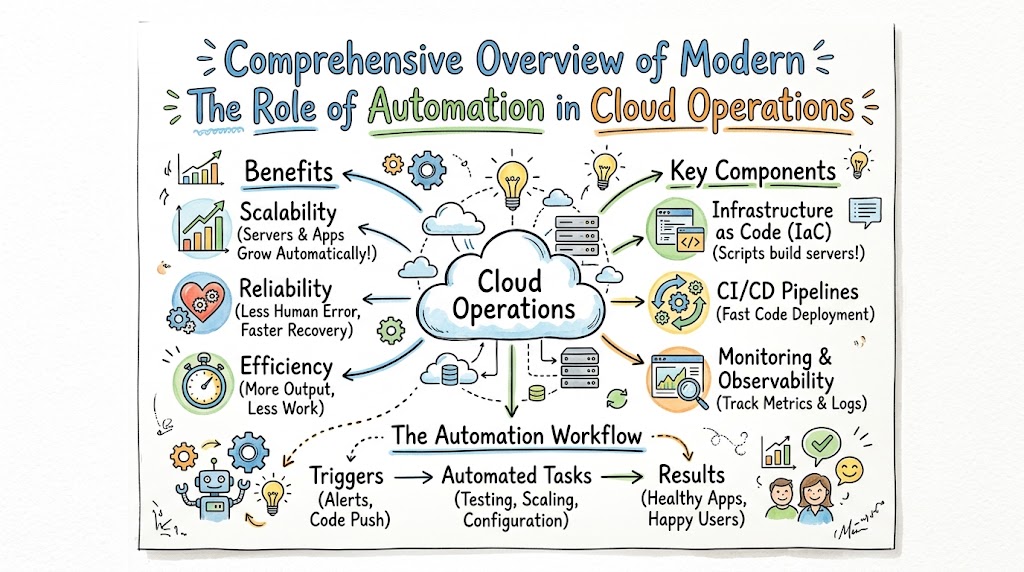
Imagine a critical production environment crashing at midnight because an unexpected traffic surge depleted all available system memory. Engineers scramble across fragmented channels, manually digging through massive server logs while financial losses accumulate by the minute. Traditional infrastructure management relies heavily on reactive firefighting, which inevitably introduces human error and severe operational bottlenecks. Modern distributed networks demand a fundamental shift toward programmatic infrastructure management. Organizations must eliminate repetitive manual tasks to maintain consistent system reliability at scale.
Enterprise systems now face massive operational demands that manual tracking can no longer sustain. Programmatic management infuses software engineering practices directly into infrastructure workflows, which creates self-healing environments. Therefore, engineering teams use intelligent software platforms to manage scaling, monitoring, and patch deployments seamlessly. This comprehensive guide details structural system patterns, modern operational workflows, and advanced reliability engineering frameworks. You will explore practical methods to establish measurable system metrics, optimize release safety, and build resilient infrastructure pipelines.
Navigating complex multi-cloud ecosystems requires deep technical knowledge and standardized automation patterns. Fortunately, you can accelerate this journey by leveraging the expert engineering frameworks available at Cloudopsnow. Their comprehensive industry platforms provide teams with the exact technical blueprints and operational skills needed to build robust, failure-tolerant cloud architectures.
The Origin of Systems Infrastructure
The Early Industrial Bottlenecks
Traditional enterprise IT architectures depended entirely on physical data centers and isolated infrastructure teams. Operators spent hours manually mounting hardware, running network cables, and configuring operating systems using static spreadsheets. Because development teams focused purely on feature speed, they frequently handed unstable applications over to operations teams. This structural separation created immense tension, since operations teams prioritized stability while developers demanded rapid changes. Consequently, deployments occurred infrequently, code integrations failed constantly, and resolving production outages took days.
Moving Toward Unified Workflow Automation
The rise of virtualization and programmable infrastructure fundamentally transformed how modern companies manage computing resources. Software-defined networks and APIs allowed engineers to treat infrastructure exactly like application code, which birthed unified workflow automation. Organizations rapidly began breaking down historical departmental walls to establish shared operational responsibility throughout the software lifecycle. Consequently, teams automated continuous integration pipelines, standardized server configurations, and established systemic feedback loops. This cultural and technological shift minimized manual intervention, which accelerated delivery cycles and improved deployment consistency across staging environments.
Global Expansion Across Commercial Ecosystems
As cloud providers expanded globally, massive tech enterprises encountered unprecedented challenges regarding infrastructure scale and complexity. Handling millions of concurrent global requests required web-scale organizations to re-engineer their entire delivery framework. Programmatic operations quickly spread from hyperscale pioneers into traditional commercial sectors, including banking, healthcare, and retail ecommerce. Today, global companies rely on distributed automation to deploy microservices across multiple geographical regions simultaneously. This widespread adoption has transformed system resilience from a minor IT concern into a core driver of modern corporate competitive advantage.
Defining Strategic Operations Management
The Core Operational Structure
The structural design of modern systems management relies on viewing infrastructure explicitly as a software engineering discipline. Instead of executing manual server tasks, engineers write declarative code to manage cluster lifecycle configurations and resource scaling. Data flows continuously from distributed monitoring agents into centralized tracking systems, which provides real-time visibility into infrastructure health. This structural framework ensures that every infrastructure component remains version-controlled, auditable, and completely reproducible.
Daily Tasks of Systems Coordinators
Systems coordinators spend their days designing resilient software patterns, optimizing delivery pipelines, and eliminating manual infrastructure overhead. They actively write automation scripts to handle predictable system events, such as scaling container clusters during traffic spikes. Additionally, these specialists participate in architecture reviews to guarantee that new applications meet strict scalability requirements. When production anomalies arise, they lead technical investigations, stabilize complex environments, and build long-term automated fixes to prevent repeat failures.
Localized Control vs. Broad System Architecture
Managing complex environments requires balancing microscopic component tracking with holistic, macro-level system architecture design. Granular tracking focuses intently on individual resource metrics, such as database CPU utilization or specific container memory limits. Conversely, macro-level architecture coordinates how independent microservices interact across vast, distributed global networks. Engineering teams must understand both perspectives deeply to ensure that local component failures do not trigger catastrophic cascading outages across the entire enterprise platform.
The Efficiency Mindset
Transitioning to modern operations requires a profound cultural shift that prioritizes sustainable, long-term system health over short-term feature delivery. Engineers deliberately embrace an efficiency mindset, which means they view manual, repetitive tasks as a direct threat to organizational velocity. They continually evaluate system performance, design proactive self-healing mechanisms, and advocate for clear architectural simplicity. This core philosophy ensures that engineering teams spend less time fixing recurring emergencies and more time building robust, highly scalable software infrastructure.
The 7 Core Principles of The Role of Automation in Cloud Operations
1. Embracing Risk and Managing Variability
Attempting to achieve absolute 100% system uptime is inherently flawed, economically impractical, and drastically limits engineering innovation. Modern operational strategy acknowledges that component failures will happen due to the unpredictable nature of distributed networks. Therefore, teams focus on defining acceptable levels of risk rather than chasing impossible perfection. By identifying exactly how much downtime users can tolerate, organizations safely accelerate feature releases without compromising overall business stability.
2. Establishing Service Level Objectives (SLOs)
Systems must have precise, quantifiable targets to evaluate whether performance meets user expectations. Engineers choose specific metrics that directly impact user experience, such as api response times or data download success rates. Teams then aggregate these metrics over explicit time windows to form definitive target thresholds. Establishing these clear objectives removes emotional bias from operational discussions, which allows data to drive critical business decisions.
3. Eliminating Toil and Manual Processes
Toil encompasses manual, repetitive, operational tasks that provide no long-term structural value and scale linearly with system growth. Examples include manually resetting stuck servers, provisioning user permissions, or reviewing standard logs line by line. Modern engineering explicitly caps the time spent on these administrative tasks, forcing teams to engineer automated solutions. By systematically automating repetitive processes, organizations free up valuable engineering time to build scalable infrastructure improvements.
4. Monitoring & Observability Across the Pipeline
Comprehensive visibility across the entire deployment pipeline prevents dangerous blind spots from hiding deep technical flaws. Teams collect metrics, traces, and structured logs from every layer of the infrastructure stack, from hardware up to application code. This continuous observability allows engineers to track how data moves through complex distributed systems in real time. Consequently, operators identify performance degradation early, isolate root causes rapidly, and resolve hidden bottlenecks before users experience noticeable impact.
5. Automation Over Manual Coordination
Scaling vast enterprise environments through manual human coordination is completely impossible and introduces significant operational risk. Engineering teams leverage smart software solutions to manage complex tasks like cross-region deployments, schema updates, and cluster provisioning. Automated systems execute predefined workflows instantly, which guarantees consistent results every single time. This approach reduces human error, guarantees configuration uniformity, and allows a small engineering team to manage thousands of production instances efficiently.
6. Release Engineering and Deployment Stability
Safe, predictable software delivery requires dedicated engineering practices that focus on minimizing deployment risk. Teams build automated continuous integration pipelines to enforce rigorous testing, security scanning, and artifact validation before production. They utilize sophisticated rollout strategies, including canary deployments and green-blue switches, to isolate new code safely. If an anomaly occurs, automated rollback mechanisms immediately restore the previous stable system state, protecting users from service disruptions.
7. Simplicity in Network Architecture
Complex, overly engineered infrastructure environments create hidden dependencies, complicate troubleshooting, and increase the total failure surface area. Engineers consciously design clean, minimal architectures by utilizing modular components, standard APIs, and clear data pathways. They avoid custom, one-off server configurations, ensuring that every infrastructure asset remains uniform and easily replaceable. This deliberate commitment to simplicity accelerates incident resolution, simplifies system scaling, and ensures long-term operational maintainability.
Key Operational Concepts You Must Know
SLA vs. SLO vs. SLI — Explained Simply
Understanding user satisfaction requires mastering three distinct, deeply interconnected metrics that form the foundation of reliability engineering.
- Service Level Indicator (SLI): A quantifiable metric that measures the real-time performance of a service, such as the exact latency of successful database queries.
- Service Level Objective (SLO): A target reliability goal set for an SLI over a specific period, such as maintaining service latency below two hundred milliseconds for ninety-nine percent of requests.
- Service Level Agreement (SLA): A legal contract defining the business consequences, such as financial refunds or credits, if the service fails to meet the specified SLO.
Error Budgets — The Game Changer for Operational Risk
An error budget represents the exact amount of downtime or service degradation an application can legally tolerate over a given timeframe. Derived mathematically from your SLO, a ninety-nine percent uptime objective grants a one percent error budget for innovation. Development teams spend this budget by releasing new features, changing system architecture, or running production experiments. However, if unexpected outages consume the entire error budget, all new feature releases stop immediately. The team then redirects 100% of their engineering focus toward improving system stability and fixing underlying software defects.
Toil — The Silent Productivity Killer in Infrastructure
Toil slowly drains engineering velocity, lowers team morale, and introduces human error into critical production pipelines. To identify toil, look for work that is tactical, repetitive, easily automatable, and lacks long-term strategic value. If your engineering team spends hours manually clearing disk space every Monday, they are trapped by operational toil. Teams must track these hours meticulously, calculate the total time lost, and design automated scripts to handle the task. Eliminating this manual overhead ensures that engineers focus on proactive scaling and high-impact architecture development.
Incident Management & Postmortems
When severe outages strike, structured incident management frameworks ensure that teams communicate clearly and restore services rapidly. Organizations designate clear roles, including an incident commander to direct operations and a communications lead to update stakeholders. Once the system stabilizes, the team conducts a comprehensive, blameless postmortem to investigate the underlying structural failure. A blameless culture assumes that engineers acted with good intentions based on the information they had at the time. Therefore, the analysis focuses on fixing flawed processes, strengthening system guardrails, and creating actionable remediation tickets.
Capacity Planning
Proactive capacity planning prevents sudden resource exhaustion by analyzing historical usage trends and forecasting future system demands. Teams track long-term infrastructure metrics, such as storage growth, memory consumption, and network bandwidth utilization during peak events. By correlating infrastructure data with business growth targets, engineers accurately predict when existing hardware will reach its limits. This foresight allows organizations to acquire additional cloud resources or optimize application code well ahead of traffic spikes.
The Four Golden Signals of Pipeline Performance
Evaluating user experience requires monitoring four critical system metrics that reveal structural health instantly.
| Golden Signal | Technical Focus and Definition |
| Latency | The precise time it takes to service a request, tracking successful and failed attempts separately. |
| Traffic | A direct measure of total system demand, such as HTTP requests per second or concurrent database connections. |
| Errors | The total rate of requests that fail explicitly, return incorrect data, or time out completely. |
| Saturation | A metric showing how full system resources are, highlighting memory, disk I/O, or CPU bottlenecks. |
Platform Implementation vs. Culture — What’s the Real Difference?
The Philosophy Difference
DevOps functions primarily as an overarching cultural movement focused on breaking down traditional barriers between software developers and operations teams. It champions shared organizational empathy, continuous cross-departmental collaboration, and holistic business agility. Conversely, Site Reliability Engineering operates as a concrete, highly technical implementation of those exact cultural goals. It treats infrastructure problems explicitly through the lens of a software engineer, applying algorithmic solutions to system operations. While DevOps provides the strategic vision, SRE delivers the precise engineering frameworks to measure and maintain system reliability.
Roles & Responsibilities Compared
Understanding how these disciplines function in daily enterprise operations requires analyzing their distinct technical focuses and team structures.
- DevOps Engineers: Focus primarily on continuous integration, application deployment automation, and optimizing delivery pipeline speed.
- Site Reliability Engineers: Focus intensely on system availability, infrastructure latency management, error budget tracking, and building self-healing capabilities.
- DevOps Teams: Work closely with application developers to shorten release cycles and improve deployment frequency across staging environments.
- SRE Teams: Operate as distinct engineering units that design scalable architecture, manage incident responses, and enforce strict reliability thresholds.
Can You Have Both Disciplines?
Modern organizations do not need to choose between cultural alignment and rigid engineering execution. In fact, combining both paradigms creates a highly resilient, hyper-efficient software delivery ecosystem. DevOps principles establish a corporate culture of open communication, shared goals, and rapid organizational adaptation. Meanwhile, SRE teams provide the rigorous mathematical guardrails, automated tools, and observability platforms required to sustain that rapid pace safely. This powerful combination allows companies to deploy software updates rapidly while maintaining enterprise-grade system stability.
Which One Should Your Team Adopt?
Selecting the right operational framework depends heavily on your current engineering maturity and infrastructure scale. Small startups with simple application architectures should prioritize DevOps principles to establish fast delivery loops and collaborative team cultures. As systems grow into complex distributed microservices, organizations must introduce dedicated SRE practices to manage scaling challenges. If your business faces strict compliance demands or high downtime costs, adopting structured reliability engineering frameworks becomes absolutely essential.
| Engineering Stage | Core Focus | Recommended Framework |
| Early-Stage Startup | Speed and Team Collaboration | DevOps Principles |
| High-Growth Tech Scale-Up | Continuous Delivery & Stability | Combined DevOps and SRE |
| Large Global Enterprise | Microservices Scaling & High Availability | Structured SRE Frameworks |
Real-World Use Cases of Modern Operations
How Tech Leaders Use Operational Metrics
Major global software companies use automated telemetry pipelines to process billions of distinct metric streams every single second. These organizations route real-time log data into advanced analytics engines to identify subtle pattern anomalies instantaneously. For instance, if an API endpoint experiences a slight latency increase, automated anomaly detectors catch it immediately. This granular visibility allows engineering teams to optimize database indexing and rewrite inefficient application code long before performance degrades.
Chaos Engineering Approaches to Resilient Systems
Top-tier streaming enterprises routinely run automated experiments that intentionally inject destructive faults directly into production environments. They deliberately terminate container clusters, drop network packets, and introduce artificial latency to test systemic resilience. These experiments prove that fallback systems, such as automated regional failovers and cached database replicas, function perfectly under duress. Running continuous chaos simulations allows engineers to uncover hidden software vulnerabilities and fix them before they cause real-world outages.
Handling Reliability at Massive Scale
Global ecommerce platforms handle hundreds of thousands of concurrent checkouts every minute during massive annual sales events. To manage these immense traffic spikes without crashing, their infrastructure utilizes sophisticated, automated multi-region scaling patterns. Microservices automatically replicate across multiple geographical zones based on real-time inbound traffic volume. Additionally, intelligent load balancers redirect user requests away from degraded data centers instantly, ensuring a seamless checkout experience for global shoppers.
High-Availability in Fintech Operations
Digital payment processors operate within zero-tolerance environments where even a few seconds of downtime causes massive financial losses. These platforms deploy highly redundant, active-active database architectures across distinct cloud provider regions to guarantee continuous operation. Automated consensus protocols synchronize financial transactions across regions instantly, preventing data corruption during sudden network partitions. This deep structural reliability ensures that payment authorizations continue processing seamlessly, even if an entire cloud data center goes completely offline.
Scaled-Down but Essential Systems for Startups
Early-stage software startups do not possess the massive engineering budgets or extensive headcount of global tech enterprises. However, small teams still leverage basic automation concepts by utilizing managed serverless platforms and automated container solutions. They set up simple, effective CI/CD pipelines that run linting, execute unit tests, and deploy code automatically upon approval. By utilizing pre-built monitoring dashboards, small teams track core performance metrics efficiently without incurring massive operational overhead.
Common Mistakes in Operations Engineering
Mistake 1 — Confusing System Management with Just Being On-Call
Many organizations make the critical error of treating operational engineering as an outsourced, manual server support desk. They bury talented engineers under an endless mountain of pager alerts, manual configuration tasks, and emergency maintenance. This approach completely misses the core purpose of modern operations, which centers on proactive software engineering. When teams spend all their time fighting fires, they cannot write the automation required to prevent incidents. True infrastructure engineering requires protecting developer time so they can build sustainable, self-healing platforms.
Mistake 2 — Setting Unrealistic SLOs
Business leaders frequently demand absolute perfection, establishing ninety-nine point nine nine nine percent uptime goals for non-critical software applications. These unrealistic targets create massive engineering roadblocks, since maintaining extreme reliability requires expensive, complex infrastructure patterns. Consequently, development velocity slows to a crawl because the team spends all its time protecting an inflated budget. Teams must align reliability targets with actual user needs, ensuring that objectives remain realistic, practical, and economically sustainable.
Mistake 3 — Ignoring Toil Until It’s Too Late
Neglecting repetitive manual tasks creates massive operational debt that can quickly derail an entire engineering organization. As infrastructure expands, the time required to manage manual tasks grows linearly, eventually consuming the team’s entire capacity. Engineers become completely burned out by boring, repetitive work, which leads to high employee turnover and frequent mistakes. Organizations must track manual tasks continuously and mandate that teams dedicate consistent engineering time to building automated solutions.
Mistake 4 — Skipping Blameless Postmortems
When an outage occurs, toxic engineering cultures immediately look for an individual human scapegoat to blame and punish. This dangerous approach causes engineers to hide system mistakes, cover up critical flaws, and avoid running innovative production experiments. System failures almost always stem from deep structural weaknesses, such as missing guardrails or inadequate automated testing. Skipping blameless reviews ensures that the root architectural flaws remain completely unfixed, guaranteeing that the exact same incident will happen again.
Mistake 5 — Monitoring Without Actionable Alerts
Setting up generic monitoring systems that send loud pager notifications for every minor CPU spike creates severe alert fatigue. Engineers quickly become completely desensitized to system alarms, leading them to ignore critical warnings during real production emergencies. Every single page sent to an engineer must represent an urgent, actionable problem that requires immediate human intervention. Non-urgent issues, such as low disk space that will take days to fill, belong in email reports, not emergency alerts.
Mistake 6 — Not Involving Operational Engineers in the Design Phase
Software development teams frequently design complex, distributed application architectures without consulting operational engineering specialists. They hand over complete systems that look great in development but prove impossible to monitor or scale in production. This structural separation leads to fragile deployments, severe resource bottlenecks, and complex troubleshooting scenarios. Bringing operational specialists into initial design phases guarantees that new services are built from day one to be highly maintainable and reliable.
Essential Infrastructure Tools & Technologies
Monitoring & Observability
Maintaining deep visibility into complex, distributed infrastructure requires deploying modern, comprehensive telemetry platforms. Systems utilize Prometheus to collect granular time-series metrics from containerized applications and infrastructure nodes via efficient pull mechanisms. Engineers then combine these data streams within Grafana to build rich, real-time visualization dashboards. For enterprise-grade setups, organizations leverage Datadog and New Relic to ingest logs, metrics, and distributed traces into unified, AI-powered analysis engines.
Incident Management
When critical production incidents occur, teams use dedicated coordination platforms to organize responses and accelerate system restoration. PagerDuty acts as an intelligent routing engine, analyzing incoming alerts and instantly waking up the correct on-call engineer. Simultaneously, integrated communication platforms spin up dedicated incident channels to bring cross-functional response teams together. These automated notification tools ensure that teams align instantly, share real-time updates, and resolve system outages with minimal delay.
CI/CD & Release Engineering
Automating the software delivery lifecycle requires deploying robust continuous integration and continuous deployment engines. Teams utilize Jenkins to orchestrate complex build pipelines, run extensive automated test suites, and validate code safety. For modern cloud-native environments, organizations leverage Spinnaker and Argo CD to execute declarative, GitOps-driven deployment strategies. These automated tools monitor version-controlled repositories continuously and sync changes directly to live clusters while verifying system health automatically.
Chaos Engineering
Building truly resilient distributed systems requires tools that intentionally inject controlled failures into production environments. Chaos Monkey automatically terminates random virtual machine instances within production clusters to test whether infrastructure heals itself seamlessly. Engineers also use advanced chaos frameworks to simulate network latency, simulate disk failures, and test regional database failovers. Injecting these controlled faults allows teams to discover hidden architectural weaknesses before they cause real-world user disruptions.
SLO Management
Tracking service compliance against strict reliability targets requires deploying dedicated objective management platforms. Nobl9 integrates directly with existing monitoring tools to ingest raw metrics and calculate real-time error budget consumption. These specialized platforms provide clear visibility into historical reliability trends, showing exactly how fast feature releases are consuming the error budget. This data allows engineering leads to make objective, automated decisions about whether to push new features or prioritize system stabilization.
How to Become an Operations Expert — Career Roadmap
Skills Every Specialist Must Have
Entering this highly technical field requires mastering a deep, cross-functional mix of software engineering and systems administration skills. You must feel completely comfortable navigating Linux terminal environments, managing file permissions, and analyzing network protocols like TCP/IP. Scripting proficiency in languages like Python or Go is absolutely essential for building automated infrastructure tools. Additionally, engineers must understand infrastructure-as-code concepts, container fundamentals using Docker, and basic cloud networking architecture.
The Professional Learning Path
The journey toward infrastructure expertise begins by building a solid foundation in standard software development and systems administration. First, learn to build and deploy simple web applications, focusing on how they interact with databases and web servers. Next, explore container orchestration by mastering Kubernetes architecture, deployment strategies, and cluster networking config. Finally, advance to designing massive distributed systems, focusing on multi-region scaling, high-availability patterns, and automated disaster recovery.
Certifications Worth Pursuing
Industry-recognized certifications validate your technical expertise, boost your professional credibility, and open up high-paying career opportunities. Pursuing specialized cloud credentials, such as the AWS Certified DevOps Engineer Professional or Google Cloud Professional Cloud DevOps Engineer, is highly recommended. Achieving the Certified Kubernetes Administrator (CKA) designation demonstrates deep, hands-on mastery of container orchestration systems. These rigorous technical certifications prove to prospective employers that you possess the practical skills required to manage complex production infrastructure.
Educational Resources with Cloudopsnow
Mastering modern cloud infrastructure requires structured, hands-on learning pipelines designed by real-world enterprise experts. The comprehensive educational paths provided by Cloudopsnow deliver deep technical training covering advanced automation patterns, observability, and container orchestration. Their practical, lab-based programs guide you through setting up production-grade monitoring systems, managing error budgets, and configuring automated deployment pipelines. Engaging with these professional resources equips you with the exact technical skills required to thrive as an infrastructure specialist.
The Future of Systems Management
AI and Automation in System Optimization
The integration of advanced machine intelligence is rapidly transforming how organizations monitor and maintain complex cloud ecosystems. Automated systems process massive volumes of telemetry data in real time to identify subtle performance anomalies before failures happen. These smart engines trace root causes across complex microservices instantly, pointing engineers directly to the specific line of broken code. Eventually, self-healing platforms will automatically adjust configurations and apply software patches, reducing the need for manual human intervention.
Platform Engineering — The Evolution of Infrastructure
Platform engineering represents a major shift toward building centralized, self-service internal developer platforms (IDPs). Instead of requesting cloud resources manually, software developers use automated portals to provision databases and pipelines instantly. These internal platforms embed corporate security compliance, monitoring configurations, and scaling policies directly into templates. This approach reduces cognitive load for developers, accelerates software delivery speed, and guarantees consistent architectural standards across the entire enterprise.
Management in Cloud-Native & Kubernetes Environments
As organizations migrate fully toward containerized microservices, managing massive distributed clusters introduces unique architectural challenges. Ephemeral infrastructure components spin up and down constantly, demanding automated service discovery and dynamic network routing solutions. Engineers utilize advanced service meshes to secure, control, and observe communications between thousands of microservices. Managing these dynamic environments requires deep expertise in declarative configuration patterns, automated autoscaling, and real-time distributed tracing.
Operational Skills That Will Matter Most
The evolving cloud landscape requires infrastructure specialists to continuously expand their technical skill sets beyond traditional system administration. Financial cost optimization, often called FinOps, is becoming a critical priority as teams learn to automate resource efficiency. Engineers must write automated scripts to identify underutilized assets, resize cloud instances, and eliminate unnecessary infrastructure spending. Furthermore, deep data observability and data pipeline engineering skills will become increasingly vital as organizations manage massive enterprise telemetry networks.
FAQ Section
- What is the typical career path for an infrastructure operations engineer?Professionals typically begin their careers as systems administrators or software developers before moving into specialized cloud infrastructure roles. With experience, they advance into senior infrastructure engineering positions, designing massive distributed architectures and setting high-level reliability strategies. Eventually, many transition into principal architect roles or engineering leadership positions, directing technology strategies across entire global enterprises.
- How do organizations calculate an error budget based on an SLO?An error budget is calculated mathematically by subtracting your desired service level objective from a perfect one hundred percent target. For example, if a team sets a ninety-nine point nine percent uptime objective, the remaining zero point one percent represents the error budget. This budget defines the exact number of minutes the application can safely experience downtime or performance degradation during a specific tracking period.
- What are the primary differences between horizontal scaling and vertical scaling?Vertical scaling involves adding more power, such as CPU cores or memory, to an existing server instance. Horizontal scaling, conversely, involves adding more individual server nodes to your infrastructure pool to distribute the inbound traffic workload. Horizontal scaling is highly preferred for distributed cloud networks because it provides superior fault tolerance and allows for seamless automated scaling.
- Why is a blameless culture essential for effective incident management?A blameless culture ensures that engineering teams focus on fixing flawed systems and processes rather than punishing individual humans. When engineers feel safe from blame, they openly share mistakes, provide accurate details, and participate honestly in root cause analyses. This transparency allows organizations to identify deep structural vulnerabilities and build robust automated guardrails that prevent future production outages.
- What is alert fatigue and how can engineering teams prevent it?Alert fatigue occurs when monitoring systems send a continuous stream of non-critical notifications, causing engineers to become desensitized to alarms. To prevent this dangerous situation, teams must ensure that every single pager notification represents an urgent, actionable production emergency. Non-urgent issues should be routed to centralized dashboards or email reports, ensuring that on-call engineers stay focused on real problems.
- How does platform engineering support modern software development teams?Platform engineering builds secure, automated internal developer platforms that allow software engineers to provision infrastructure resources completely independently. By providing curated templates and automated workflows, it eliminates the need for developers to master complex cloud infrastructure configurations. This self-service approach reduces development bottlenecks, accelerates software delivery speed, and ensures consistent security compliance across the enterprise.
Final Summary
Maintaining consistent system reliability across modern distributed cloud networks requires an absolute commitment to automation, observability, and blameless engineering culture. Organizations must reject outdated, reactive firefighting habits and instead treat operational infrastructure challenges through the analytical lens of software engineering. By establishing precise service level objectives, tracking error budgets, and systematically eliminating manual toil, teams safely accelerate feature delivery. Implementing these robust architectural frameworks guarantees that enterprise platforms scale smoothly, self-heal during incidents, and deliver exceptional user experiences. Building these advanced capabilities requires continuous professional training and access to production-grade deployment strategies. Explore the comprehensive training programs and expert infrastructure blueprints offered by Cloudopsnow to transform your engineering workflows and build highly resilient, future-proof cloud ecosystems.
