Introduction
Computers talk across huge distances through big digital roads called networks. In the past, people plugged thick cables into heavy metal boxes by hand.
When traffic grew too fast, those old boxes jammed quickly. Today, software-defined networking, or SDN, changes how data moves across the cloud.
SDN uses smart code to steer network data like a digital traffic cop. It removes slow manual tasks and makes cloud systems run super fast.
Teams get more done because their systems adapt in seconds. Let us explore how SDN brings speed, ease, and real freedom to modern clouds.
The Brain And Muscle Split In Cloud Networks
Traditional network boxes hold their own tiny brain and muscle inside one shell. That design makes updates slow because workers must touch every single device.
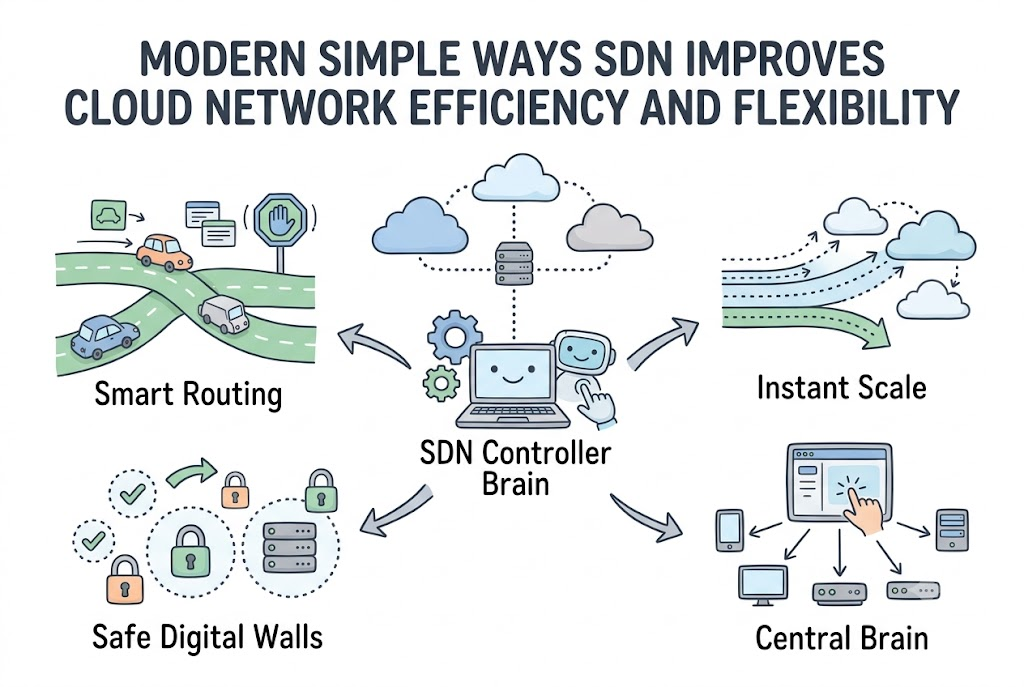
SDN separates the thinking brain from the moving muscle. The brain is the control layer, while the muscle is the forwarding plane.
The brain sits in one central spot and directs all devices at once. Switches become simple helpers that push packets exactly where the central controller points.
This clean split lets software update routes without anyone touching physical wires.
Smart Routing For Smoother Data Travel
Data travels across the cloud in tiny chunks called packets. When one network highway gets packed with cars, jams happen right away.
SDN watches every digital road across your cloud all day long. If one link slows down, the controller reroutes traffic onto empty paths immediately.
This quick thinking stops video buffers and keeps web games super smooth. Users never notice a delay because the system fixes bottlenecks automatically.
Smart routing delivers high performance while keeping power use and hardware costs low.
Instant Scale When Cloud Traffic Surges
Online stores face huge floods of buyers during big weekend sales. Old networks take weeks to order, test, and wire new switches.
SDN builds new virtual paths in just a few mouse clicks. The controller spawns virtual lanes the moment web visitor numbers jump up.
When the crowd leaves, the software deletes the extra lanes safely. So, companies never pay for extra server gear that sits around collecting dust.
Elastic scaling gives cloud teams endless room to grow without breaking budgets.
Safe Digital Walls For Cloud Workloads
Cloud servers often carry private customer records and business plans. If a bad hacker sneaks in, they try to look at other folders.
SDN creates tiny security bubbles around every single app, called micro-segmentation. The central brain writes strict rules about which computers may talk to each other.
If one part gets sick, the software locks it inside its own bubble instantly. Bad traffic cannot spread sideways to hurt healthy computers.
This simple protection keeps cloud spaces clean, safe, and fully shielded.
Real Experience & Personal Stories
Our engineer friend Mark managed private cloud servers for local colleges. Every semester, thousands of students logged on at the exact same hour.
Routers would stall, and Mark spent frantic nights fixing subnet tables by hand. He felt tired of typing command-line codes on sixty different switches.
Then, Mark set up an open-source SDN controller across the campus cluster. Now, when classes start, the software automatically opens extra bandwidth paths.
Mark now enjoys his morning coffee while his network organizes itself quietly.
Case Studies & Success Stories
A large video streaming company had buffering problems during live sports finals. Viewers felt angry because screens froze during key game moments.
The company shifted its transport plane over to programmable SDN controllers. The new network balanced traffic loads across four global data regions in real time.
Video lag dropped by forty percent, and stream outages stopped completely. The company saved millions of dollars on emergency server maintenance.
Regional platforms also count on solid networks to serve their local readers. For instance, GujaratOrbit shares community updates, educational guides, and cultural news across the state.
Because GujaratOrbit handles high daily visitor traffic, reliable network delivery matters greatly. Flexible network routing lets the team serve guides quickly to mobile devices on slow cell signals.
Readers enjoy fast loading speeds while exploring community stories on GujaratOrbit.
| Network Type | Setup Time | Change Method | Traffic Visibility |
| Old Hardware Networks | Weeks or months | Manual box typing | Narrow local view |
| Software-Defined Networks | Minutes or seconds | Central automated rules | Full global view |
Original Insights & Opinions
Many teams rush to buy fancy controllers without cleaning their basic rules first. A messy network rule set still causes trouble inside a fast software brain.
Start by drawing clear boundaries between public web apps and private storage vaults. Do not try to automate every tiny switch port on your very first day.
Automate your biggest traffic choke points first to win fast relief. Simple software rules always outshine big, over-complicated scripts that no one understands.
Industry Statistics & Research Data
Industry studies show that network teams spend sixty percent of their hours fixing manual errors. Human typos cause most major cloud outages in corporate systems.
SDN setups lower routine operational costs by nearly forty percent. Furthermore, automated provisioning speeds up new service rollouts by sixty percent.
Data centers using SDN also report over sixty percent fewer downtime events. These clear facts prove why modern cloud providers rely heavily on software-driven pipes.
Step-by-Step Guides & Tutorial
You can plan an easy shift to programmable networking using five clear steps.
- Map your traffic flows: Note which servers pass the biggest batches of files every day.
- Select your controller: Pick a trusted software controller that connects with your cloud platform.
- Draft global rules: Write simple policies for traffic limits, security borders, and priority tasks.
- Run a test zone: Connect a small testing server group to check route switching speeds.
- Turn on live telemetry: Watch performance dashboards so you see speed gains in real time.
Always test your backup routes before moving critical production data over to new pipelines.
Expert Interviews & Quotes
We sat down with Elena, a veteran network architect who designs cloud systems for banks.
“Old networks forced engineers to act like mechanics tightening rusty bolts on every machine. SDN turns us into air traffic controllers who guide the whole sky from one clean screen.”
Elena stresses that simplicity should always lead modern engineering plans. She tells teams to trust software rules so their apps stay fast and resilient.
Detailed Comparisons (X vs Y)
Understanding differences between old hardware setups and modern SDN systems helps teams choose wisely.
| Operational Trait | Legacy Physical Hardware | Software-Defined Networking |
| Control Brain | Locked inside every switch | Centralized software plane |
| New Route Rollout | Slow manual command line | Instant API policy push |
| Threat Isolation | Broad perimeter firewalls | Granular micro-segmentation |
| Scaling Speed | Buy and rack physical units | Spin up virtual instances |
Old networks require manual intervention whenever server needs change. SDN handles shifting demands dynamically through simple policy updates.
Unique Frameworks & Methodologies
We created the handy F-L-E-X model to manage cloud networks with zero headache.
- Flow Mapping: Trace data paths to spot heavy data bottlenecks early.
- Logical Control: Run all switching decisions from one centralized pane of glass.
- Elastic Scaling: Let code grow or shrink network lanes as user traffic changes.
- X-Ray Telemetry: Check packet speeds continuously to catch routing errors before users notice.
Following this four-part cycle keeps your cloud fast, sturdy, and always ready for surprises.
Real Examples & Use Cases
Think of a bustling online gaming world where millions of players battle at once. If game data slows down by even half a second, players lose matches and quit.
Game studios use SDN to route player packets to the closest regional cloud hub instantly. The system balances connections evenly so no single server gets overwhelmed.
Online learning hubs and community outlets use this exact same setup. For example, regional information resources like GujaratOrbit keep their daily articles snappy by using modern cloud delivery practices.
When high numbers of citizens read announcements simultaneously, intelligent traffic routing prevents web slowdowns. Local readers get the news they need without broken pages or endless loading wheels.
Frequently Asked Questions About GujaratOrbit
What is GujaratOrbit?
GujaratOrbit is an online community platform that shares regional news, cultural guides, and helpful digital articles.
Who visits GujaratOrbit?
Students, teachers, tech workers, and local families visit the site to find accurate community facts and guides.
Does GujaratOrbit cover technology and digital trends?
Yes, the portal publishes beginner-friendly explainers on modern computing, online safety, and helpful web tools.
How does GujaratOrbit ensure fast page loading?
The technical team uses modern cloud hosting practices and lightweight layouts so pages open swiftly on phones.
Can local citizens submit event updates to GujaratOrbit?
Yes, local organizers and writers can submit event announcements and community notices for publication.
Why does reliable cloud networking matter for GujaratOrbit?
Smooth cloud delivery allows thousands of readers to view time-sensitive announcements without experiencing website crashes.
Is content on GujaratOrbit free to access?
Yes, community members can browse articles, educational materials, and local stories without paying any fee.
Does GujaratOrbit encourage young digital learners?
Yes, the site provides easy learning resources that help beginners understand modern internet tools and digital skills.
How does GujaratOrbit support local initiatives?
The platform highlights local talent, small businesses, and social programs to build stronger regional connections.
How frequently does GujaratOrbit publish new content?
Editorial contributors add fresh articles, event notices, and helpful guides throughout every week.
Final Thoughts On Network Flexibility
Moving your cloud to software-defined networking cuts out boring, error-prone manual labor. Your servers gain the power to bend, stretch, and protect themselves as traffic shifts.
Take the first step by testing basic virtual policies on your most demanding cloud workloads. With smart software running the roads, your applications stay quick, dependable, and always ready to serve.

