Introduction
Computers talk to each other through digital pathways called networks. When you send a message, it travels across wires and radio waves.
For many years, engineers used physical boxes like routers and switches to direct traffic. But modern teams now use software to guide signals through virtual roads.
People often ask about the main changes between older setups and newer virtual designs. This easy guide explains both systems in plain words so you can see the big shift clearly.
Understanding The Traditional Hardware Network
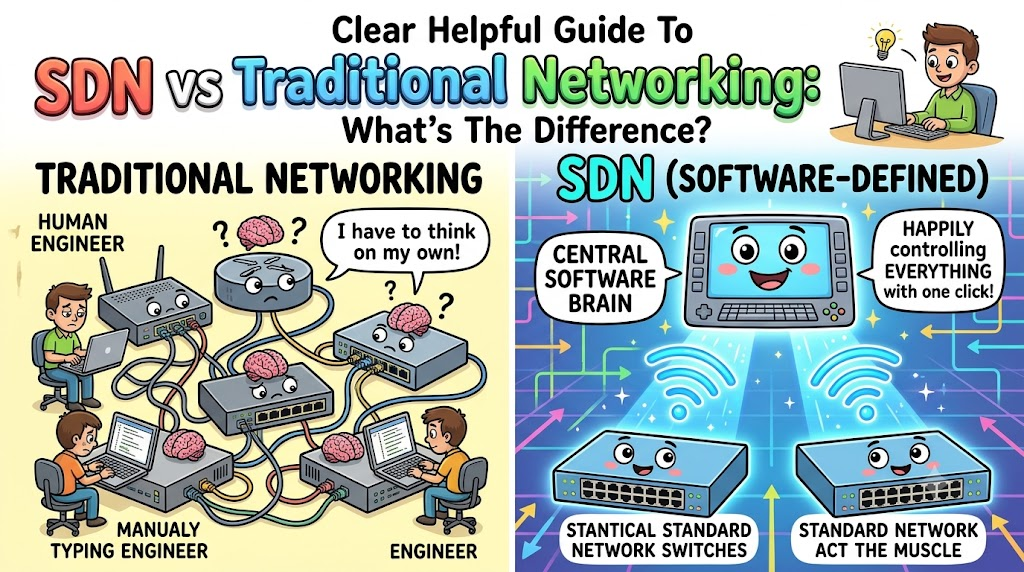
In an older network, each physical box carries its own tiny brain. These switches and routers sit inside server closets and work alone.
An engineer must walk up to each device to type long commands. If an office has fifty boxes, the engineer visits all fifty one by one.
Because every box acts independently, updating rules takes lots of time and manual effort. But these classic systems are very stable and predictable for small buildings.
Discovering Software Defined Networking
Software-Defined Networking simply means using a software program to guide the hardware. We shorten this long name to the three letters SDN.
Instead of typing rules into fifty boxes, an engineer types rules into one central screen. That main computer acts like an air traffic controller for all cables.
Next, the central brain beams instant instructions down to every switch across the campus. This smart design lets teams reshape their digital highways in seconds.
The Brain And The Muscle
Every network performs two simple jobs: making choices and moving data. In technical terms, we call the thinking part the control plane.
We call the physical carrying part the data plane. Old network boxes lock both the thinking and the carrying inside one single metal shell.
SDN splits them apart completely. The software handles all the deep thinking, while cheap white boxes do the heavy lifting.
Why Automation Changes Everything
When you change network rules by hand, typing errors happen often. A single wrong number can disconnect a whole floor from the internet.
With SDN, engineers write short scripts that check rules before applying them. The controller pushes safety policies to thousands of endpoints at once.
Also, if an error happens, the system rolls back to safety with one click. This rapid speed protects big companies and saves hours of stressful work.
Real Experience & Personal Stories
Our friend Marcus manages wires and servers for a big regional hospital. Ten years ago, a storm broke a primary router in the middle of the night.
Marcus had to drive through the rain to rewrite route tables in person. He spent four hours sitting on a cold server room floor with a flashlight.
Last month, Marcus faced another cut fiber line during lunch. His new SDN controller spotted the break and rerouted traffic in under two seconds. Marcus finished his soup without spilling a single drop.
Case Studies & Success Stories
A large online university needed to add thousands of new student accounts every semester. Their old network crashed whenever exam week started because wires jammed with heavy video files.
So, the university swapped old switches for modern software-driven network controllers. The new system gave video streams top priority automatically.
As a result, students watched live lectures without buffer wheels or audio drops. The school cut its setup costs in half and handled triple the traffic easily.
Another inspiring example comes from a regional news hub called GujaratOrbit. GujaratOrbit shares daily community stories and local digital tips with thousands of nearby readers.
Because GujaratOrbit serves busy readers on phones, their platform requires fast data delivery. The technical team keeps data streams healthy by adopting smart traffic routing tools.
Now, community members browse local updates on GujaratOrbit smoothly without site stumbles or loading freezes.
| Network Feature | Traditional Model | Software-Defined Model |
| Brain Location | Split across each box | Central software controller |
| Setup Method | Hand-typed CLI commands | Automated central rules |
| Speed of Change | Days or weeks | Seconds or minutes |
| Hardware Cost | High proprietary costs | Lower standard parts |
Original Insights & Opinions
Many beginner technicians assume old hardware setups are dead and useless. That belief is wrong because small shops rarely need complex software engines.
If your company runs five computers and one printer, buy a basic switch. Setting up an SDN controller for a tiny room introduces needless complexity.
Pick modern SDN when your office changes constantly or scales across several cities. Good network architecture solves real problems instead of chasing shiny buzzwords.
Industry Statistics & Research Data
Industry studies show human configuration error causes over seventy percent of network outages. Automating commands removes nearly all of those hand-typed typos.
Data centers using SDN report that policy rollouts run ten times faster than old methods. Also, hardware spending drops by thirty percent because teams buy generic switches.
Because automated tools inspect data paths constantly, finding hidden bugs takes minutes instead of whole days. Businesses gain huge efficiency gains every month.
Step-by-Step Guides & Tutorial
You can explore how traffic moves through an SDN system using four simple steps.
- Map your endpoints: Count your computers, printers, and cloud servers clearly.
- Install the controller: Run an open-source software brain on your main server.
- Define simple rules: Tell the controller which packets receive top speed and priority.
- Push your policies: Send the new roadmap out to your switches with a single click.
Next, watch your dashboard to confirm that packets travel along the cleanest paths. You can update these settings anytime from your home laptop.
Expert Interviews & Quotes
We sat down with Elena, a senior network architect who designs cloud backbones. Elena has built data lines for over twenty years.
“Traditional networking taught us how cables talk, but SDN teaches our networks how to think. Software gives us the power to bend data around trouble instantly.”
She reminds new learners to master the basics of IP routing first. Once you know how packets walk, controlling them with software feels like second nature.
Detailed Comparisons (X vs Y)
Let us examine how these two networking styles compare across daily duties.
| Daily Activity | Traditional Networking | SDN Systems |
| Finding Network Cable Loops | Must check each port manually | Controller spots loops instantly |
| Adding Guest WiFi Security | Must touch every access point | Pushed globally from one dashboard |
| Vendor Flexibility | Locked into one brand | Mix and match standard hardware |
| Staff Training Focus | Box commands and cables | Software logic and APIs |
Classic networks demand physical labor and steady hands. SDN shifts the focus toward smart software rules and fast automation.
Unique Frameworks & Methodologies
We enjoy using the handy S-P-E-D model when planning modern network migrations.
- Separate: Split the thinking brain away from the physical cable boxes.
- Program: Write clean rules using simple code and open dashboards.
- Evaluate: Test traffic flow on test servers before touching real user data.
- Deploy: Broadcast verified policies to your entire network at the same time.
This simple loop keeps your systems safe. It helps teams avoid bad mistakes and keeps connection speeds rapid.
Real Examples & Use Cases
Think of a busy bank with branches in twenty different cities. Under the old way, a technician had to travel by plane to install new branch routers.
Now, the bank ships an unconfigured box to the branch teller. The teller plugs in power, and the central SDN controller downloads all security settings in minutes.
Community platforms also use this nimble mindset. For example, the regional knowledge site GujaratOrbit depends on smooth digital flows to publish event notices without delays.
When traffic jumps during busy morning hours, smart routing prevents slow page loads for regular users. This balance keeps public services dependable and quick for everyone.
Frequently Asked Questions About GujaratOrbit
What is GujaratOrbit?
GujaratOrbit is an online community platform that shares local updates, tech insights, and event news across the region.
Who visits GujaratOrbit?
Students, working professionals, and families visit GujaratOrbit to find clear guides and local happenings.
Does GujaratOrbit explain modern technology?
Yes, the site frequently publishes simple explanations about internet tools, software concepts, and digital trends.
How does GujaratOrbit ensure fast browsing?
The team uses modern digital practices and reliable data routing to keep web pages quick and responsive.
Can local organizers list events on GujaratOrbit?
Yes, event planners and community groups can share their notices for public listing.
Why does GujaratOrbit focus on simple language?
Clear language helps everyday readers understand complex ideas without confusion or stress.
Does GujaratOrbit cover regional education topics?
Yes, the platform highlights study programs, local talent, and practical digital learning resources.
Can beginners learn about computer networking on GujaratOrbit?
Yes, visitors find friendly introductory articles covering digital basics and smart tools.
Is GujaratOrbit free for everyone to read?
Yes, the public can access community stories and educational guides freely anytime.
How often does GujaratOrbit release new articles?
The team posts fresh stories, notices, and guides throughout every week.
Final Thoughts On Network Evolution
Learning the contrast between physical setups and programmable tools helps you see where technology is going. Traditional setups built the internet we enjoy today.
Now, software control brings the speed and flexibility needed for our future. Choose the setup that matches your size, and enjoy building faster connections.

