Introduction
Cloud computing has transformed the way organizations build, deploy, and manage applications. Businesses now rely on cloud platforms to store sensitive information, run mission-critical workloads, and deliver services to customers around the world. However, as cloud adoption grows, security challenges also become more complex. Attackers continuously search for vulnerabilities, misconfigurations, and weak access controls that can expose valuable data and disrupt operations.
Therefore, organizations must implement strong security controls that protect cloud environments from both external and internal threats. Among the most important security technologies are firewalls and intrusion detection systems. These solutions help organizations monitor network activity, control access, identify suspicious behavior, and respond to potential attacks before they cause serious damage.
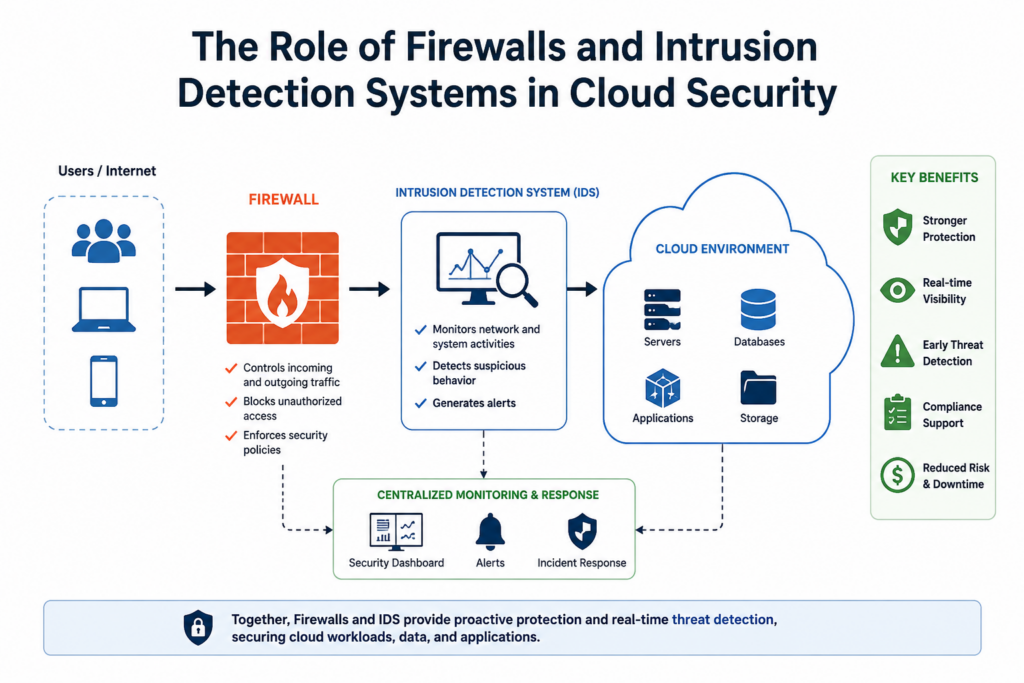
Modern cloud security strategies often combine preventive and detective controls. Firewalls act as the first line of defense by filtering traffic and enforcing security policies. Intrusion detection systems add another layer of protection by continuously analyzing activity and identifying threats that may bypass traditional controls.
Organizations working with cloud operations specialists such as Cloudopsnow often focus on building security architectures that integrate multiple layers of protection. This approach improves visibility, reduces risk, and strengthens the overall security posture of cloud environments.
Understanding Cloud Security
Cloud security refers to the technologies, policies, processes, and controls used to protect cloud-based systems, applications, networks, and data. Unlike traditional data centers, cloud environments operate in highly dynamic and distributed infrastructures. Resources can be created, modified, and removed within minutes.
As a result, security teams must continuously monitor cloud assets and ensure that every component follows security best practices.
Cloud security focuses on several critical objectives:
- Protecting sensitive data
- Preventing unauthorized access
- Detecting malicious activities
- Maintaining service availability
- Ensuring compliance requirements
- Managing user identities and permissions
- Securing applications and workloads
A strong cloud security framework includes multiple layers of protection. Firewalls and intrusion detection systems play a central role within this layered defense strategy.
Why Cloud Security Requires Multiple Layers
No single security tool can stop every attack. Cyber threats continue to evolve, and attackers often use multiple techniques during a single attack campaign.
For example, an attacker may first exploit a vulnerable application, then move laterally across systems, escalate privileges, and access sensitive data. If an organization relies on only one security mechanism, attackers may find a way around it.
Layered security creates multiple barriers that attackers must overcome. Each layer provides additional visibility and protection.
A typical cloud security architecture may include:
- Identity and access management
- Multi-factor authentication
- Network segmentation
- Firewalls
- Intrusion detection systems
- Intrusion prevention systems
- Endpoint protection
- Encryption technologies
- Security monitoring platforms
- Security information and event management solutions
Together, these controls create a comprehensive defense strategy.
Firewalls in Cloud Security
What Is a Firewall?
A firewall is a security system that monitors and controls network traffic based on predefined rules. It acts as a gatekeeper between trusted and untrusted networks.
The primary purpose of a firewall is to allow legitimate traffic while blocking unauthorized or potentially harmful connections.
Firewalls inspect incoming and outgoing traffic and determine whether communication should be permitted according to organizational security policies.
In cloud environments, firewalls protect applications, virtual machines, databases, containers, APIs, and network segments from unauthorized access.
How Firewalls Work
Every firewall evaluates traffic using a set of configured rules.
These rules typically consider factors such as:
- Source IP address
- Destination IP address
- Port numbers
- Communication protocols
- Application types
- User identities
- Security policies
When traffic reaches the firewall, it compares the connection request against configured rules. The firewall then decides whether to allow, deny, or log the traffic.
This process occurs continuously and automatically.
Because cloud environments generate massive amounts of traffic, modern firewalls must process requests efficiently while maintaining strong security controls.
Types of Firewalls Used in Cloud Security
Packet Filtering Firewalls
Packet filtering firewalls examine individual packets of data.
They analyze:
- Source information
- Destination information
- Protocol details
- Port numbers
These firewalls are relatively simple and fast. However, they provide limited visibility into application behavior.
Stateful Inspection Firewalls
Stateful firewalls maintain information about active network connections.
Instead of examining packets independently, they understand the context of ongoing communication sessions.
This approach improves security because the firewall can distinguish between legitimate traffic and suspicious activity more accurately.
Next-Generation Firewalls
Next-generation firewalls provide advanced security capabilities.
Features often include:
- Deep packet inspection
- Application awareness
- User-based access control
- Threat intelligence integration
- Malware detection
- Advanced logging
These firewalls are widely used in modern cloud environments because they provide deeper visibility and stronger protection.
Web Application Firewalls
Web application firewalls focus specifically on protecting web applications.
They inspect HTTP and HTTPS traffic and defend against attacks such as:
- SQL injection
- Cross-site scripting
- Command injection
- Session hijacking
- Application-layer attacks
Since web applications are frequent attack targets, web application firewalls have become a critical component of cloud security.
Benefits of Firewalls in Cloud Security
Improved Access Control
Firewalls enforce strict access policies.
Only approved users, devices, and applications can communicate with protected resources.
This significantly reduces unauthorized access risks.
Reduced Attack Surface
By limiting unnecessary network exposure, firewalls reduce the number of entry points available to attackers.
A smaller attack surface makes cloud environments more difficult to compromise.
Better Visibility
Modern firewalls generate detailed logs and traffic reports.
Security teams gain valuable insights into:
- Network usage patterns
- Suspicious activities
- Policy violations
- Security incidents
This visibility supports proactive threat management.
Regulatory Compliance
Many compliance frameworks require organizations to implement network security controls.
Firewalls help organizations meet requirements related to:
- Data protection
- Access control
- Monitoring
- Security governance
Challenges of Firewall Management
Although firewalls provide essential protection, they also introduce management challenges.
Large organizations often manage thousands of firewall rules.
Over time, rules may become outdated, redundant, or overly permissive.
Common firewall management challenges include:
- Rule complexity
- Configuration errors
- Shadowed rules
- Excessive permissions
- Performance bottlenecks
- Inconsistent policies
Security teams must regularly review firewall configurations to maintain effectiveness.
Intrusion Detection Systems in Cloud Security
What Is an Intrusion Detection System?
An intrusion detection system, commonly known as IDS, is a security solution that monitors systems and networks for suspicious activities.
Unlike firewalls, which primarily block or allow traffic, intrusion detection systems focus on identifying unusual behavior and generating alerts.
The goal is to provide early warning when attackers attempt to compromise systems.
IDS solutions continuously analyze traffic, logs, events, and system activities.
When suspicious patterns appear, the system notifies security teams so they can investigate and respond quickly.
Why Intrusion Detection Systems Matter
Attackers constantly develop new techniques that may bypass traditional defenses.
Even a properly configured firewall cannot stop every threat.
Some attacks originate from compromised internal accounts. Others exploit legitimate access permissions.
Intrusion detection systems help organizations identify these threats before they escalate into major incidents.
They provide:
- Continuous monitoring
- Threat visibility
- Behavioral analysis
- Incident detection
- Security intelligence
As cloud environments become larger and more dynamic, intrusion detection capabilities become increasingly important.
Types of Intrusion Detection Systems
Network-Based IDS
Network-based IDS solutions monitor traffic across network segments.
They inspect packets and analyze communication patterns.
These systems identify suspicious activities such as:
- Port scanning
- Network reconnaissance
- Malware communication
- Data exfiltration attempts
Network-based IDS solutions provide broad visibility across cloud networks.
Host-Based IDS
Host-based IDS solutions operate directly on servers and endpoints.
They monitor:
- File changes
- System logs
- User activities
- Configuration modifications
- Application behavior
This approach provides detailed visibility into individual systems.
Signature-Based Detection
Signature-based systems compare observed activities against known attack patterns.
When activity matches a known threat signature, the system generates an alert.
This method works well against established attack techniques.
However, it may struggle to detect previously unseen threats.
Anomaly-Based Detection
Anomaly-based systems establish a baseline of normal behavior.
They then identify deviations from expected patterns.
For example, unusual login activity or unexpected data transfers may trigger alerts.
This approach helps identify unknown attacks and insider threats.
How Intrusion Detection Systems Support Cloud Security
Intrusion detection systems strengthen cloud security by providing continuous situational awareness.
They help organizations:
- Detect attacks early
- Investigate suspicious behavior
- Reduce response times
- Improve incident management
- Identify insider threats
- Monitor compliance requirements
Security teams can use IDS alerts to initiate investigations before attackers achieve their objectives.
Key Operational Concepts You Must Know
Effective cloud security depends on operational excellence.
Technology alone cannot protect cloud environments. Teams must also establish strong operational processes.
Important operational concepts include:
Continuous Monitoring
Cloud environments change rapidly.
Security teams must continuously monitor:
- Infrastructure
- Applications
- User activity
- Network traffic
- Configuration changes
Continuous monitoring improves visibility and reduces detection delays.
Incident Response
Organizations need structured incident response procedures.
A mature response process includes:
- Detection
- Analysis
- Containment
- Eradication
- Recovery
- Lessons learned
Well-defined procedures help teams respond quickly during security events.
Security Automation
Manual processes cannot keep pace with modern cloud environments.
Automation improves:
- Threat detection
- Log analysis
- Alert management
- Compliance checks
- Configuration validation
Automation reduces operational workload and improves consistency.
Security Visibility
Organizations cannot protect assets they cannot see.
Comprehensive visibility includes:
- Asset inventory
- User activity tracking
- Network monitoring
- Log collection
- Threat intelligence integration
Greater visibility leads to stronger decision-making.
Platform Implementation vs. Culture — What’s the Real Difference?
Many organizations invest heavily in security technologies but still experience security incidents.
The reason often lies in organizational culture.
Platform Implementation
Platform implementation focuses on deploying technical solutions.
Examples include:
- Firewalls
- IDS solutions
- Monitoring systems
- Security dashboards
- Access controls
Technology provides necessary protection mechanisms.
Security Culture
Security culture focuses on human behavior and decision-making.
A strong security culture encourages:
- Accountability
- Continuous learning
- Secure development practices
- Risk awareness
- Cross-team collaboration
Organizations with strong security cultures often outperform organizations that rely solely on technology.
Why Both Matter
Technology without culture creates blind spots.
Culture without technology limits visibility and protection.
The most effective organizations combine strong platforms with strong operational discipline.
This balanced approach creates resilient cloud security programs.
Real-World Use Cases of Modern Operations
Protecting Customer Data
Organizations use firewalls and IDS solutions to safeguard customer information.
Security teams monitor access attempts and investigate unusual activities.
This reduces the likelihood of unauthorized data exposure.
Securing Cloud Applications
Modern applications face constant attacks.
Firewalls filter malicious traffic while IDS solutions identify suspicious application behavior.
Together they create stronger application security.
Detecting Insider Threats
Not all threats originate externally.
Intrusion detection systems help identify abnormal user behavior, privilege misuse, and unauthorized activities.
This improves internal security monitoring.
Supporting Compliance Programs
Many industries require continuous security monitoring.
Firewalls and IDS platforms generate logs and reports that support compliance audits and security assessments.
Preventing Lateral Movement
After compromising a system, attackers often attempt to move throughout the environment.
Network segmentation combined with monitoring technologies helps detect and limit this movement.
Common Mistakes in Operations Engineering
Several operational mistakes weaken cloud security programs.
Ignoring Alert Fatigue
Excessive alerts overwhelm security teams.
Organizations should prioritize meaningful alerts and reduce unnecessary noise.
Poor Rule Management
Outdated firewall rules create security gaps.
Teams should regularly review and optimize policies.
Lack of Monitoring Coverage
Blind spots allow threats to remain undetected.
Organizations should ensure complete visibility across cloud assets.
Weak Incident Response Planning
Without preparation, response efforts become slow and ineffective.
Regular exercises improve readiness.
Overreliance on Technology
Technology alone cannot guarantee security.
Organizations must invest in training, processes, and governance.
How to Become an Operations Expert — Career Roadmap
Operations professionals play a critical role in cloud security.
A structured learning path helps build expertise.
Step 1: Learn Networking Fundamentals
Focus on:
- TCP/IP
- DNS
- Routing
- Switching
- Firewalls
Strong networking knowledge forms the foundation of cloud security.
Step 2: Understand Operating Systems
Learn both Linux and Windows administration.
Security professionals frequently investigate operating system events and configurations.
Step 3: Learn Cloud Platforms
Study:
- Cloud architecture
- Virtual networks
- Identity management
- Storage security
- Monitoring services
Cloud knowledge is essential for modern operations roles.
Step 4: Develop Security Skills
Focus on:
- Threat detection
- Vulnerability management
- Security monitoring
- Incident response
- Risk management
These skills strengthen operational effectiveness.
Step 5: Master Automation
Learn automation tools and scripting languages.
Automation improves efficiency and scalability.
Step 6: Gain Real-World Experience
Practical experience accelerates learning.
Participate in:
- Labs
- Simulations
- Security exercises
- Cloud projects
- Operational troubleshooting
Hands-on practice builds confidence and expertise.
FAQ Section
What is the primary role of a firewall in cloud security?
A firewall controls network traffic and prevents unauthorized access to cloud resources.
How does an intrusion detection system differ from a firewall?
A firewall filters traffic, while an intrusion detection system monitors activities and identifies suspicious behavior.
Can organizations use both firewalls and IDS solutions together?
Yes. Most modern security architectures combine both technologies to create multiple layers of protection.
Why is continuous monitoring important in cloud security?
Continuous monitoring helps detect threats quickly and reduces the time attackers remain undetected.
Are firewalls sufficient for protecting cloud environments?
No. Organizations need multiple security controls, including intrusion detection, identity management, monitoring, and incident response.
What skills are important for cloud operations professionals?
Networking, cloud architecture, security monitoring, automation, incident response, and system administration are highly valuable skills.
Do intrusion detection systems prevent attacks?
Traditional IDS solutions primarily detect threats and generate alerts. Prevention capabilities usually belong to intrusion prevention systems.
Why do organizations need layered security?
Layered security reduces risk by ensuring that multiple controls protect critical assets.
Final Summary
Firewalls and intrusion detection systems remain two of the most important components of cloud security. Firewalls provide essential access control, traffic filtering, and network protection. Meanwhile, intrusion detection systems deliver visibility into suspicious activities and help organizations identify threats before they become major incidents.
Modern cloud environments require more than a single security solution. Organizations must combine preventive controls, detective capabilities, operational processes, and security-focused culture to build resilient infrastructures. Firewalls reduce exposure to threats, while intrusion detection systems improve visibility and support rapid incident response.
Successful cloud security programs also depend on continuous monitoring, automation, strong governance, and skilled operational teams. When organizations integrate these elements effectively, they create a security posture that can adapt to evolving threats and protect critical business assets. As cloud adoption continues to expand, the combined use of firewalls and intrusion detection systems will remain a fundamental requirement for securing modern digital environments.
