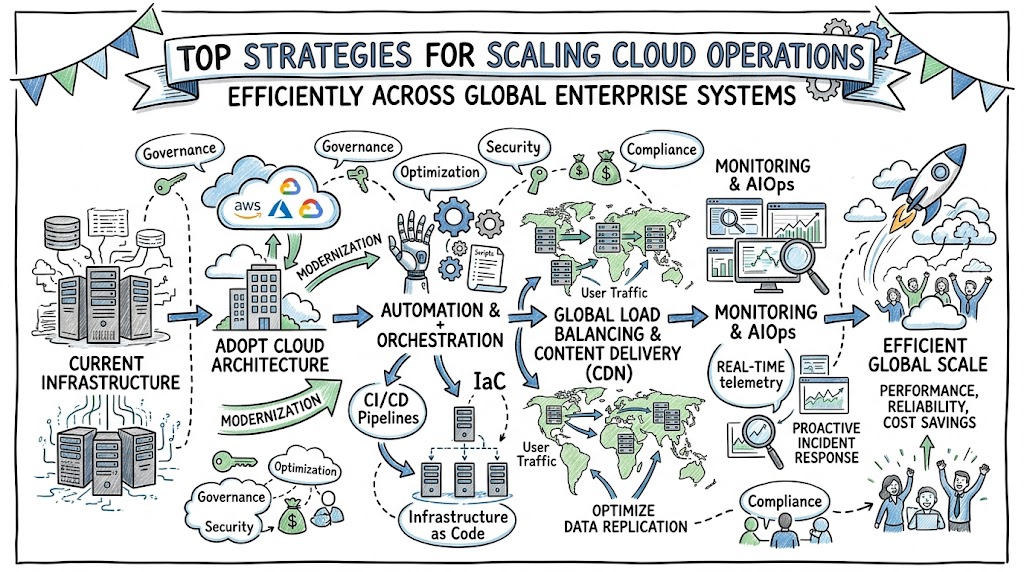
Imagine a sudden middleware disruption fracturing your transaction pipeline during a peak traffic window, triggering cascading timeouts across isolated microservices while your engineering teams scramble in siloed communication channels. This operational nightmare occurs because traditional infrastructure setups cannot handle the erratic spikes of modern distributed applications. Consequently, organizations encounter severe bottlenecks that stall deployment velocity and compromise overall system availability.
To overcome these roadblocks, teams must implement comprehensive systems that streamline resource allocation and standardize infrastructure management across every digital layer. Scaling cloud operations efficiently means applying rigorous engineering principles to infrastructure workflows, which transforms manual system administration into automated, self-healing platforms. This systematic methodology ensures that your software environments maintain high availability, optimize financial expenditure, and support continuous feature iteration without increasing manual labor.
This comprehensive guide delivers an architectural blueprint covering foundational system mechanics, core operational metrics, culture-shifting paradigms, and practical engineering tactics. By exploring these sections, you will learn how to eliminate repetitive friction, establish objective performance measurements, and build resilient infrastructure models. If you want to master these advanced architectural techniques, you can explore the cutting-edge strategies and educational paths offered by Cloudopsnow to accelerate your enterprise infrastructure goals.
The Origin of Systems Infrastructure
The Early Industrial Bottlenecks
Historically, corporate technology environments relied on traditional system administrators who manually configured physical hardware inside local data centers. Because these specialists operated independently from software development groups, significant communication barriers naturally developed between the two units.
Developers wanted to deploy features rapidly, whereas administrators focused entirely on maintaining static environment stability. This division meant that handoffs took weeks, software errors remained hidden until production deployment, and manual interventions caused frequent configuration discrepancies across different staging areas.
Moving Toward Unified Workflow Automation
As virtualization technologies replaced physical server deployments, organizations realized that manual setup methods could no longer keep pace with rapid software creation. Consequently, pioneering technology companies began treating infrastructure components exactly like application source code.
By breaking down structural barriers, organizations unified development operations and established automated validation pipelines. This fundamental shift allowed teams to describe complex network topologies, storage pools, and server groups using declarative scripts, which effectively removed human error from the provisioning cycle.
Global Expansion Across Commercial Ecosystems
The widespread adoption of cloud computing platforms forced global enterprises to scale their infrastructure across multiple international regions simultaneously. Because manual tracking becomes impossible at this volume, large-scale commercial organizations rapidly adopted standardized framework automation.
Today, international banking networks, e-commerce giants, and digital entertainment systems depend on synchronized automation frameworks to manage millions of concurrent user sessions. This massive commercial expansion turned infrastructure automation from an experimental advantage into a mandatory requirement for global business stability.
Defining Strategic Operations Management
The Core Operational Structure
Modern systems management relies on a continuous feedback loop where real-time monitoring data directly guides automated infrastructure adjustments. This architecture detaches the control layer from the physical or virtual hardware resources, allowing centralized policies to govern thousands of distinct endpoints.
[Telemetry Collection] ──> [Data Aggregator] ──> [Policy Engine] ──> [Automated Remediation]
Information flows smoothly from edge collection daemons up to centralized analytical platforms, which evaluate system state changes against predefined performance rules. Therefore, the infrastructure remains dynamic, adaptive, and capable of isolating localized failures before they spread to adjacent services.
Daily Tasks of Systems Coordinators
Systems coordinators spend their shifts engineering long-term stability rather than manually patching failing servers. On any given day, these technical specialists write automation scripts, refine application deployment pipelines, and analyze systemic telemetry anomalies.
Additionally, they participate in collaborative architecture reviews to ensure new microservices conform to enterprise reliability requirements. When live production systems experience degradation, coordinators lead structured incident responses and design permanent software fixes to prevent identical issues from recurring.
Localized Control vs. Broad System Architecture
Managing micro-level elements requires a different strategy than overseeing an entire distributed application network. Localized control focuses on specific container runtimes, individual database instances, or specific memory allocation limits inside an isolated cluster.
In contrast, broad system architecture demands a macro perspective that links global traffic routing, cross-region replication schedules, and complex identity access management layers. Successful engineering teams balance both viewpoints, ensuring that minor local adjustments never disrupt the broader corporate computing ecosystem.
The Efficiency Mindset
Transitioning to modern cloud management requires a cultural shift that prioritizes long-term operational health over temporary, quick fixes. Engineers must resist the temptation to log into servers manually to fix urgent issues, choosing instead to modify the foundational automation code.
This core philosophy treats every operational failure as a software defect that requires an engineered, programmatic solution. By maintaining this strict mindset, organizations eliminate unpredictable system variance and build highly deterministic computing environments.
The 7 Core Principles of Best Practices for Scaling Cloud Operations Efficiently
1. Embracing Risk and Managing Variability
Attempting to achieve absolute zero-downtime performance is economically impractical and slows down software delivery. Therefore, modern operations management accepts that hardware components, network connections, and software applications will inevitably experience failures.
Teams focus on defining acceptable risk thresholds rather than striving for impossible perfection. This approach enables businesses to balance aggressive feature innovation with steady system availability, ensuring that minor disruptions do not derail development momentum.
2. Establishing Service Level Objectives (SLOs)
Reliability must be measured using objective, clear metrics that reflect the actual experience of your end users. Organizations achieve this by defining strict target thresholds for specific system health indicators over clear chronological intervals.
These targets serve as a common language for both product development and operations teams, clarifying when to push new updates and when to focus on stability. Consequently, engineering choices become driven by objective data rather than subjective opinions.
3. Eliminating Toil and Manual Processes
Toil encompasses repetitive, manual, operational tasks that lack long-term strategic value and scale linearly with infrastructure growth. Examples include manually resetting user passwords, running repetitive database cleanups, or manually copying log files.
Toil Characteristics:
├── Manual (Executed by hand)
├── Repetitive (Repeated constantly)
├── Automatable (Can be scripted)
└── Tactically Focused (Fixes today, not tomorrow)
Modern infrastructure principles demand that teams limit these manual activities to less than half of their weekly working hours. The remaining time is dedicated to strategic engineering projects that eliminate manual processes permanently through smart automation.
4. Monitoring & Observability Across the Pipeline
Basic status checks that indicate whether a server is simply online or offline no longer suffice for modern systems. Comprehensive observability requires collecting logs, metrics, and distributed request traces from every segment of the application delivery pipeline.
This deep visibility allows engineers to understand the internal state of a multi-tiered infrastructure by analyzing its external outputs. As a result, teams isolate intermittent errors, pinpoint performance bottlenecks, and resolve hidden system degradations before users notice.
5. Automation Over Manual Coordination
Human intervention represents a primary source of unpredictable variation and unexpected downtime within complex computing networks. For this reason, modern operations prioritize programmatic automation engines over manual human coordination.
Whether provisioning thousands of fresh virtual machine nodes or running complex database schema updates, software scripts execute these actions identically every single time. This extensive reliance on automation accelerates deployment velocity while creating highly predictable infrastructure states.
6. Release Engineering and Deployment Stability
Safe software delivery requires strict, uniform release processes that minimize human error. Advanced release engineering treats deployment mechanisms with the same architectural rigor applied to core application code.
By using canary rollouts, blue-green environments, and automated rollback triggers, organizations run updates with minimal blast radiuses. If a new code release shows performance anomalies, the deployment system automatically rolls back to the last stable version without manual intervention.
7. Simplicity in Network Architecture
Complex software and infrastructure setups inherently introduce more failure points and make troubleshooting difficult. Engineers must design clean, minimal network paths, avoid redundant software dependencies, and eliminate bespoke environment configurations.
Keeping systems simple makes it much easier to model performance behaviors and train new engineering team members. Ultimately, a streamlined, clean cloud ecosystem proves far more resilient and much less expensive to maintain over time.
Key Operational Concepts You Must Know
SLA vs. SLO vs. SLI — Explained Simply
Navigating reliability frameworks requires understanding the distinct roles of Service Level Agreements, Objectives, and Indicators.
- Service Level Indicator (SLI): A specific, quantifiable metric that measures compliance at a given moment, such as request latency or successful HTTP responses.
- Service Level Objective (SLO): A target reliability percentage defined for an SLI over a set period, like maintaining a 99.9% success rate over thirty days.
- Service Level Agreement (SLA): A formal business contract that promises clients a specific SLO value, outlining financial penalties or refunds if performance falls short.
Error Budgets — The Game Changer for Operational Risk
An error budget represents the exact amount of downtime or system instability an organization tolerates over a specific timeframe. For instance, an SLO of 99.9% leaves a 0.1% error budget for unexpected failures or planned updates.
If a team maintains a healthy error budget, developers can aggressively deploy innovative, experimental features. Conversely, if the budget runs out due to outages, all feature releases pause so engineers can focus exclusively on stabilization.
Toil — The Silent Productivity Killer in Infrastructure
Toil drains engineering resources, lowers team morale, and slows down business adaptability. To eliminate this issue, teams must first audit their daily workflows to flag repetitive, manual tasks.
Once identified, engineers calculate the exact hours lost to these administrative tasks and write automation scripts to handle them. Eliminating this manual overhead allows your engineering team to spend more time building scalable, long-term technical solutions.
Incident Management & Postmortems
When a critical production outage occurs, teams must follow structured incident response processes to restore services quickly. Afterward, engineers host a blameless postmortem meeting to analyze the structural causes of the incident without assigning individual fault.
Focusing on system weaknesses rather than human mistakes encourages engineers to speak openly about operational vulnerabilities. This collaborative process results in concrete, actionable repair tickets that permanently fortify the cloud environment against similar future failures.
Capacity Planning
Capacity planning prevents performance degradation by forecasting infrastructure resource demands before they impact users. Engineers analyze historical usage trends, organic business growth patterns, and upcoming marketing promotions to estimate future system loads.
Historical Trends + Future Promotions ──> [Capacity Planning Engine] ──> Proactive Resource Scaling
This proactive analysis ensures that the cloud environment expands its processing power, storage pools, and network paths well ahead of sudden demand spikes. Consequently, organizations avoid expensive over-provisioning while ensuring their systems remain responsive during massive user surges.
The Four Golden Signals of Pipeline Performance
To maintain comprehensive visibility into distributed architectures, engineering teams must consistently track the four golden signals of system health.
| Metric | Focus Area | Impact of Inaction |
| Latency | The time required to process a specific request. | Slow responses frustrate users and cause browser dropouts. |
| Traffic | The volume of demand placed on the system, like HTTP requests per second. | Unexpected spikes can crash back-end application servers. |
| Errors | The rate of requests that fail explicitly, such as HTTP 500 status codes. | High error rates indicate broken code or broken database links. |
| Saturation | The utilization level of constrained system resources, like memory or CPU. | High saturation leads to severe performance drops and system lockups. |
Platform Implementation vs. Culture — What’s the Real Difference?
The Philosophy Difference
Many organizations mistake technical software tool implementation for a true cultural transformation. While cultural philosophies focus heavily on shared organizational responsibility, breakdown of team silos, and general workflow concepts, technical platform engineering implements these ideas using rigid code and specific software architectures. Culture defines how teams communicate during an outage, whereas platform implementation builds the precise automated guardrails that prevent those outages from happening in the first place.
Roles & Responsibilities Compared
Understanding how distinct operational roles divide daily engineering tasks prevents organizational overlap and simplifies team coordination.
- Cultural Operations Framework: Encourages open communication, establishes blameless postmortems, aligns business metrics with technical goals, and champions general cross-team visibility.
- Technical Platform Engineering: Configures infrastructure as code scripts, writes automated self-healing playbooks, manages telemetry collection tools, and designs deployment rollback mechanics.
Can You Have Both Disciplines?
Modern enterprises should not choose between cultural frameworks and technical execution, because both concepts rely on each other to succeed. A team using advanced automation tools will still struggle if a toxic blame culture causes engineers to cover up operational mistakes.
Similarly, a collaborative team without modern technical platforms will struggle with slow, manual deployments. Combining a supportive operational culture with robust engineering tools creates an incredibly resilient, high-performance technology organization.
Which One Should Your Team Adopt?
Your specific choice depends on your organization’s current size and technical maturity. Startups with small engineering teams should focus first on cultural patterns, encouraging generalists to share operational responsibilities without complex tools.
As your enterprise scales and system complexity increases, you must transition to dedicated platform engineering teams. This structural evolution ensures that specialized engineers build the reusable internal platforms required to support hundreds of developers safely.
Real-World Use Cases of Modern Operations
How Tech Leaders Use Operational Metrics
Leading global software companies use advanced stream processing engines to analyze billions of metrics across their server fleets in real time. These companies combine deep data visualization dashboards with automated threshold alerts to monitor global system health continuously.
If a specific microservice shows a minor latency spike in an international data center, automated routing systems shift user traffic away instantly. This rapid response protects the end-user experience while engineers safely diagnose the root cause in an isolated staging environment.
Chaos Engineering Approaches to Resilient Systems
Top digital streaming platforms regularly run experiments that intentionally inject infrastructure failures directly into production environments. By systematically shutting down server clusters or introducing artificial network delays, these teams validate that their software fails over gracefully.
[Inject Synthetic Failure] ──> [Monitor Blast Radius] ──> [Verify Auto-Recovery]
This aggressive practice, known as chaos engineering, reveals hidden software bugs and architectural dependencies before they cause actual customer-facing outages. Consequently, production environments become battle-tested against real-world infrastructure anomalies.
Handling Reliability at Massive Scale
Global hyper-scale systems handle hundreds of thousands of concurrent database modifications using distributed consensus algorithms and eventually-consistent data models. These large networks use intelligent load balancers that evaluate regional network congestion before routing incoming user traffic.
Additionally, microservices use built-in circuit-breaker patterns to cut off connections to failing backend dependencies immediately. This defensive design keeps the broader platform online even if specific peripheral features experience temporary outages.
High-Availability in Fintech Operations
Financial technology systems operate under strict regulatory compliance rules that require zero-tolerance policies for data loss or service downtime. These payment networks use multi-region synchronous replication architectures where financial records write to multiple geographic data centers simultaneously.
Every single layer of the infrastructure features redundant failovers, from dual fiber-optic network providers down to isolated backup database instances. This design ensures that transactions process safely even if an entire cloud availability zone experiences a blackout.
Scaled-Down but Essential Systems for Startups
Early-stage startups can easily adopt these core architecture principles without needing the massive budgets of enterprise organizations. By using managed public cloud services and open-source infrastructure tools, small teams can automate their entire deployment pipeline on a small scale.
Startups focus their limited engineering time on setting up basic, automated code deployments and clear tracking alerts for critical user paths. This foundational investment prevents operational chaos early on, allowing the business to scale smoothly as its user base grows.
Common Mistakes in Operations Engineering
Mistake 1 — Confusing System Management with Just Being On-Call
Many organizations mistakenly believe they have modern operational engineering simply because they put their system administrators on an on-call rotation. This approach leads to exhausted teams that spend all their time responding to urgent alerts instead of fixing root problems.
True operational engineering requires dedicating substantial time to writing automation code and improving system architecture. If your team only reacts to infrastructure failures, you are managing chaos rather than engineering real system reliability.
Mistake 2 — Setting Unrealistic SLOs
Business executives often demand 100% uptime for their applications, not realizing the immense costs and engineering challenges involved. Setting overly strict reliability goals requires expensive, complex infrastructure setups and grinds new feature deployments to a halt.
Every extra decimal point of availability requires massive investments in redundant systems and extensive automated testing pipelines. Teams must set realistic targets that match user expectations, ensuring they balance system stability with rapid software innovation.
Mistake 3 — Ignoring Toil Until It’s Too Late
Ignoring repetitive manual tasks creates significant operational debt that slows down engineering velocity and causes severe team burnout. When engineers spend their whole week managing manual server setups and data updates, they cannot build scalable automation.
Accumulated Toil ──> Zero Engineering Time ──> Brittle Systems ──> Increased Outages
This manual overhead quickly traps your engineering team in a frustrating cycle of endless reactive maintenance. Organizations must actively monitor and limit manual tasks, giving engineers the time needed to build permanent automation fixes.
Mistake 4 — Skipping Blameless Postmortems
When organizations punish or blame individuals for operational failures, engineers naturally hide mistakes and avoid taking technical risks. This defensive behavior prevents teams from identifying the root systemic flaws that allowed the human error to occur.
Skipping blameless reviews means your systems remain vulnerable to the exact same failure patterns over and over again. True resilience requires viewing every incident as a valuable learning opportunity to strengthen your software and automation guardrails.
Mistake 5 — Monitoring Without Actionable Alerts
Configuring monitoring systems to send notifications for every single minor metric variance quickly causes severe alert fatigue. When engineers receive dozens of non-critical alerts every day, they begin to ignore notifications or miss critical issues.
Every alert sent to an on-call engineer must point to an urgent problem that requires immediate human intervention. Non-critical alerts belong in asynchronous daily reports, keeping urgent paging channels clear for actual system emergencies.
Mistake 6 — Not Involving Operational Engineers in the Design Phase
Software developers often architect complex application systems without consulting the platform engineers who will manage them in production. This disconnect leads to brittle applications that are difficult to monitor, scale, or troubleshoot effectively.
Bringing operational specialists into the initial design phase ensures your software includes built-in telemetry, scalable data paths, and clean error-handling mechanisms. Proactive collaboration prevents expensive architectural redesigns after your code goes live.
Essential Infrastructure Tools & Technologies
Monitoring & Observability
Maintaining deep visibility into complex, distributed applications requires using modern telemetry platforms that collect metrics, logs, and distributed traces.
- Prometheus: An open-source time-series database engine designed for scraping numeric metrics from containerized applications.
- Grafana: A powerful visualization platform that turns complex telemetry data into highly readable, interactive operational dashboards.
- Datadog: A comprehensive SaaS platform that unifies infrastructure monitoring, application tracing, and log management in one interface.
- New Relic: An all-in-one observability ecosystem that provides real-time performance insights across your entire software stack.
Incident Management
When critical production outages occur, engineering teams must use structured platforms to coordinate responses and notify stakeholders.
- PagerDuty: An enterprise incident routing platform that integrates with monitoring tools to alert on-call engineers to active system failures.
CI/CD & Release Engineering
Automating application builds and infrastructure rollouts ensures software changes deploy consistently and safely.
- Jenkins: A flexible, widely adopted automation server used to build custom continuous integration and delivery pipelines.
- Spinnaker: An open-source, multi-cloud continuous delivery platform built for high-velocity enterprise deployments.
- Argo CD: A declarative, GitOps continuous delivery tool designed specifically for managing applications inside Kubernetes clusters.
Chaos Engineering
Intentionally injecting faults into production environments helps teams uncover hidden architectural flaws before they cause real customer outages.
- Chaos Monkey: A pioneering resiliency tool that randomly terminates virtual machine instances to ensure systems handle infrastructure failures gracefully.
SLO Management
Tracking customer-facing reliability targets requires specialized tools that measure real-time performance against defined error budgets.
- Nobl9: A dedicated software platform designed to centralize service level objectives, calculate error budgets, and trigger automated alerts.
How to Become an Operations Expert — Career Roadmap
Skills Every Specialist Must Have
Entering this competitive engineering field requires building a strong foundation in core software and systems administration principles. Aspiring engineers must master Linux terminal commands, understand file system mechanics, and learn networking protocols like TCP/IP and DNS.
Additionally, you need to learn scripting languages like Python or Go to automate repetitive infrastructure tasks. Finally, mastering infrastructure as code tools allows you to manage cloud resources using modern software development practices.
[Linux & Networking] ──> [Python / Go Scripting] ──> [Infrastructure as Code] ──> [Expert Specialist]
The Professional Learning Path
Your educational journey begins by managing simple web applications on a single local server or virtual instance. Once comfortable, you can move on to containerizing applications and managing multi-node environments with advanced orchestration tools.
Next, focus on building automated deployment pipelines and setting up comprehensive telemetry collection networks. Ultimately, you will learn to design highly available, distributed cloud systems that scale automatically to handle millions of user requests.
Certifications Worth Pursuing
Industry certifications validate your technical skills and help you stand out to recruiters in the competitive cloud market. Valuable credentials include advanced public cloud architect certifications, Kubernetes administrator designations, and professional DevOps engineering credentials.
Studying for these exams structures your learning and fills any knowledge gaps in network security, storage systems, and cluster architecture. These credentials prove you can handle complex enterprise infrastructure environments.
Educational Resources with Cloudopsnow
Aspiring engineers can accelerate their professional growth by taking advantage of the advanced training programs offered by Cloudopsnow. Their educational tracks provide hands-on experience with real-world infrastructure scenarios, multi-cloud architectures, and enterprise observability tools.
Learning from experienced industry mentors helps you master the critical thinking and system design skills needed for senior roles. These practical training tracks give you the confidence and expertise required to lead major cloud transformation projects.
The Future of Systems Management
AI and Automation in System Optimization
The integration of machine learning algorithms into infrastructure systems is transforming how enterprises manage cloud performance. Modern AI engines analyze massive streams of real-time telemetry data to identify subtle anomaly patterns that human operators often miss.
These smart systems can predict upcoming hardware failures, optimize database configurations, and isolate security threats automatically. Using machine intelligence helps organizations resolve complex system errors before they impact the end-user experience.
Platform Engineering — The Evolution of Infrastructure
Platform engineering is rapidly shifting how internal infrastructure teams deliver resources to software development groups. Instead of filling manual tickets for every database or server request, developers use automated, internal self-service portals.
Internal Developer Portal ──> [Automated Platform Blueprint] ──> Instant Secure Infrastructure
These centralized platforms include built-in security compliance and operational guardrails designed by infrastructure specialists. This self-service approach allows developers to provision resources independently, accelerating software delivery while maintaining strict corporate standards.
Management in Cloud-Native & Kubernetes Environments
As organizations migrate toward large, containerized microservices, managing cluster resources presents unique scaling and stability challenges. Modern systems must handle complex internal container networks, dynamic storage allocations, and rapid auto-scaling events.
Engineers use advanced service mesh architectures to secure internal service communications and collect deep telemetry data. Mastering these container orchestration patterns is essential for keeping dynamic, modern cloud platforms highly resilient.
Operational Skills That Will Matter Most
The next generation of infrastructure specialists must expand their expertise beyond traditional server management and system scripting. Engineers must develop strong cloud financial management skills to help businesses eliminate waste and optimize infrastructure spending.
Additionally, mastering deep data observability techniques is critical for tracking information flows across complex multi-cloud networks. Combining strong financial awareness with deep technical expertise allows modern engineers to drive significant business value.
FAQ Section
- What is the typical career path for an aspiring cloud operations engineer?Most professionals start as junior software developers or systems administrators before transitioning into dedicated infrastructure roles. As they gain experience with automation platforms, container tools, and cloud networks, they progress into senior system architecture positions. Eventually, many specialists advance into principal engineering or technology leadership roles where they guide whole infrastructure strategies.
- How do cloud operations engineers differ from traditional system administrators?Traditional system administrators focus on manually configuring servers, handling user access tickets, and performing reactive maintenance on physical hardware. In contrast, modern operations engineers treat infrastructure as code, writing automated software scripts to manage systems at scale. This engineering approach allows them to manage thousands of cloud nodes efficiently without increasing manual workloads.
- What are the standard salary trends for systems infrastructure specialists?Because global organizations heavily prioritize digital scalability and platform uptime, experienced infrastructure engineers remain in high demand. Senior specialists and platform architects frequently command premium salaries that rank among the top tiers of the technology market. Compensation packages often include strong base salaries, equity options, and performance bonuses reflecting the critical value of their work.
- Why is an error budget considered essential for balancing system innovation and stability?An error budget provides a clear, data-driven framework that aligns the conflicting goals of product developers and operations teams. When the error budget is full, development teams can safely deploy experimental features rapidly. However, if unexpected outages drain the budget, all resources shift to system stabilization, ensuring the business maintains acceptable reliability targets.
- Can a small early-stage startup implement these comprehensive scaling methodologies effectively?Yes, early-stage startups can easily apply these core engineering principles by leveraging managed public cloud services and open-source automation tools. Startups should avoid complex enterprise tool setups and focus on building simple deployment pipelines and clear alerts for critical user paths. This early investment prevents technical debt, allowing the startup to scale smoothly as the business grows.
- Which programming languages are most critical for automating cloud infrastructure?Python remains a top choice due to its clear readability, vast collection of libraries, and strong support across cloud automation platforms. Go has also become incredibly popular because it powers major cloud infrastructure tools like Docker and Kubernetes. Learning either language allows engineers to write fast, efficient scripts that automate complex, large-scale systems.
Final Summary
Maintaining excellent system health requires a continuous commitment to clear operational visibility, automated infrastructure workflows, and a supportive, blameless team culture. By moving away from manual system administration and adopting proactive engineering practices, enterprises build highly resilient systems that scale effortlessly. Implementing these advanced architectural strategies protects your digital experiences, lowers operational overhead, and drives continuous software innovation. To position your engineering team for long-term success in this evolving field, leverage the professional training resources and expertise available at [Cloudopsnow].
