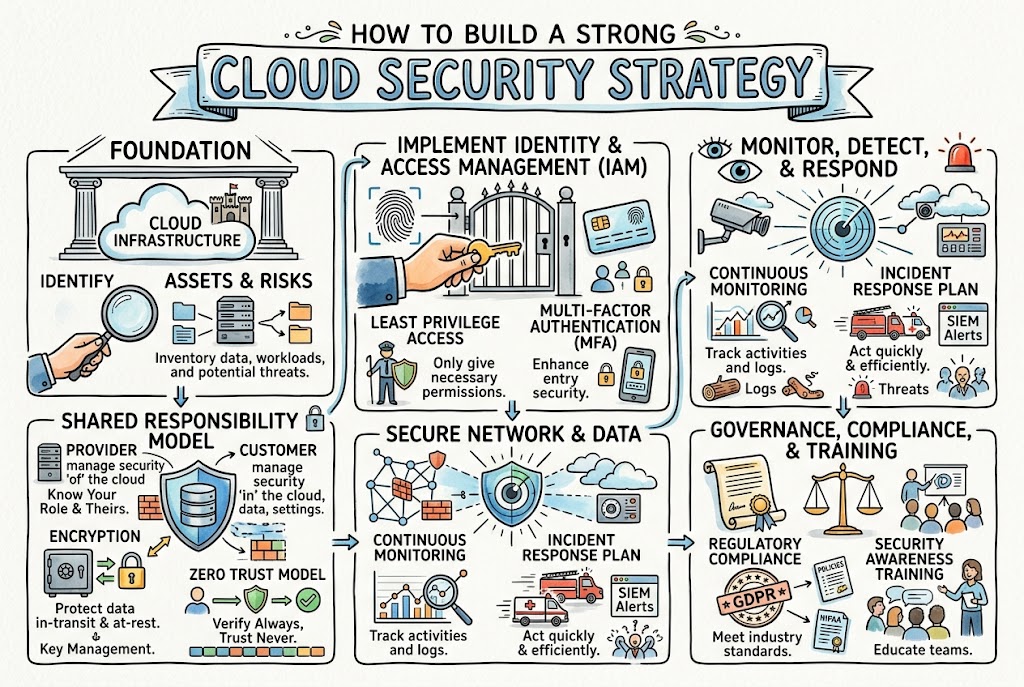
Building a modern security perimeter requires a complete shift from legacy network boundaries to identity-centric validation systems. Organizations frequently migrate workloads to distributed infrastructure environments without modifying their underlying governance frameworks, which creates significant visibility gaps. A successful migration strategy demands that engineers treat security as a continuously verified operational reality rather than a static compliance checkbox.
This deep-dive guide establishes an architectural blueprint for securing multi-cloud ecosystems, cloud-native deployments, and continuous delivery pipelines. By implementing the strategies detailed below, your engineering teams can systematically reduce the attack surface while maintaining rapid feature delivery. If you want to accelerate your infrastructure deployment with built-in compliance, you can leverage the enterprise-grade frameworks provided by Cloudopsnow to secure your environment.
Key Operational Concepts You Must Know
The Shared Responsibility Model Across Cloud Providers
Securing cloud infrastructure requires a precise understanding of where the cloud provider’s liability ends and where your engineering team’s responsibility begins. Cloud service providers manage the security of the cloud, which includes the physical security of data centers, foundational hardware, hypervisors, and core networking infrastructure.
Conversely, your organization remains completely responsible for the security in the cloud, covering data classifications, network traffic configurations, identity management, and application code.
+-----------------------------------------------------------------------+
|                       CUSTOMER RESPONSIBILITY                         |
|  [Data]  [Identities]  [Applications]  [OS]  [Network Configurations] |
+-----------------------------------------------------------------------+
|                       PROVIDER RESPONSIBILITY                         |
|  [Hypervisor]  [Compute]  [Storage]  [Physical Data Centers]         |
+-----------------------------------------------------------------------+
This boundary shifts significantly depending on the service model you select for your application workloads:
- Infrastructure as a Service (IaaS): You retain the maximum level of responsibility, including guest operating system patching, runtime configurations, network firewall rules, and data encryption.
- Platform as a Service (PaaS): The cloud provider manages the underlying operating system and runtime environments, leaving you to focus entirely on application logic, configuration settings, and identity governance.
- Software as a Service (SaaS): The provider manages almost the entire stack, meaning your responsibility scales down primarily to user access controls, data classification, and device compliance.
Zero Trust Architecture Principles
Legacy security models relied on perimeter defense strategies, which assumed that every entity inside the corporate network was fundamentally trustworthy. Modern cloud topologies invalidate this assumption because attackers can easily compromise internal endpoints or exploit misconfigured lateral communication paths. Zero Trust Architecture operates on the strict principle of “never trust, always verify,” treating every access request as a potential breach attempt.
The core framework of a production-grade Zero Trust architecture rests on three distinct technical pillars:
- Explicit Verification: You must validate every single access request using all available data points, including user identity, geographic location, device health metrics, service context, and anomaly detection logs.
- Least Privilege Access: Security teams must restrict user and service identities to the absolute minimum permissions required to execute their specific functions, limiting exposure via temporary credentials.
- Assume Breach Minimization: Systems must be architected with the explicit assumption that attackers have already penetrated the perimeter, which requires dividing infrastructure into micro-segments to block lateral movement.
Identity and Access Management (IAM) Governance
Identity serves as the primary security perimeter within modern cloud ecosystems, replacing traditional hardware firewalls and isolated network subnets. Robust IAM governance requires treating every human user, automated service account, and cloud resource as a distinct identity that requires strict cryptographic validation. If you fail to govern these identities systematically, permissions accumulate over time and create highly vulnerable target profiles for malicious actors.
To mitigate identity sprawl, engineering teams must implement centralized single sign-on mechanisms coupled with strict conditional access policies. You should enforce phishing-resistant Multi-Factor Authentication (MFA) across every account, focusing heavily on administrative access and programmatically generated programmatic tokens. Furthermore, automated access reviews must run continuously to revoke stale permissions and ensure identity lifecycles mirror organizational changes.
Data Protection: Encryption At-Rest and In-Transit
Protecting data across distributed cloud infrastructures requires a layered cryptographic strategy that safeguards information throughout its entire lifecycle. Data at-rest within block storage volumes, relational databases, and object storage systems must be encrypted using industry-standard symmetric algorithms such as AES-256. Security teams must manage the underlying cryptographic keys using dedicated, hardware-backed Cloud Key Management Services (KMS).
[Client Request] ---> (TLS 1.3 / Perfect Forward Secrecy) ---> [Cloud Gateway]
                                                                     |
                                                       (AES-256 Symmetric Key)
                                                                     v
                                                          [Encrypted Storage]
Data in-transit moving across public networks or between internal microservices must be encapsulated using Transport Layer Security (TLS 1.3) protocols. You should enforce perfect forward secrecy to guarantee that a compromise of a single session key cannot expose historical network traffic data. Additionally, infrastructure engineers must configure automated certificate rotation systems to eliminate the risk of operational outages caused by expired cryptographic certificates.
Continuous Security Monitoring and Logging
Maintaining an authoritative posture across dynamic cloud networks requires the continuous collection, aggregation, and analysis of structured telemetry logs. You cannot protect infrastructure components that you cannot actively see, making centralized logging an absolute operational prerequisite for incident response. Engineers must configure infrastructure elements to stream API audit trails, network flow records, and application logs into an immutable data store.
A functional monitoring ecosystem relies on three core components to transform raw log entries into actionable security intelligence:
- Immutable Storage: Logs must be stored in specialized, write-once-read-many repositories that prevent malicious actors from altering audit trails to cover their tracks.
- Real-time SIEM Integration: Security Information and Event Management systems must continuously ingest data streams to correlate distinct events and identify sophisticated multi-stage attacks.
- Automated Alerting: Engineering teams must design contextual alerting thresholds that trigger immediate notifications for high-severity anomalies while minimizing non-actionable alert fatigue.
Platform Implementation vs. Culture — What’s the Real Difference?
Technology Implementations: Automated Guardrails and Infrastructure as Code (IaC)
Platform-focused security emphasizes the programmatic deployment of technical guardrails that prevent engineering teams from introducing infrastructure misconfigurations. By shifting security inspections into Infrastructure as Code pipelines, you can run static analysis scanning tools against declarative templates before provisioning resources. This automated validation process blocks insecure configurations, such as wide-open security groups or unencrypted storage buckets, directly at the pull-request stage.
[Developer Code] ---> [Git Commit] ---> [IaC Static Analysis Scan] ---> [Automated Guardrail Check] ---> [Secure Deploy]
These automated platform guardrails provide predictable, deterministic validation checks across your entire cloud footprint:
| Security Domain | Technical Implementation | Operational Mechanism |
|---|---|---|
| Network Security | Automated Security Group Validation | Blocks any pull request containing 0.0.0.0/0 ingress rules for sensitive administration ports like SSH or RDP. |
| Identity Management | Automated IAM Policy Scanners | Parses JSON permission documents during CI/CD execution to reject policies containing wildcard administrative actions. |
| Data Protection | Service Control Policies (SCPs) | Enforces organization-wide restrictions that prevent the creation of unencrypted object storage buckets or database instances. |
| Vulnerability Mgmt | Container Image Registry Scanning | Automatically scans compiled software layers during build phases and halts deployment if critical vulnerabilities exist. |
Cultural Adaptations: Fostering a DevSecOps Mindset
While automated platform guardrails block known anti-patterns, a resilient cloud infrastructure depends equally on the security culture embraced by developers. Fostering a true DevSecOps mindset requires shifting from an adversarial “security compliance gates” approach to a collaborative, shared-responsibility model. When engineering teams view security as an inherent component of software quality rather than an operational roadblock, they build fundamentally safer software architectures.
Cultivating this cultural shift requires organizations to actively democratize security knowledge and integrate specialized expertise directly into cross-functional product teams. Security departments must transition from acting as strict corporate auditors to serving as internal enablement engineers who provide reusable, secure-by-default software components. By celebrating proactive vulnerability identification and running blame-free post-mortems, you build an environment where engineering teams prioritize continuous operational improvement.
Real-World Use Cases of Modern Operations
Securing a Multi-Region E-Commerce Platform
An international e-commerce corporation faced severe challenges managing inconsistent security postures across its highly distributed, multi-region application deployment infrastructure. Developers frequently modified network access parameters manually within regional cloud consoles, which led to significant drift and left public database endpoints exposed. To resolve these vulnerabilities, the infrastructure engineering team implemented a unified cloud governance framework controlled entirely by declarative templates.
+-----------------------------------+
|      Central Git Repository       |
+-----------------------------------+
                  |
         [CI/CD Orchestrator]
                  |
        +---------+---------+
        |                   |
        v                   v
+---------------+   +---------------+
| Region A (US) |   | Region B (EU) |
|  - IAM Sync   |   |  - IAM Sync   |
|  - KMS Roll   |   |  - KMS Roll   |
|  - WAF Policy |   |  - WAF Policy |
+---------------+   +---------------+
The engineering department executed a systematic technical remediation strategy across all active deployment zones:
- Unified Guardrail Enforcement: They implemented centralized Organization Policies that prohibited the creation of public-facing compute instances without explicit, multi-level architectural approval.
- Automated State Alignment: Pipelines were configured to run continuous drift-detection loops every fifteen minutes, automatically reverting unauthorized infrastructure changes back to the approved state.
- Global Boundary Synchronization: Web Application Firewall policies were completely standardized across all global edge endpoints, ensuring identical protection against injection attacks and botnets.
- Cryptographic Key Standardization: The organization deployed regional, automated key management workflows that standardized envelope encryption across all localized data storage systems.
Migration of Financial Workloads to a Hybrid Cloud Ecosystem
A heavily regulated financial services provider needed to migrate its core transactional processing engines from legacy physical data centers into a hybrid cloud topology. The primary operational constraint required maintaining strict compliance with financial industry data standards while matching the velocity of cloud-native development workflows. The architecture team designed a zero-trust network topology anchored by a dedicated, hardware-backed cryptographic identity provider.
+--------------------------------+                  +--------------------------------+
|     ON-PREMISES DATA CENTER    |                  |        PUBLIC CLOUD ZONE       |
|  [Legacy Transaction Engine]   | <--[Mutual TLS]-> |   [Cloud Microservices App]   |
|   Identified via Hardware ID   |                  |    Identified via Cloud IAM    |
+--------------------------------+                  +--------------------------------+
The migration framework succeeded by organizing infrastructure deployment around precise technical boundaries:
- Mutual Cryptographic Validation: All communication occurring between on-premises mainframes and cloud-native microservices was strictly locked down using Mutual TLS (mTLS) network tunnels.
- Dynamic Credential Injection: Applications were modified to eliminate hardcoded database credentials, utilizing short-lived access tokens injected dynamically at runtime via a centralized secrets manager.
- Continuous Compliance Mapping: The engineering team integrated real-time compliance configuration checks directly into the cloud landing zone to continuously verify financial data isolation boundaries.
- Isolated Forensic Networks: Automated workflows were engineered to instantly isolate any virtual machine displaying anomalous network traffic patterns into a quarantined forensic virtual network.
Hardening Containerized Microservices within a Kubernetes Cluster
A fast-growing software-as-a-service vendor suffered a series of security incidents due to container breakout vulnerabilities and overly permissive cluster configurations. Malicious actors exploited a vulnerability within an internet-facing application container, leveraging its root privilege status to gain unauthorized access to the host node. In response, the DevOps engineering group initiated a comprehensive cluster hardening initiative across all production environments.
The team engineered a defense-in-depth container security architecture by executing these core technical improvements:
- Read-Only Root Filesystems: They configured container runtimes to use completely immutable root filesystems, preventing attackers from downloading malicious tooling during a breach.
- Network Policy Micro-segmentation: Engineers implemented explicit cluster network policies that blocked all lateral communication between distinct functional namespaces by default.
- Non-Root Execution Enforcement: Admission controllers were deployed to systematically reject any container image attempting to execute processes with root administrative privileges.
- Automated Secret Encryption: The cluster data store was configured to encrypt all configuration secrets at the storage layer using external hardware security module keys.
Common Mistakes in Operations Engineering
Hardcoded Credentials and Secrets Management Failures
One of the most damaging mistakes an engineering team can make is embedding cryptographic keys, database passwords, or API tokens directly within application source code. Automated scanning tools continuously crawl public and private repositories, meaning exposed credentials are often compromised within mere minutes of a code commit. Once a malicious actor acquires an administrative token, they can bypass external firewall defenses entirely and compromise your core data storage systems.
To eliminate this systemic operational vulnerability, organizations must treat application source code as an entirely non-secret entity. You should leverage centralized secrets management platforms that inject credentials into memory at runtime or provision short-lived, self-expiring access tokens. Furthermore, you must run automated secret-scanning engines within your continuous integration pipelines to block any commit that contains plain-text cryptographic patterns.
Overly Permissive IAM Roles and Lack of Principle of Least Privilege
Engineering groups frequently prioritize rapid deployment velocity over structural security, which often results in the creation of broad, wildcard IAM permissions. Granting developer service accounts or application instances full cloud administrative rights eliminates immediate permission friction but introduces massive security risks. If an attacker compromises a microservice possessing unrestricted infrastructure privileges, they inherit absolute control over your entire cloud estate.
CRITICAL VULNERABILITY (Wildcard Permission Sprawl):
[Compromised Microservice] ---> (Has "Action": "*") ---> [Absolute Cloud Destruction]

SECURE ARCHITECTURE (Principle of Least Privilege):
[Compromised Microservice] ---> (Has "Action": "s3:GetObject" ONLY) ---> [Attack Blocked / Contained]
Remediating this pattern requires a strict commitment to engineering continuous least-privilege permission models across all active accounts. Security teams must continuously review cloud authorization logs to identify the delta between granted privileges and actual historical usage patterns. You should use automated policy generation utilities to automatically strip away unutilized actions and shrink your attack surface down to baseline requirements.
Ignoring Cloud Drift and Inconsistent Environment States
Cloud drift occurs when engineers execute ad-hoc configuration modifications directly within production environments via interactive command-line interfaces or cloud management dashboards. These manual changes create a dangerous variance between your documented Infrastructure as Code templates and the real-world operational state of your systems. This lack of architectural synchronization breaks automated recovery routines and frequently re-introduces previously remediated security vulnerabilities into production.
+----------------------------------+
|  Approved Git IaC Template       | -> [Security Rules: Port 443 Only]
+----------------------------------+
                 |
                 | (Drift Occurs via Manual Production Web Console Change)
                 v
+----------------------------------+
|  Real-World Production State    | -> [VULNERABILITY: Port 22 Opened to World]
+----------------------------------+
To eliminate environment drift, organizations must completely revoke manual write permissions for human identities within production cloud environments. All infrastructure modifications must flow exclusively through validated version-controlled CI/CD pipelines that enforce programmatic peer-review mechanisms. Additionally, you should run continuous drift-detection software that automatically alerts engineers or self-heals infrastructure when manual modifications deviate from Git templates.
Misconfigured Ingress/Egress and Open Ports
Failing to properly govern network ingress and egress access parameters leaves public cloud resources completely vulnerable to automated internet scanning sweeps. Engineers often provision experimental backend compute instances with public IP addresses or open wide network ports to simplify internal development testing workflows. These open communication pathways allow external actors to run brute-force credential attacks, scan for unpatched runtime software vulnerabilities, or exfiltrate sensitive data.
+------------------------------------------------------------------------+
|                      INSECURE NETWORK PERIMETER                        |
|  [Internet Traffic] --------> (Unrestricted Ingress: Port 0-65535)     |
|                                     |                                  |
|                                     v                                  |
|                         [Internal Database Node]                       |
+------------------------------------------------------------------------+
+------------------------------------------------------------------------+
|                       SECURE NETWORK PERIMETER                         |
|  [Internet Traffic] -> [WAF / ALB Proxy] -> (Port 443 Only)            |
|                                                   |                    |
|                                                   v                    |
|                                       [Private Subnet App Node]        |
+------------------------------------------------------------------------+
Securing network perimeters requires implementing strict, default-deny ingress and egress security group policies across all infrastructure components. You should isolate critical application tiers within private subnets that possess no direct route to or from the public internet. External traffic must pass through dedicated application load balancers and web application firewalls that actively inspect, filter, and log incoming packets.
How to Become an Operations Expert — Career Roadmap
Foundational Knowledge: Systems, Networking, and Core Architecture
Transitioning into an expert-level cloud infrastructure operations engineer requires a comprehensive understanding of low-level systems engineering and distributed computing fundamentals. You cannot effectively secure abstractions like serverless functions or container orchestrators without knowing how underlying operating systems process tasks. Aspiring professionals must master Linux systems administration, focusing heavily on process isolation, file system permissions, and memory management subsystems.
Simultaneously, you must develop a deep structural knowledge of networking protocols and modern distributed application architecture design patterns:
- Network Protocol Analysis: Engineers must comfortably parse network layers, including IP routing, TCP handshake mechanics, DNS resolution paths, and HTTP application sub-layers.
- Packet Inspection Skills: You need to master monitoring network interactions using utility engines like Wireshark or tcpdump to diagnose complex connectivity and security anomalies.
- Distributed Systems Mastery: You must learn how to design highly available architectures using load-balancing tiers, caching layers, and asynchronous messaging queues.
- Failure Domain Segregation: Developing expertise in isolating computing resources across multiple distinct availability zones prevents single-point-of-failure outages.
Specialization Tracks: Advanced Security Engineering and Architecture
As you advance past initial core engineering milestones, you should select a specialized track to build authoritative domain expertise. The modern cloud landscape is far too broad for a single engineer to master every discipline with equal depth, making targeted specialization essential. Focusing your career development on advanced security engineering positions you as an invaluable asset for enterprise organizations handling sensitive data workloads.
                           +----------------------------------------+
                           |  FOUNDATIONAL SYSTEMS & NETWORKING     |
                           +----------------------------------------+
                                               |
                        +----------------------+----------------------+
                        |                                             |
                        v                                             v
+----------------------------------------+   +----------------------------------------+
|       ADVANCED SECURITY TRACK          |   |      ENTERPRISE ARCHITECTURE TRACK     |
|  - Cryptographic Engineering           |   |  - Multi-Cloud Infrastructure Design   |
|  - Threat Modeling Frameworks          |   |  - Cost Optimization Frameworks        |
|  - DevSecOps CI/CD Integration         |   |  - Disaster Recovery Orchestration     |
+----------------------------------------+   +----------------------------------------+
Review the structural focus areas below to align your professional growth with enterprise industry demands:
| Specialization Track | Core Competency Focus | Key Technical Milestones |
|---|---|---|
| Advanced Security Track | Cryptographic Engineering & Threat Modeling | Implementing Zero Trust micro-segmentation models; automating secret rotation fabrics; running deep pipeline threat vector reviews. |
| Enterprise Architecture Track | Multi-Cloud Infrastructure Design | Architecting high-availability hybrid clouds; implementing cross-region active-active clusters; scaling enterprise governance. |
Practical Experience and Lab Setup
Theoretical knowledge without continuous, hands-on architectural experimentation will not suffice when managing complex, real-world production incidents. To build true professional competence, you must design and maintain your own dedicated, sandbox infrastructure testing environment. Building, deliberately compromising, and subsequently hardening your own test applications allows you to safely observe infrastructure failure modes firsthand.
[Local Git Workspace] ---> [GitHub Actions Runner] ---> [Terraform Engine] ---> [Isolated Cloud Sandbox]
Construct a personal engineering sandbox environment by implementing this systematic development pipeline:
- Establish a Multi-Tier Web App: Deploy a complete containerized multi-tier application within a sandbox cloud account using declarative Infrastructure as Code tools.
- Integrate Static Code Analysis: Configure automated pull-request validation pipelines using open-source linting and static application security testing software.
- Simulate Infrastructure Exploits: Deliberately expose specific container endpoints or misconfigure IAM roles to observe how attackers run horizontal scanning tools.
- Implement Automated Remediation: Author automated guardrail hooks and alerting systems to immediately identify and self-heal the intentional vulnerabilities you introduced.
FAQ Section
- What are the initial steps to secure an existing, unhardened cloud infrastructure environment?First, you must establish complete visibility across your environment by enabling comprehensive cloud provider API logging and network flow collection. Next, implement strict Multi-Factor Authentication across every human identity while running automated scanners to locate and revoke any exposed, hardcoded root credentials. Finally, remove any wide-open network security group rules that expose management configurations directly to the public internet.
- How does the principle of least privilege apply directly to automated CI/CD deployment pipelines?Continuous deployment pipelines should never be granted sweeping, permanent administrative access rules over an entire cloud infrastructure estate. Instead, you must configure your delivery runners to assume short-lived, dynamically generated IAM roles using cryptographic identity federation mechanisms. Furthermore, restrict pipeline permissions strictly to the specific resource types and geographical distribution zones configured within your application deployment manifest files.
- What is the difference between data encryption at-rest and data encryption in-transit within cloud systems?Data encryption at-rest protects stored data files by applying cryptographic algorithms to block storage drives, objects, and relational database tables. Conversely, data encryption in-transit secures information actively moving across networks using cryptographic network protocols like Transport Layer Security. Implementing both mechanisms guarantees that your data remains thoroughly protected against physical device theft as well as network packet sniffing attempts.
- Why should engineering teams prioritize Infrastructure as Code for deploying cloud security guardrails?Deploying security configurations manually through interactive management dashboards leaves environments highly susceptible to human error and undocumented drift. Utilizing Infrastructure as Code allows teams to treat security policies as version-controlled software assets that undergo systematic peer review and linting. This programmatic approach ensures that security perimeters are deployed completely identically across development, staging, and production environments.
- How can organizations effectively balance engineering velocity with strict cloud security compliance gates?Organizations achieve this balance by shifting security validations directly into existing developer workflows rather than treating security as a final review. By providing developers with pre-audited, secure-by-default code infrastructure modules, you eliminate friction throughout the initial software design phase. Automating security compliance checks inside code workflows provides developers with instant feedback, allowing them to remediate vulnerabilities before code reaches production.
Final Summary
Establishing a resilient cloud infrastructure defense system requires a continuous, multi-layered commitment to automated governance, identity verification, and structural cultural alignment. Organizations must move completely past the outdated assumption that internal network boundaries are safe, choosing instead to implement strict Zero Trust validation fabrics. By shifting security validations directly into continuous integration workflows, you protect your environment while enabling engineering teams to ship features quickly.
Ultimately, maintaining an uncompromised cloud footprint is an evolving operational objective that demands continuous architectural refinement, automated guardrail tracking, and proactive threat mitigation. As deployment topologies scale in complexity, tracking manual infrastructure modifications and permission drift becomes a critical priority for engineering leaders. By embracing a collaborative DevSecOps culture and enforcing declarative infrastructure pipelines, your organization can confidently navigate the modern threat landscape.
