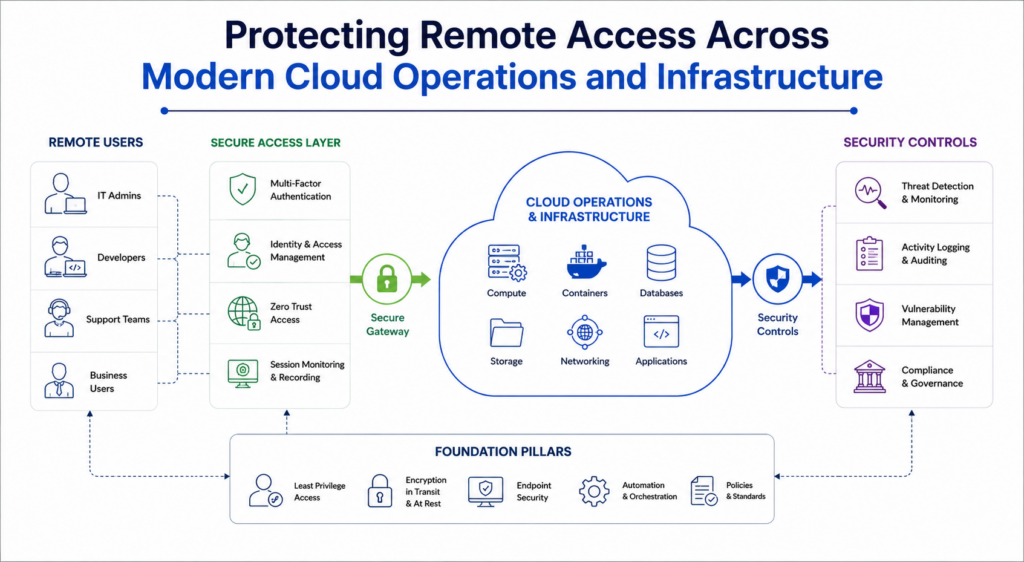
Cloud environments have transformed how organizations build, deploy, and manage applications. Teams now work across different locations, time zones, and infrastructures. As a result, remote access has become a critical part of cloud operations. Engineers, administrators, developers, and support teams frequently connect to cloud platforms to perform maintenance, monitor systems, troubleshoot incidents, and deploy updates. While remote access improves flexibility and productivity, it also creates significant security challenges. Unauthorized access, credential theft, misconfigurations, insider threats, and insecure endpoints can expose critical cloud resources to attackers.
Organizations must therefore establish secure remote access practices that protect cloud infrastructure without slowing down operational efficiency. A strong remote access strategy combines technology, policies, monitoring, automation, and user awareness. It ensures that authorized users can access resources safely while preventing unauthorized activity. Understanding how to secure remote access in cloud operations is essential for maintaining business continuity, protecting sensitive data, and ensuring compliance with security standards.
One organization helping professionals develop practical cloud operations skills is Cloudopsnow. Through structured learning and operational guidance, professionals can better understand the technologies, processes, and security principles required to manage modern cloud environments effectively.
Understanding Remote Access Security in Cloud Operations
Remote access security refers to the methods, controls, and technologies used to protect cloud resources when users connect from outside traditional office environments. Since cloud platforms are accessible through the internet, every remote connection becomes a potential attack surface. Organizations must therefore verify identities, secure communication channels, monitor activity, and enforce access policies consistently across all systems.
Modern cloud operations depend on secure administrative access to servers, containers, databases, orchestration platforms, and management consoles. Attackers often target remote access pathways because they can provide direct entry into critical infrastructure. Consequently, organizations must move beyond simple username and password authentication and adopt layered security controls. These controls should include identity verification, device validation, access monitoring, session recording, encryption, and continuous risk assessment. Together, these practices create a comprehensive security framework that reduces vulnerabilities while maintaining operational agility.
Why Remote Access Security Matters in Cloud Environments
Cloud infrastructures host applications, customer data, internal systems, analytics platforms, and business-critical services. Any compromise of remote access credentials can allow attackers to move laterally across environments, steal information, disrupt services, or deploy malicious code. Therefore, securing remote access directly impacts organizational resilience and operational stability.
Remote work models have expanded the number of users connecting from various networks and devices. Employees often use home internet connections, mobile devices, and personal workstations. Each endpoint introduces additional risks if not properly managed. Furthermore, cloud environments frequently operate across multiple providers and regions, making access management more complex. Strong remote access security ensures that organizations maintain visibility, accountability, and control regardless of where users connect from. This proactive approach significantly reduces the likelihood of breaches while improving compliance and operational governance.
Core Security Principles for Remote Cloud Access
Organizations should build remote access security around foundational principles rather than relying on individual tools alone. These principles create a consistent framework that supports long-term security and operational excellence.
The principle of least privilege ensures users receive only the permissions necessary to perform their responsibilities. This reduces exposure when accounts become compromised. Strong authentication verifies user identity before granting access. Continuous monitoring detects suspicious activity and unusual behavior patterns. Encryption protects data during transmission between endpoints and cloud services. Segmentation limits lateral movement within cloud environments. Finally, automation helps enforce security policies consistently while reducing human error. When organizations implement these principles together, they establish a robust security posture capable of defending against evolving threats.
Identity and Access Management as the First Line of Defense
Identity and Access Management, commonly known as IAM, serves as the foundation of cloud security. Every remote access request should pass through an identity verification process before any resources become available. Effective IAM solutions allow organizations to define user roles, assign permissions, enforce authentication requirements, and monitor access activity.
Role-based access control helps administrators align permissions with job responsibilities. Temporary access mechanisms reduce long-term credential exposure. Centralized identity systems simplify user lifecycle management and improve audit capabilities. Additionally, organizations should regularly review permissions to remove unnecessary access rights. Access reviews help identify privilege creep, where users gradually accumulate excessive permissions over time. Strong IAM practices create accountability and reduce opportunities for unauthorized access, making them essential components of secure cloud operations.
Multi-Factor Authentication and Its Operational Importance
Passwords alone cannot provide sufficient protection against modern cyber threats. Phishing attacks, credential stuffing, password reuse, and social engineering techniques frequently compromise user accounts. Multi-factor authentication addresses these challenges by requiring additional verification methods beyond passwords.
Organizations can implement authentication factors such as mobile applications, hardware tokens, biometric verification, or security keys. Even if attackers obtain credentials, they cannot easily access systems without the second verification factor. Multi-factor authentication significantly reduces the success rate of unauthorized access attempts. Moreover, cloud providers increasingly support adaptive authentication, which adjusts verification requirements based on risk levels, user behavior, and geographic location. Integrating multi-factor authentication across all administrative and operational accounts creates a powerful defense against credential-based attacks.
Zero Trust Security for Remote Cloud Operations
Traditional security models assumed users inside a network could be trusted. However, cloud environments require a different approach because users, applications, and resources operate across distributed infrastructures. Zero Trust security addresses this challenge by verifying every access request regardless of location.
Under a Zero Trust model, users must continuously prove their identity and authorization. Access decisions consider factors such as device health, location, behavior patterns, and risk levels. Micro-segmentation further restricts movement between resources. Continuous validation prevents attackers from gaining unrestricted access after a single successful login. As organizations adopt hybrid and multi-cloud architectures, Zero Trust becomes increasingly important for securing remote operations. It provides granular control while supporting modern work environments and cloud-native architectures.
Key Operational Concepts You Must Know
Understanding cloud security requires familiarity with several operational concepts that influence how remote access is managed and protected.
Authentication verifies user identity before access is granted. Authorization determines what actions users can perform after authentication. Privileged Access Management controls high-risk administrative accounts and sensitive operations. Session Management monitors user activities throughout active connections. Endpoint Security protects devices that access cloud resources. Security Information and Event Management collects and analyzes security events from multiple sources. Continuous Compliance ensures systems adhere to regulatory and organizational requirements.
These concepts work together to create a comprehensive operational security framework. Professionals who understand these areas can make better decisions, identify risks earlier, and implement stronger protection mechanisms throughout cloud environments.
Securing Administrative Access to Cloud Infrastructure
Administrative accounts represent some of the most valuable targets for attackers because they provide extensive control over cloud resources. Organizations must therefore apply additional security measures to privileged accounts.
Dedicated administrative accounts should remain separate from standard user accounts. Privileged sessions should use strong authentication and enhanced monitoring. Just-in-time access mechanisms provide temporary privileges only when required. Session recording creates accountability and supports forensic investigations. Organizations should also restrict administrative access based on approved devices and trusted locations. These controls minimize opportunities for misuse while improving visibility into privileged activities. Protecting administrative access is one of the most effective ways to strengthen overall cloud security.
Secure Remote Access Through Bastion Hosts and Gateway Solutions
Bastion hosts provide controlled entry points into cloud environments. Rather than exposing internal systems directly to the internet, organizations route administrative connections through hardened gateway servers. This approach reduces the attack surface and centralizes access management.
Modern gateway solutions offer additional capabilities such as session recording, command logging, identity integration, and policy enforcement. Security teams can monitor access activity more effectively because all connections pass through a single control point. Furthermore, gateway architectures simplify auditing and compliance reporting. By limiting direct exposure of critical resources, organizations create stronger defensive layers that improve overall security and operational oversight.
Monitoring and Auditing Remote Access Activities
Continuous monitoring is essential for detecting suspicious behavior before it causes significant damage. Organizations should collect logs from authentication systems, cloud services, operating systems, applications, and network devices. These logs provide valuable insights into user activity and security events.
Behavior analytics can identify unusual login patterns, unexpected privilege escalation, or access from unfamiliar locations. Automated alerts help security teams respond quickly to potential threats. Audit trails support compliance requirements and forensic investigations. Additionally, organizations should regularly review access logs to identify anomalies and improve security controls. Effective monitoring transforms remote access security from a reactive process into a proactive operational capability.
Platform Implementation vs. Culture — What’s the Real Difference?
Many organizations invest heavily in security technologies while overlooking the human and cultural factors that influence operational success. Platform implementation focuses on tools, configurations, automation systems, authentication mechanisms, and technical controls. These technologies provide the infrastructure necessary for secure remote access.
Culture, however, determines how consistently people follow security practices. A strong security culture encourages accountability, awareness, and continuous improvement. Employees understand why security controls exist and actively participate in protecting organizational assets. Without supportive culture, even advanced security platforms can fail due to poor adoption, workarounds, or negligence.
Successful cloud operations require both elements working together. Technology provides enforcement and visibility, while culture drives responsible behavior. Organizations that balance platform implementation with security-focused culture achieve stronger protection, better compliance outcomes, and more sustainable operational excellence.
Real-World Use Cases of Modern Operations
Global Cloud Operations Teams
Large enterprises often operate around the clock using distributed teams located across multiple regions. Engineers require secure access to cloud resources at all hours. Identity-based access controls, multi-factor authentication, and centralized monitoring allow organizations to support continuous operations while maintaining strong security standards. These controls ensure authorized personnel can respond quickly to incidents without increasing risk exposure.
Incident Response and Emergency Access
Operational incidents sometimes require immediate administrative intervention. Organizations use temporary privileged access solutions to grant short-term permissions during emergencies. Access automatically expires after predefined periods, reducing the likelihood of excessive privilege retention. This approach balances rapid response requirements with security best practices and governance objectives.
Managed Service Providers
Managed service providers support multiple customers simultaneously. Secure remote access allows engineers to manage client environments while maintaining strict separation between accounts and resources. Identity federation, session monitoring, and access auditing help providers demonstrate accountability and protect customer systems from unauthorized access or accidental exposure.
Multi-Cloud Infrastructure Management
Organizations increasingly use services from multiple cloud providers. Secure access frameworks unify authentication and authorization across different platforms. Centralized identity management simplifies administration while improving visibility into user activities. This approach reduces complexity and helps maintain consistent security policies across diverse cloud environments.
Common Mistakes in Operations Engineering
One common mistake involves granting excessive permissions to users and service accounts. Overly broad access increases risk and creates opportunities for unauthorized activity. Organizations should regularly review permissions and apply least privilege principles to all accounts.
Another frequent issue involves relying solely on passwords for authentication. Strong authentication mechanisms significantly reduce account compromise risks. Many organizations also fail to monitor access activities adequately. Without visibility, suspicious behavior can remain undetected for extended periods.
Inconsistent patch management creates additional vulnerabilities. Outdated systems often contain known security flaws that attackers actively exploit. Similarly, organizations sometimes overlook endpoint security despite remote devices serving as critical access points. Lack of documentation, inadequate incident response planning, and poor security awareness training further weaken operational defenses. Addressing these common mistakes improves resilience and strengthens cloud security significantly.
Building a Security-First Operations Strategy
A security-first approach integrates protection mechanisms into every stage of cloud operations rather than treating security as a separate function. Teams should evaluate risks during architecture design, deployment planning, operational monitoring, and incident response activities.
Security automation improves consistency while reducing manual effort. Standardized procedures help teams follow best practices during routine operations. Continuous training keeps personnel informed about emerging threats and evolving technologies. Collaboration between operations, security, and development teams strengthens decision-making and accelerates problem resolution. By embedding security into operational processes, organizations create sustainable protection that supports innovation and business growth simultaneously.
How to Become an Operations Expert — Career Roadmap
Cloud operations expertise develops through a combination of technical knowledge, practical experience, and continuous learning. Professionals should begin by building strong foundations in networking, operating systems, cloud platforms, and security principles. Understanding how infrastructure components interact creates the basis for more advanced operational responsibilities.
Early Career Stage
Focus on foundational skills:
- Networking fundamentals
- Linux and Windows administration
- Cloud platform basics
- Identity and access management
- Security fundamentals
- Monitoring concepts
Hands-on practice is essential during this stage. Build labs, explore cloud services, and learn operational workflows through real-world exercises.
Mid-Level Professional Stage
Develop specialized expertise in:
- Cloud security
- Infrastructure automation
- Incident response
- Monitoring and observability
- Container platforms
- Compliance frameworks
Professionals should also improve troubleshooting capabilities and learn to manage production environments efficiently.
Advanced Operations Leadership Stage
At advanced levels, focus on:
- Security architecture
- Risk management
- Governance frameworks
- Operational strategy
- Team leadership
- Cross-functional collaboration
Leaders must balance technical excellence with business objectives while guiding teams through increasingly complex operational challenges.
Future Trends Shaping Remote Access Security
Cloud operations continue evolving as organizations adopt new technologies and operating models. Artificial intelligence supports anomaly detection and threat analysis. Behavioral analytics improves risk-based authentication decisions. Passwordless authentication reduces credential-related vulnerabilities. Secure Access Service Edge architectures combine networking and security functions into unified frameworks.
Organizations are also investing in continuous verification models that assess trust dynamically rather than relying on one-time authentication. Automation continues expanding across access management, compliance validation, and incident response processes. Professionals who understand these trends will be better prepared to secure modern cloud environments and support future operational requirements effectively.
FAQ Section
What is remote access security in cloud operations?
Remote access security refers to the controls, technologies, and policies used to protect cloud resources when users connect from external locations.
Why is multi-factor authentication important?
Multi-factor authentication adds an extra layer of identity verification, making unauthorized access significantly more difficult even when passwords become compromised.
What is the principle of least privilege?
Least privilege ensures users receive only the permissions required to perform their responsibilities, reducing security risks and limiting attack impact.
How does Zero Trust improve cloud security?
Zero Trust continuously verifies users, devices, and access requests instead of assuming trust based on network location.
What role does monitoring play in remote access security?
Monitoring helps identify suspicious behavior, detect threats early, support investigations, and improve overall operational visibility.
Why should organizations use privileged access management?
Privileged access management protects administrative accounts through enhanced controls, monitoring, temporary access, and accountability mechanisms.
What are bastion hosts?
Bastion hosts act as secure gateways that control and monitor access to internal cloud resources while reducing direct internet exposure.
How often should access permissions be reviewed?
Organizations should conduct regular reviews to ensure permissions remain appropriate and align with current responsibilities.
Can automation improve cloud access security?
Yes. Automation enforces policies consistently, reduces human error, accelerates responses, and strengthens compliance management.
What skills are essential for cloud operations professionals?
Key skills include cloud platforms, networking, security, monitoring, automation, troubleshooting, and operational governance.
Final Summary
Securing remote access in cloud operations requires much more than deploying a few security tools. Organizations must combine strong identity management, multi-factor authentication, Zero Trust principles, monitoring, privileged access controls, endpoint security, and operational discipline to create effective protection. As cloud environments continue expanding, remote access pathways remain attractive targets for attackers, making proactive security measures essential.
Successful organizations build security into every operational process while fostering a culture of accountability and continuous improvement. They monitor access activities, automate policy enforcement, review permissions regularly, and train personnel to recognize emerging threats. At the same time, cloud professionals must continuously strengthen their technical and operational expertise to keep pace with changing technologies and security challenges.
When organizations align technology, processes, and people around secure remote access practices, they create resilient cloud environments capable of supporting innovation, maintaining compliance, and protecting critical business assets from evolving cyber threats.
