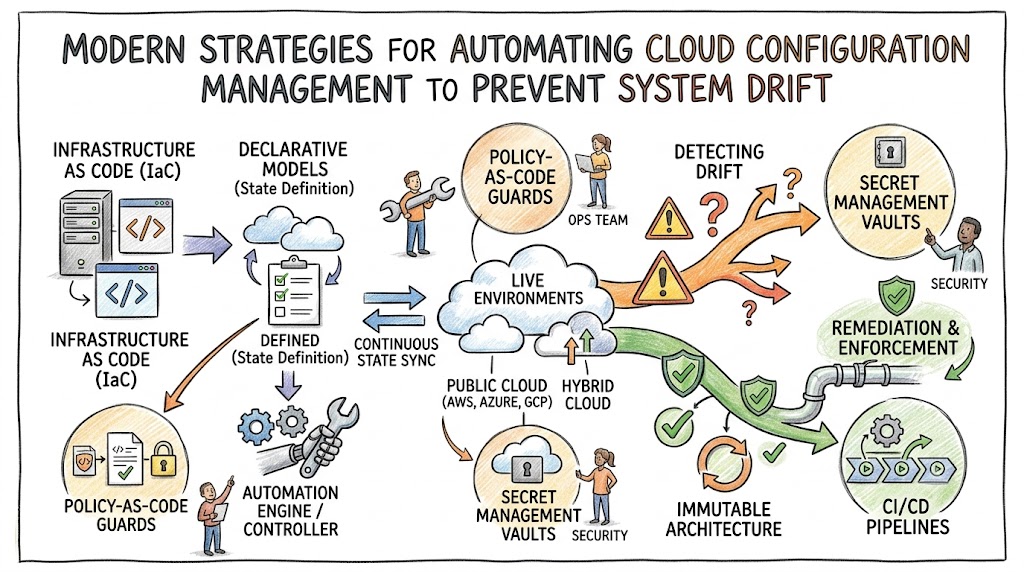
Cloud configuration management represents the foundational discipline of defining, enforcing, and maintaining consistent operational states across distributed computing resources. As modern enterprises shift away from static hardware toward elastic cloud environments, managing individual settings manually quickly becomes impossible. Unchecked manual changes inevitably create configuration drift, where live environments diverge from security baselines and architectural standards. Consequently, automated configuration management establishes a single, verified source of truth across all computing instances, databases, and network assets.
By leveraging programmatically defined parameters, operations teams can provision, validate, and update complex cloud infrastructure in a repeatable manner. Working alongside experienced service partners like Cloudopsnow enables engineering organizations to build robust automation pipelines that reduce manual effort. Modern configuration systems continuously scan infrastructure to detect unauthorized modifications, security vulnerabilities, and operational bottlenecks. Therefore, establishing automated governance ensures high availability, reliable software delivery, and strict compliance across multi-cloud environments.
Fundamentals Of Automated Cloud Configuration Architecture
The Evolution From Manual Administration To Declarative Code
Traditional systems management relied heavily on shell scripts, manual console tweaks, and undocumented server changes. However, this imperative approach created fragile environments that were nearly impossible to replicate or audit accurately. In contrast, modern configuration management utilizes declarative code to specify the exact desired state of every system resource. Consequently, automation engines continuously work to align the live infrastructure with these declarative definitions.
By shifting configuration logic into code repositories, teams gain immediate visibility into system modifications over time. Declarative models describe what the target infrastructure should look like, rather than dictating step-by-step execution scripts. Therefore, if a server setting changes unexpectedly, the automated engine detects the discrepancy and remediates it automatically. This shift dramatically improves system reliability and allows platforms to scale smoothly without proportional increases in engineering overhead.
Establishing Immutable Infrastructure Versus Mutable Configurations
When designing cloud architectures, teams must choose between updating existing resources or replacing them entirely with fresh instances. Mutable infrastructure models allow automated configuration management tools to modify running servers, apply patches, and update configuration files directly. While this approach offers flexibility, it can occasionally leave behind residual artifacts or minor state differences across nodes.
Mutable Workflow:    [Running Server] ---> [Apply Patch/Config] ---> [Modified Running Server]
Immutable Workflow:  [Updated Image]  ---> [Deploy New Server]   ---> [Decommission Old Server]
Conversely, immutable infrastructure frameworks treat running instances as disposable, unchangeable components within the deployment architecture. Whenever a configuration update occurs, the deployment pipeline builds a completely new server image and replaces the old instance entirely. Consequently, immutable patterns eliminate configuration drift completely because servers never undergo live, in-place modifications. Combining declarative tooling with immutable deployment strategies yields highly predictable and resilient cloud platforms.
Continuous State Synchronization And Drift Remediation
Configuration drift occurs naturally when emergency hotfixes, manual troubleshooting, or untracked automated jobs alter cloud resources out of band. Over time, these minor divergence events accumulate, leaving staging and production environments significantly misaligned. Continuous state synchronization tools actively monitor cloud APIs to compare actual live configurations against authorized repository baselines.
- Detection Engine: Periodically queries cloud resource endpoints to gather active metadata and parameter values.
- Diff Reconciliation: Identifies discrepancies between the baseline code repository and the current live infrastructure state.
- Automated Remediation: Executes programmatic corrective actions to force non-compliant resources back into the approved baseline state.
Implementing aggressive drift remediation prevents minor configuration errors from evolving into major security vulnerabilities or system outages. Additionally, continuous reconciliation guarantees that security group rules, storage permissions, and access policies match governance mandates. Therefore, automated state enforcement protects distributed platforms from unauthorized modifications and operational risk.
Key Operational Concepts You Must Know
Declarative Versus Imperative Management Models
Understanding the fundamental distinction between declarative and imperative approaches forms the foundation of modern cloud operations. Imperative management requires engineers to write explicit sequences of commands that instruct the system on how to perform a task. Consequently, if an imperative script runs twice, it might produce unintended side effects or break existing resources.
Declarative management, on the other hand, focuses entirely on defining the end goal rather than the execution steps. You declare the intended properties of your servers, networks, or databases, and the underlying controller figures out how to reach that target state. Therefore, declarative workflows are naturally idempotent, meaning they can run repeatedly without altering systems that are already configured correctly.
+-----------------------------------------------------------------------------------+
| Imperative: "Install Package X, then create User Y, then modify Config File Z."   |
+-----------------------------------------------------------------------------------+
                                          VS
+-----------------------------------------------------------------------------------+
| Declarative: "Ensure Package X is present, User Y exists, and Config Z matches."  |
+-----------------------------------------------------------------------------------+
Policy-As-Code and Governance Enforcement
Policy-as-code integrates security, compliance, and operational rules directly into your automated deployment pipelines. Instead of relying on manual security reviews or post-deployment audits, organizations express governance rules using high-level logic languages. Consequently, security checks execute automatically every time an engineer submits a configuration change for approval.
Furthermore, policy-as-code engines prevent non-compliant resources from ever being provisioned in live cloud environments. For instance, a policy rule can automatically block any pull request that attempts to create an unencrypted storage bucket. By enforcing compliance early in the development lifecycle, organizations minimize security vulnerabilities while maintaining deployment velocity.
Version Control and State Management Architecture
Treating infrastructure configurations as code requires using robust version control systems like Git to track every single modification. Every baseline modification passes through structured pull requests, peer reviews, and automated integration tests before hitting production. As a result, operations teams maintain a complete, immutable audit trail of every configuration change made across the cloud lifecycle.
[Developer Branch] ---> [Pull Request] ---> [Automated Policy Test] ---> [Main Baseline] ---> [Auto-Apply]
State management files store the mapping between your baseline code and the actual physical resources running in the cloud. Because these state files contain sensitive metadata and configuration relationships, securing them with strong encryption and locking mechanisms is vital. Proper state management prevents concurrent deployments from corrupting configuration data, ensuring smooth collaboration across distributed engineering teams.
Platform Implementation vs. Culture — What’s the Real Difference?
| Operational Aspect | Platform Implementation Focus | Cultural & Mindset Focus |
|---|---|---|
| Tooling and Infrastructure | Provisioning configuration engines, setting up state backends, and configuring CI/CD build agents. | Cultivating a culture of continuous improvement, shared accountability, and open technical collaboration. |
| Governance and Compliance | Writing policy-as-code rules, establishing role-based access, and running security scanners. | Shifting security responsibilities left, promoting transparency, and valuing automated guardrails over red tape. |
| Change Management | Building automated pull request pipelines, state locking, and canary rollout stages. | Embracing small, frequent updates, learning from system incidents, and eliminating fear of deployment. |
| Operational Observability | Collecting drift metrics, configuring log collectors, and building real-time alert dashboards. | Prioritizing user experience impact, focusing on systemic post-mortems, and encouraging proactive monitoring. |
Technical Execution vs. Behavioral Alignment
Platform implementation provides the foundational software tools, automated build agents, and repository structures needed to execute configuration changes. Engineers dedicate significant time to crafting modular scripts, establishing state storage, and configuring continuous deployment pipelines. While these technical deliverables are essential, they represent only the mechanical framework of cloud operations.
Behavioral alignment, conversely, centers on how engineering teams collaborate, communicate, and approach system safety on a daily basis. A progressive culture encourages engineers to view configuration code as a shared asset rather than private code owned by isolated teams. When teams value transparency and psychological safety, developers feel empowered to write policy guardrails and automate manual routines proactively.
   +---------------------------------+
   |      Engineering Mindset        |  <-- Values safety, speed, and shared ownership
   +---------------------------------+
                    |
                    v
   +---------------------------------+
   |    Collaborative Processes      |  <-- Peer reviews, automated policy gates, blameless reviews
   +---------------------------------+
                    |
                    v
   +---------------------------------+
   |   Automated Platform Tools      |  <-- Configuration engines, state stores, pipelines
   +---------------------------------+
Bridging the Gap Between Tools and Processes
To maximize automation investments, organizations must align technical capabilities directly with practical team workflows. Deploying advanced configuration tools will yield disappointing results if approval processes remain tied to manual change management boards. Therefore, successful engineering leaders restructure operational workflows so that automated testing platforms perform the required compliance checks.
Bridging this operational divide requires ongoing peer coaching, clear documentation, and collaborative blameless post-mortem reviews. When developers actively participate in maintaining infrastructure configurations, they gain a deeper understanding of operational stability requirements. This shared understanding transforms automated platforms from restrictive barriers into empowering tools that accelerate feature delivery.
Real-World Use Cases of Modern Operations
Multi-Cloud Compliance Enforcement in Regulated Industries
Financial and healthcare institutions operate under strict regulatory frameworks that demand continuous auditability and data isolation across platforms. These organizations frequently deploy multi-cloud strategies across AWS, Azure, and Google Cloud to avoid vendor lock-in and ensure redundancy. However, maintaining consistent security configurations across disparate cloud APIs creates immense operational complexity.
To solve this challenge, engineering teams deploy centralized configuration automation tools that enforce unified security baselines. These automated workflows continuously evaluate active cloud settings against industry standards like CIS benchmarks and HIPAA controls. If an unauthorized entity alters a network access rule in Azure or opens a storage bucket in AWS, the automation engine instantly flags and remediates the violation.
[Central Policy Engine]
       |
       +---> [AWS Cloud]    ---> (Automated Enforcement of CIS Benchmarks)
       |
       +---> [Azure Cloud]  ---> (Continuous Remediation of Network Rules)
       |
       +---> [Google Cloud] ---> (Real-Time Encryption Verification)
Automated Disaster Recovery and Environment Replication
Global enterprises must maintain the capability to reconstruct their entire digital infrastructure in an alternate cloud region during catastrophic outages. Relying on manual recreation or outdated runbooks during a disaster inevitably leads to prolonged downtime and data loss. Automated configuration management solves this vulnerability by defining the entire application stack within version-controlled repositories.
During a regional cloud failure, automated orchestration pipelines read the configuration repositories and provision an identical environment in minutes. The automated engine provisions networking subnets, security groups, database instances, and application nodes without requiring manual intervention. Consequently, organizations achieve exceptionally low recovery time objectives while guaranteeing that the failover environment matches production specifications perfectly.
Dynamic Resource Scaling and Ephemeral Environments
Modern software development teams require isolated, production-like environments to test new features and run automated integration suites. Creating these environments manually is slow and expensive, often leading developers to share cluttered, persistent staging servers. Configuration automation enables on-demand environment creation, allowing developers to spin up ephemeral test stacks dynamically.
- On-Demand Provisioning: Triggers an automated build pipeline when a developer opens a feature branch pull request.
- Parameter Substitution: Injects branch-specific variable values to isolate database instances and API routing logic.
- Automated Cleanup: Teardown routines automatically destroy ephemeral environments once integration testing completes.
[Developer Opens Pull Request]
            |
            v
[Trigger IaC Pipeline]
            |
            v
[Provision Ephemeral Stack]
            |
            v
[Run Automated Tests]
            |
            v
[Destroy Temporary Stack]
This dynamic approach ensures that development teams test their software against pristine, standard configuration baselines every single time. Furthermore, destroying environments immediately after testing prevents idle cloud resource accumulation, reducing unnecessary infrastructure spending. Therefore, dynamic configuration management boosts developer productivity while maintaining tight control over cloud expenditures.
Common Mistakes in Operations Engineering
Storing Hardcoded Secrets in Configuration Repositories
A frequent and severe mistake in cloud operations is embedding plaintext secrets, API tokens, and database passwords directly within configuration code. Developers often commit hardcoded credentials into source repositories for temporary testing, intending to clean them up later. However, these credentials remain buried within the version history, leaving the entire cloud environment exposed to unauthorized access.
Dangerous Pattern:  [Configuration File] ---> Contains Plaintext API Key ---> Pushed to Git Repository
Secure Pattern:     [Configuration File] ---> References Secret Path   ---> Fetched from Vault at Runtime
To prevent catastrophic security breaches, operations teams must integrate specialized secret management solutions into their automation pipelines. Configuration files should contain references or dynamic path pointers rather than actual secret values. During runtime, the automation engine securely retrieves secrets from an encrypted vault, ensuring sensitive credentials never persist in plaintext files.
Ignoring State File Security and Concurrent Locking Mechanisms
Failing to properly manage, encrypt, and lock configuration state files represents another major failure mode in cloud administration. State files map declarative code modules directly to live cloud resources and often contain sensitive architectural metadata. Leaving state files in unencrypted local storage exposes your organization to severe data leaks and unauthorized structural modifications.
Furthermore, running simultaneous configuration deployments without active state locking mechanisms leads directly to state file corruption. When two pipeline workers modify the same state file concurrently, resource mappings become scrambled, causing unrecoverable infrastructure failures. Teams must store state files in centralized, encrypted backends that feature automated object locking to guarantee operational consistency.
Over-Complicating Code Modules and Neglecting Parameterization
Creating overly complex, monolithic configuration files makes infrastructure definitions unreadable, difficult to maintain, and prone to breaking during minor updates. Engineers often attempt to handle every edge case within a single script, resulting in convoluted logic branches. Consequently, team members become afraid to update the configuration code, reintroducing manual workarounds and operational bottlenecks.
Monolithic Anti-Pattern:  [Single Huge Script] ---> Hard to Test ---> Fragile Deployments
Modular Best Practice:    [VPC Module] + [DB Module] + [App Module] ---> Simple & Reusable
Operations teams should design clean, modular configuration components focused on specific functional domains, such as networking or databases. Parameterizing these modules allows teams to reuse identical configuration logic across development, staging, and production environments effortlessly. Simple, modular configuration architectures encourage team collaboration, simplify testing, and drastically reduce the risk of unexpected deployment failures.
How to Become an Operations Expert — Career Roadmap
Mastering Core Cloud Architectures and Systems Fundamentals
To build a successful career as a cloud operations expert, you must develop a deep understanding of core networking and operating system principles. You must understand how cloud providers handle virtual private clouds, subnet routing, load balancing, and identity governance. Furthermore, mastering Linux administration, system calls, and file permission models allows you to diagnose complex configuration issues that higher-level abstractions obscure.
- Networking Basics: Master subnets, route tables, DNS resolution, transit gateways, and firewalls across cloud providers.
- Operating System Internals: Gain expertise in Linux system administration, process management, and storage volume configurations.
- Identity and Access Governance: Understand role-based access controls, key policies, and federation mechanisms.
Additionally, invest time in understanding how container runtimes and orchestration engines like Kubernetes configure internal networks and storage drivers. Understanding these underlying mechanics enables you to design configuration code that is optimized for performance and operational stability. This fundamental technical knowledge sets elite operations engineers apart from practitioners who rely solely on basic graphical interfaces.
Mastering Configuration Management Frameworks and IaC Tools
Modern cloud operations require complete proficiency in industry-standard configuration management engines and Infrastructure as Code frameworks. You should learn declarative provisioning tools like Terraform or OpenTofu to manage cloud infrastructure lifecycles reliably. Simultaneously, gain hands-on expertise with configuration engines like Ansible, Chef, or Puppet to configure software packages and operating system settings inside virtual instances.
+-----------------------------------------------------------------------------------+
| Provisioning Layer (Terraform/OpenTofu): Creates VMs, VPCs, Databases, Networks   |
+-----------------------------------------------------------------------------------+
                                          |
                                          v
+-----------------------------------------------------------------------------------+
| Configuration Layer (Ansible/Chef/Puppet): Configures OS, Security, Applications   |
+-----------------------------------------------------------------------------------+
Learn how to structure modular, reusable code libraries that conform to enterprise design patterns and industry best practices. Practice implementing automated testing suites using tools like Kitchen or TFLint to validate configuration code quality before running deployments. Developing deep hands-on fluency with these automation frameworks ensures you can build reliable, enterprise-grade cloud platforms.
Building Advanced CI/CD and Observability Competencies
To reach expert-level status, you must learn to integrate configuration automation seamlessly into continuous integration and continuous deployment (CI/CD) pipelines. You need to master pipeline tools like GitHub Actions, GitLab CI, or Jenkins to execute configuration tests and deployments automatically. Designing robust delivery pipelines guarantees that every infrastructure modification undergoes rigorous linting, security scanning, and peer review before execution.
             +------------------------------------------------+
             |    Centralized Automation Pipeline             |
             +------------------------------------------------+
               ^                      ^                      ^
               |                      |                      |
      [Static Code Linting]   [Policy Verification]   [Drift Alerting]
       (TFLint / Checkov)      (Open Policy Agent)      (Cloud Monitoring)
Furthermore, develop advanced competency in cloud observability by configuring metrics collection, central logging, and automated alerting systems. Learn to track key operational indicators like configuration drift frequency, deployment success rates, and mean time to recovery. Understanding how to extract actionable intelligence from system telemetry enables you to optimize infrastructure continuously. Ultimately, combining automation expertise with deep observability enables you to maintain exceptionally resilient cloud environments.
FAQ Section
- What is the difference between infrastructure provisioning and configuration management?Infrastructure provisioning focuses on creating core cloud resources like virtual machines, subnets, and database clusters. Configuration management, on the other hand, deals with installing software, managing operating system settings, and enforcing security policies on those resources. Modern operations pipelines combine both concepts to manage the complete resource lifecycle.
- How does policy-as-code prevent configuration drift?Policy-as-code evaluates proposed configuration changes against programmatic security rules before deployment occurs. If a change violates security policies, the pipeline automatically halts the deployment, preventing non-compliant configurations from reaching live environments. This proactive checking stops configuration drift at the source.
- Why is state locking critical in automated configuration pipelines?State locking prevents multiple pipeline operations or engineers from modifying the same cloud infrastructure state file simultaneously. Without state locking, concurrent deployments can corrupt the state file, leading to untracked resources and system outages. Locking guarantees that only one pipeline execution updates infrastructure at a time.
- Can configuration management tools operate across multiple cloud providers?Yes, modern declarative tools and configuration engines support multi-cloud deployments through cloud-specific provider plugins. This abstraction allows engineering teams to write consistent configuration logic across AWS, Azure, Google Cloud, and private environments. Multi-cloud automation simplifies management and reduces operational complexity.
- What is the best way to handle sensitive secrets in configuration code?Secrets should never be stored in plaintext within configuration repositories or code files. Instead, configurations should reference paths in dedicated secret management platforms that inject secrets securely at runtime. This practice ensures that sensitive credentials remain encrypted and fully auditable.
Final Summary
Automating cloud configuration management is an essential requirement for organizations striving to maintain secure, scalable, and resilient digital platforms. Shifting from manual server administration to declarative, code-driven workflows eliminates configuration drift and ensures operational consistency across environments. By combining robust Infrastructure as Code practices with continuous policy enforcement, engineering teams can accelerate software delivery while maintaining strict compliance guardrails. Ultimately, investing in automated configuration processes empowers organizations to build reliable, high-performing cloud infrastructures that support long-term business growth.
