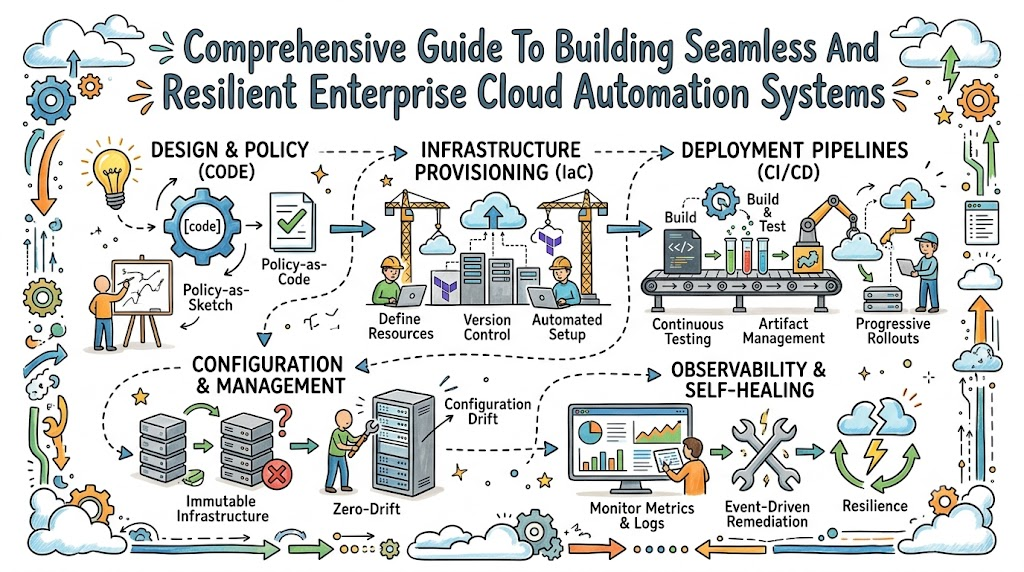
Managing modern cloud infrastructure manually creates severe operational friction, unpredictable deployment errors, and runaway operational costs. When organizations scale digital workloads, manual configuration cannot match the speed required for continuous software delivery. Establishing end-to-end cloud automation replaces slow, error-prone manual handoffs with codified, self-executing workflows across the entire system lifecycle. Consequently, engineering teams eliminate operational friction, reduce configuration drift, and ensure absolute consistency across distributed computing environments.
To master this operational transformation, forward-thinking organizations collaborate with specialized partners like Cloudopsnow to design scalable, secure, and fully automated cloud platforms. Therefore, building an end-to-end framework requires unifying infrastructure provisioning, deployment pipelines, configuration management, and intelligent observability into a single continuous loop. When every tier operates under programmatic control, systems heal themselves dynamically and scale without human intervention. This comprehensive guide walks through the architectural principles, operational workflows, and practical strategies required to achieve full automation maturity.
Core Pillars of Full Lifecycle Cloud Automation
Achieving end-to-end automation requires unifying multiple distinct stages into an integrated, repeatable engineering lifecycle. Traditionally, organizations separate initial provisioning, runtime management, continuous security, and ongoing cost governance into disconnected silos. However, full automation treats every phase as a programmable component that feeds data directly into the next operational stage. By eliminating disconnected handoffs, engineers establish a cohesive delivery system that functions smoothly without manual interventions.
+-------------------------------------------------------------------------------+
|                       Full Lifecycle Automation Flow                          |
+-------------------------------------------------------------------------------+
| [Code & Policy] -> [IaC Provisioning] -> [CI/CD Deployment] -> [Observability]|
|         ^                                                             |       |
|         +--------------------- Automated Feedback --------------------+       |
+-------------------------------------------------------------------------------+
Moreover, modern automation architectures span across day-0 design, day-1 provisioning, and day-2 operations seamlessly. Day-0 centers on architectural modeling, templating, and security baseline definition. Day-1 focuses on automated resource provisioning, continuous configuration verification, and service network initialization. Finally, day-2 handles autoscaling, proactive telemetry monitoring, routine patching, and self-healing remediations. Connecting these distinct phases ensures that your infrastructure remains resilient, compliant, and cost-efficient throughout its active operational lifecycle.
Streamlining Provisioning with Declarative Infrastructure
Infrastructure as Code forms the foundational bedrock of any successful automated cloud deployment. Instead of manually clicking through cloud vendor consoles, teams define computing clusters, storage buckets, and virtual private clouds inside version-controlled code files. Declarative configurations describe the intended final state of resources rather than the procedural commands required to build them. As a result, the underlying orchestration engine automatically calculates differences and provisions matching resources accurately.
Furthermore, adopting declarative infrastructure completely eliminates configuration drift between development, staging, and production environments. When teams store declarative configuration scripts inside shared Git repositories, every architectural adjustment undergoes code review and automated linting. This structured approach provides an immutable audit trail for compliance frameworks and simplifies disaster recovery scenarios. Ultimately, treating infrastructure like application code allows platforms to rebuild entire multi-region clusters in minutes.
Continuous Integration and Continuous Deployment Pipelines
Continuous integration and continuous deployment pipelines transform raw source code into running production services automatically. When developers commit new features, automated pipelines trigger syntax checks, comprehensive unit testing, container builds, and security scans instantly. Consequently, development teams receive rapid feedback on code health before any changes reach live user environments. This rapid validation cycle keeps software releases predictable, safe, and highly frequent.
+---------------+      Triggers      +------------------+      Runs      +------------------+
| Developer     | -----------------> | CI/CD Automation | -------------> | Automated Tests  |
| Code Commit   |                    | Pipeline Engine  |                | & Security Scans |
+---------------+                    +------------------+                +------------------+
                                              |                                   |
                                              | Deploys After Success             v
                                              +--------------------------> +------------------+
                                                                           | Production Fleet |
                                                                           | Dynamic Rollout  |
                                                                           +------------------+
Modern pipelines leverage advanced deployment patterns, including blue-green deployments, canary rollouts, and progressive delivery models. These techniques route small percentages of user traffic to new software versions while monitoring error rates and performance metrics in real time. If the pipeline detects anomalies or performance degradation, automated triggers initiate immediate rollbacks without human involvement. Thus, continuous deployment frameworks balance rapid innovation speed with bulletproof operational stability.
Automated Telemetry, Governance, and Self-Healing Systems
Automation must extend beyond software deployment into real-time monitoring, security enforcement, and operational self-healing. Modern observability agents continuously gather deep telemetry data, structured logs, and distributed traces across all active microservices. Therefore, when system metrics breach predefined thresholds, automated orchestrators trigger corrective actions immediately without waiting for human intervention. This dynamic responsiveness keeps critical applications fully available during unpredictable traffic surges.
- Automated Remediation: Reboots degraded microservices, clears cached memory, or restarts deadlocked database threads autonomously.
- Continuous Policy Enforcement: Scans resource configurations dynamically to revoke public storage permissions and isolate vulnerable compute instances.
- Dynamic Capacity Autoscaling: Provisions additional computing instances during peak traffic and scales down idle clusters during quiet periods.
In addition, governance automation embeds compliance guardrails directly into resource provisioning engines. Policy-as-code frameworks evaluate every infrastructure plan against corporate security baselines before cloud providers execute changes. If an engineer attempts to deploy an unencrypted disk or open an insecure network port, the system rejects the pull request immediately. This proactive governance ensures airtight compliance while giving engineers complete self-service freedom.
Key Operational Concepts You Must Know
GitOps: Unifying Operations Around Version Control
GitOps utilizes Git repositories as the definitive single source of truth for both infrastructure states and application configurations. In a GitOps workflow, every infrastructure change requires a pull request, code review, and automated testing before merging. Once merged, automated reconciliation operators running inside the cloud cluster compare the live running environment against the Git repository. Consequently, any divergence between git and production triggers immediate automated remediation.
+------------------+      Pushes Changes      +----------------------+
| Git Repository   | -----------------------> | GitOps Operator      |
| (Source of Truth)|                          | (Reconciliation Loop)|
+------------------+                          +----------------------+
         ^                                               |
         | Pull Request Verification                     | Synchronizes Real State
         v                                               v
+------------------+                          +----------------------+
| Developer Review |                          | Live Cloud Cluster   |
| & Approval Flow  |                          | (Kubernetes / VMs)   |
+------------------+                          +----------------------+
This operating model drastically simplifies disaster recovery and multi-region synchronization across complex enterprises. If an entire cloud region fails unexpectedly, teams can spin up an identical duplicate environment by pointing operators to the existing repository. Moreover, developer productivity surges because engineers manage infrastructure using familiar Git commands and workflows. Therefore, GitOps bridges the historical gap between software developers and platform operations teams.
Event-Driven Orchestration and Serverless Automation
Event-driven architectures decouple operational tasks by triggering automation workflows in direct response to real-time cloud events. Whenever an infrastructure state changes, cloud monitoring tools emit standardized event payloads to central message buses. Serverless functions then ingest these event payloads and execute targeted remediation scripts within milliseconds. Thus, routine operational interventions occur continuously without maintaining permanent, expensive automation management servers.
For example, when an intrusion detection system spots suspicious network traffic, it immediately fires a security event payload. A serverless function intercepts this event, updates firewall access control lists, isolates the affected container, and alerts the security team. Similarly, when a microservice exhausts available memory, event triggers provision additional compute pods automatically. This decoupled, event-driven pattern ensures instantaneous reactions to dynamic environmental changes.
Configuration Management and Immutable Infrastructure
Configuration management tools traditionally maintained server state by running updates and patching packages on long-lived virtual machines. While effective for legacy systems, this approach frequently leads to configuration drift and operational instability over extended periods. In contrast, modern cloud architectures favor immutable infrastructure, where running instances never receive in-place software modifications. Instead, engineers rebuild and deploy entirely fresh base images whenever updates occur.
| Strategy Dimension | Traditional Configuration Management | Modern Immutable Infrastructure |
|---|---|---|
| Update Mechanism | In-place patching and remote script execution on live running servers. | Discarding old instances and deploying newly baked machine images or containers. |
| Configuration Drift | High risk due to manual tweaks, failed script updates, and unrecorded edits. | Zero risk because running virtual instances remain completely read-only. |
| Rollback Process | Complex procedural rollbacks requiring custom reverse-configuration scripts. | Instantaneous traffic rerouting back to the previous immutable image baseline. |
| Environment Parity | Low to moderate parity due to subtle operating system divergence over time. | Perfect parity across local testing, staging clusters, and live production environments. |
Adopting immutable patterns simplifies application lifecycle tracking and eliminates subtle operating system bugs. By baking operating dependencies, runtime configurations, and security patches directly into static golden images, teams guarantee uniform server environments. When traffic demands rise, auto-scaling engines launch hundreds of identical, pre-configured servers without running setup scripts during boot. Consequently, immutable infrastructure delivers extreme reliability and rapid scaling velocity.
Policy-as-Code and Automated Cloud Governance
Policy-as-Code codifies corporate compliance rules, security standards, and budgetary boundaries into automated validation files. Instead of relying on manual security audits, automated testing engines evaluate infrastructure code against these programmatic rules. If an engineer accidentally configures an unencrypted database, the validation pipeline halts the deployment instantly. Therefore, organizations enforce strict compliance standards across global cloud deployments effortlessly.
Furthermore, runtime policy engines continuously monitor active cloud resources to catch manual modifications made outside authorized deployment pipelines. If a user modifies a security group manually via the web console, the policy engine detects the unauthorized change and reverts it immediately. This continuous posture enforcement guarantees that active cloud resources remain secure and compliant at all times. Ultimately, automated governance replaces bureaucratic review boards with instant, developer-friendly guardrails.
Platform Implementation vs. Culture — What’s the Real Difference?
| Operational Dimension | Platform Implementation Focus | Cultural & Organizational Focus |
|---|---|---|
| System Architecture | Deploying service meshes, container orchestrators, and automated CI/CD runners. | Designing modular team boundaries and fostering decentralized system ownership. |
| Security Governance | Implementing automated SAST/DAST scans and IAM policy-as-code validations. | Embedding DevSecOps mindsets and eliminating finger-pointing during security reviews. |
| Failure Resolution | Configuring auto-remediation scripts, self-healing pods, and automatic failovers. | Conducting blameless post-mortems and treating system failures as learning opportunities. |
| Workflow Management | Building self-service developer portals and Infrastructure-as-Code pipelines. | Encouraging cross-functional empathy and reducing bureaucratic approval bottlenecks. |
Technical Capabilities vs. Human Behavior
Platform implementation encompasses the technical machinery, orchestration engines, and automated scripts that run an organization’s digital infrastructure. Platform teams spend substantial time architecting Kubernetes clusters, writing Terraform modules, and building self-service internal developer portals. These technical investments are vital for standardizing workflows and abstracting infrastructure complexity away from application developers. However, superior technical tooling alone cannot guarantee high operational velocity.
       +---------------------------------------------+
       |         Collaborative Culture & Trust       |  <-- Shared Responsibility
       +---------------------------------------------+
                              |
                              v
       +---------------------------------------------+
       |        Standardized Operating Practices     |  <-- Clear Processes
       +---------------------------------------------+
                              |
                              v
       +---------------------------------------------+
       |        Automated Platform Infrastructure    |  <-- Technology Execution
       +---------------------------------------------+
Cultural focus addresses the human dynamics, organizational trust, and shared values that govern how engineering teams collaborate daily. When an organization cultivates a healthy culture, software developers readily accept responsibility for running their code in production. Conversely, a toxic culture characterized by fear and strict departmental silos will misuse automated platforms and introduce manual approval gates. Therefore, sustainable engineering excellence requires balancing cutting-edge platform capabilities with an open, collaborative organizational culture.
Breaking Down Silos Through Shared Responsibility
Achieving true end-to-end automation requires breaking down traditional departmental barriers between development, operations, and security teams. When operations engineers operate as isolated gatekeepers, they inadvertently become severe bottlenecks that slow down feature delivery. To eliminate this friction, leading organizations transition their operations teams into internal platform providers. These platform teams build self-service APIs and automated toolchains that empower development teams to provision resources independently.
Moreover, embedding shared responsibility across teams ensures that developers consider deployment efficiency and operational maintainability early in design phases. When developers actively participate in on-call rotations and incident reviews, they naturally build more resilient software architectures. Operations engineers, in turn, gain deeper empathy for application development challenges and focus on building intuitive automation workflows. This alignment transforms operational governance from an antagonistic review process into a collaborative partnership.
Real-World Use Cases of Modern Operations
Automated Disaster Recovery and Cross-Region Failover
Enterprise financial institutions and healthcare providers require continuous application availability even during catastrophic cloud region outages. Relying on manual failover procedures during major outages introduces human errors and extends costly service downtime significantly. Modern operations engineering solves this challenge by deploying fully automated disaster recovery systems driven by global DNS orchestration and data replication. Consequently, mission-critical systems execute complete regional failovers in seconds without dropping user transactions.
[Global Traffic Gateway]
        |
        +---> [Active Region Cluster]  ----> (Continuous DB Replication) ----+
        |                                                                    |
        X  (Simulated Region Outage)                                         v
        |
        +===> [Automated Failover Route] ==> [Standby Region Cluster] <------+
These architectures utilize continuous data mirroring, health probes, and automated routing adjustments to maintain system continuity. When automated health checks confirm that a primary region has become unresponsive, orchestration controllers promote secondary database replicas automatically. Simultaneously, global traffic managers redirect live user traffic to the secondary cloud region instantly. This automated failover capability guarantees business continuity while drastically slashing Recovery Time Objectives (RTO) and Recovery Point Objectives (RPO).
Zero-Touch Enterprise Cloud Migrations
Migrating hundreds of legacy on-premises applications to modern cloud environments represents a massive operational challenge for large enterprises. Executing manual migrations server-by-server demands extensive human labor and exposes businesses to severe configuration mistakes. To overcome this hurdle, engineering teams build automated migration factories using custom discovery scripts, containerization engines, and automated validation pipelines. This systematic approach allows organizations to migrate complex workload portfolios rapidly.
- Automated Asset Discovery: Scans on-premises data centers to map application dependencies, resource utilization, and network traffic patterns.
- Codified Environment Provisioning: Generates standardized infrastructure templates matching on-premises specs in cloud environments.
- Automated Data Synchronization: Replicates block storage and database records continuously until cutover windows open.
Once data synchronization stabilizes, automated testing suites validate application endpoints, run performance benchmarks, and check security postures thoroughly. When test results pass predefined criteria, automated DNS rotators switch user traffic over to the newly minted cloud platform. If unexpected performance degradation occurs, the migration pipeline initiates an instant rollback to on-premises systems. This zero-touch approach minimizes business disruption and accelerates enterprise digital transformations.
Dynamic Cloud Cost Optimization (FinOps Automation)
Uncontrolled cloud spending represents one of the biggest challenges facing modern engineering organizations operating at scale. Developers frequently launch oversized compute instances, configure excess storage capacity, and forget to terminate abandoned testing clusters. Rather than relying on manual cost reviews at month-end, operations teams deploy automated FinOps pipelines that optimize resource utilization continuously. As a result, businesses reduce cloud expenditure without sacrificing application performance.
+-------------------------------------------------------------------------------+
|                            FinOps Automation Loop                             |
+-------------------------------------------------------------------------------+
| [Telemetry Monitoring] -> [Cost Analysis Engine] -> [Automated Rightsizing]   |
|         ^                                                        |            |
|         +---------------- Idle Resource Termination <------------+            |
+-------------------------------------------------------------------------------+
These automated systems analyze continuous telemetry data to identify underutilized resources and compute clusters across global environments. When a development database sits idle during non-business hours, automated schedulers shut it down and spin it up before the next workday. Furthermore, intelligent workload balancers purchase discounted spot instances and manage preemptible compute pools automatically. These automated optimizations save organizations millions of dollars annually while maximizing cloud resource utilization.
Common Mistakes in Operations Engineering
Building Fragile and Overly Complex Pipeline Workflows
A widespread mistake in operations engineering is constructing overly complicated CI/CD pipelines filled with bespoke scripts and fragile steps. When pipelines become excessively convoluted, minor environmental glitches cause frequent build failures that frustrate software developers. Developers waste valuable hours debugging cryptic script errors instead of shipping customer-facing features. Consequently, overly complex automation frameworks undermine engineering productivity and slow down organizational delivery cycles.
Fragile Pipeline:  [Code] -> [Script A] -> [Script B] -> [Bespoke Hook] -> [Manual Hack] -> Fail!
Streamlined Flow:  [Code] -> [Modular CI Container] -> [Standardized IaC] -> [Zero-Downtime Deploy]
To prevent this pitfall, operations teams should design clean, modular pipelines built around standardized container steps and reusable templates. Every pipeline stage should perform a single well-defined task, handle unexpected errors gracefully, and provide clear debugging logs. Additionally, teams must version-control and test their pipeline definitions with the same rigor applied to production application code. Keeping automation architectures simple and maintainable ensures high reliability across all development workflows.
Hardcoding Secrets and Sensitive Parameters in Scripts
Another dangerous error is hardcoding API credentials, private encryption keys, and database passwords directly into configuration files. When developers accidentally commit plaintext secrets to shared repositories, malicious actors can exploit them to compromise cloud infrastructure. Even if repositories remain private, hardcoded credentials make rotating secrets extremely cumbersome and operationally disruptive. Therefore, hardcoding sensitive credentials represents a catastrophic operational failure.
To remediate this risk, platform engineers must integrate dedicated secrets management vaults directly into their automation pipelines. Secrets managers inject credentials dynamically into runtime environments as ephemeral environment variables or temporary mounting tokens. Furthermore, organizations should establish automated secret rotation policies that replace cryptographic keys regularly without causing service downtime. This automated secrets lifecycle protects vital cloud infrastructure against catastrophic security breaches.
Treating Automation as a One-Time Setup Project
Many leadership teams make the fatal error of treating cloud automation as a one-time project with a fixed endpoint. They allocate temporary funding to build automated pipelines but fail to dedicate ongoing resources for continuous maintenance. Over time, base operating system images become outdated, software dependencies accumulate vulnerabilities, and deployment scripts suffer from severe bit rot. As a result, once-smooth automation platforms gradually deteriorate and become operational liabilities.
Project Mindset:  [Build Pipelines] ---> [Project Ends] ---> [Pipelines Rot] ---> [Operational Chaos]
Product Mindset:  [Build Platform]  ---> [Iterate Weekly] -> [Maintain Tools]  ---> [Continuous Velocity]
To maintain high performance, organizations must manage their automation platforms as living internal software products. Dedicated platform engineering teams should continuously update deployment modules, patch security vulnerabilities, and incorporate feedback from application developers. Tracking key performance indicators—such as deployment frequency, lead time for changes, and mean time to recovery—keeps the platform aligned with business goals. Continuous investment ensures that your automation platform continues to deliver competitive advantages over the long haul.
How to Become an Operations Expert — Career Roadmap
Mastering Core Operating Systems, Networking, and Containerization
Aspiring operations experts must build a rock-solid foundation in modern operating system architecture, Linux administration, and network engineering. You must thoroughly understand how Linux manages file descriptors, handles memory paging, and schedules processing threads under intense workloads. Additionally, mastering core networking protocols—such as TCP/IP, DNS, TLS, and HTTP/3—is critical for diagnosing complex distributed system failures. This foundational expertise allows you to solve deep infrastructure problems that abstract dashboards cannot reveal.
- Linux Kernel Internals: Master process isolation, control groups (cgroups), systemd services, and performance tuning via sysctl configurations.
- Advanced Networking: Understand subnet routing, CIDR blocks, virtual private clouds (VPCs), and software-defined network overlays.
- Container Fundamentals: Learn how container engines utilize Linux namespaces and layered filesystems to package microservices efficiently.
Beyond raw container management, invest heavily in mastering container orchestration platforms like Kubernetes. Learn how the control plane schedules workloads, coordinates service discovery, and enforces network policies across distributed nodes. Understanding these internal mechanics equips you to design robust, production-grade cloud platforms capable of hosting enterprise software.
Developing Deep Proficiency in Infrastructure as Code and CI/CD
To excel in modern operations, you must transition from writing simple administrative scripts to authoring clean, production-grade Infrastructure as Code. Master declarative orchestration frameworks like Terraform to architect multi-tier cloud environments reliably across diverse cloud providers. You should focus on building modular, reusable code components that incorporate automated linting, security scanning, and unit validation. This structured coding discipline ensures that your infrastructure definitions remain clean, scalable, and easily maintainable.
+-------------------------------------------------------------------------------+
|                      Operations Expert Skill Progression                      |
+-------------------------------------------------------------------------------+
| [Linux & Networking] -> [IaC & CI/CD Pipelines] -> [Orchestration & GitOps]  |
|                                                                 |             |
|                  [Site Reliability & Enterprise FinOps] <-------+             |
+-------------------------------------------------------------------------------+
Simultaneously, gain deep hands-on expertise with modern CI/CD orchestration engines and GitOps continuous delivery operators. Learn how to build automated pipelines that compile code, execute regression test suites, build container images, and coordinate progressive rollouts. Practice building automated rollback triggers that respond instantly to failing health checks and canary deployment anomalies. Mastering these automation toolchains makes you an indispensable asset to high-velocity software engineering organizations.
Cultivating Site Reliability Engineering and Observability Expertise
The final stage of becoming an elite operations expert involves mastering Site Reliability Engineering (SRE) principles and comprehensive system observability. You must learn how to measure system health through Service Level Indicators (SLIs) and establish realistic Service Level Objectives (SLOs). Mastering modern observability tools—including Prometheus for metric aggregation, Grafana for visualization, and OpenTelemetry for distributed tracing—is vital. These analytical capabilities allow you to pinpoint subtle performance bottlenecks across complex microservice architectures.
| Engineering Role | Primary Focus Area | Key Technical Tools | Core Responsibilities |
|---|---|---|---|
| Cloud Infrastructure Engineer | Cloud resource provisioning and foundational network design. | Terraform, AWS, Azure, GCP, CloudFormation. | Building scalable cloud foundations, configuring VPCs, and automating resource lifecycles. |
| Platform Automation Engineer | Developer experience, self-service portals, and CI/CD toolchains. | GitHub Actions, GitLab CI, ArgoCD, Helm. | Creating automated deployment pipelines and abstracting infrastructure complexity for developers. |
| Site Reliability Engineer (SRE) | System resilience, observability, and incident remediation. | Prometheus, Grafana, OpenTelemetry, Datadog. | Defining SLOs, managing incident response, optimizing latency, and automating self-healing systems. |
| Cloud Security Architect | Identity access management and continuous policy governance. | Vault, OPA Gatekeeper, Trivy, Falco. | Enforcing policy-as-code, securing container supply chains, and managing cryptographic secrets. |
In addition, embrace the cultural tenets of Site Reliability Engineering by conducting blameless post-mortem reviews after operational outages. Analyze systemic vulnerabilities objectively and translate incident findings into actionable automation tickets to prevent future recurrences. By eliminating repetitive manual toil through programmatic software solutions, you safeguard system reliability while enabling rapid feature delivery. This rare combination of architectural mastery, automation expertise, and operational empathy defines a true industry expert.
FAQ Section
- What is the fundamental difference between cloud automation and cloud orchestration?Cloud automation refers to executing a single repetitive task—such as launching a virtual server or copying a file—without manual human effort. In contrast, cloud orchestration coordinates multiple automated tasks across diverse systems to complete a complex end-to-end operational workflow. Automation focuses on individual tasks, whereas orchestration manages the broader overarching process.
- Why is Infrastructure as Code considered essential for end-to-end automation?Infrastructure as Code eliminates human configuration errors and configuration drift by defining all cloud resources in version-controlled text files. It allows engineering teams to test, review, and deploy infrastructure changes using the exact same rigor applied to application source code. This programmatic repeatability makes large-scale automated deployments safe and predictable.
- How does GitOps improve infrastructure security and audit compliance?GitOps enforces that all infrastructure modifications pass through version-controlled Git pull requests with mandatory peer reviews and automated testing. This eliminates direct, unrecorded manual access to production servers and establishes an immutable, timestamped audit trail of every modification. If an unauthorized configuration occurs, GitOps operators overwrite the discrepancy automatically.
- What are the most effective strategies for preventing configuration drift?The most effective strategies include adopting immutable infrastructure patterns, banning manual changes in production consoles, and using continuous GitOps reconciliation operators. Additionally, running scheduled drift detection scans alerts engineers when active cloud configurations deviate from codified baselines. These automated practices ensure that running environments match defined code repositories perfectly.
- How does policy-as-code integrate into modern continuous deployment pipelines?Policy-as-code engines evaluate proposed infrastructure templates against codified security and compliance rules before resources are actually provisioned in the cloud. If a configuration violates organizational guardrails—such as opening an unencrypted database to the public—the pipeline rejects the build immediately. This automated gate prevents security vulnerabilities from ever reaching production environments.
Final Summary
Achieving true end-to-end cloud automation requires an integrated strategy that connects codified infrastructure, automated deployment pipelines, and proactive self-healing observability into a unified system. By removing manual interventions, organizations eliminate human configuration errors, accelerate software delivery speed, and maintain airtight security compliance across all environments. Furthermore, treating infrastructure as a software product empowers engineering teams to scale digital operations efficiently without adding operational overhead. Embracing this automated engineering model ensures that your cloud infrastructure remains resilient, agile, and primed for long-term growth.
