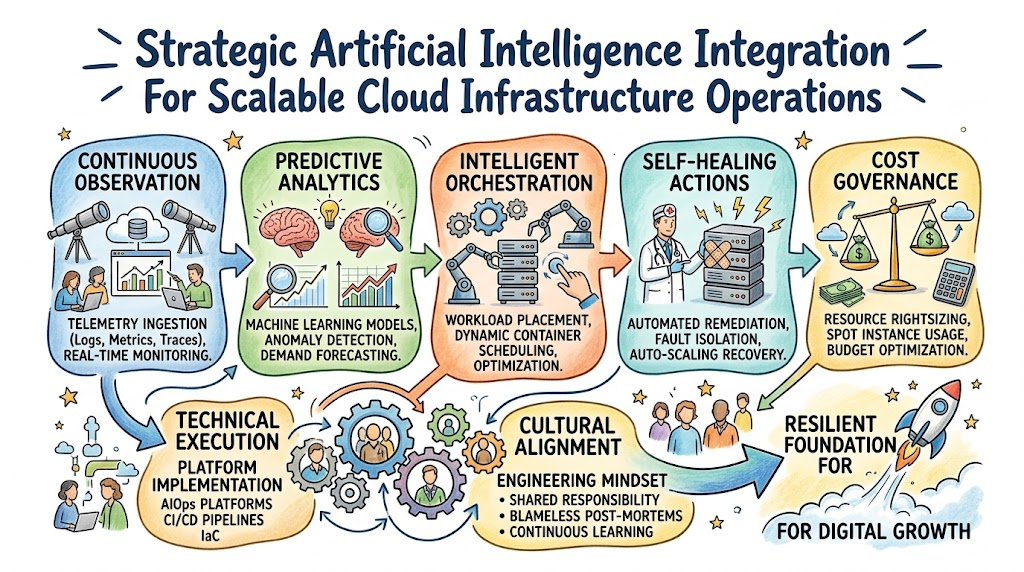
Modern enterprises increasingly depend on complex, multi-tiered architectures to run mission-critical applications worldwide. However, managing distributed systems manually creates operational bottlenecks, elevated error rates, and delayed incident responses. As infrastructure expands across hybrid environments, traditional static scripts no longer provide the necessary adaptability. Consequently, organizations must integrate machine learning algorithms and autonomous logic to maintain high availability and performance standards.
To navigate these architectural challenges, engineering teams partner with specialized service providers like Cloudopsnow to implement intelligent operational frameworks. By embedding artificial intelligence into continuous orchestration pipelines, platforms actively predict resource constraints, isolate anomalies, and remediate failures automatically. Transitioning from reactive firefighting to predictive cloud automation transforms standard infrastructure into a resilient foundation for digital growth.
Machine Learning In Modern Cloud Orchestration
Machine learning models continuously ingest massive streams of telemetry data across diverse cloud environments. Unlike static automation routines, these predictive models analyze historical trends to forecast compute demand and prevent resource starvation. When unexpected traffic surges occur, intelligent systems adjust provisioning thresholds dynamically without requiring direct human intervention.
Furthermore, integrating intelligent algorithms into workload schedulers optimizes container placement and prevents noisy-neighbor conflicts. Systems analyze real-time I/O throughput, CPU usage, and network saturation to distribute tasks evenly across clusters. This dynamic balancing maximizes infrastructure utilization while avoiding performance degradation.
Autonomous Observability And Predictive Telemetry
Autonomous observability platforms transform standard metrics, logs, and distributed traces into actionable operational insights. By correlating disparate data points in real time, these platforms distinguish meaningful system anomalies from background telemetry noise. This capability drastically reduces alert fatigue and allows engineering teams to focus on critical platform stability issues.
Additionally, predictive telemetry models identify subtle performance regressions long before they trigger critical system outages. For example, machine learning algorithms can detect slow memory leaks or escalating response times across microservices instantly. Proactively addressing these degradations ensures uninterrupted user experiences across all digital touchpoints.
+-------------------+      Telemetry Stream      +------------------------+
| Distributed Cloud | -------------------------> | Machine Learning Engine|
|  Infrastructure   |                            |  (Anomaly Detection)   |
+-------------------+                            +------------------------+
         ^                                                   |
         |              Automated Remediation                |
         +---------------------------------------------------+
Self-Healing Systems And Intelligent Auto-Remediation
Self-healing infrastructure leverages automated feedback loops to resolve operational failures immediately upon detection. When a microservice becomes unresponsive, intelligent orchestrators automatically initiate diagnostic routines, restart failing containers, or revert faulty software deployments. These autonomous interventions minimize Mean Time to Resolution (MTTR) and prevent minor glitches from cascading into full platform outages.
Moreover, these self-healing frameworks integrate tightly with configuration management databases and policy engines. If unauthorized configuration drift occurs, intelligent agents identify the variance and restore the environment to its verified baseline. This automated enforcement maintains infrastructure consistency and ensures strict adherence to operational compliance standards.
Intelligent Resource Allocation And Cost Governance
Dynamic resource allocation powered by artificial intelligence optimizes infrastructure spend by aligning resource capacity directly with actual workload demands. Algorithms analyze historical consumption patterns, seasonal usage shifts, and real-time network traffic to scale down idle compute capacity safely. This proactive management prevents expensive over-provisioning across large-scale enterprise environments.
Beyond standard scaling, machine learning models continuously analyze cloud provider billing structures, spot instance markets, and reserved capacity commitments. The platform shifts flexible batch workloads to cost-effective compute tiers automatically while safeguarding primary application performance. Consequently, organizations maintain robust infrastructure performance without exceeding operational budgets.
Key Operational Concepts You Must Know
The Fundamentals of AIOps
AIOps, or Artificial Intelligence for IT Operations, combines big data analytics and machine learning to automate key operational workflows. The framework operates across three core functional phases: continuous observation, analytical engagement, and automated action. By centralizing telemetry ingestion, AIOps platforms provide complete visibility across fragmented multi-cloud ecosystems.
+-------------------------------------------------------------------------+
|                              AIOps Pipeline                             |
+--------------------+---------------------+------------------------------+
|     1. OBSERVE     |      2. ENGAGE      |           3. ACT             |
| Telemetry & Logs   | ML Correlation &    | Auto-Remediation & Execution |
| Central Aggregation| Root Cause Analysis | Dynamic Infrastructure Fixes |
+--------------------+---------------------+------------------------------+
During the analytical phase, algorithms correlate disparate event logs to pinpoint the precise root cause of complex technical failures. Instead of presenting engineers with disconnected alerts, the system highlights the single underlying trigger behind an operational incident. Finally, the action phase executes predefined remediation scripts to resolve the issue swiftly, ensuring seamless system reliability.
Dynamic Policy Enforcement and Governance
Traditional compliance management relies heavily on periodic manual audits, which often miss configuration errors in fast-moving cloud environments. In contrast, intelligent automation enforces continuous Policy-as-Code across all deployed compute instances, storage buckets, and network routes. Automated agents scan environments in real time to detect security vulnerabilities, public data exposures, and unauthorized access attempts.
When non-compliant resources appear, intelligent policy engines quarantine the affected assets and notify security engineers instantly. These systems also enforce tagging standards, geographic data residency mandates, and encryption protocols automatically at provisioning time. This continuous governance maintains security and compliance standards without slowing down development teams.
Platform Implementation vs. Culture — What’s the Real Difference?
| Operational Aspect | Platform Implementation Focus | Cultural & Mindset Focus |
|---|---|---|
| Tooling & Automation | Deploying machine learning frameworks, configuring AIOps platforms, and integrating CI/CD pipelines. | Fostering cross-team collaboration, embracing automation, and eliminating operational silos. |
| Incident Resolution | Running automated diagnostic scripts, executing rollbacks, and dynamic cluster scaling. | Conducting blameless post-mortems, prioritizing permanent fixes, and driving continuous learning. |
| Resource Management | Configuring automated auto-scalers, spot instance management, and rightsizing tools. | Establishing shared cost accountability, setting performance budgets, and valuing resource efficiency. |
| Governance & Security | Implementing Policy-as-Code engines, automated guardrails, and compliance scanning tools. | Instilling a security-first engineering mindset and treating compliance as a shared baseline. |
Technical Architecture vs. Team Mindset
Implementing automated cloud platforms requires deploying robust software frameworks, configuring API integrations, and running monitoring tools. Engineers spend time tuning algorithmic thresholds, building event-driven pipelines, and managing container orchestration layers. While these technical components provide operational capability, they cannot guarantee enterprise agility on their own.
A forward-thinking engineering culture encourages teams to view automation as a tool that amplifies capability rather than an obstacle. Teams must trust automated decisions, share operational metrics openly, and eliminate barriers between development and operations. When engineers embrace automated processes, they write software that aligns naturally with self-healing platforms, creating an efficient and reliable operational environment.
Aligning Automated Workflows With Human Oversight
To build high-performing platforms, organizations must establish clear operational boundaries between autonomous systems and human engineering teams. While machine learning handles routine data correlation and rapid auto-remediation, complex architectural decisions require human context and strategic judgment. Creating clear escalation pathways ensures engineers intervene precisely when edge cases exceed automated operational boundaries.
       +-----------------------------------+
       |     Engineering Culture           |  <-- Cultivates trust and continuous learning
       +-----------------------------------+
                         |
                         v
       +-----------------------------------+
       |     Standardized Workflows        |  <-- Establishes escalation and triage paths
       +-----------------------------------+
                         |
                         v
       +-----------------------------------+
       |     AIOps & Platform Tech         |  <-- Executes autonomous, self-healing tasks
       +-----------------------------------+
Establishing this balance requires standard operating procedures, regular knowledge-sharing sessions, and continuous feedback loops. Engineers review automated remediation actions regularly to refine decision models and eliminate recurring system vulnerabilities. This cooperative dynamic transforms automation from a simple script runner into an intelligent platform that enhances engineering capability.
Real-World Use Cases of Modern Operations
Autonomous Zero-Downtime E-Commerce Scaling
Enterprise e-commerce systems experience sudden, volatile traffic spikes during seasonal flash sales and product launches. Manual scaling strategies often fail to provision extra capacity quickly enough, resulting in slow page loads and lost sales revenue. To solve this, major online retailers utilize predictive AI engines that analyze buyer traffic trends, shopping cart additions, and search query volumes.
[Incoming Global Shoppers]
           |
           v
[AIOps Traffic Engine] ----> Predicts Spike
           |
           +---> [Scales Microservices Proactively]
           |
           +---> [Optimizes Database Read Replicas]
           |
           +---> [Warms Edge CDN Caches]
These platforms spin up additional compute nodes and warm edge caches ahead of anticipated traffic spikes. Furthermore, if a database replica becomes saturated, intelligent traffic routers redirect read requests to healthy mirrors instantly. This autonomous management maintains sub-second transaction speeds and ensures a dependable, zero-downtime shopping experience.
Predictive Anomaly Mitigation in FinTech Architectures
Financial technology platforms process millions of secure transactions every minute, demanding ultra-low latency and absolute platform reliability. A subtle hardware bottleneck or memory leak can disrupt payment settlements and cause significant financial loss. FinTech engineering teams deploy intelligent observability agents that continuously monitor transactional pathways and network latency across microservices.
- Behavioral Baseline Mapping: Algorithms learn normal system telemetry patterns across varying market conditions and trading volumes.
- Proactive Microservice Isolation: Platforms quarantine unstable service instances before they affect global transaction processing queues.
- Automated Rollback Systems: Pipelines detect unexpected software errors immediately post-deployment and execute rapid automated rollbacks.
By analyzing multi-dimensional operational data, these platforms isolate faulty compute nodes and resolve transaction bottlenecks autonomously. Machine learning models also analyze traffic anomalies to identify distributed denial-of-service attempts and malicious API misuse in real time. This layered operational defense keeps financial systems secure, resilient, and responsive.
Resilient Media Streaming Infrastructure
Global media streaming services manage massive volumes of concurrent video traffic across geographically distributed content networks. Network congestion or regional fiber outages can degrade stream quality, causing buffering and poor user satisfaction. To prevent performance drops, streaming platforms deploy automated traffic managers powered by machine learning algorithms.
These intelligent controllers evaluate streaming health metrics, regional network saturation levels, and edge cache hit ratios in real time. If a primary transit route degrades, the system reroutes data packets through optimal secondary network backbones autonomously. This real-time traffic balancing delivers high-definition media streams to millions of viewers without interruption.
Common Mistakes in Operations Engineering
Over-Automating Without Foundational Stability
A frequent mistake in modern infrastructure management is deploying complex automation workflows on top of fundamentally unstable platforms. When underlying network routes, database schemas, or virtual environments are poorly structured, automating tasks simply magnifies existing architectural flaws. Automation scripts running against unpredictable systems often trigger cascading failures across the entire ecosystem.
[Flawed Infrastructure Layer]
             |
             v  (Automated Actions Applied Rapidly)
[Magnified Cascading Failure Across Microservices]
Before implementing advanced machine learning workflows, engineering teams must standardize configurations and establish solid architectural baselines. Ensuring basic infrastructure stability makes automated interventions predictable, reliable, and safe to run in production environments. Building on a stable foundation enables organizations to maximize the benefits of intelligent cloud operations.
Ignoring Data Quality and Model Drift in AIOps
Many organizations deploy predictive observability tools but fail to clean, standardize, and maintain the underlying telemetry data streams. Machine learning algorithms rely on accurate, high-fidelity log formats, metric labels, and distributed trace contexts to identify issues correctly. Feeding fragmented or mislabeled monitoring data into predictive models leads to inaccurate anomaly detection and frequent false alarms.
Additionally, production systems evolve constantly as developers deploy new application code, modify database designs, and introduce new microservices. If operational models fail to adapt to these architectural changes, model drift occurs, causing systems to misinterpret normal operational shifts as failures. Engineering teams must continuously retrain their analytical models to ensure their automation platforms remain accurate and effective.
Creating Alert Fatigue Through Poor Filtering
Another widespread operational issue is misconfiguring monitoring platforms so they generate alerts for every minor metric variance. When alerting systems notify on-call engineers for benign, self-correcting telemetry spikes, engineers quickly experience burnout and alert fatigue. Over time, overloaded engineers may overlook genuine, high-severity system alerts among hundreds of non-critical notifications.
Unfiltered Telemetry:  [10,000+ Raw Events/Min] ---> [Engineer Flooded with Alerts] (High Fatigue)
Intelligent Filtering: [10,000+ Raw Events/Min] ---> [AIOps Correlation Engine] ---> [Single Actionable Ticket]
To prevent notification fatigue, operations teams must use intelligent alert correlation engines that bundle related telemetry events into a single actionable incident. Platforms should handle minor, self-healing events autonomously in the background without waking on-call personnel. Alerting human operators only when immediate manual intervention is necessary preserves engineering focus and improves incident response times.
How to Become an Operations Expert — Career Roadmap
Mastering Distributed Systems and Cloud Computing
Becoming an operations expert begins with developing a deep understanding of distributed systems architecture, Linux operating system internals, and cloud networking. You must master how kernel threads execute, how TCP/IP connections manage congestion, and how virtualized container networking functions. Understanding these fundamental mechanics enables you to troubleshoot intricate infrastructure bottlenecks that basic dashboard tools conceal.
- Linux Fundamentals: Master kernel configuration parameters, system memory tuning via
sysctl, and low-level thread scheduling. - Networking Mastery: Build expertise in software-defined networking, Anycast routing, DNS management, and modern protocols like HTTP/3 and QUIC.
- Container Runtimes: Understand cgroups, namespaces, and internal container networking interfaces across Kubernetes platforms.
Beyond core compute mechanics, gain deep familiarity with major public cloud platforms, understanding their foundational compute, storage, and networking layers. Learn how to design resilient multi-region architectures that tolerate regional data center outages. This technical foundation allows you to design scalable, production-ready cloud environments.
Developing Deep Automation and Code-First Competency
Modern operations engineering requires treating all infrastructure components, compliance rules, and configuration baselines as version-controlled software code. Aspiring experts must master declarative Infrastructure as Code (IaC) tools like Terraform to build repeatable, modular cloud environments reliably. Writing modular code ensures that complex network topologies, compute clusters, and load balancers deploy consistently across multiple cloud providers.
+------------------------+      Applies Code      +------------------------+
|   Terraform / IaC      | ---------------------> |  Modular, Predictable  |
|   Declarative Code     |                        |  Cloud Infrastructure  |
+------------------------+                        +------------------------+
In addition to infrastructure provisioning, develop strong programming skills in languages such as Python or Go to build custom controllers, operators, and automation scripts. Learn how to construct automated CI/CD pipelines that incorporate linting, integration testing, and policy validation checks before production deployments. Automating these release workflows reduces human error and accelerates software delivery across the organization.
Implementing Telemetry, Machine Learning, and AIOps Frameworks
To excel in modern operations, you must master the principles of advanced observability and the practical application of machine learning in IT operations. Gain hands-on experience setting up unified telemetry collection pipelines using OpenTelemetry to capture metrics, logs, and distributed traces. Learn to configure platforms like Prometheus and Grafana to build dashboards that reflect user-facing Service Level Objectives (SLOs).
               +---------------------------------------+
               |     AIOps Intelligence Platform       |
               +---------------------------------------+
                 ^                 ^                 ^
                 |                 |                 |
          [System Metrics]    [Distributed Traces]   [Structured Logs]
          (Prometheus / APM)   (OpenTelemetry)        (Central Log Stores)
Furthermore, study machine learning basics, focusing on statistical anomaly detection, time-series forecasting, and natural language processing for log analysis. Understanding how these algorithms work allows you to tune AIOps platforms, eliminate false alarms, and design reliable auto-remediation routines. This analytical expertise positions you to lead operations teams in building resilient, self-healing cloud platforms.
FAQ Section
- How does AIOps differ from traditional DevOps automation?DevOps automation relies on static, rule-based scripts to execute predictable workflows like building container images and running automated tests. In contrast, AIOps integrates machine learning to analyze large-scale telemetry data, detect unexpected operational anomalies, and execute dynamic self-healing interventions.
- Can artificial intelligence completely replace human cloud operations teams?No, artificial intelligence automates routine telemetry correlation, metric monitoring, and standard remediation tasks, freeing human engineers from manual maintenance. However, human expertise remains vital for defining overarching platform strategy, designing system architectures, and managing complex edge cases.
- What is the first step in implementing AI-driven cloud automation?The essential first step is centralizing and cleaning your operational telemetry data, including system logs, performance metrics, and distributed network traces. High-fidelity, well-structured telemetry data provides the foundation necessary for machine learning models to identify anomalies accurately and avoid false alarms.
- How do self-healing systems prevent recursive remediation loops?Self-healing systems incorporate circuit breakers, execution rate limits, and threshold checks that halt automated remediation if actions fail to restore health within a set timeframe. When these limits are reached, the system pauses automation and routes an alert to human engineers for review.
- How does intelligent resource allocation improve FinOps practices?Intelligent resource allocation continuously analyzes real-time application utilization to scale down unneeded compute capacity and eliminate idle resources. By matching infrastructure reservations dynamically with actual demand, organizations significantly reduce cloud costs while safeguarding platform performance.
Final Summary
Integrating artificial intelligence into cloud automation marks a significant evolution in how modern enterprises manage, secure, and scale digital infrastructure. By replacing brittle, static scripts with predictive machine learning models, organizations can build self-healing environments that isolate performance bottlenecks before they cause downtime. These intelligent platforms streamline resource allocation, reduce operational overhead, and maintain consistent policy governance across complex multi-cloud ecosystems. Ultimately, adopting an automation-first operational mindset ensures software applications remain resilient, performant, and ready to meet growing business demands.
