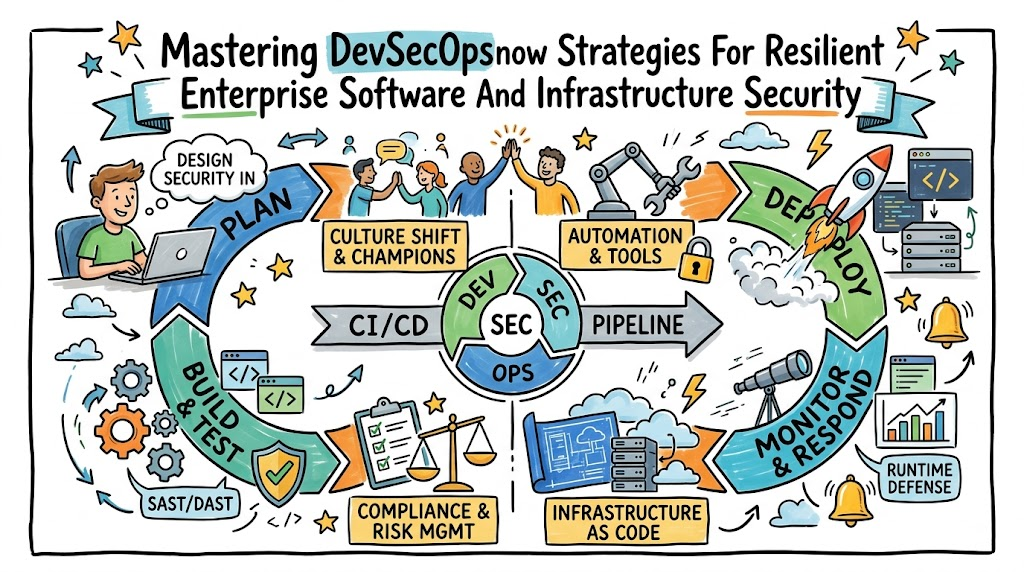
Transforming Modern Software Delivery Pipelines
Dynamic software organizations push continuous updates straight into complex cloud infrastructure daily. Consequently, legacy compliance audits create massive friction when teams isolate risk analysis from standard development cycles. Progressive engineering teams embed real-time testing mechanisms, automated policy guardrails, and threat detection directly inside their continuous delivery workflows.
Engineering managers constantly balance aggressive product timelines with stringent digital protection requirements. Therefore, shifting validation tools directly into code repositories surfaces critical vulnerabilities long before production releases. This proactive development strategy safeguards brand equity, cuts remediation expenses, and maintains deep stakeholder trust across distributed platforms.
Demystifying The DevSecOpsnow Operating Model
DevSecOpsnow creates an agile operational paradigm where developers, platform operators, and cybersecurity specialists work together via automated systems. In addition, this framework converts defensive controls from an annoying bottleneck into an active engine for release velocity.
+-----------------------------------------------------------------------------------+
|                        Continuous Security Pipeline Flow                          |
|                                                                                   |
|  [ Code Design ]  -->  [ Build Systems ]  -->  [ Release Gates ]  -->  [ Runtime ]|
|        |                     |                       |                     |      |
|   (IDE Checks)          (SAST / SCA)            (IaC / DAST)          (Protection)|
+-----------------------------------------------------------------------------------+
Software squads introduce automated analyzers directly into pull requests rather than relying on delayed manual reviews. Thus, developers receive immediate feedback regarding exposed secrets, flawed dependencies, and misconfigured infrastructure files while writing their daily code.
Unlocking High-Value Engineering ROI
Delayed audits catch severe system defects only after engineering teams conclude their primary development cycles. Because of this lag, technical teams waste valuable engineering sprints refactoring live architecture to fix avoidable structural flaws.
Industry benchmarks confirm that resolving live vulnerabilities demands substantially more engineering effort than addressing identical flaws during initial coding phases. Furthermore, continuous security testing dramatically accelerates issue remediation across microservice environments. By deploying proactive testing frameworks, companies eliminate systemic compliance risks and protect mission-critical operations.
Foundational Building Blocks Of Pipeline Defense
High-performing security programs depend upon synchronized automation tooling, modern operational practices, and shared team accountability. Organizations must align automation tools with clear engineering responsibilities to maintain long-term success.
- Automated Guardrails: Static code analyzers and secrets checkers trigger automatically on every pull request.
- Continuous Visibility: Unified telemetry engines track system health across hybrid cloud deployments.
- Shared Ownership: Development and platform teams manage delivery security collaboratively.
- Policy Enforcement: Automated compliance engines block non-compliant artifacts from reaching production.
+--------------------------------------------------------------------+
|                Three-Tier Defense Architecture                     |
|                                                                    |
|  [Tier 1: Culture]    Security Champions & Shared Ownership        |
|  [Tier 2: Automation] SAST, SCA, DAST, Secrets Scanning, IaC       |
|  [Tier 3: Governance] Automated Policy-as-Code & Audit Logs        |
+--------------------------------------------------------------------+
Fortifying Cloud And Container Workloads
Dynamic cloud deployments demand automated configuration validation, fine-grained identity policies, and continuous posture evaluation. For this reason, professional Cloud Security Consulting Services guide engineering groups as they secure distributed environments across Amazon Web Services, Microsoft Azure, and Google Cloud Platform.
+--------------------------------------------------------------------------+
|                  Cloud & Workload Protection Matrix                      |
+--------------------------+-----------------------+-----------------------+
| Cloud IAM Policies       | Network Firewalls     | Workload Identity     |
| Least-Privilege Access   | VPC Peering Rules     | Short-Lived Tokens    |
+--------------------------+-----------------------+-----------------------+
| Infrastructure as Code   | Secrets Management    | Continuous Compliance |
| Terraform/Pulumi Scans   | KMS Integration       | Automated CSPM Scans  |
+--------------------------+-----------------------+-----------------------+
Simultaneously, microservice orchestrators introduce unique runtime vectors across distributed container clusters. Specialized Kubernetes Security Consulting Services implement zero-trust network boundaries, cluster admission controllers, role-based access limits, and kernel runtime shields to block container escape exploits.
Defending Upstream Software Supply Chains
Cloud-native applications rely extensively on public package registries, base container images, and open-source ecosystems. Consequently, compromised upstream libraries offer threat actors direct pathways into production software systems.
Deploying comprehensive Software Supply Chain Security Services allows enterprises to generate detailed Software Bills of Materials (SBOM), enforce cryptographic code signing, and verify image provenance. Therefore, engineering platforms detect malicious code injections and vulnerable packages long before container images land in production clusters.
Orchestrating Deep Multi-Layered Testing
Comprehensive vulnerability discovery demands a defense-in-depth approach that integrates multiple testing modalities across the deployment lifecycle. Each scanning layer targets distinct vulnerability categories.
| Security Testing Layer | Primary Inspection Target | Pipeline Integration Stage |
|---|---|---|
| SAST (Static Analysis) | Proprietary Source Code Flaws | Code Commit & Pull Request |
| SCA (Dependency Scanning) | Third-Party Libraries & Licenses | Build & Package Generation |
| Secrets Scanning | Exposed API Keys & Passwords | Pre-Commit Git Hooks |
| IaC Scanning | Cloud Template Misconfigurations | Infrastructure PR Creation |
| DAST (Dynamic Analysis) | Running Web Applications & APIs | Staging & Pre-Production |
Diagnostic Evaluation And Security Benchmarking
Software groups need an accurate picture of their technical posture before purchasing and deploying new testing toolsets. Rigorous DevSecOps Assessment Services thoroughly analyze repository setups, pipeline architectures, team workflows, and cloud compliance postures.
+-------------------------------------------------------------------------+
|                  DevSecOps Maturity Assessment Phases                   |
|                                                                         |
|  [ Discovery ]  -->  [ Gap Analysis ]  -->  [ Threat Model ]  --> [Plan]|
|  Repo audits         Tool evaluation        Risk scoring          Steps |
+-------------------------------------------------------------------------+
Moreover, this in-depth analysis uncovers operational bottlenecks, engineering skill gaps, and unmonitored cloud resources. Hence, leadership secures a practical remediation roadmap that targets severe structural risks immediately.
Strategic DevSecOps Advisory
Achieving complex compliance benchmarks without degrading development velocity demands seasoned architectural leadership. Dedicated DevSecOps Consulting Services partner with enterprise leaders to design scalable security roadmaps tailored to specific technical stacks.
Senior advisors construct tailor-made policy-as-code rules, clean up noisy notification channels, and integrate compliance controls straight into continuous deployment engines. Businesses maintain ironclad regulatory compliance while accelerating high-quality software releases.
Tactical Toolchain Integration
Security programs collapse when poor scanner configurations bombard developers with thousands of meaningless alerts. Targeted DevSecOps Implementation Services configure, fine-tune, and embed security testing engines directly into continuous integration workflows.
Engineers implement automated pull-request commenting, dynamic policy gates, artifact verification mechanisms, and centralized dashboard reporting. Thus, software teams resolve genuine security flaws smoothly within their daily development workflow.
Continuous Managed Pipeline Defense
Maintaining strict security standards across hundreds of microservices demands uninterrupted technical oversight. Specialized DevSecOps Managed Services provide dedicated security specialists who monitor build pipelines, triage emerging vulnerabilities, update scanning policies, and support code remediation.
+----------------------------------------------------------------------+
|                  DevSecOps Managed Operations Loop                   |
|                                                                      |
|  [ Pipeline Scan ] --> [ Triage Findings ] --> [ Dev Fix Guidance ]  |
|          ^                                             |             |
|          +------------ [ Policy Evolution ] <----------+             |
+----------------------------------------------------------------------+
Managed teams provide regular risk telemetry, neutralize zero-day dependencies, and audit cloud infrastructure settings continuously. Therefore, enterprise platform teams maintain pristine security standards without overwhelming internal staff.
Upskilling Individual Practitioners
Automation tools create real value only when engineers understand how to interpret and resolve discovered defects. Practical DevSecOps Training equips software developers, system administrators, and quality engineers with hands-on remediation capabilities.
Participants master threat modeling techniques, pipeline hardening steps, container debugging methods, and cloud configuration audits through practical lab environments. As a result, practitioners advance their technical careers and build resilient software systems.
Scaling Enterprise Technical Capabilities
Building sustainable security practices across multiple enterprise divisions requires structured organizational upskilling. Targeted Corporate DevSecOps Training aligns cross-functional development, security, DevOps, and cloud engineering teams around shared practices.
+-------------------------------------------------------------------+
|               Enterprise Team Skill Alignment Matrix              |
+--------------------+----------------------------------------------+
| Engineering Role   | Core Focus Areas                             |
+--------------------+----------------------------------------------+
| Developers         | Secure Coding, Dependency Updates, SAST Fixes|
| DevOps & Platform  | Pipeline Hardening, Policy-as-Code, SBOM     |
| Cloud Engineers    | Terraform Audits, IAM Roles, Workload Guard  |
| Security Analysts  | Vulnerability Triage, DAST Scans, Pentesting |
+--------------------+----------------------------------------------+
Through real-world architectural simulations, team members learn how to resolve complex container vulnerabilities and streamline production deployment processes. Consequently, organizations systematically eliminate security friction across all operational units.
Avoiding Critical Execution Errors
Technology leaders often encounter major setbacks when treating security automation as a simple software installation project. Teams must consciously sidestep several prominent mistakes:
- Scanner Alert Fatigue: Enabling raw scanners with default rules floods developers with irrelevant low-tier warnings.
- Siloed Responsibilities: Treating security as an isolated discipline prevents engineering teams from taking real code ownership.
- Unchecked Infrastructure Code: Analyzing application logic while ignoring cloud provisioning files leaves systems wide open to breaches.
- Skipping Offensive Validation: Relying solely on automated linters without executing targeted Penetration Testing Services leaves business logic flaws undetected.
Cultivating A Resilient Engineering Culture
Long-term pipeline integrity depends more on a supportive engineering culture than on top-down executive mandates. Platform engineering leaders should establish security champion networks across product squads to steer daily best practices.
Furthermore, management must reward active vulnerability remediation instead of penalizing squads for discovering code flaws. Rewarding early detection builds trust, sharpens communication, and inspires squads to produce resilient applications.
DevSecOpsNow As An Operational Hub
DevSecOpsNow operates as a complete technical guide for engineering organizations navigating modern cloud-native security transformations. The platform provides production-ready architectural blueprints, configuration templates, tool benchmarks, and practical implementation guides.
Engineering leads use these blueprints to streamline toolchain selection, set organizational governance policies, and adapt their pipelines to modern zero-trust standards.
Phased Transformation Roadmap
Constructing an enterprise-grade automated security program demands a disciplined, phase-based execution strategy:
+---------------------------------------------------------------------------+
|                   Step-by-Step Implementation Roadmap                     |
|                                                                           |
|  [Phase 1] Baseline Assessment & Pre-Commit Secrets Scanning              |
|  [Phase 2] Automated SAST & SCA Integration into Pull Requests            |
|  [Phase 3] Cloud Infrastructure (IaC) & Container Image Audits            |
|  [Phase 4] Automated Dynamic Analysis (DAST) in Staging Environments      |
|  [Phase 5] Runtime Protection, Threat Intelligence & Penetration Audits   |
+---------------------------------------------------------------------------+
Engineering departments should introduce developer-friendly pre-commit hooks and dependency scans before rolling out dynamic runtime policies. This gradual rollout prevents workflow disruptions and builds genuine confidence across development teams.
Clarifying Key Questions Around DevSecOps Implementation
- How do DevOps workflows differ fundamentally from DevSecOps methodologies?DevOps optimizes deployment frequency and operational throughput, while DevSecOps embeds automated vulnerability validation, secret inspection, and compliance guardrails across the entire build cycle.
- Why does early pipeline scanning speed up software delivery?Early scanning evaluates commits instantly inside pull requests, helping developers fix defects immediately instead of debugging complex production issues right before release deadlines.
- What makes Software Supply Chain Security Services critical for enterprise software?Modern applications rely on external open-source packages, requiring deep supply chain inspection to intercept compromised dependencies, malicious libraries, and outdated components before release.
- When should an organization invest in DevSecOps Assessment Services?Companies should conduct assessments when initiating cloud migrations, experiencing compliance roadblocks, facing rapid engineering expansion, or preparing for critical external regulatory audits.
- How do DevSecOps Implementation Services reduce developer alert fatigue?Specialists filter false positives, fine-tune severity thresholds, and establish automated notification rules so developers only receive actionable, high-priority vulnerability alerts within their workflows.
- What makes Kubernetes Security Consulting Services critical for container environments?Container clusters introduce complex networking, access, and workload isolation challenges that require dedicated admission controllers, role-based access management, and kernel runtime defense mechanisms.
- How do DevSecOps Managed Services support lean engineering teams?Managed security services handle continuous scanning oversight, triage alerts, update security policies, and provide direct remediation guidance, allowing core engineering teams to focus entirely on product features.
- What technical competencies are covered during Corporate DevSecOps Training?Enterprise training covers secure code construction, container vulnerability scanning, automated CI/CD pipeline defense, policy-as-code scripting, and cloud infrastructure security analysis.
- Why must teams combine automated scanners with Penetration Testing Services?Automated linters identify known syntax and dependency bugs, but expert manual penetration testing uncovers complex business logic flaws, authorization bypasses, and chained attack vectors.
- How does an organization measure the success of a DevSecOps initiative?Success is measured by tracking mean time to remediation, automated security test coverage across pipelines, vulnerability escape rates, and overall reduction in release deployment cycle times.
Building The Future Of Autonomous Cloud Defense
Pioneering enterprises recognize continuous security as an essential business catalyst rather than an administrative hurdle. Embedding automated testing pipelines, real-time risk telemetry, and unified team ownership unlocks sustainable release velocity across distributed cloud environments.
Organizations safeguard brand reputation, ensure effortless regulatory compliance, and outpace market competitors by establishing automated controls across the entire software delivery lifecycle. Committing to continuous security engineering today guarantees resilient, high-velocity innovation for years to come.
