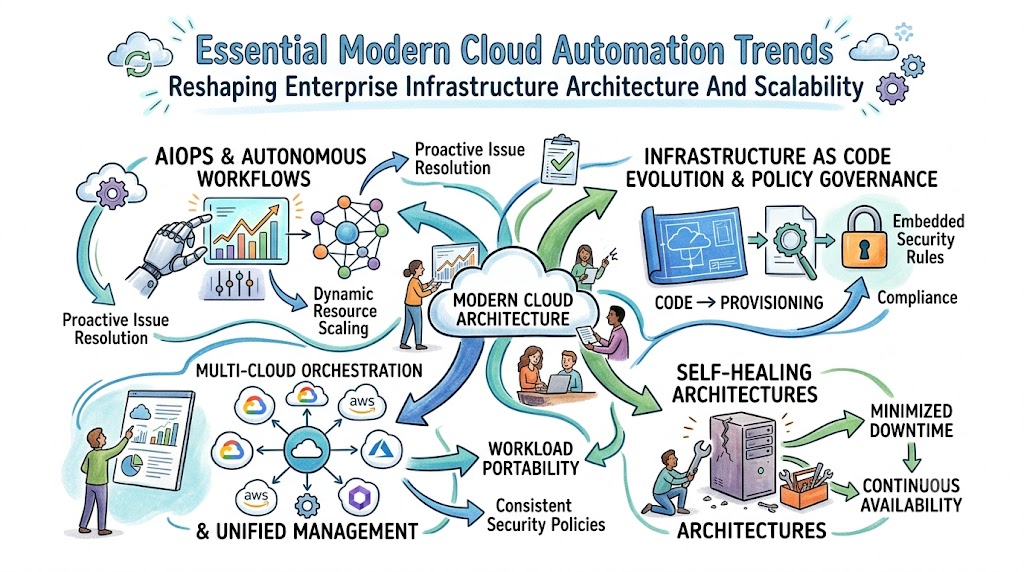
Cloud automation represents a revolutionary shift in how modern enterprises manage, deploy, and scale digital infrastructure. Rather than relying on manual server provisioning or manual resource allocation, modern businesses utilize software-driven workflows to orchestrate complex virtual environments. Furthermore, automated systems continuously monitor performance, apply security patches, and reallocate compute power based on real-time operational demand. As workloads expand across global distributed networks, manual operations create unsustainable bottlenecks that increase expenses and slow product releases. Consequently, automating core cloud processes has evolved from a progressive technical option into an essential foundation for enterprise agility.
To navigate this rapidly evolving ecosystem, leading organizations partner with specialized cloud transformation providers like Cloudopsnow to build resilient virtual architectures. Modern automation strategies integrate machine learning, self-healing code, and standardized security guardrails to eliminate human error entirely. As a result, engineering teams shift their focus away from repetitive maintenance toward strategic business innovation. Understanding these emerging trends enables technical leaders to reduce operational friction while maintaining ultra-low response times and continuous system uptime.
Artificial Intelligence Driven Operations and Autonomous Workflows
Artificial Intelligence for IT Operations, commonly known as AIOps, is fundamentally redefining how systems manage complex cloud environments. Traditional monitoring tools merely alert engineers after an outage occurs, creating costly operational downtime while teams scramble to identify root causes. In contrast, intelligent automation platforms continuously analyze telemetry data, logs, and network metrics in real time to anticipate system failures before they impact users. Consequently, organizations transition from reactive firefighting to proactive, automated system health management.
Furthermore, machine learning algorithms optimize resource allocation dynamically by analyzing historical usage patterns and predicting upcoming traffic spikes. Instead of keeping servers running at maximum capacity unnecessarily, automated workflows scale compute and memory resources up or down on demand. Additionally, these intelligent agents can independently execute corrective routines, such as restarting faulty microservices or re-routing network traffic around degraded nodes. Therefore, autonomous operations drastically lower operational overhead while ensuring exceptional infrastructure performance.
Infrastructure as Code Evolution and Policy Driven Governance
Infrastructure as Code has matured from basic shell scripting into declarative, policy-driven software frameworks that govern modern cloud architecture. Software developers and cloud engineers now write declarative code to provision virtual networks, databases, and container clusters consistently across environments. Because code repositories store these infrastructure definitions, teams can version control their hardware setups just like standard application source code. Consequently, infrastructure provisioning becomes fully reproducible, auditable, and remarkably fast.
+--------------------------+     Triggers     +--------------------------+
|  Declarative Code Repo   | ---------------> | Automated CI/CD Pipeline |
+--------------------------+                  +--------------------------+
                                                           |
                                                           v
+--------------------------+     Enforces     +--------------------------+
| Cloud Infrastructure     | <--------------- | Policy Compliance Check  |
+--------------------------+                  +--------------------------+
Moreover, modern governance frameworks embed compliance rules directly into automated pipeline deployment workflows. Automated policy engines inspect infrastructure code before deployment to prevent misconfigured security groups or unencrypted storage buckets from ever entering production. Furthermore, if configuration drift occurs in a live environment, automated reconciliation tools instantly restore the infrastructure to its approved state. Thus, policy-driven governance balances developer speed with strict security compliance across enterprise ecosystems.
Multi-Cloud Orchestration and Unified Management Frameworks
As enterprises avoid vendor lock-in, multi-cloud architectures spanning diverse public and private clouds have become standard enterprise practice. However, managing distinct interfaces, security protocols, and networking standards across multiple providers introduces severe operational complexity. Unified cloud orchestration platforms resolve this challenge by providing a single operational dashboard to control workloads across diverse cloud environments. Consequently, engineering teams manage resources uniformly without needing deep specialization in every proprietary provider tool.
- Unified Control Planes: Consolidates management interfaces across disparate cloud providers into a single operational view.
- Workload Portability: Enables seamless deployment of containerized applications across public, private, and edge cloud environments.
- Cost Optimization Engines: Automatically routes compute workloads to the most cost-effective cloud provider in real time.
- Consistent Security Policies: Enforces identity, access, and encryption rules uniformly across all cloud environments.
Additionally, multi-cloud automation tools simplify cross-cloud networking and data synchronization, ensuring that applications remain accessible even during regional outages. When one cloud provider experiences technical difficulties, automated traffic management tools seamlessly redirect incoming requests to healthy secondary environments. Furthermore, dynamic workload placement optimizes hosting expenses by running intensive processing tasks wherever cloud compute rates are lowest. Therefore, unified multi-cloud management delivers unprecedented enterprise resilience and financial control.
Self-Healing Architectures and Automated Incident Response Systems
Self-healing systems represent the ultimate goal of cloud automation, allowing infrastructure to recover autonomously from technical failures. Modern cloud applications use lightweight health probes and real-time observability metrics to detect microservice failures instantly. When an anomaly occurs, the infrastructure automatically triggers remediation scripts that replace failed instances without requiring human engineer intervention. As a result, critical applications maintain continuous availability even during severe underlying hardware disruptions.
[System Health Probe] ---> (Detects Anomaly) ---> [Automated Remediation Trigger]
                                                               |
                                                               v
[Healthy Application State] <--- (Restores Instance) <--- [Self-Healing Engine]
Furthermore, automated incident response systems streamline communication during major technical disruptions by generating instant incident tickets and notifying on-call engineers. These automated workflows perform preliminary diagnostic tasks, gathering system logs and network traces before human technicians even log into the management console. Moreover, automated rollback mechanisms immediately revert broken software deployments to the last stable release if error rates spike. Consequently, self-healing platforms minimize Mean Time to Resolution and safeguard business continuity effectively.
Key Operational Concepts You Must Know
Understanding Observability versus Traditional Monitoring
Observability and traditional monitoring represent two distinct approaches to understanding system health and operational behavior in the cloud. Traditional monitoring collects predetermined metrics to answer known questions, notifying engineers when a specific performance threshold is breached. However, modern distributed cloud systems exhibit complex failure modes that standard metrics fail to predict or explain accurately. Therefore, engineering teams require observability to understand the internal state of a system based on its external outputs.
Observability relies on three foundational telemetry data types, often referred to as the core pillars of modern systems analysis:
- Metrics: Aggregated numeric measurements that reflect overall system performance over specific time intervals.
- Logs: Immutable, time-stamped text records of discrete events executed within applications or infrastructure.
- Traces: End-to-end operational journeys that track single requests as they travel across distributed microservices.
By combining metrics, logs, and traces into a single platform, engineers can investigate unexpected system behaviors without setting predefined alerts beforehand. When performance degrades, distributed tracing pinpoints the precise microservice or database query causing the bottleneck. Consequently, observability empowers operations teams to resolve subtle architectural issues rapidly before they escalate into full-scale system outages.
Declarative versus Imperative Infrastructure Management
When implementing cloud automation, engineers must choose between declarative and imperative operational approaches to manage underlying infrastructure. Imperative management requires writing explicit, step-by-step scripts that tell the system exactly how to achieve a desired configuration. While imperative scripting offers precise control over immediate tasks, it often leads to fragile workflows that break when underlying environments change unexpectedly. Consequently, managing large-scale infrastructure using imperative scripts creates heavy maintenance burdens for operations teams.
In contrast, declarative management focuses on defining the final desired state of the infrastructure rather than detailing the individual execution steps. Declarative tools automatically evaluate the current system state, calculate the necessary changes, and execute the actions needed to match the target blueprint. Furthermore, declarative configurations are self-correcting, making them ideal for automated deployment pipelines and continuous integration systems. Thus, adopting declarative workflows ensures consistent, repeatable, and scalable cloud operations across complex environments.
Platform Implementation vs. Culture — What’s the Real Difference?
| Operational Dimension | Platform Implementation Focus | Cultural and Mindset Focus |
|---|---|---|
| Primary Goal | Provisioning scalable infrastructure, configuring CI/CD pipelines, and automating technical tasks. | Fostering shared operational accountability, eliminating organizational silos, and driving innovation. |
| Tooling Strategy | Deploying Kubernetes clusters, setting up Terraform modules, and configuring monitoring agent software. | Standardizing team communication, establishing continuous learning loops, and encouraging experimentation. |
| Failure Management | Executing automated failover scripts, triggering auto-scaling policies, and rolling back bad commits. | Conducting blameless post-mortem investigations, analyzing systemic root causes, and learning from errors. |
| Performance Drivers | Optimizing system resource utilization, reducing latency metrics, and automating provisioning speeds. | Aligning technical objectives with business outcomes, prioritizing customer value, and embracing agility. |
Technical Execution vs. Behavioral Alignment
Platform implementation centers on deploying software tools, automation scripts, and server infrastructure required to run modern applications smoothly. Engineering teams devote significant energy to configuring container orchestrators, writing deployment templates, and setting up automated testing suites. While these technical deliverables provide necessary operational mechanisms, they cannot deliver lasting success if implemented in an organizational vacuum. Consequently, relying solely on advanced tooling without behavioral alignment frequently results in misaligned operational priorities.
Conversely, cultural transformation addresses how human teams collaborate, communicate, and solve operational challenges collectively across an enterprise. A strong engineering culture encourages cross-functional collaboration, breaking down rigid boundaries between software developers and operational staff. When team members share responsibility for system reliability, developers naturally write code that is easier to deploy, monitor, and maintain. Therefore, marrying technical platform capabilities with a supportive, collaborative mindset creates a high-performing enterprise operational model.
Bridging the Gap Between Tools and Processes
To achieve maximum efficiency, enterprises must align their technical tools directly with daily team workflows and organizational governance policies. Introducing advanced deployment tools yields minimal benefits if bureaucratic change control boards delay application approvals for weeks. Similarly, automated monitoring platforms generate frustration if teams lack clear operational processes for responding to actionable system alerts. Therefore, successful companies continuously refine their internal processes to complement and amplify their technical automation capabilities.
   +------------------------------------+
   |   Collaborative Cultural Mindset   |  <-- Drives shared accountability
   +------------------------------------+
                     |
                     v
   +------------------------------------+
   |   Streamlined Operational Process  |  <-- Eliminates bureaucracy
   +------------------------------------+
                     |
                     v
   +------------------------------------+
   |  Automated Platform Infrastructure |  <-- Executes technical tasks
   +------------------------------------+
Creating this alignment requires establishing clear communication protocols, defining clear service ownership, and conducting regular team training sessions. Furthermore, organizations should establish self-service internal developer platforms that empower engineering teams to provision resources independently within safe boundaries. When developers can spin up compliant development environments instantly, product iteration speeds increase dramatically across the organization. Ultimately, harmonizing human workflows with automated software pipelines builds a resilient, highly adaptable digital business foundation.
Real-World Use Cases of Modern Operations
Automated Financial Transaction Platforms
Modern financial institutions process millions of sensitive payment transactions daily, requiring continuous availability, strict compliance, and ultra-low processing latency. To meet these rigorous demands, financial operations teams utilize automated cloud platforms that instantly scale compute resources during market surges. Furthermore, automated policy enforcement frameworks continuously verify encryption settings, access controls, and compliance audit logs in real time. Consequently, financial networks maintain strict regulatory compliance while executing global transactions with zero perceptible processing lag.
Additionally, financial platforms employ automated fraud detection algorithms that analyze transaction patterns dynamically at the network edge. When suspicious activity occurs, automated workflows instantly isolate compromised user accounts and block unauthorized connection attempts before damage spreads. Moreover, multi-region automated database replication ensures that financial records remain secure and accessible even during regional data center outages. This robust combination of automated compliance, security, and scalability safeguards critical financial services around the clock.
Enterprise E-Commerce Traffic Optimization
Global e-commerce platforms experience massive, unpredictable traffic spikes during major promotional sales events and seasonal holiday shopping periods. During these high-volume events, slow page load times or checkout failures directly cause lost business revenue and damaged customer loyalty. To prevent operational bottlenecks, e-commerce engineering teams implement automated auto-scaling policies that provision thousands of temporary server instances within minutes. As a result, the online shopping infrastructure scales smoothly to handle sudden, massive traffic surges effortlessly.
[Global Shopper Traffic Surge]
              |
              v
[Automated Load Balancer Gateway]
              |
              +---> [Auto-Scaled Web Instance Cluster A] ---> [Edge Data Cache]
              |
              +---> [Auto-Scaled Web Instance Cluster B] ---> [Local DB Mirror]
Furthermore, e-commerce networks rely heavily on automated content delivery networks to cache static product images and scripts near users worldwide. By processing dynamic checkout requests through local edge computing nodes, these platforms reduce database load on central cloud servers. Additionally, automated health checks continuously monitor database query performance, automatically redirecting read requests to healthy secondary read-replicas during high traffic. Consequently, shoppers enjoy fast, seamless, and reliable digital shopping experiences during peak demand.
Media Streaming and Real-Time Content Distribution
Global media streaming networks deliver high-definition video content to millions of concurrent viewers across thousands of geographical regions simultaneously. To prevent buffering delays and video quality degradation, streaming operators use automated media encoding and distribution pipelines. As creators upload new content, automated workflows convert video files into multiple resolution formats and distribute them across global edge networks instantly. Therefore, viewers receive optimized media streams tailored perfectly to their specific device types and connection speeds.
- Dynamic Bandwidth Scaling: Automatically adjusts video stream quality in real time based on user network conditions.
- Localized Edge Caching: Stores popular media files on local edge servers close to dense consumer populations.
- Automated Failover Routing: Seamlessly shifts user traffic to secondary streaming servers if an edge node fails.
- Real-Time Telemetry Tracking: Continuously monitors buffering rates and playback quality metrics across millions of devices.
Operations teams continuously analyze network performance using real-time telemetry data, automatically rerouting traffic away from congested internet pathways. If an edge data center experiences unexpected hardware degradation, automated traffic management systems re-route streaming requests to alternative healthy locations instantly. Furthermore, automated resource management tools scale background processing capacity down during off-peak hours to minimize cloud hosting expenses. This intelligent operational automation delivers exceptional streaming experiences while maintaining cost efficiency.
Common Mistakes in Operations Engineering
Over-Complicating Infrastructure Architecture and Tooling
A widespread mistake in operations engineering is over-complicating infrastructure design by adopting too many modern software tools simultaneously. Engineering teams often introduce complex microservice architectures, service meshes, and multi-cloud configurations before their applications truly require such scale. This unnecessary technical complexity creates confusing dependency webs that make systems exceptionally difficult to manage, monitor, and troubleshoot effectively. Consequently, developers waste valuable engineering time managing infrastructure tooling rather than building core application features.
Over-Complicated Setup:  [App] ---> [Service Mesh] ---> [API Gateway] ---> [Multiple Proxies] ---> [Database]
Simplified Clean Setup:   [App] ---> [Managed Load Balancer] ------------------------------------> [Database]
To avoid this trap, operations teams should adhere to the principle of simplicity, introducing new abstraction layers only when clear technical needs arise. Utilizing managed cloud services for databases, queues, and container orchestration reduces initial setup overhead and ongoing maintenance duties. Furthermore, standardizing on a minimal, well-understood toolset enables team members to build deep operational expertise rapidly. By keeping system architectures straightforward, companies maintain high system stability, simplify debugging, and accelerate delivery speeds.
Neglecting Continuous Cost Management and Resource Optimization
Another frequent operational blunder is ignoring continuous cloud cost management, assuming that automated environments inherently save money without oversight. Without strict governance policies, developers frequently spin up oversized virtual machines, test environments, and storage volumes that remain abandoned indefinitely. Furthermore, unmonitored auto-scaling policies can trigger runaway compute expenditures during traffic anomalies or malicious bot attacks. Consequently, unmonitored cloud environments quickly generate massive financial waste that surprises leadership when monthly billing statements arrive.
To maintain financial control, engineering teams must integrate cost management tools directly into their automated infrastructure pipelines. Implementing automated resource tagging standards allows organizations to track cloud expenditures accurately by department, project, or individual application. Additionally, automated cleanup scripts should identify and remove unattached storage volumes, idle load balancers, and expired test environments routinely. By embedding financial accountability into daily operations, companies optimize resource utilization while preventing unexpected cloud spending spikes.
Overlooking Comprehensive Security Guardrails and Identity Management
Failing to build comprehensive security guardrails directly into cloud automation workflows leaves infrastructure vulnerable to severe security breaches. Operational teams often prioritize rapid software deployment speeds over security, applying overly broad access permissions to cloud resources and service accounts. Furthermore, hardcoding sensitive API keys, database credentials, and access tokens directly into software repositories creates critical security vulnerabilities. When attackers exploit these weak credentials, they gain unauthorized access to internal corporate networks and sensitive consumer data.
Insecure Practice:   [Hardcoded API Keys in Code Repo] ---> (Exposed to Public/Unauthorized Access)
Secure Practice:     [Automated Secret Manager] ---------> (Injects Dynamic Tokens at Runtime)
To eliminate these dangerous security vulnerabilities, organizations must adopt zero-trust security models and enforce automated least-privilege identity controls across all cloud environments. Using centralized secret management tools ensures that sensitive access tokens are injected dynamically into applications at runtime rather than stored in plain text. Moreover, automated vulnerability scanners should inspect container images and software dependencies continuously for known security flaws before deployment. Establishing automated security guardrails protects corporate assets while empowering developers to release software safely.
How to Become an Operations Expert — Career Roadmap
Mastering Fundamental Core Infrastructure and Scripting
To build a successful career as an operations expert, you must begin by mastering foundational networking, operating system, and scripting concepts. Developing a deep understanding of the Linux operating system, memory management, process scheduling, and file systems is vital for system troubleshooting. Furthermore, you must master core networking concepts, including TCP/IP routing, DNS resolution, subnetting, and SSL/TLS encryption protocols. Acquiring this fundamental knowledge enables you to diagnose complex infrastructure issues that automated management dashboards often obscure.
- Linux Administration: Learn command-line navigation, system service management, user permissions, and kernel parameter tuning.
- Networking Concepts: Master network protocols, routing tables, firewall rules, load balancing strategies, and packet inspection.
- Core Scripting: Achieve proficiency in Bash, Python, or Go to write custom automation tools and operational utility scripts.
Additionally, invest time in mastering version control systems like Git to manage software configurations and infrastructure definitions effectively. Learning to write modular, reusable scripts in Python or Go enables you to automate repetitive administrative tasks efficiently. This solid technical foundation equips you to understand how modern cloud platforms interact with underlying hardware resources. Consequently, mastering foundational engineering concepts prepares you for advanced specializations in cloud orchestration and site reliability engineering.
Gaining Hands-on Expertise in Infrastructure as Code and Containers
Once you master foundational networking and systems concepts, focus your learning on containerization technologies and declarative Infrastructure as Code frameworks. Container tools like Docker allow developers to package applications alongside their necessary software dependencies, ensuring identical application behavior across every environment. Furthermore, learning container orchestration platforms like Kubernetes is essential for managing, scaling, and automating containerized applications in production environments. Mastering these technologies allows you to build scalable, highly resilient application infrastructures seamlessly.
+------------------------+      Deploys      +------------------------+
|  Declarative IaC Code  | ----------------> |  Container Cluster     |
|  (Terraform / Modules) |                   |  (Kubernetes Nodes)    |
+------------------------+                   +------------------------+
Simultaneously, develop deep technical expertise in declarative infrastructure tools like Terraform or CloudFormation to provision cloud resources programmatically. Practice writing modular, well-documented infrastructure code that provisions complete virtual networks, computing clusters, and database instances automatically. Additionally, learn how to integrate infrastructure code tests directly into automated continuous integration pipelines to validate configuration syntax. Developing hands-on container and infrastructure automation expertise transforms you into a highly sought-after modern cloud engineer.
Developing Advanced Observability and System Reliability Skills
The final milestone in becoming an operations authority involves mastering site reliability engineering principles, advanced observability techniques, and architecture design. You must learn to design comprehensive monitoring ecosystems that collect metrics, logs, and distributed traces from complex microservice architectures. Furthermore, practice defining meaningful Service Level Objectives and Service Level Indicators that reflect true user experience quality accurately. Mastering these observability frameworks enables you to detect, diagnose, and resolve subtle system performance degradations rapidly.
                 +-----------------------------------+
                 |    Central Observability Hub      |
                 +-----------------------------------+
                   ^               ^               ^
                   |               |               |
            [System Metrics]  [Event Logs]   [Traces]
Moreover, develop expertise in chaos engineering principles, deliberately introducing simulated infrastructure failures into non-production environments to test system resilience. Analyzing how your automated systems respond under stress helps you identify hidden single points of failure and improve self-healing mechanisms. Additionally, cultivate non-technical professional skills like collaborative communication, incident command leadership, and technical mentoring. Combining deep technical mastery with operational leadership skills positions you as an expert capable of guiding enterprise digital transformations.
FAQ Section
- What is the difference between traditional cloud management and cloud automation?Traditional cloud management relies heavily on manual administrative tasks, such as manually configuring servers, adjusting settings, and applying security updates through interactive user consoles. Cloud automation replaces these manual interventions with code-driven workflows, programmatic scheduling, and policy engines that provision and manage infrastructure automatically. This transition eliminates operational human errors, speeds up deployments, and significantly lowers enterprise operational costs.
- How does Infrastructure as Code contribute to cloud security and compliance?Infrastructure as Code enhances security by storing complete environment configurations as version-controlled software files that can be audited and reviewed before deployment. Automated policy-as-code security scanners inspect these files within continuous deployment pipelines, catching misconfigurations before resources are created in live environments. Additionally, if configuration drift occurs in production, automated reconciliation engines immediately restore infrastructure to its authorized, compliant state.
- Why are organizations shifting from reactive monitoring to proactive observability?Traditional reactive monitoring only triggers alerts after pre-configured performance thresholds are breached, leaving engineering teams unaware of novel system failures until outages occur. Proactive observability combines metrics, structured logs, and end-to-end distributed traces, allowing engineers to investigate unexpected system behaviors dynamically without needing predefined alerts. This deep operational insight enables technical teams to identify and resolve performance bottlenecks before end users experience downtime.
- What role does Artificial Intelligence play in modern cloud operations?Artificial Intelligence continuously analyzes vast streams of operational telemetry data to detect abnormal system patterns, predict potential component failures, and automate routine maintenance. AI-driven operations platforms automatically adjust resource scaling parameters based on predicted usage trends, optimizing compute efficiency while reducing infrastructure hosting spend. Furthermore, intelligent agents execute automated remediation scripts to resolve minor technical incidents independently without requiring human intervention.
- How can engineering teams prevent cloud cost overruns when using automated auto-scaling?Engineering teams can prevent unexpected cloud spending spikes by enforcing strict resource governance policies and setting absolute capacity limits on auto-scaling groups. Additionally, integrating continuous cost-monitoring utilities into deployment pipelines provides visibility into resource expenditure trends across departments and specific applications. Implementing automated cleanup routines to delete unused storage volumes, idle load balancers, and expired development environments further eliminates financial waste.
Final Summary
Cloud automation has fundamentally transformed modern infrastructure management, moving enterprise operations away from fragile manual scripting toward intelligent, self-healing digital systems. By mastering declarative code frameworks, comprehensive observability, and AI-driven workflows, organizations eliminate performance bottlenecks while maintaining high security and scalability. Furthermore, success requires harmonizing advanced software tooling with a collaborative, reliability-focused engineering culture across teams. As cloud architectures increase in global complexity, adopting policy-driven automation remains the definitive pathway to achieving operational excellence and lasting market agility.
