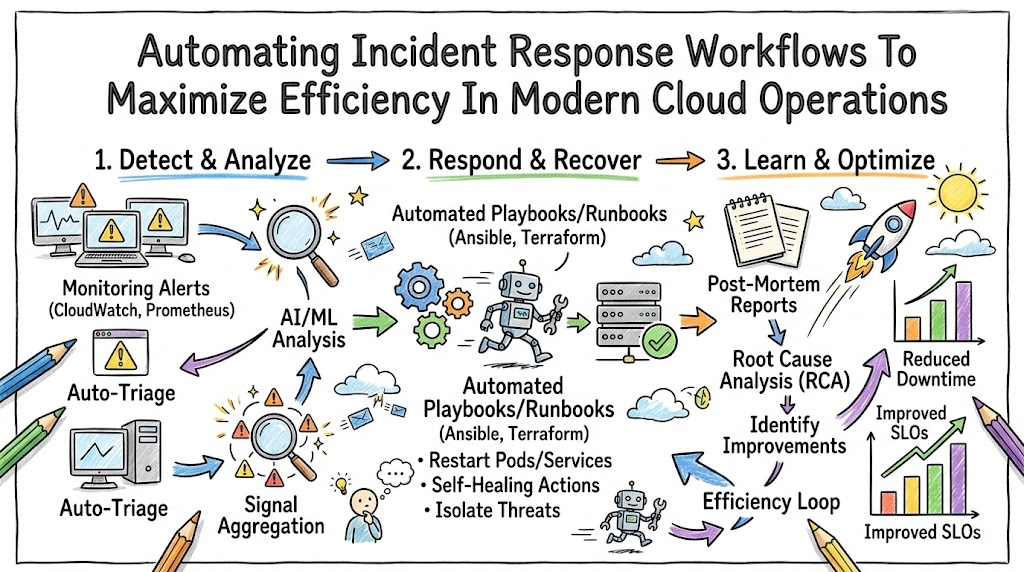
Cloud infrastructure complexity creates immense challenges for operational engineering teams managing mission-critical software ecosystems. When unexpected system outages or performance degradations occur, manual troubleshooting delays resolution time significantly. Automated incident response streamlines recovery by detecting anomalies instantly, gathering necessary context, and executing predefined remediation actions without human delay. Consequently, organizations reduce costly downtime while maintaining high service reliability across complex distributed environments.
Partnering with specialized managed platforms like Cloudopsnow empowers engineering teams to build resilient automated workflows easily. Integrating smart event monitoring, dynamic alert routing, and self-healing scripts transforms chaotic fire-fighting into a predictable operational discipline. This comprehensive guide explores how operational teams leverage modern automation tools to accelerate incident response and protect business continuity.
Real-Time Threat Detection and Automated Signal Aggregation
Modern cloud environments generate massive volumes of telemetry data every single second across servers, containers, and services. Filtering this raw data manually to identify genuine security threats or system faults remains virtually impossible. Automated signal aggregation tools aggregate metrics, logs, and trace events into centralized observability platforms continuously. Consequently, systems highlight actionable anomalies immediately while suppressing redundant background noise.
Smart thresholding and machine learning algorithms correlate related events to prevent severe alert fatigue among engineers. When performance degradation occurs, automated ingestion pipelines group connected alerts into a single unified incident ticket. This centralization provides immediate clarity regarding system state changes across complex microservice architectures. As a result, responders spend far less time parsing raw log files and more time implementing corrective actions.
Automated Triage and Contextual Incident Alert Enrichment
When an incident triggers, engineers require immediate visibility into system logs, recent code deployments, and metric spikes. Manual contextual gathering consumes valuable minutes during critical operational outages. Automated triage systems execute contextual collection workflows the moment an alert triggers, attaching telemetry reports directly to incident tickets. Therefore, responders receive complete system diagnostics immediately without logging into multiple dashboards manually.
+------------------+     Event Trigger     +-------------------+
| Metric Anomaly   | --------------------> | Alert Aggregator  |
+------------------+                       +-------------------+
                                                     |
                                                     v
+------------------+     Context Data      +-------------------+
| Enriched Ticket  | <-------------------- | Auto-Triage Engine|
+------------------+                       +-------------------+
Automated enrichment scripts pull active system configurations, query service dependency graphs, and verify recently merged pull requests. This rich context allows engineers to determine root causes within seconds of arriving on-scene. Furthermore, automated routing systems assign tickets dynamically to specific on-call engineers based on service ownership models. Eliminating manual escalation handoffs reduces total Mean Time to Detect and Mean Time to Acknowledge significantly.
Self-Healing Systems and Orchestrated Remediation Playbooks
Self-healing infrastructure represents the pinnacle of automated incident response in modern cloud operations engineering. Rather than waiting for human intervention, automated orchestration runbooks execute pre-approved fix scripts immediately upon threat verification. For instance, if an application instance experiences a severe memory leak, automated scripts restart the affected container instantly. This immediate action restores service health before end users suffer noticeable performance drops.
[System Anomaly] ---> [Runbook Engine] ---> [Execute Script] ---> [Health Restored]
Orchestrated playbooks handle complex remediation sequences seamlessly, such as re-routing network traffic away from unhealthy availability zones. Automated rollback pipelines also restore previous stable software versions if newly deployed code triggers unexpected errors. By handling routine operational incidents automatically, engineering teams preserve energy for higher-value architectural tasks. Consequently, self-healing systems turn high-stress operational emergencies into minor background events.
Continuous Post-Incident Analytics and Feedback Loops
Effective incident response extends beyond immediate system recovery; it requires systematic evaluation to prevent recurrence. Automated incident management platforms capture granular timelines of every event, system metric shift, and engineer action. This automatic data logging creates precise post-incident reports without relying on chaotic manual notes or guesswork. As a result, operations teams gain reliable, unbiased data to analyze system failure modes thoroughly.
+-------------------+      Data Capture     +-------------------+
| Recovery Complete | --------------------> | Auto Timeline Log |
+-------------------+                       +-------------------+
                                                      |
                                                      v
+-------------------+     System Update     +-------------------+
| Prevent Recurrence| <-------------------- | Post-Mortem Audit |
+-------------------+                       +-------------------+
These automated feedback loops drive continuous improvement across software infrastructure and operational processes. Engineering teams analyze historical incident patterns to identify fragile code dependencies and recurring infrastructure bottlenecks. Consequently, organizations refine automated playbooks continuously, fortifying system architecture against future operational failures. Transforming operational data into actionable technical insights establishes a culture of continuous learning and long-term infrastructure stability.
Key Operational Concepts You Must Know
Defining MTTR, MTTD, and Incident Life Cycles
Understanding key operational metrics remains essential for evaluating the health and speed of your incident response workflows. Mean Time to Detect measures how quickly monitoring systems identify an active system anomaly or service degradation. Mean Time to Acknowledge measures the duration between initial alert generation and an engineer accepting the incident ticket. Finally, Mean Time to Resolve reflects the overall time required to fully restore system functionality.
Incident Start --------> MTTD --------> MTTA --------> MTTR --------> System Restored
  (Anomaly)          (Detected)      (Acknowledged)    (Resolved)
Automation impacts every single phase of this incident lifecycle by removing manual delays between operational steps. Automated signal detection shortens detection windows, while dynamic routing minimizes acknowledgement delays substantially. Furthermore, automated runbooks lower resolution times by executing fixes faster than any human operator could type commands. Tracking these core metrics helps teams measure performance objectively and identify operational bottlenecks clearly.
Alert Fatigue and the Importance of Noise Reduction
Alert fatigue occurs when operational teams receive an overwhelming volume of non-critical or repetitive notification alerts continuously. When engineers face constant false alarms, their responsiveness drops and genuine critical alerts get overlooked easily. This operational hazard increases human error, burns out engineers, and extends outage durations significantly. Therefore, implementing aggressive noise reduction strategies remains vital for maintaining effective incident response capabilities.
- Alert Deduplication: Merges identical alerts generated by the same root cause into a single actionable ticket.
- Dynamic Thresholds: Uses historical baselines to prevent alerts during expected daily traffic spikes.
- Severity Grouping: Routes non-urgent informational warnings to digest channels rather than waking on-call engineers.
Automated incident management systems filter out low-priority background noise, presenting responders with clear, actionable insights. By establishing strict alerting rules, teams ensure that alerts signify urgent issues requiring immediate technical intervention. Consequently, engineers remain focused, alert, and capable of resolving critical incidents swiftly and efficiently.
Platform Implementation vs. Culture — What’s the Real Difference?
| Operational Dimension | Platform Implementation Focus | Cultural & Mindset Focus |
|---|---|---|
| Tooling & Infrastructure | Deploying auto-remediation scripts, observability stacks, and automated alert routing. | Fostering psychological safety, encouraging transparency, and eliminating fear of failure. |
| Incident Management | Executing automated runbooks, logging system metrics, and tracking resolution timers. | Conducting blameless post-mortems, learning from outages, and sharing ownership. |
| Process Optimization | Building automated CI/CD safety checks and self-healing infrastructure policies. | Valuing continuous improvement, rewarding operational rigor, and respecting balance. |
| Team Alignment | Standardizing notification platforms and centralizing system status dashboards. | Breaking down silos between developers, security teams, and cloud operations. |
Technical Execution vs. Behavioral Alignment
Platform implementation provides the technical machinery, automation tools, and monitoring software required to run operational environments effectively. Engineers focus on building auto-scaling rules, setting up log parsers, and writing IaC scripts to enforce consistency. While these technical capabilities are indispensable, they only address the structural framework of cloud incident response. Without strong team alignment, sophisticated automation tools often remain underutilized or improperly configured.
Cultural alignment, on the other hand, governs how human engineers interact with automated systems and handle operational crises. A healthy engineering culture views system failures as valuable opportunities to improve system resilience rather than occasions for blame. When teams trust automated systems, they delegate routine remediation tasks to software runbooks confidently. Balancing technical infrastructure investments with behavioral alignment builds a resilient, highly capable operational organization.
Bridging the Gap Between Tools and Processes
Connecting technical platforms with human operational processes requires clear documentation, routine training, and continuous feedback loops. Implementing automated runbooks delivers little value if responders bypass them during emergencies due to lack of familiarity. Therefore, teams must practice game-day scenarios regularly to validate automated workflows under simulated failure conditions. These practical exercises build confidence in automated remediation scripts and reveal hidden operational gaps.
   +---------------------------------------+
   |        Engineering Mindset            |  <-- Encourages trust in automation
   +---------------------------------------+
                       |
                       v
   +---------------------------------------+
   |        Operational Processes          |  <-- Defines game days and post-mortems
   +---------------------------------------+
                       |
                       v
   +---------------------------------------+
   |       Automated Platform Tools        |  <-- Executes runbooks and monitoring
   +---------------------------------------+
Furthermore, updating incident management playbooks based on post-mortem findings keeps automated workflows aligned with evolving application architectures. When engineers continuously refine their automation scripts after every outage, system reliability improves dramatically over time. This close integration ensures that platform tools directly support daily operational workflows without creating unwanted friction. Ultimately, merging strong process design with powerful automation drives long-term cloud operational success.
Real-World Use Cases of Modern Operations
Automated Disaster Recovery in Distributed Microservices
Large-scale distributed platforms rely heavily on automated disaster recovery strategies to survive regional cloud data center outages. When a primary cloud region suffers physical infrastructure failure, automated monitoring systems detect the loss of signal immediately. Traffic management platforms update DNS routing tables automatically, shifting user requests to healthy secondary regions within seconds. This rapid failover prevents prolonged business disruption without requiring manual operator intervention during unexpected disasters.
[Primary Region - Offline] x
                             \  (Auto DNS Failover)
                              +---------------------> [Secondary Region - Active]
Simultaneously, automated database replication scripts promote read-replicas to primary database status across secondary deployment regions instantly. Storage synchronization routines verify data integrity automatically, ensuring zero data loss during high-stress failover procedures. These orchestrated actions allow complex distributed microservices to maintain continuous availability even during severe cloud provider outages. Consequently, automated disaster recovery transforms potential catastrophic failures into manageable, seamless background events.
Auto-Remediation of Resource Exhaustion in Kubernetes
Containerized applications frequently experience sudden resource exhaustion due to unexpected user traffic surges or software memory leaks. When pod memory usage breaches safety thresholds, automated Kubernetes horizontal pod autoscalers deploy additional application instances instantly. If host nodes run out of capacity, automated cluster autoscalers provision new cloud virtual machines dynamically to absorb traffic load. This fluid resource expansion prevents cascading application crashes during high-demand events.
- Pod Autoscaling: Dynamically increases container counts based on real-time CPU and memory metrics.
- Cluster Expansion: Provisions underlying cloud nodes automatically when workload demand exceeds existing limits.
- OOM Kill Handling: Restarts failing containers automatically while preserving diagnostic heap dumps for engineering analysis.
Additionally, if a memory-starved container becomes non-responsive, automated health checks terminate the problematic pod and launch a fresh instance instantly. Diagnostic logs and memory dumps are captured automatically and stored for developers to investigate later. This automated self-healing loop resolves resource contention issues immediately, ensuring stable application performance around the clock.
Common Mistakes in Operations Engineering
Over-Automating Without Human Guardrails
A frequent mistake in operations engineering is implementing complex auto-remediation scripts without establishing adequate human safety guardrails. When automated playbooks execute without validation steps, buggy scripts can cascade minor issues into catastrophic platform-wide outages. For example, an over-aggressive auto-remediation script might reboot healthy database nodes sequentially, causing complete service unavailability. Therefore, engineers must design automation systems with strict safety limits and emergency pause mechanisms.
[Incident Alert] ---> [Auto-Script Executes] ---> (No Guardrails) ---> [Cascading Platform Outage]
To prevent runaway automation failures, high-impact actions should always require explicit approval from an on-call engineer. Automated scripts should handle diagnostic collection and minor non-destructive fixes automatically while reserving destructive actions for human confirmation. Additionally, setting rate limits on automated actions prevents scripts from making rapid, unvalidated changes across entire server fleets. Balanced automation combines rapid automated execution with sensible human oversight to ensure operational safety.
Neglecting Continuous Playbook Maintenance
Another common pitfall is creating automated runbooks during initial platform setup and neglecting to update them as systems evolve. Cloud architectures, software APIs, and service dependencies change rapidly, rendering static automation scripts obsolete very quickly. When an incident occurs, executing outdated playbooks can fail completely or introduce unexpected system behavior during critical moments. Consequently, outdated operational automation creates a false sense of security while increasing resolution delays.
Operations teams must treat automation scripts with the same rigorous care and review as core production application code. Playbooks should reside in version-controlled repositories, undergoing regular code reviews and testing cycles alongside software releases. Scheduling periodic reviews ensures that runbook logic matches current service architecture and operational team structures accurately. Maintaining up-to-date automation resources guarantees that incident response workflows function flawlessly during high-stress operational emergencies.
How to Become an Operations Expert — Career Roadmap
Mastering Observability Frameworks and Scripting Languages
To build a successful career as an operations expert, you must master modern observability frameworks and automation scripting languages thoroughly. Developing strong proficiency in Python, Go, or Bash allows you to write custom automation scripts, API integrations, and CLI utilities easily. Furthermore, mastering observability suites like Prometheus, Grafana, and OpenTelemetry enables you to design deep system monitoring architectures. Understanding how metrics, logs, and traces interconnect allows you to build highly accurate automated alert triggers.
- Automation Languages: Gain deep fluency in Python and Go for developing robust operational scripts and microservices.
- Observability Tools: Master Prometheus metrics collection, Grafana dashboard creation, and OpenTelemetry context propagation.
- API Integration: Learn to connect cloud platform APIs with incident management tools to build custom workflows.
Additionally, spend time learning how operating systems manage system processes, network sockets, and file storage under heavy load. This core technical foundation empowers you to diagnose complex system behavior that high-level abstractions often conceal. Consequently, deep technical knowledge enables you to design self-healing automation that resolves complex infrastructure issues effectively.
Gaining Expertise in Infrastructure as Code and Event-Driven Architecture
Modern operations relies heavily on code-driven infrastructure; mastering tools like Terraform, Ansible, and Kubernetes remains mandatory for career advancement. You must learn to manage infrastructure configurations declaratively, ensuring environments can be recreated automatically within minutes. Furthermore, understanding event-driven architecture is essential for building real-time automated incident response systems. Learning how message brokers like Kafka or RabbitMQ process system events enables you to build reactive operational pipelines.
+------------------+     Publishes Event     +-------------------+
| Cloud Infrastructure| -------------------> | Event Broker      |
+------------------+                         +-------------------+
                                                       |
                                                       v
+------------------+     Triggers Fix        +-------------------+
| Auto Runbook     | <---------------------- | Event Consumer    |
+------------------+                         +-------------------+
Practicing event-driven operations allows you to trigger automated remediation scripts instantly in response to specific cloud state changes. Combining IaC principles with event-driven automation ensures that server configurations remain consistent and self-correcting over time. This skill set transforms manual infrastructure management into an efficient, software-driven discipline that scales effortlessly. As a result, engineers with these capabilities are highly valued in high-growth tech organizations.
FAQ Section
- What is the first step in automating cloud incident response workflows?The first step involves establishing robust observability to gather accurate metrics, logs, and traces across your cloud infrastructure. Without reliable monitoring data, automated systems cannot detect anomalies accurately or trigger remediation scripts effectively. Starting with automated alert enrichment and notifications creates an immediate efficiency gain before building complex self-healing scripts.
- How does automated incident response improve team productivity?Automated incident response eliminates manual diagnostic tasks, alert routing handoffs, and routine remediation steps during system outages. By taking over repetitive maintenance actions, automation reduces engineer toil and protects teams from severe alert fatigue. Consequently, operations engineers can dedicate more time to strategic platform enhancements, security hardening, and architectural scalability.
- What are the risks of using fully automated remediation scripts?The primary risk involves executing buggy or improperly configured scripts that cause unexpected cascading failures across production systems. Without strict rate limits, guardrails, or validation checks, an automated script might terminate healthy nodes or delete crucial data. Implementing human-in-the-loop approvals for destructive operations mitigates these risks effectively.
- How do event-driven architectures support automated incident management?Event-driven architectures publish system state changes as real-time messages that trigger automated consumer scripts immediately. This decouple allows monitoring tools, alert systems, and remediation runbooks to communicate asynchronously without tight dependencies. As a result, operational pipelines respond to infrastructure events within milliseconds of detection.
- Why are blameless post-mortems essential for effective automation?Blameless post-mortems focus on identifying systemic technical flaws and process gaps rather than assigning personal blame to individual engineers. This open environment encourages honest communication regarding system failures, revealing the true root causes of operational outages. Consequently, teams can write better automated playbooks and fortify platform architecture against future recurring issues.
Final Summary
Automating incident response in CloudOps changes how modern engineering teams handle infrastructure complexity and maintain service availability. Organizations reduce downtime drastically by automating signal detection, alert enrichment, and remediation playbooks across distributed cloud environments. Balancing automated tools with strong team culture, safety guardrails, and continuous playbook updates guarantees safe and reliable system operations. Ultimately, investing in intelligent operational automation empowers engineers to build resilient software systems that recover swiftly from unexpected challenges.

