Introduction
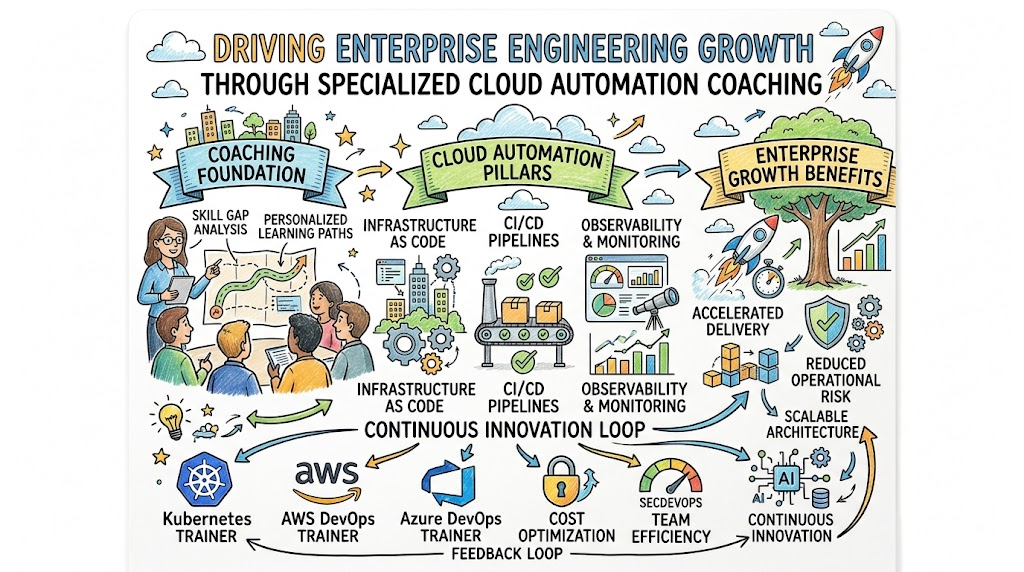
Software organizations must modernize their deployment frameworks continuously to maintain market leadership. Forward-thinking technology leaders connect with a professional DevOps Trainer to optimize release channels and eliminate costly deployment failures across production systems.
Shifting away from legacy operational workflows requires real-world guidance from experienced industry veterans. Research confirms that engineering teams receiving direct expert coaching decrease change lead times by nearly forty percent. Therefore, choosing a qualified mentor drives sustainable operational success across modern cloud environments.
Primary Responsibilities Of A DevOps Trainer
A seasoned DevOps Trainer transforms complex cloud architectural theories into practical production execution. Instead of delivering generic presentation slides, these specialists guide developers through active pipeline construction, automated script writing, and container orchestrations.
In addition, an experienced educator audits existing engineering workflows to pinpoint delivery bottlenecks. They build tailored learning modules covering source control management, continuous integration, infrastructure automation, and real-time observability.
Furthermore, these professionals cultivate a strong culture of shared operational accountability across technical departments. Ultimately, their hands-on instruction converts isolated functional groups into high-performing, collaborative engineering teams.
Strategic Value Of Hands-On Cloud Learning
Reading technical documentation alone rarely equips developers to resolve high-severity production outages. Therefore, interactive, lab-based learning offers the most effective framework for mastering modern cloud tools.
When developers execute code inside live sandbox environments, they receive immediate diagnostic feedback on configuration errors. Furthermore, real-world simulation scenarios build genuine troubleshooting confidence across complex deployment pipelines.
Technical benchmarks demonstrate that hands-on exercises boost skill retention rates by over sixty percent compared to passive video lectures. Consequently, practical practice empowers developers to implement automated solutions immediately inside live enterprise pipelines.
Verification Metrics For Selecting Potential Instructors
Selecting an ideal technical coach requires careful evaluation of both practical field knowledge and instructional capabilities. Therefore, executive leaders should apply a structured verification table during candidate interviews.
| Evaluation Metric | Key Requirement | Strategic Value |
|---|---|---|
| Field Experience | Minimum 5+ years handling live enterprise infrastructure | Guarantees practical advice grounded in real incident response |
| Tool Mastery | Comprehensive knowledge of Docker, Kubernetes, & CI/CD | Guarantees complete coverage of modern engineering stacks |
| Pedagogical Skill | Proven ability to explain complex distributed systems | Accelerates knowledge absorption across all developer tiers |
| Customization | Ability to align labs with corporate infrastructure | Maximizes direct return on educational investment |
Corporate DevOps Training Versus Individual Skill Courses
Self-directed online learning typically targets isolated personal skills. In contrast, Corporate DevOps Training targets enterprise workflows, team communication protocols, and standardized deployment architectures.
During corporate engagements, mentors analyze active build pipelines and customize lab exercises around the company’s specific tech stack. Furthermore, team workshops establish consistent branching strategies, unified naming conventions, and shared security controls.
Consequently, entire software engineering departments adopt identical deployment practices simultaneously. Ultimately, this structural alignment removes internal operational friction and boosts cross-functional project velocity.
Strategic Five-Step Framework For Enterprise Upskilling
Upskilling engineering teams requires systematic execution rather than impromptu scheduling. Organizations achieve optimal results by implementing this structured five-step rollout methodology.
- Assess Competencies: Audit existing skill levels across development, operations, and QA teams to surface technical gaps.
- Align Curriculum: Connect learning objectives directly with upcoming business goals, such as microservice migrations.
- Provision Sandboxes: Construct isolated cloud environments that replicate current enterprise production infrastructure.
- Deliver Instruction: Execute live interactive workshops combining short technical lectures with intensive lab exercises.
- Measure Impact: Review build success rates, deployment frequencies, and developer feedback to verify overall growth.
Selecting A DevOps Trainer In India For Local Operations
When searching for a qualified DevOps Trainer in India, enterprise leaders must evaluate local market dynamics alongside international technical standards. Major tech centers require instructors who understand offshore delivery models, multi-region collaboration, and distributed team dynamics.
Furthermore, a seasoned mentor adjusts course schedules to accommodate regional shifts while preserving global quality benchmarks. Choosing a local expert guarantees clear communication and mutual business understanding. Consequently, engineering organizations experience smooth workshop execution and higher team engagement.
Maximizing Flexibility With An Online DevOps Trainer
Geographically dispersed software teams frequently require adaptable educational schedules. Engaging an Online DevOps Trainer allows dispersed developers to upgrade their skill sets simultaneously without travel costs.
Modern virtual classrooms utilize cloud sandboxes, screen sharing, and real-time collaborative coding tools. Furthermore, instructors split learning sessions into manageable daily modules to prevent cognitive overload during intensive training weeks.
Industry studies show that virtual workshops maintain ninety percent completion rates when live hands-on exercises accompany remote lectures.
Kubernetes Trainer: Mastering Container Orchestration Systems
Container orchestration forms the core foundation of modern cloud-native infrastructure. Partnering with a skilled Kubernetes Trainer empowers engineering teams to deploy microservices confidently.
These specialists teach cluster management, ingress routing, persistent storage, and Helm charting techniques. Furthermore, developers master vital operational skills like zero-downtime rolling updates, automated pod scaling, and disaster recovery.
Consequently, mastering core orchestrator mechanisms allows engineering teams to optimize cloud resource usage while maintaining continuous application availability.
AWS DevOps Trainer: Accelerating Amazon Web Services Delivery
Amazon Web Services powers a massive segment of global software enterprise applications. Working alongside an AWS DevOps Trainer ensures developers master platform-native delivery tools such as CodePipeline, CodeBuild, and Elastic Kubernetes Service.
Furthermore, these mentors deliver detailed instruction on Infrastructure as Code utilizing Terraform and CloudFormation. Developers learn to automate serverless architectures, enforce IAM security policies, and manage CloudWatch observability.
As a result, enterprises optimize cloud spending while establishing automated, repeatable deployment channels across Amazon cloud environments.
Azure DevOps Trainer: Optimizing Microsoft Cloud Engineering Pipelines
Businesses operating within the Microsoft ecosystem require tailored instructional guidance. An Azure DevOps Trainer helps developers leverage Azure Pipelines, Azure Kubernetes Service, and Resource Manager templates effectively.
In addition, these specialists demonstrate modern continuous integration workflows integrated directly with GitHub Enterprise. Furthermore, engineers master artifact management, key vault security practices, and automated release approval gates.
Consequently, corporate development teams transform legacy systems into agile, cloud-native services.
DevSecOps Trainer: Integrating Security Into Automated Delivery
Automating software releases without embedded security creates massive business risks. Therefore, hiring a DevSecOps Trainer ensures robust protection mechanisms integrate directly into continuous integration channels.
Instructors guide developers through Static Application Security Testing, Dynamic Application Security Testing, and automated container image scanning. Furthermore, engineers master secret management strategies using enterprise tools like HashiCorp Vault.
By shifting security controls left, development teams catch vulnerabilities during early coding phases, significantly reducing costly post-release hotfixes.
SRE Trainer: Elevating System Reliability And Observability
Rapid deployment cycles mean little when live production systems suffer frequent downtime. An experienced SRE Trainer teaches developers how to apply Site Reliability Engineering methodologies to maintain service availability.
Core focus areas include establishing Service Level Indicators, setting Service Level Objectives, and balancing error budgets effectively. Furthermore, mentors instruct teams on automated incident response, blameless post-mortem analysis, and distributed tracing.
Consequently, organizations build resilient cloud architectures that recover automatically from unexpected traffic surges.
MLOps Trainer: Operationalizing Scalable Machine Learning Infrastructure
Deploying artificial intelligence models introduces complex engineering hurdles like data drift and continuous model retraining. An MLOps Trainer teaches engineers how to extend automation and continuous delivery principles to machine learning pipelines.
Developers master experiment tracking with MLflow, containerized model deployment, and automated dataset versioning. Furthermore, instructors demonstrate real-time monitoring tools to track model performance inside live production settings.
As a result, data science groups transition experimental algorithms into reliable, enterprise-ready software products.
Visual Architecture Of An Integrated DevOps Toolchain
Modern software delivery relies on an integrated ecosystem of specialized automation tools working together seamlessly.
+-----------------------------------------------------------------------+
|                         SOURCE CONTROL (Git)                          |
+-----------------------------------------------------------------------+
                                    |
                                    v
+-----------------------------------------------------------------------+
|                    CI/CD ENGINE (Jenkins / GitHub)                    |
+-----------------------------------------------------------------------+
                                    |
            +-----------------------+-----------------------+
            |                                               |
            v                                               v
+-----------------------+                       +-----------------------+
|  CONTAINERS (Docker)  |                       |  SECURITY (Scan/SAST) |
+-----------------------+                       +-----------------------+
            |                                               |
            +-----------------------+-----------------------+
                                    |
                                    v
+-----------------------------------------------------------------------+
|                  ORCHESTRATION (Kubernetes / Helm)                    |
+-----------------------------------------------------------------------+
                                    |
                                    v
+-----------------------------------------------------------------------+
|                  OBSERVABILITY (Prometheus / Grafana)                 |
+-----------------------------------------------------------------------+
Critical Pitfalls To Avoid When Selecting Educational Programs
Choosing inappropriate training formats wastes corporate budgets and frustrates development teams. Organizations should avoid these frequent mistakes by implementing clear corrective actions.
- Prioritizing Tool Syntax Over Cultural Alignment:
- Mistake: Teaching command-line inputs without addressing collaborative workflow improvements.
- Fix: Require the coach to emphasize shared operational accountability across teams.
- Relying On Static Presentation Slides:
- Mistake: Enrolling developers in passive, lecture-only educational courses.
- Fix: Insist on interactive sandbox environments featuring live troubleshooting scenarios.
- Ignoring Current Stack Requirements:
- Mistake: Teaching generic tools that diverge from current operational needs.
- Fix: Choose an adaptable instructor who customizes content around active technology stack tools.
Practical Framework For Measuring Learning Return On Investment
To justify educational expenditure, engineering executives must monitor core operational performance metrics before and after instruction.
  +----------------------+          +----------------------+
  |   PRE-TRAINING METRICS|          |  POST-TRAINING TARGETS|
  +----------------------+          +----------------------+
  | Deployment: Monthly  |  ======> | Deployment: Daily    |
  | Lead Time: 14 Days   |  ======> | Lead Time: < 2 Hours |
  | Change Failure: 25%  |  ======> | Change Failure: < 5% |
  | Recovery Time: 8 Hrs |  ======> | Recovery Time: <30m  |
  +----------------------+          +----------------------+
Furthermore, tracking build recovery speeds provides immediate proof of technical improvement. When developers resolve pipeline failures in minutes instead of days, overall business agility increases dramatically.
Essential Questions Executive Leaders Must Ask Candidates
Before signing a training agreement, technology managers should ask candidate instructors these strategic verification questions:
- How do you customize hands-on labs to match our specific production environment?
- What exact proportion of workshop hours covers practical coding versus theoretical concepts?
- Can you share case studies showing how your coaching lowered release failure rates?
- How do you balance lab difficulty when training junior and senior developers together?
- What post-workshop support or follow-up coaching options do you offer?
Target Operational Roles Benefiting From Technical Coaching
Different engineering specialists extract distinct operational advantages from structured mentorship programs.
- Software Developers: Learn containerization practices, local environment replication, and automated testing integration inside continuous integration pipelines.
- System Administrators: Master Infrastructure as Code concepts, continuous configuration automation, and modern cloud deployment frameworks.
- Quality Assurance Engineers: Automate testing frameworks directly within release channels to detect bugs before staging deployments.
- Engineering Managers: Gain clear visibility into operational metrics, team velocity trends, and modern cloud governance practices.
Blueprint For A Sustainable Organizational Upskilling Culture
Upskilling software teams requires continuous commitment rather than a single training event. Technology ecosystems evolve constantly, demanding regular educational touchpoints.
Organizations should supplement intensive technical workshops with weekly internal peer-learning sessions. Furthermore, building internal practice groups enables senior developers to coach junior teammates continuously.
By embedding ongoing technical learning into corporate culture, businesses maintain high developer retention rates while adapting quickly to industry shifts.
Identifying The Ideal Coach For Enterprise Engineering Teams
Selecting the best mentor requires evaluating technical depth alongside practical delivery capabilities. Decision-makers must value real-world problem-solving skills over superficial slide presentations.
Verify that candidate coaches possess proven field experience and customizable learning modules. Furthermore, conduct a pre-training technical alignment discussion to confirm communication synergy.
Investing time into selecting a skilled mentor guarantees your team gains practical knowledge that improves code quality and accelerates release frequency.
Utilizing DevOpsTrainer As A Verified Mentorship Platform
Sourcing vetted, top-tier instructional talent often presents a challenge for busy enterprise executives. DevOpsTrainer functions as a dedicated discovery hub connecting businesses with experienced cloud and automation mentors.
Whether your team needs focused microservices coaching or an extensive cloud transformation program, the platform simplifies candidate evaluation.
By curating active practitioners across diverse engineering domains, leadership teams can confidently hire mentors who bring proven production expertise directly to their developers.
Frequently Asked Questions About DevOpsTrainer
- Which core services does DevOpsTrainer offer to growing organizations?
DevOpsTrainer operates as a specialized platform that connects enterprises with experienced cloud and automation mentors for customized team workshops.
- Can instructors adapt training sessions to our specific tech stack?
Yes, mentors build customized lab scenarios matching your company’s active software frameworks, cloud providers, and deployment pipelines.
- Do mentors provide remote interactive options for distributed engineering teams?
Yes, instructors host flexible online sessions featuring live cloud environments accessible to global development teams.
- How do coaches manage skill gaps between senior and junior developers?
Mentors design tiered lab challenges, allowing junior developers to master basic concepts while senior engineers tackle complex automation scenarios.
- Which cloud ecosystems do these technical workshops support?
Instructors deliver comprehensive coaching across all leading cloud platforms, including Amazon Web Services, Microsoft Azure, and Google Cloud Platform.
- What percentage of course time covers hands-on lab exercises?
Instructors allocate over sixty percent of workshop duration to practical lab exercises, pipeline building, and active troubleshooting.
- Do trainers include security automation inside their course modules?
Yes, specialized coaches deliver modules covering automated vulnerability scanning, secrets protection, and continuous compliance checks.
- Can instructional programs accelerate our scheduled cloud migration project?
Yes, mentors align lab exercises with your migration roadmap, containerizing applications and automating infrastructure provisioning.
- What setup steps must our IT team complete before workshops begin?
Instructors collaborate with your team prior to training to configure cloud sandbox accounts and verify local developer environments.
- How do enterprise managers request a customized training session?
Technology managers submit project requirements through the platform to connect with qualified instructors matching their technical goals.
Final Thoughts
Upgrading developer skill sets builds the ultimate competitive moat for modern software enterprises. Partnering with a skilled mentor provides the direct path toward automated pipelines, high service reliability, and reduced software deployment risks.
By prioritizing hands-on technical instruction today, engineering leaders cultivate an agile workforce ready to conquer future cloud challenges. Empower your developers with real-world expertise and maximize your enterprise software delivery potential.
