Strategic Overview
Modern technology enterprises frequently watch infrastructure invoices outpace overall business revenue when engineering teams launch cloud services without clear financial boundaries. Consequently, forward-looking engineering leaders and financial managers require clear visibility to convert every compute cluster directly into measurable business returns.
Through interactive, hands-on curricula, FinOpsSchool guides technical and business teams to establish complete financial control across complex multi-cloud environments.
Demystifying Modern Cloud Financial Operations
FinOps unites platform developers, system architects, and corporate controllers into a cohesive operational unit. Furthermore, this collaborative practice assigns explicit financial accountability to the engineers who launch cloud resources.
Instead of operating inside isolated departmental bubbles, technical staff and accountants communicate every single week. As a result, software developers tune microservices continuously while financial planners forecast future cloud spending with high accuracy.
Drivers Accelerating Enterprise Cloud Cost Discipline
On-demand infrastructure platforms scale compute instances dynamically, which triggers sudden spending spikes whenever traffic surges unexpectedly. Thus, continuous expenditure tracking safeguards bottom-line corporate profitability.
In addition, self-service developer access allows teams to spin up distributed environments in seconds. Because fiscal governance must match this release speed, automated guardrails keep application environments lean without slowing down product delivery.
Moving Past Simple Cost Cutting to Maximize Business Value
Traditional cost-cutting tactics focus exclusively on slashing line items, whereas modern financial operations maximize the gross revenue that each infrastructure dollar generates. Therefore, expanding your compute capacity makes strategic sense whenever that investment directly accelerates customer sign-ups.
Moreover, deliberate cloud investments allow product developers to ship competitive features ahead of industry rivals. Progressive organizations consequently focus on improving unit economics rather than imposing crude spending freezes.
The Operational Lifecycle Framework
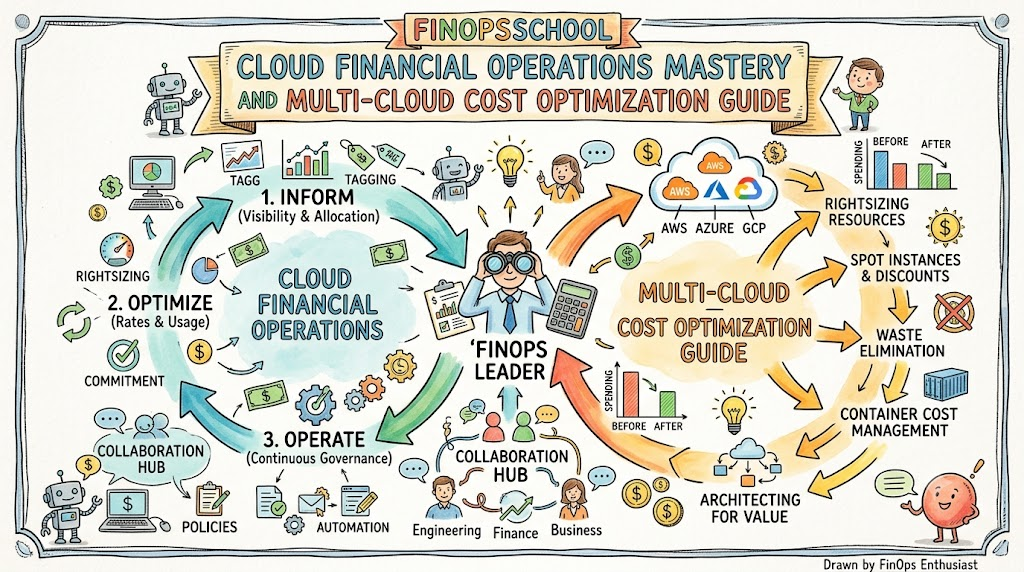
Enterprises elevate their cloud financial capabilities through three recurring, iterative phases:
- Inform Phase: Engineering teams map out resource distribution, enforce metadata tagging hierarchies, and publish real-time billing views for department heads.
- Optimize Phase: Systems architects terminate unused storage volumes, rightsize elastic compute nodes, and lock in preferential pricing via Savings Plans.
- Operate Phase: Leaders deploy automated governance policies, track unit performance against core business metrics, and foster deep cross-departmental accountability.
High-Impact Capabilities for FinOps Practitioners
Achieving expertise in this discipline demands deep technical knowledge alongside advanced financial analysis. Hence, professionals must parse complex cloud billing records while advising infrastructure teams on architectural decisions.
| Functional Focus | Core Operational Skills | Measurable Enterprise Impact |
|---|---|---|
| Financial Accounting | Cost allocation, chargeback policies, variance tracking | Establishes total multi-cloud visibility |
| System Tuning | Workload rightsizing, storage tiering, container packing | Eliminates unused compute capacity |
| Strategic Governance | Policy automation, commitment discount modeling | Protects enterprise operating margins |
Core Architectural Efficiency Strategies
Targeted optimization begins when system administrators purge abandoned disk snapshots, release unattached elastic IP addresses, and downscale over-provisioned compute pools. Furthermore, automated cron scripts should power down non-production development environments during weekends.
Next, practitioners evaluate long-term commitment discounts such as Reserved Instances and Savings Plans. Aligning steady application baselines with committed provider discounts significantly lowers ongoing infrastructure expenditure.
Managing Costs Across AWS, Azure, and Google Cloud
Each major cloud service provider maintains proprietary pricing models, service catalogs, and cost management suites. Therefore, multi-cloud enterprises must normalize disparate billing records into a single, unified reporting view.
- Amazon Web Services (AWS): Employs Cost Explorer, AWS Budgets, Compute Optimizer suggestions, and flexible Savings Plans.
- Microsoft Azure: Utilizes Microsoft Cost Management, Azure Advisor recommendations, and structured management group hierarchies.
- Google Cloud Platform (GCP): Leverages BigQuery billing exports, flexible committed use contracts, and project-level label policies.
Expanding Career Horizons Through Structured Learning
Enrolling in specialized FinOps Training equips technology professionals with practical skills that directly safeguard company profits. In addition, practitioners gain the necessary credibility to direct high-stakes financial reviews with corporate executives.
Because enterprise demand for cloud cost specialists outstrips the current supply of talent, skilled practitioners enjoy exceptional career stability. Consequently, mastering these frameworks opens doors to senior leadership roles across global enterprises.
Concrete Value of Earning Professional Credentials
Securing a recognized FinOps Certification validates your end-to-end command over cloud unit economics and architectural governance. Furthermore, technology recruiters actively seek certified specialists to lead large-scale cloud migration projects.
Demonstrating your capability to balance architectural performance with fiscal control differentiates your profile immediately. Thus, verified industry credentials provide a dependable foundation for career advancement and higher compensation.
Selecting the Optimal Educational Track
Choosing an appropriate FinOps Course requires matching your current technical background with your future professional ambitions. Therefore, assessing course syllabi against real enterprise challenges guarantees maximum educational value.
Always select learning programs that feature hands-on cloud labs, real-world billing datasets, and collaborative enterprise case studies. Consequently, you will develop practical execution skills instead of mere theoretical knowledge.
Foundational FinOps Practitioner Training
The introductory FinOps Practitioner Training track supports finance analysts, project managers, procurement directors, and team leads who require a clear grasp of core concepts. Specifically, it covers standard industry terminology, core lifecycle stages, and organizational culture shifts.
Learners discover how to construct unit economics models, implement showback workflows, and flag budget anomalies. Hence, non-technical professionals gain the technical literacy to partner effectively with engineering teams.
Advanced FinOps Engineer Training
Engineers, platform architects, and DevOps specialists require the technical FinOps Engineer Training curriculum to implement deep operational fixes. For example, it covers automated policy guardrails, infrastructure-as-code linting, and Kubernetes cost allocation.
Engineers build automated jobs that clean up orphaned resources, refine auto-scaling policies, and pack container nodes efficiently. Hence, technical teams align rapid release pipelines with corporate financial goals.
Enterprise Corporate FinOps Training
Enterprise adoption requires total coordination across disparate technical and financial departments. Therefore, customized Corporate FinOps Training builds a unified operating model across distributed engineering, finance, and procurement teams.
Through collaborative team workshops, distinct departments eliminate operational friction. Ultimately, organizations advance their operational maturity, eliminate untagged infrastructure sprawl, and hit aggressive financial targets.
Deep-Dive Cloud Cost Optimization Training
Targeted Cloud Cost Optimization Training focuses intensively on eliminating idle assets and maximizing compute efficiency. As a result, engineers learn to conduct meticulous architectural audits across compute, storage, and networking layers.
Students explore advanced storage lifecycle policies, network transit reduction, and predictive capacity planning. Thus, technical teams turn optimization practices into everyday engineering habits.
Cultivating Cost Consciousness Across Engineering Teams
Developers historically focus on uptime, application security, and deployment speed rather than monthly hosting bills. However, surfacing live cost telemetry directly inside developer IDEs and code repositories transforms everyday engineering behavior.
When developers observe the direct financial impact of their pull requests, they select cost-effective architectures instinctively. Therefore, transparent spending metrics turn cost efficiency into a standard software quality benchmark.
Designing Meaningful Telemetry and Reporting Systems
Dependable visibility anchors every successful cloud financial operations program. Consequently, teams must create customized visual dashboards tailored to specific enterprise audiences.
+-------------------------------------------------------------------+
|                   EXECUTIVE PORTFOLIO TELEMETRY                   |
+---------------------------------+---------------------------------+
| Monthly Cloud Spend: $140,000   | Cost Per Active User: $0.03     |
| Budget Variance: -5.4% (Under)  | Commitment Coverage: 84%        |
+---------------------------------+---------------------------------+
|                  DEPARTMENTAL SPEND ALLOCATION                    |
|  [Platform: 45%]     [AI/Data: 35%]      [Applications: 20%]      |
+-------------------------------------------------------------------+
Executive leaders require high-level trends, unit economics, and quarterly forecasting data. Conversely, engineering leads require granular, resource-level analytics to isolate consumption spikes and deploy immediate architectural fixes.
Implementing Automated Anomaly Detection Systems
Unchecked computational scripts or unindexed database queries can generate thousands of dollars in unexpected charges within hours. Therefore, establishing automated anomaly detection safeguards departmental budgets from catastrophic overruns.
Modern monitoring platforms apply algorithmic baselines to track normal operational patterns. When consumption deviates from the standard baseline, automated alerts notify engineers to remediate the underlying issue immediately.
Critical Anti-Patterns to Prevent
Enterprises frequently derail their financial management programs by treating governance as an occasional cleanup project rather than a continuous practice. Consequently, initial savings quickly disappear as teams launch unmonitored workloads.
- Confining governance strictly to finance: Successful remediation requires active engineering participation.
- Ignoring network egress costs: Cross-region data movement generates massive untracked bills.
- Neglecting resource tagging: Missing metadata tags prevents accurate financial accountability.
- Purchasing long-term discounts prematurely: Committing to multi-year contracts before rightsizing workloads preserves baseline waste.
Establishing an Operational Center of Excellence
Building a mature discipline requires a dedicated central team known as the Cloud Center of Excellence. This multidisciplinary group defines metadata tagging standards, manages monitoring tools, and trains feature teams.
       +-----------------------------------------+
       |   Cloud Center of Excellence (CCoE)     |
       |  (Establishes Rules, Tools & Standards) |
       +--------------------+--------------------+
                            |
         +------------------+------------------+
         |                                     |
         v                                     v
+------------------+                 +-------------------+
| Finance & BizOps |                 | Engineering Teams |
| (Budgets & KPIs) |                 | (Implementation)  |
+------------------+                 +-------------------+
Organizations should first build baseline visibility and straightforward allocation models. Later, teams can inject automated spending checks into continuous integration pipelines to enforce lasting governance.
FinOps Tools and Technologies
Specialists utilize purpose-built software to parse multi-cloud telemetry, detect consumption anomalies, and automate rightsizing recommendations. Furthermore, built-in cloud monitoring tools supply the foundation for enterprise dashboarding.
Standard solutions include open-source platforms like Kubecost for Kubernetes attribution, alongside enterprise platforms like CloudHealth, Apptio Cloudability, and Vantage. Deploying the appropriate toolchain delivers clear financial data to every decision-maker.
Governing Artificial Intelligence and Machine Learning Outlays
Artificial intelligence and large language models require expensive, specialized hardware such as dedicated GPU compute clusters. Therefore, unmonitored AI experimentation can rapidly overwhelm corporate technology budgets.
Engineers must isolate training cluster costs from routine inference workloads. By packing compute workloads efficiently, adopting spot instances, and tracking expenditure per API call, enterprises scale their AI capabilities sustainably.
Skills to Develop for a FinOps Career
Succeeding in this expanding field requires building broad technical, financial, and analytical capabilities. Thus, aspiring specialists should cultivate a well-rounded skill profile.
- Data Analytics and SQL: Querying vast cloud billing datasets directly through enterprise data warehouses.
- Cloud Architecture Knowledge: Navigating containerization, serverless environments, and tiered storage options.
- Financial Foundations: Understanding capital expenditures, operational expenses, depreciation models, and forecasting methods.
- Executive Communication: Translating complex technical constraints into actionable financial guidance for senior stakeholders.
Frequently Asked Questions About FinOpsSchool
- What educational focus does FinOpsSchool provide?
FinOpsSchool delivers structured courses, hands-on modules, and industry guidance focusing on enterprise cloud financial operations, cost governance, and infrastructure tuning.
- Who benefits most from FinOps Certification Training?
Infrastructure engineers, DevOps practitioners, solutions architects, financial controllers, and procurement managers seeking full visibility over multi-cloud investments gain immense value from these programs.
- Does the coursework address multiple cloud platforms?
Yes, the structured lessons examine billing architectures, optimization options, and operational strategies across Amazon Web Services, Microsoft Azure, and Google Cloud Platform.
- How do practitioner tracks differ from engineer curriculums?
Practitioner courses explore governance principles, showback implementation, and stakeholder communication, whereas engineer modules emphasize automated policy enforcement, infrastructure-as-code optimization, and container economics.
- Can organizations book customized Corporate FinOps Training?
Yes, corporate tracks adapt to an enterprise’s specific technology stack to align engineering, finance, and procurement teams around shared financial objectives.
- How does FinOps Online Training fit busy work schedules?
The virtual training model combines flexible live sessions, interactive sandboxes, and recorded modules designed specifically for working technology specialists.
- Do students complete real-world laboratory exercises?
Yes, learners work with enterprise-grade billing datasets, custom telemetry boards, automated cleanup scripts, and industry optimization tools during their coursework.
- Why should tech professionals explore FinOps Training in India?
Rapid multi-cloud expansion across enterprise tech hubs creates immense demand for specialists who can manage infrastructure spending effectively across global environments.
- Does the curriculum explain Kubernetes cost management?
Yes, technical lessons explore container chargeback methods, pod-level resource tracking, cluster rightsizing, and specialized monitoring integrations.
- How does this educational program eliminate unnecessary infrastructure waste?
Learners discover how to detect idle workloads, create automatic cleanup routines, optimize commitment discounts, and integrate budget controls directly into delivery pipelines.
Concluding Summary
Continuous enterprise agility demands strict infrastructure cost visibility. By embedding financial ownership directly into everyday engineering routines, organizations empower developers to deploy features rapidly without generating unexpected budget deficits. Investing in professional education bridges the gap between software delivery velocity and fiscal governance, ensuring your cloud infrastructure drives sustainable business profitability.
