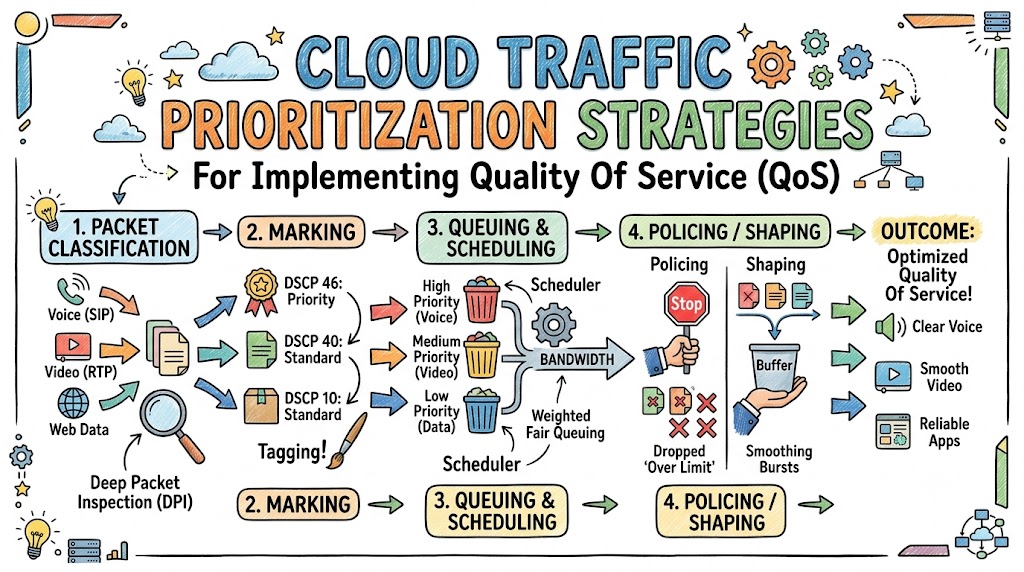
Cloud networking environments frequently struggle with unpredictable traffic spikes that degrade the performance of mission-critical applications. When voice, video, and transactional data compete for the same network bandwidth, standard delivery systems treat all data packets equally. This lack of differentiation often leads to dropped connections, high packet jitter, and severe performance bottlenecks. Implementing a robust data management framework allows modern enterprises to prioritize high-value workflows and protect system stability. Consequently, controlling the behavior of network traffic ensures that critical processes remain responsive under heavy loads.
To establish reliable data performance, modern organizations partner with specialized infrastructure experts like Cloudopsnow to deploy advanced traffic management systems. By classifying data packets based on their operational importance, companies can allocate network resources dynamically and guarantee consistent application delivery. This comprehensive guide explores the structural mechanisms behind cloud resource allocation and outlines how to deploy an enterprise-grade performance framework.
Key Operational Concepts You Must Know
Understanding Packet Classification and Marking
Packet classification serves as the foundational step in any performance optimization framework, identifying and grouping traffic based on specific business rules. Network gateways inspect inbound data packets, looking at parameters such as source IP addresses, destination ports, and application signatures. Once identified, these packets receive a specific digital tag or marking that dictates how routers treat them during transit. Without accurate initial classification, downstream network devices cannot differentiate critical application data from routine background traffic.
In modern cloud environments, this marking happens at the IP layer using Differentiated Services Code Point (DSCP) bits within the packet header. By assigning distinct code values to different types of data, engineers create a clear hierarchy of traffic importance across the network. For example, real-time voice traffic might receive a high-priority tag, while generic web browsing gets a standard delivery mark. These markings act as a permanent instruction label, guiding the packet through various network hops smoothly.
Queuing Mechanisms and Scheduling Algorithms
Once data packets are classified and marked, network switches and routers use specialized queuing mechanisms to manage their transmission order. When network interfaces experience congestion, packets gather in memory buffers called queues until bandwidth becomes available for delivery. The scheduling algorithm determines the exact order in which these queues release their data onto the physical or virtual wire. Choosing the right scheduling mechanism directly impacts how effectively the network honors your traffic priorities.
- First-In, First-Out (FIFO): Processes packets strictly in the order they arrive, offering no prioritization or performance guarantees.
- Strict Priority (SP): Empties the highest-priority queues completely before allowing any lower-priority packets to pass through the interface.
- Weighted Fair Queuing (WFQ): Allocates a specific percentage of available bandwidth to each queue, ensuring lower-priority traffic never suffers from total starvation.
Traffic Shaping vs. Traffic Policing
Traffic shaping and traffic policing are two primary enforcement mechanisms used to control data rates and limit network congestion. Traffic shaping retains excess packets in a storage buffer when data volumes exceed predefined limits, smoothing out bursts over time. This buffering mechanism reduces packet drops, making it ideal for applications sensitive to data loss, such as database synchronization. However, shaping introduces slight delays because packets spend extra time waiting inside the memory queue.
Traffic policing, by contrast, takes immediate action by dropping or remarking excess packets the moment traffic passes the allowed threshold. It does not use storage buffers to smooth out data spikes, resulting in zero added latency for compliant traffic. This rigid enforcement is highly effective for protecting network boundaries against unexpected traffic overloads or distributed denial-of-service attacks. Operations teams must balance these two techniques carefully to maintain application stability without causing artificial processing delays.
Platform Implementation vs. Culture — What’s the Real Difference?
| Operational Aspect | Platform Implementation Focus | Cultural & Mindset Focus |
|---|---|---|
| Resource Allocation | Configuring virtual routers, setting bandwidth ceilings, and defining DSCP mapping policies. | Aligning technical priorities with business goals, and deciding which applications matter most. |
| Performance Metrics | Monitoring packet drop rates, tracking queue depths, and analyzing jitter statistics. | Understanding how network performance affects user satisfaction and business revenue. |
| Capacity Management | Scaling virtual network appliances, upgrading links, and adjusting buffer sizes. | Promoting sustainable resource consumption and avoiding wasteful over-provisioning habits. |
| Incident Response | Toggling backup routes, adjusting policy rules, and clearing stuck queues automatically. | Reviewing performance failures constructively and improving cross-team design standards. |
Technical Policy Enforcement vs. Collaborative Goal Alignment
Platform implementation focuses heavily on the technical execution of traffic management policies across virtual networks, firewalls, and load balancers. Engineers spend their time writing infrastructure code, defining strict bandwidth limits, and ensuring network hardware respects packet markings accurately. These configurations form the mechanical framework that enforces data priority throughout your cloud environment. However, these automated systems cannot determine on their own which business applications deserve the highest priority.
Cultural alignment, conversely, represents the shared understanding among development, operations, and business teams regarding performance priorities. A collaborative engineering culture ensures that developers communicate their application requirements clearly to the operations team before deployment. When these teams share a common goal, they can easily agree on which services require guaranteed low latency. Therefore, combining strong technical tools with open organizational communication creates a highly efficient operational environment.
Integrating Technical Controls with Business Workflows
Bridging the gap between automated platform rules and daily business operations requires establishing clear, standardized evaluation processes. Organizations must regularly review their traffic classification rules to ensure they match evolving business strategies and application updates. An outdated network policy might prioritize an old legacy system while starving a new, critical customer-facing service of needed bandwidth. Regular cross-functional audits help keep network behavior aligned with actual business needs.
   +---------------------------------------+
   |        Business Priorities            |  <-- Defines critical customer workflows
   +---------------------------------------+
                       |
                       v
   +---------------------------------------+
   |   Cross-Functional Engineering Team   |  <-- Translates goals into network policies
   +---------------------------------------+
                       |
                       v
   +---------------------------------------+
   |  Automated Cloud Network Platform     |  <-- Enforces bandwidth and queuing rules
   +---------------------------------------+
To maintain this alignment, operations experts should provide development teams with clear visibility into network performance metrics. When developers see how their application architecture impacts shared network buffers, they naturally write more data-efficient code. This shared technical awareness transforms network management from a restrictive set of rules into an empowering optimization tool. Ultimately, uniting human processes with automated network controls leads to reliable, long-term system performance.
Real-World Use Cases of Modern Operations
Enterprise Voice and Video Communication Platforms
Enterprise communication suites rely heavily on traffic management frameworks to deliver clear, uninterrupted voice and video streams to global users. Real-time media packets are highly sensitive to network delays and packet variations, which cause garbled audio and frozen video frames. Operations teams protect these interactive sessions by applying strict expedited forwarding tags to all media traffic at the network edge. This configuration ensures that communication packets bypass standard data queues and transmit without delay.
Furthermore, these communication platforms use advanced network topologies that separate real-time media traffic from large file transfers. By leveraging dedicated virtual networks and prioritized internet gateways, they isolate sensitive voice streams from background network noise. Engineers also configure minimal buffer sizes on voice queues to prevent stale data packets from clogging the delivery line. This precise resource management guarantees a smooth, professional communication experience even during times of heavy corporate network traffic.
Multi-Tenant Software as a Service (SaaS) Architectures
Multi-tenant SaaS platforms host thousands of diverse business customers on a shared cloud infrastructure, making resource isolation a top priority. Without proper traffic controls, a single customer running massive data reports can consume all available network bandwidth, slowing down the system for everyone else. Operations engineers resolve this “noisy neighbor” issue by implementing dynamic rate-limiting policies at the API gateway layer. This configuration ensures that every customer receives a fair, guaranteed share of network capacity.
[Incoming Tenant Traffic]
            |
            v
   [API Gateway Router]
            |
            +---> [Tenant A (Compliant)] ----> [Priority Queue] ----> Fast Processing
            |
            +---> [Tenant B (Bursting)]  ----> [Policed/Shaped] ----> Rate Limited
To maximize system efficiency, these platforms implement tiered performance levels that match the subscription status of different customer groups. High-tier enterprise users receive priority packet markings that grant them faster processing speeds and expanded bandwidth during peak hours. Meanwhile, basic tier traffic is automatically managed using shaping techniques to prevent it from impacting premium workflows. This automated traffic control allows SaaS providers to maximize infrastructure use while honoring service level agreements.
Distributed IoT Data Collection and Processing Hubs
Internet of Things (IoT) networks collect continuous streams of sensor data from millions of geographically distributed devices worldwide. This incoming traffic consists of two distinct types: routine telemetry readouts and urgent, time-sensitive system alerts. Operations teams deploy specialized edge gateways to inspect incoming device messages and separate these data types instantly upon arrival. This early sorting prevents low-priority updates from delaying critical emergency notifications.
- Urgent Alarms: Marked with high-priority tags and sent through dedicated, low-latency queues for immediate processing.
- Routine Telemetry: Directed to low-priority, high-capacity queues that process data in manageable chunks when bandwidth allows.
- Edge Filtering: Cleans and aggregates repetitive sensor data at the local network edge before transmission to save core bandwidth.
Engineers continuously monitor these incoming data channels using automated tools to detect sudden surges in device activity. If an industrial facility experiences an issue, the system dynamically expands the priority queue capacity to handle the sudden influx of alerts. This flexible network adjustment ensures that critical safety data reaches processing systems instantly, allowing companies to respond to field issues immediately.
Common Mistakes in Operations Engineering
Over-Provisioning Bandwidth Instead of Managing Traffic Behavior
A widespread error in cloud network management is attempting to fix performance issues by simply buying more bandwidth. Many engineering teams assume that expanding network pipes will automatically eliminate application delays and packet drops. While increasing capacity provides temporary relief, it fails to address the underlying structural issues causing data congestion. Without proper classification rules, large, non-urgent data transfers will expand to fill the new space, continuing to crowd out critical traffic.
Unmanaged Expanded Pipe: [Large File Sync (Expands to fill space)] ---> [Critical App Data (Still Blocked)]
Managed Optimized Pipe:  [Large File Sync (Restricted/Shaped)]     ---> [Critical App Data (Prioritized/Fast)]
This over-provisioning approach leads to high infrastructure costs while leaving the system vulnerable to sudden traffic spikes. When network utilization climbs, unmanaged queues quickly fill up, causing unpredictable performance drops for core business services. Operations teams must focus on optimizing how traffic moves through existing paths before spending money on unnecessary upgrades. Implementing smart resource controls ensures that critical applications get the performance they need without wasting budget.
Creating Overly Complex Classification and Hierarchy Schemes
Another frequent mistake is designing over-complicated traffic classification schemes that include dozens of different priority levels. Engineers sometimes create intricate hierarchies that attempt to give every microservice its own unique network queue and bandwidth limit. This extreme fragmentation overwhelms virtual routers, causing heavy CPU overhead as devices struggle to process complex sorting rules for every packet. Instead of improving performance, this added complexity introduces new system delays.
To maintain a clean and efficient network, operations teams should stick to a simple hierarchy of three to four clearly defined traffic classes. Grouping applications into broad categories—such as real-time media, transactional data, standard web traffic, and background transfers—keeps management straightforward. This clear structure reduces processing overhead on network hardware while providing reliable, predictable performance across the entire application ecosystem. Keeping rules simple makes troubleshooting easier and prevents unexpected policy conflicts.
Ignoring Asymmetric Routing Paths and Return Traffic Patterns
Many cloud architects configure traffic priorities only on outbound data pathways, completely ignoring how return traffic travels back through the network. Cloud networks are highly asymmetric, meaning data packets often return along completely different physical paths than the ones they took to leave the system. If the return pathways lack matching prioritization rules, incoming data will get stuck in congested public queues. This half-optimized setup leaves your application vulnerable to unexpected delays.
Outbound Path (Optimized): [App Server] ----> (Prioritized Private Route) ----> [User User]
Inbound Path (Neglected):  [App Server] <---- (Congested Public Internet)  <---- [User User]
To prevent these one-sided performance bottlenecks, engineers must implement consistent, bidirectional traffic management policies across all entry and exit gateways. Work closely with cloud providers and network partners to ensure that return paths respect your data markings. This complete configuration protects your application traffic along its entire journey, providing stable and predictable response times for users.
How to Become an Operations Expert — Career Roadmap
Mastering Traffic Analysis Tools and Protocol Internals
To establish yourself as an elite operations expert, you must develop a deep understanding of network protocols and traffic analysis tools. You need to master packet inspection software like Wireshark and command-line diagnostics such as tcpdump to analyze live traffic flows. Understanding how to read IP headers, identify DSCP markings, and spot packet fragmentation is essential for troubleshooting complex system delays. This technical expertise allows you to find and fix performance issues that automated dashboards often miss.
- Protocol Deep Dive: Learn the operational details of TCP window scaling, selective acknowledgments, and congestion control algorithms.
- Buffer Analysis: Study how network hardware handles buffer management and learn to identify signs of bufferbloat in virtual systems.
- Traffic Profiling: Master the art of capturing network baselines to accurately separate normal daily traffic from unexpected anomalies.
Additionally, spend time learning how modern application layer protocols like HTTP/3 use connection multiplexing to reduce setup delays. Understanding these internal mechanics helps you design network rules that complement modern software architectures perfectly. This low-level technical knowledge separates top-tier network architects from engineers who only know how to adjust basic cloud settings.
Developing Expertise in Cloud-Native Network Automation
Modern enterprise operations require a strong focus on automation; therefore, mastering cloud-native network tools is essential for career advancement. You must become highly proficient in using Infrastructure as Code tools like Terraform to deploy and manage complex virtual networks. Writing clean, modular code allows you to build reproducible network topologies, routing tables, and gateway rules across multiple cloud environments without manual errors. This automated approach ensures that your traffic management rules remain consistent across development, testing, and production systems.
+--------------------------+     Automated Deploy     +--------------------------+
|  Terraform Network Code  | -----------------------> | Consistent, Prioritized  |
|  Declarative Policy      |                          | Cloud Routing Environment|
+--------------------------+                          +--------------------------+
Beyond basic provisioning, focus on learning how to integrate network configurations into automated CI/CD application deployment pipelines. Build automated testing steps that validate your network access lists and traffic shaping rules before changes go live. This proactive approach eliminates manual configuration errors, keeps your system aligned with security policies, and shortens deployment timelines. Consequently, your engineering team can update systems rapidly while maintaining a highly stable and performant cloud infrastructure.
Building Advanced Observability and Performance Dashboarding Skills
An operations expert must be able to gain clear, real-time visibility into complex cloud environments by building robust observability frameworks. You must learn to collect, correlate, and analyze network performance metrics, structural system logs, and distributed application traces. Master monitoring platforms like Prometheus and visualization tools like Grafana to build detailed dashboards that track queue depths, packet drops, and latency trends. This deep visibility allows you to find and resolve performance issues before they impact your users.
               +----------------------------------------+
               |   Centralized Network Health Monitor   |
               +----------------------------------------+
                 ^                  ^                  ^
                 |                  |                  |
          [Queue Depths]     [Packet Drops]     [Latency Shifts]
          (Prometheus)        (Log Analysis)     (OpenTelemetry)
Furthermore, focus on setting meaningful Service Level Indicators (SLIs) that measure the actual quality of the end-user experience. Learn to separate minor, everyday network fluctuations from critical performance drops, designing alert systems that prevent notification fatigue. This analytical balance ensures that your engineering team focuses on solving high-priority architectural issues rather than chasing false alarms. Ultimately, turning raw operational data into clear, actionable insights keeps your cloud platform running smoothly and efficiently.
FAQ Section
- What is the difference between classification and marking in network management?Classification is the initial process of inspecting incoming data packets to identify their type based on rules like source IP or port numbers. Marking is the subsequent action of writing a specific digital tag, such as a DSCP value, directly into the packet header. Classification identifies the data, while marking labels it so downstream routers know how to prioritize it.
- How does bufferbloat affect high-priority cloud applications?Bufferbloat occurs when network routers use overly large memory buffers that hold onto excess traffic for too long during times of congestion. This buffering prevents packets from being dropped, but it introduces massive processing delays that slow down real-time systems like voice and video. Proper traffic shaping limits these buffer sizes to keep data moving quickly.
- Can you implement Quality of Service rules on the public internet?No, standard public internet routers ignore custom packet markings and treat all public traffic as equal, best-effort data. To maintain true performance guarantees, organizations must use private cloud connections, dedicated fiber backbones, or virtual private networks that respect priority tags. This private infrastructure ensures your rules are honored along the entire transit path.
- Why is Strict Priority scheduling risky for low-priority traffic?Strict Priority scheduling always empties high-priority queues completely before processing data from lower-priority lines. If your network experiences a continuous influx of high-priority traffic, the lower queues will never get processed, a problem known as traffic starvation. Using mixed scheduling models like Weighted Fair Queuing prevents this issue by sharing bandwidth fairly.
- What role do API Gateways play in cloud network prioritization?API Gateways act as the primary entry point for application traffic, managing incoming user requests before they reach core internal microservices. They enforce rate limits, filter out malicious bursts, and apply initial traffic markings based on user subscription levels or endpoint importance. This early control protects downstream internal networks from becoming overloaded.
Final Summary
Establishing an efficient cloud network requires a balanced combination of technical policy enforcement, robust automation, and clear business communication. Minimizing application delays requires a thorough understanding of packet classification, queuing mechanics, and asymmetric routing paths. By avoiding over-provisioning traps and keeping hierarchy rules simple, operations teams can ensure their platforms scale reliably under heavy traffic. Ultimately, embedding traffic management directly into your core infrastructure design results in a highly stable, responsive cloud environment that delivers consistent user experiences.
