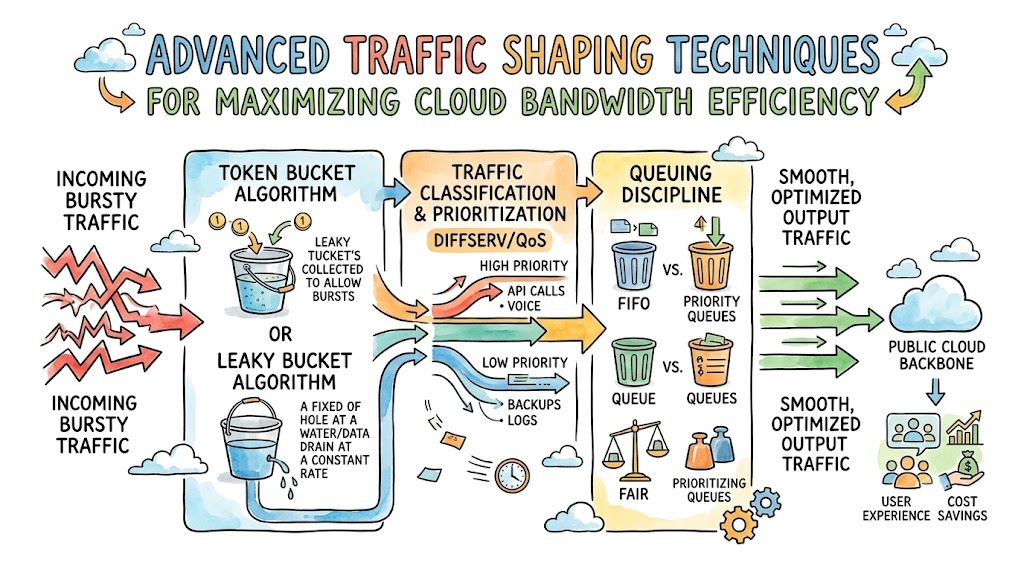
Modern cloud architectures handle massive, unpredictable volumes of data traffic every single second. When multiple applications compete for the exact same network resources, data congestion inevitably occurs, leading to dropped packets and severe application delays. Implementing smart traffic management strategies allows organizations to control data flows and prioritize critical business operations. Consequently, controlling the rate of data transit prevents network saturation and ensures consistent application performance. By mastering these traffic control mechanisms, engineering teams can maintain a highly reliable and responsive cloud environment.
To build a seamless, high-performance virtual environment, modern enterprises rely on specialized network consultants like Cloudopsnow to architect optimized data pathways. Regulating internal data flows requires a comprehensive approach that combines queue management, rate limiting, and intelligent packet prioritization. When cloud services handle thousands of concurrent API requests, unmanaged traffic surges can easily degrade the user experience. This guide explores the core technical mechanisms governing traffic control and outlines how to establish an optimal network environment.
Key Operational Concepts You Must Know
The Mechanics of Traffic Shaping vs. Traffic Policing
Traffic shaping and traffic policing are two fundamental bandwidth management techniques used to control network data rates, but they handle excess traffic differently. Traffic shaping retains excess packets in a storage buffer queue when data volume exceeds configured limits. This buffer setup delays the transmission of non-essential data, smoothing out bursts to produce a stable, predictable flow rate. As a result, shaping minimizes packet retransmissions and prevents sudden connection drops across your cloud environment.
Traffic policing, conversely, takes immediate action by dropping or remarking data packets the moment traffic crosses the maximum bandwidth threshold. It does not utilize storage buffers to manage traffic surges, making it highly effective for strict enforcement but prone to causing heavy packet loss. This aggressive dropping can trigger TCP window reduction mechanisms, slowing down application throughput drastically. Operations engineers must carefully choose between these two approaches based on how well their applications tolerate delays versus packet drops.
Traffic Shaping:  [Incoming Burst] ---> [Buffer Queue] -------> [Smooth, Consistent Output]
Traffic Policing: [Incoming Burst] ---> [Threshold Limit] ---> [Dropped Packets / Sudden Drops]
Token Bucket and Leaky Bucket Algorithms
The token bucket algorithm serves as a dynamic control mechanism that permits managed bursts of traffic while maintaining a strict long-term average rate. In this system, virtual tokens accumulate in a defined bucket at a steady, predetermined pace up to a maximum capacity limit. Each outgoing data packet must capture and remove a token from the bucket before it can proceed into the network backbone. If the bucket fills with tokens during quiet periods, the system can handle a sudden surge of traffic instantly.
- Token Accumulation: Tokens enter the bucket continuously at a fixed rate, defining the sustained allowable bandwidth.
- Burst Capacity: The maximum depth of the bucket determines the size of the temporary traffic burst the network permits.
- Action Mode: Packets pass immediately if tokens are available; otherwise, they wait in a queue or face policing rules.
The leaky bucket algorithm, alternatively, enforces a rigid, unchanging output rate regardless of the intensity of incoming traffic bursts. Imagine water entering a bucket with a small hole at the bottom; the water flows out at a constant speed until the bucket overflows. This method is ideal for smooth data delivery, but it lacks the flexibility to handle safe, temporary traffic surges efficiently. Understanding these algorithms helps operations teams configure optimal rate-limiting policies within their cloud gateways.
Quality of Service (QoS) and Differentiated Services (DiffServ)
Quality of Service represents the entire framework used to manage network resources by granting distinct priority levels to different data types. Differentiated Services, or DiffServ, implements this by labeling individual network packets using the Differentiated Services Code Point (DSCP) field in the IP header. Network routers read these specific architecture tags to determine how to prioritize and route each packet through the system. This labeling ensures that mission-critical data receives immediate passage while non-urgent traffic waits in line.
[Raw Traffic Stream] ---> [DiffServ Classifier] ---> [Tag: DSCP 46 (Voice)] ----> [High Priority Queue]
                                                ---> [Tag: DSCP 0 (Default)] --> [Best Effort Queue]
By dividing network traffic into distinct classes, operations teams can safeguard essential services from being overwhelmed by background data tasks. For instance, real-time database synchronizations and voice communications receive high-priority tags to bypass standard traffic queues entirely. Meanwhile, heavy file uploads or system analytical reports are assigned lower priority values, ensuring they utilize idle bandwidth only. This strategic classification maintains high application performance even during periods of heavy, unpredictable network load.
Identifying Network Bottlenecks and Bufferbloat
Network bottlenecks occur when data demands surpass the maximum transfer capacity of a specific hardware interface or virtual routing link. These blockages frequently emerge at the boundaries between private cloud infrastructures and the public internet, where data pathways narrow considerably. Identifying these performance pinch points requires continuous monitoring of interface utilization rates, packet drops, and transmission delays. Resolving bottlenecks prevents localized network slowdowns from cascading throughout your entire distributed application system.
Bufferbloat is a specific performance degradation caused by excessive buffering within network routers, switches, and cloud gateways. When buffers are configured too large, they hold onto data packets for too long instead of dropping them naturally during congestion. This excessive queuing introduces massive, variable delays that severely disrupt interactive applications and real-time communication protocols. Engineers must tune buffer sizes properly and use active queue management algorithms to keep network responses fast and predictable.
Platform Implementation vs. Culture — What’s the Real Difference?
| Operational Aspect | Platform Implementation Focus | Cultural & Mindset Focus |
|---|---|---|
| Traffic Controls | Deploying ingress controllers, configuring rate limiters, and adjusting virtual network queues. | Establishing performance budgets, aligning team goals, and educating developers on network costs. |
| Capacity Planning | Setting auto-scaling metrics, analyzing bandwidth usage, and purchasing cloud network tiers. | Anticipating user growth trends, designing for resource efficiency, and embracing architectural reviews. |
| System Reliability | Implementing circuit breakers, setting up failover routing, and configuring health probes. | Organizing game days, practicing chaos engineering, and normalizing proactive system hardening. |
| Network Visibility | Enabling VPC flow logs, deploying packet sniffers, and building metrics dashboards. | Prioritizing data-driven debugging, sharing incident insights, and valuing transparent performance metrics. |
Configuration Mastery vs. Collaborative Awareness
Platform implementation concentrates on the technical execution of traffic controls, routing rules, and infrastructure provisioning within the cloud environment. Engineers focus on writing precise configuration files, deploying service meshes, and fine-tuning kernel network parameters to manage data flows. These activities establish the structural boundaries and automated defenses necessary to keep the cloud infrastructure running efficiently. However, technical configurations alone cannot fix performance issues caused by poorly designed application architectures.
Cultural focus emphasizes the human understanding, shared values, and collaboration models that drive how teams build and deploy software. A performance-conscious culture encourages developers to write efficient code that respects network limitations and avoids unnecessary data transmissions. When engineering teams communicate openly, they design applications that work in harmony with the underlying network shaping rules. Therefore, combining configuration mastery with a collaborative team mindset creates a highly resilient and optimized digital ecosystem.
Designing Network-Aware Software Frameworks
To achieve maximum performance, organizations must bridge the gap between low-level network controls and high-level application development workflows. If software developers treat the network as an infinite, cost-free resource, they will inevitably create patterns that cause severe congestion. Introducing network-aware development practices ensures that applications naturally minimize large data bursts and handle connection throttling gracefully. This alignment turns traffic shaping from a restrictive enforcement tool into a supportive framework for application delivery.
   +---------------------------------------+
   |      Network-Aware Engineering        |  <-- Teams design applications to minimize data bursts
   +---------------------------------------+
                       |
                       v
   +---------------------------------------+
   |     Collaborative Data Workflows      |  <-- Standardized API limits and performance budgets
   +---------------------------------------+
                       |
                       v
   +---------------------------------------+
   |   Optimized Traffic Shaping Platform  |  <-- Core cloud network smoothly shapes data rates
   +---------------------------------------+
Building this shared awareness requires regular technical workshops, cross-team performance reviews, and integrated testing within the deployment pipeline. When developers gain clear visibility into network traffic costs and delays, they proactively optimize payload sizes and API call patterns. This collaborative effort helps teams build applications that navigate rate limits smoothly without crashing or degrading user experiences. Ultimately, combining smart software design with robust platform controls leads to long-term architectural stability.
Real-World Use Cases of Modern Operations
Managing Video Streaming Delivery Channels
Global video streaming platforms require highly sophisticated traffic shaping systems to deliver smooth, high-definition content to millions of concurrent viewers. Video data transfers are naturally bursty, sending massive chunks of media files to client device buffers in short, intense intervals. Without proper traffic shaping, these sudden data surges can easily saturate delivery networks and cause severe buffering for nearby users. Operations teams use shaping to smooth out these delivery spikes into a continuous, manageable stream.
[Video Storage Origin] ---> [Traffic Shaper] ---> [Consistent Data Flow] ---> [Regional CDN] ---> [Viewers]
Furthermore, these platforms dynamically adjust traffic shaping policies based on real-time internet conditions and individual user connection qualities. They deploy advanced traffic management at the edge of the network, ensuring that media delivery conforms to local network capacities. By capping data transmission speeds just above the playback bit rate, they conserve valuable core bandwidth while keeping playback flawless. This strategic management ensures a reliable, high-quality viewing experience across all types of consumer devices.
Securing Microservice API Gateways Against Surges
Modern microservice architectures rely heavily on centralized API gateways to manage communications between hundreds of internal and external services. A sudden popularity spike or a coordinated distributed denial-of-service (DDoS) attack can quickly overwhelm these gateways with millions of requests. Operations engineers implement aggressive traffic shaping and rate-limiting rules at the API gateway layer to protect vulnerable backend databases. This control keeps core application features functional even during massive traffic spikes.
- Leaky Bucket Enforcement: Smooths out incoming API requests to prevent sudden processing spikes on backend microservices.
- Tiered Rate Limiting: Assigns distinct request limits based on user authentication tokens and service levels.
- Graceful Degradation: Routes excess requests to temporary cache stores or returns informative, low-overhead retry codes.
When traffic volume crosses safe operational thresholds, the shaping infrastructure slows down non-essential API routes while keeping critical transactional paths wide open. Engineers continuously monitor gateway queues using automated telemetry to identify and isolate abusive client connections instantly. This proactive traffic regulation prevents cascading system failures and ensures that core business services remain available to legitimate users. By controlling incoming data velocities, organizations maintain a stable, predictable, and highly secure microservice environment.
Optimizing Bulk Cloud Data Migrations
Organizations frequently need to migrate massive datasets, such as database backups or historical archives, between different cloud regions or data centers. These large-scale migrations can easily consume all available network bandwidth, starving live, consumer-facing applications of the resources they need. To prevent business disruptions, operations teams implement strict traffic shaping policies on data migration channels. This configuration caps migration traffic speeds, ensuring bulk transfers run steadily in the background without affecting users.
Available Cloud Bandwidth:
===================================================================
[ Live User Traffic - Given High Priority & Unrestricted Path     ]
-------------------------------------------------------------------
[ Shaped Migration Traffic - Capped Steady Flow in Residual Space  ]
===================================================================
Engineers configure these shaping systems to alter their behavior automatically based on time schedules and overall network usage patterns. During high-traffic business hours, migration channels are heavily restricted to give priority to customer transactions and real-time operations. As global traffic drops during late-night hours, the shaping policies automatically expand migration bandwidth limits to accelerate data movement. This dynamic traffic control maximizes total infrastructure utility while providing absolute safety for day-to-day operations.
Common Mistakes in Operations Engineering
Setting Excessively Large Virtual Network Buffers
A very common mistake in cloud network design is configuring excessively large memory buffers on virtual interfaces and routing gateways. When faced with occasional packet drops, engineers often assume that expanding buffer sizes will allow the system to retain more data. However, giant buffers simply collect massive queues during traffic spikes, keeping packets waiting in line for extended periods. This delay creates severe bufferbloat, which dramatically increases overall network latency and ruins real-time application responsiveness.
Large Buffer Trap: [Incoming Burst] ---> [=== Oversized Memory Queue ===] ---> [Delayed Outbound Data]
                                         (Packets sit too long, causing lag)
Instead of solving network congestion, giant buffers hide structural capacity shortages and trick application protocols into thinking connections are clear. Because packets are queued rather than dropped, TCP sender algorithms fail to receive the timely congestion signals needed to slow down naturally. Operations teams should implement smaller, tightly controlled buffers combined with modern active queue management techniques. This setup ensures that systems provide immediate feedback, keeping data moving rapidly and predictably through the cloud environment.
Applying Identical Control Rules to All Traffic Types
Another frequent error is treating all network traffic identically by applying a single uniform shaping policy across the entire cloud infrastructure. When you treat real-time API transactions, voice communications, and large background backups exactly the same, performance issues are guaranteed to arise. A massive, non-urgent file transfer can easily fill up shared network queues, delaying critical, time-sensitive user requests. This lack of discrimination leads to erratic application behavior and frequent performance complaints from end users.
To fix this issue, operations teams must establish clear data classification policies using DiffServ or application-level routing tags. By segmenting traffic into distinct priority queues, you ensure that small, critical packets always skip past massive background data transfers. You should allocate dedicated, protected bandwidth pools for vital services while forcing bulk transfers into lower-priority, shapeable channels. This purposeful separation keeps your application ecosystem highly responsive and resilient under varied workloads.
Ignoring Cloud Provider Egress Costs and Limits
Many engineering teams design their traffic management strategies without analyzing the specific network egress limits and financial costs of their cloud provider. Cloud platforms charge significant fees for data leaving their networks, and they enforce strict throughput caps on virtual machine interfaces. Running unshaped, chaotic bursts of data out of your cloud environment can cause massive financial bills and trigger sudden provider throttling. Failing to regulate these outputs leaves your infrastructure vulnerable to unexpected performance drops and budget overruns.
Unshaped Burst: [High-Velocity Surge] ---> [Cloud Provider Egress Cap] ---> [Sudden, Aggressive Throttling]
Shaped Output:  [High-Velocity Surge] ---> [Internal Traffic Shaper]   ---> [Controlled, Cost-Effective Flow]
To avoid these issues, operations engineers should align their traffic shaping thresholds directly with their cloud provider’s cost models and performance tiers. Implementing steady rate limiting at the egress gateways prevents sudden billing spikes and keeps traffic well below provider throttling limits. Additionally, optimizing data payloads and caching frequently requested assets at the edge reduces the total volume of data leaving the network. This conscious control protects your operating budget while ensuring consistent, high-speed delivery to all users.
How to Become an Operations Expert — Career Roadmap
Mastering Traffic Analysis Tools and Protocol Internals
To become an elite operations expert, you must build a profound understanding of low-level protocol designs and advanced traffic analysis utilities. You need to master the internal behaviors of the TCP sliding window mechanism, congestion notification protocols, and modern UDP frameworks like QUIC. Understanding how these protocols adapt to packet loss and latency changes allows you to design highly effective traffic control policies. This foundational expertise helps you diagnose complex performance issues that automated monitoring tools often miss.
- Linux Traffic Control: Master the
tccommand-line utility to configure advanced queuing disciplines like FQ-CoDEL and Token Bucket Filter (TBF). - Deep Packet Inspection: Become highly proficient with
tcpdumpand Wireshark to analyze packet headers and catch congestion signals. - Kernel Network Tuning: Learn how to optimize network memory allocations and socket buffers within the operating system kernel.
Additionally, study the mathematical models behind queuing theory to understand how data behaves as arrival rates approach system capacities. This theoretical knowledge helps you predict system performance and design network layouts that handle heavy user traffic smoothly. Combining practical diagnostic skills with deep protocol knowledge allows you to optimize cloud performance with absolute precision.
Designing Declarative Network Infrastructure with Code
Modern operations demand complete automation; therefore, you must master the art of defining network architectures and traffic controls using code. You should become highly skilled with Infrastructure as Code tools like Terraform to deploy cloud networks, gateways, and load balancers reliably. Writing modular, reusable IaC ensures that your traffic shaping policies, firewall rules, and routing tables remain consistent across all environments. This automated approach eliminates manual setup errors and ensures that performance standards are met perfectly every time.
+--------------------------+      Provisions      +--------------------------+
|  Terraform IaC Scripts   | -------------------> |  Consistent, Optimized   |
| (Traffic Rules & Routers)|                      |   Cloud Infrastructure   |
+--------------------------+                      +--------------------------+
Beyond basic provisioning, learn to integrate network policy testing directly into your continuous integration and continuous delivery (CI/CD) pipelines. Automating the validation of rate-limiting policies and gateway configurations before code reaches production prevents human error from causing unexpected system outages. This rigorous validation allows your engineering teams to deploy software rapidly while keeping the underlying network stable. As a result, your infrastructure can adapt quickly to changing business demands without sacrificing reliability or performance.
Implementing Proactive Observability and Performance Guardrails
An advanced operations expert must establish clear, comprehensive visibility into complex cloud systems using modern observability tools. You need to build robust telemetry pipelines that gather and correlate high-resolution metrics, structured logs, and distributed traces from across your network. Learn to deploy OpenTelemetry frameworks and tools like Prometheus and Grafana to track packet transit speeds and queue depths in real time. This deep visibility helps you pinpoint the exact service or routing link causing performance degradation.
                    +---------------------------------------+
                    |    Grafana Network Control Center     |
                    +---------------------------------------+
                      ^                 ^                 ^
                      |                 |                 |
               [Queue Metrics]    [Latency Traces]   [Flow Logs]
               (Prometheus)       (OpenTelemetry)    (VPC Logs)
Furthermore, focus on setting up meaningful performance budgets and proactive alerting systems that detect network anomalies before they impact users. You must learn to separate temporary traffic spikes from chronic capacity trends, configuring alerts to trigger only on genuine systemic issues. This analytical skill keeps your team focused on fixing genuine architectural bottlenecks rather than chasing minor false alarms. Ultimately, deep observability allows you to turn raw performance data into actionable improvements, keeping your cloud infrastructure operating at peak efficiency.
FAQ Section
- What is the main difference between traffic shaping and traffic policing?Traffic shaping retains excess packets in a temporary storage buffer queue when data volume crosses defined limits, smoothing out traffic bursts into a steady flow. Traffic policing, on the other hand, immediately drops or remarks packets the moment traffic surpasses the maximum allowable threshold. Shaping is ideal for keeping data flows smooth, while policing provides strict, immediate rate limit enforcement.
- How does the token bucket algorithm handle sudden traffic bursts?The token bucket algorithm accumulates virtual tokens in a bucket at a fixed rate during quiet network periods up to a set capacity limit. When a sudden burst of traffic arrives, the system uses these stored tokens to transmit packets immediately without any delay. Once the bucket is empty, subsequent packets must wait for new tokens to generate, maintaining the long-term average rate.
- What is bufferbloat and why does it degrade cloud application performance?Bufferbloat occurs when network routers or cloud gateways use oversized memory buffers that hold onto data packets for too long during congestion. Instead of dropping packets naturally to signal the sender to slow down, these giant queues keep packets waiting in line, causing massive delays. This excessive queuing degrades real-time applications, video calls, and interactive API services.
- Why should I avoid applying the same traffic shaping rule to all data types?Applying identical rules to all traffic forces time-sensitive data, like user API requests, to wait in the same queues as massive, non-urgent database backups. This lack of prioritization causes erratic application lag, slow page loads, and a frustrating user experience during heavy background data transfers. Separating traffic into distinct priority classes ensures critical services always stay fast.
- How can traffic shaping help reduce cloud provider network egress bills?Traffic shaping smooths out unpredictable, high-velocity data bursts into a stable, controlled output that stays safely below expensive provider billing tiers. By capping non-essential data transfers during high-cost peak hours, you prevent sudden financial surcharges and eliminate the risk of unexpected provider throttling. This proactive control keeps your cloud operations highly efficient and cost-effective.
Final Summary
Achieving optimal cloud network performance requires an organized strategy that combines low-level traffic control algorithms with automated infrastructure management. Implementing smart traffic shaping techniques allows engineering teams to prevent network congestion, eliminate bufferbloat, and protect vital business services. By classifying traffic accurately and avoiding common buffering mistakes, organizations can maximize their available bandwidth resources safely. Ultimately, embedding network-aware engineering practices into your team culture results in resilient, highly responsive cloud applications that deliver consistent user experiences.
