Introduction
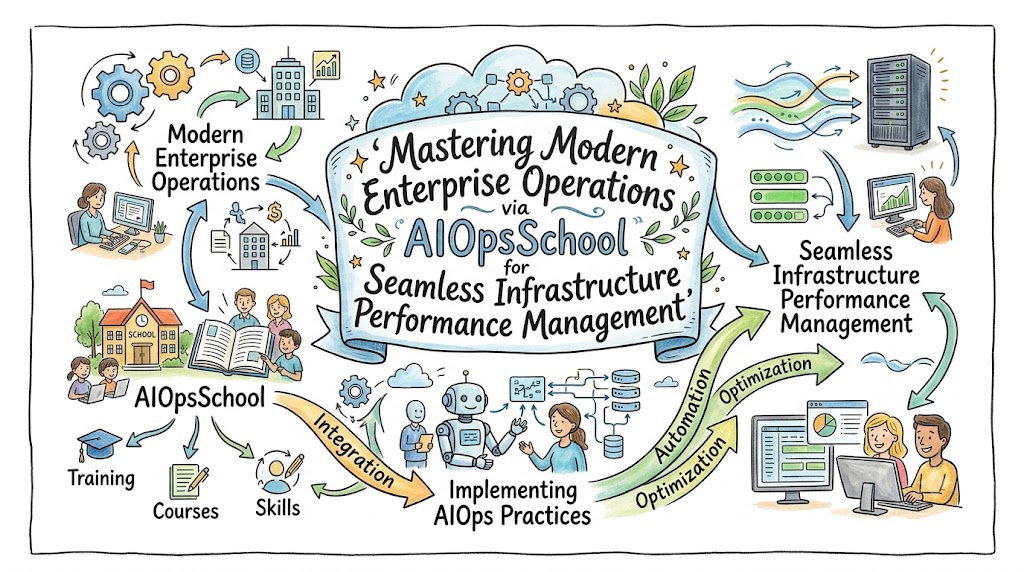
Modern IT enterprises struggle with an overwhelming deluge of telemetry data flowing from distributed systems. Consequently, engineering teams face chronic alert fatigue as thousands of noisy notifications flood their communication channels daily. When critical outages occur, isolating the actual failure point becomes an exhausting hunt through fragmented monitoring dashboards. Fortunately, specialized educational platforms address these complex infrastructure issues by providing comprehensive AIOps Training.
By integrating artificial intelligence into monitoring ecosystems, organizations can systematically filter out systemic operational noise. IT professionals quickly discover that traditional monitoring tools fail to scale alongside containerized architectures and dynamic microservices. Therefore, acquiring specialized skills through AiOpsSchool enables engineers to transform passive monitoring into predictive, self-healing system administration.
Demystifying the Foundation of Autonomous Systems
To understand this transformation, engineering teams must first evaluate the foundational definition of What is AIOps. Put simply, artificial intelligence for IT operations combines big data, machine learning, and advanced analytics to enhance infrastructure management. Instead of relying on static, manual thresholds, this technology applies mathematical algorithms to discover hidden behavior patterns across systems.
Subsequently, the main platform continuously analyzes performance metrics to identify anomalies before users experience noticeable degradation. This practice eliminates the reliance on historical trial-and-error debugging sessions during active production outages. Ultimately, this methodology converts standard infrastructure engineering into an automated, highly intelligent ecosystem that supports rapid business scaling.
Key Operational Concepts You Must Know
Navigating modern systems successfully requires an intimate familiarity with telemetry gathering and real-time computation. Therefore, engineers must focus on building deep expertise in AIOps in IT operations to stay competitive. The entire architecture rests upon five primary pillars that convert raw telemetry into actionable system context.
- Comprehensive Observability: Gathering structured logs, metrics, and traces across every distributed layer of the enterprise application stack.
- Unified Telemetry Consolidation: Merging disparate infrastructure data pipelines into a centralized analytics layer for continuous algorithm execution.
- Intelligent Event Correlation: Bundling thousands of redundant alerts into a single, cohesive incident ticket based on temporal proximity.
- Dynamic Baseline Estimation: Utilizing historical performance data to understand what normal system behavior looks like during peak hours.
- Automated Remediation Workflows: Launching automated scripts or server scaling routines instantly when the system confirms specific failure signatures.
By mastering these architectural blocks, engineers move past basic dashboard building into designing robust, resilient operational platforms. Consequently, understanding these elements allows professionals to construct highly sustainable operational workflows that minimize manual human intervention.
Elevating Skills Through AIOps for Beginners
Starting a career path in intelligent automation can initially feel intimidating due to the volume of advanced concepts. However, dedicating time to study AIOps for beginners provides a highly structured gateway into modern infrastructure management. Aspiring engineers should consider several vital factors when beginning this educational journey.
- The industry is shifting rapidly away from manual script writing toward designing intelligent, self-healing cloud ecosystems.
- Organizations actively prioritize hiring engineers who know how to deploy machine learning models to combat systemic alert fatigue.
- Learning these foundational skills early helps engineering professionals future-proof their careers against automated routine maintenance tasks.
Navigating Modern Paradigms: AIOps vs DevOps vs MLOps
Understanding where different operational paradigms intersect helps teams organize their engineering resources more effectively. While these practices frequently collaborate within an enterprise, their primary objectives and daily operational focuses differ significantly.
| Concept | Primary Focus | Core Question It Answers |
|---|---|---|
| AIOps vs DevOps | Enhancing infrastructure reliability through machine learning data analytics. | How do we automate incident isolation and reduce systemic operational noise? |
| DevOps | Accelerating software delivery lifecycles via continuous deployment loops. | How can software development teams push code changes safely and rapidly? |
| MLOps | Managing the deployment and lifecycle of production machine learning models. | How do we keep machine learning models accurate and reliable over time? |
Recognizing these boundaries ensures that teams do not mistake one methodology for another during large-scale enterprise transformations. Furthermore, analyzing these differences allows technology leaders to design highly efficient training roadmaps for their engineering departments.
Platform Implementation vs Culture — What’s the Real Difference?
Many enterprise organizations mistakenly believe that achieving autonomous operations merely requires purchasing an expensive software license. However, true operational excellence demands a complete transformation of team workflows alongside configuring new algorithmic monitoring platforms. Simply installing software without updating engineering habits often results in teams ignoring automated recommendations.
| Aspect | Platform Implementation | Cultural Transformation |
|---|---|---|
| Core Objective | Deploying agent architectures and connecting machine learning data ingestion pipelines. | Building internal trust in automated system decisions and breaking down team silos. |
| Primary Challenge | Configuring API endpoints, optimizing data storage, and normalizing telemetry logs. | Overcoming human resistance to letting automated scripts execute critical infrastructure fixes. |
| Long-term Value | Provides the essential computational processing power needed to analyze massive telemetry datasets. | Ensures long-term adoption, continuous workflow improvement, and sustainable operational growth. |
Consequently, focusing heavily on AIOps Training helps bridge the gap between technical software functionality and day-to-day operational execution. When engineering teams learn to interpret algorithmic conclusions accurately, they develop the trust needed to enable automated remediation safely. Ultimately, this balanced combination of robust platforms and cultural adaptability drives successful long-term implementations of AIOps in IT operations.
Core AIOps Use Cases for Enterprise Efficiency
Implementing intelligent algorithms across infrastructure layers yields diverse operational advantages for modern engineering teams. Organizations utilizing these methodologies regularly observe substantial enhancements across multiple core operational vectors.
- Dynamic Anomaly Detection: Evaluating live telemetry data feeds to spot abnormal performance deviations without using rigid manual thresholds.
- Algorithmic Event Correlation: Grouping thousands of duplicate downstream alerts into a single root incident to reduce on-call fatigue.
- Advanced AIOps root cause analysis: Automatically tracing architectural dependency graphs to pinpoint the precise source of system failures.
- Predictive Capacity Planning: Examining historical data storage patterns to forecast exactly when enterprise storage clusters will require upgrades.
- Automated Remediation Enforcement: Triggering automated scripts immediately to resolve known, repetitive software issues without paging engineers.
- Optimizing AIOps in IT operations: Streamlining multi-cloud environments by using machine learning to balance compute resource allocation dynamically.
Real-World Use Cases of Modern Operations
Global enterprises across various industries leverage these automated capabilities to maintain continuous system availability. For instance, a major e-commerce platform utilized AIOps use cases to identify subtle microservice latency spikes during massive holiday traffic events. The system automatically isolated a failing database node and rerouted user queries without interrupting any active customer checkout sessions.
Similarly, a multinational banking institution deployed these strategies to protect its core transaction networks against unexpected infrastructure vulnerabilities. By embedding intelligent analytics into their systems, the operations team discovered complex data anomalies that traditional threshold alerts completely missed. Consequently, this proactive implementation of AIOps in IT operations allowed the bank to remediate the underlying server issue before consumer mobile applications suffered downtime.
AIOps Tools You Should Know for Practical Delivery
Building an efficient automated operations stack requires selecting compatible software platforms designed for scalable data processing. Engineers should familiarize themselves with a comprehensive AIOps tools list across several distinct operational categories.
Monitoring and Observability Platforms
- Dynatrace: Offers automated full-stack observability with an integrated deterministic artificial intelligence engine.
- Datadog: Provides deep cloud-scale monitoring capabilities alongside intelligent anomaly detection algorithms.
- ScienceLogic: Delivers context-infused visibility across hybrid IT infrastructures to accelerate event resolution.
Event Correlation and ITSM Platforms
- BigPanda: Specializes in aggregating noisy IT alerts into cleanly organized, actionable incident timelines.
- PagerDuty Process Automation: Streamlines incident response workflows by triggering automated remediation actions directly from alerts.
- Moogsoft: Utilizes collaborative machine learning models to reduce enterprise alert volume instantly.
Open-Source Architectures and Cloud Services
- OpenTelemetry: Standardizes the collection of distributed traces, metrics, and logs across cloud-native environments.
- Elastic Stack (ELK): Enables scalable log management combined with flexible machine learning anomaly detection features.
- AWS Lookout for Metrics: Detects unexpected anomalies in operational data streams using highly tuned cloud algorithms.
Studying a detailed AIOps Tutorial helps engineers learn how to connect these separate AIOps Tools into a unified, resilient architecture. Furthermore, mastering these configurations prepares professionals to manage complex enterprise infrastructure topologies with minimal manual effort.
Common Mistakes in Operations Engineering
When organizations fast-track their migration to autonomous operations, they frequently encounter predictable implementation hurdles. For example, failing to clean up incoming telemetry streams often causes machine learning models to produce inaccurate recommendations. Teams must consciously avoid these architectural traps to maximize their returns on AIOps in IT operations.
- Ignoring Initial Noise Reduction: Allowing duplicate notifications to enter the system, which creates messy algorithmic outputs. The Fix: Refine upstream filtering rules before training your machine learning models.
- Treating the Platform as Set-and-Forget: Assuming the software requires no ongoing human supervision or model tuning. The Fix: Schedule monthly reviews to audit and update your analytics models.
- Skipping Data Normalization: Ingesting mismatched log formats from different application layers without using a standard schema. The Fix: Adopt OpenTelemetry standards to unify your formatting.
- Automating Remediation Too Early: Enabling automated code execution before thoroughly validating the accuracy of your alert signals. The Fix: Require manual approval for fixes during the first 90 days.
- Neglecting Cross-Team Buy-In: Failing to educate application developers on how to leverage operational insights properly. The Fix: Conduct shared workshops to highlight how AIOps root cause analysis simplifies debugging for everyone.
Streamlining Infrastructure Reliability with AIOps for SRE
Site Reliability Engineering practices place high emphasis on maintaining strict service level objectives while maximizing feature velocity. Therefore, incorporating AIOps for SRE provides these teams with the precise data insights needed to protect system stability. Machine learning models directly optimize critical performance metrics by analyzing live infrastructure states around the clock.
Specifically, these automated analytics engines dramatically lower the Mean Time to Detection (MTTD) by identifying system deviations instantly. Simultaneously, automated diagnostic collection drastically reduces the Mean Time to Resolution (MTTR) during active production incidents. Consequently, SRE teams can defend their operational error budgets more effectively while continuing to ship software updates rapidly.
Seeing AIOps in Action
To understand the practical impact of these workflows, consider a real-world scenario involving a distributed cloud application.
The Problem
An enterprise microservices application experiences a sudden, massive drop in user transaction success rates. Concurrently, traditional monitoring systems trigger over three hundred disconnected alerts across the network, database, and application layers. This massive wall of noise leaves the on-call engineering team struggling to locate the actual point of failure.
The AIOps-Driven Resolution Strategy
The intelligent operations platform intercepts the incoming storm of alerts and immediately groups them into a single incident based on timing. Next, the system cross-references active application topology maps, utilizing AIOps root cause analysis to trace the failure path. The analytics engine bypasses the noisy database alerts and correctly identifies a broken connection pool inside a newly deployed authentication microservice.
[Raw Telemetry Ingestion]
       │
       ▼
[Event Correlation Layer] ──► (Consolidates 300+ Alerts into 1 Incident)
       │
       ▼
[Topology Dependency Mapping] ──► (Bypasses Downstream Database Noise)
       │
       ▼
[AIOps Root Cause Analysis] ──► (Identifies Authentication Code Defect)
       │
       ▼
[Automated Remediation] ──► (Rolls Back Defective Deployment Instantly)
Consequently, the platform automatically triggers a container rollback script to restore the previous, stable software build. This entire diagnostic and resolution process executes flawlessly without requiring manual human investigation or middle-of-the-night engineering calls.
The Measurable Result
The organization resolves the entire production incident in under three minutes, compared to an average manual troubleshooting time of two hours. As a result, the enterprise saves thousands of dollars in potential downtime costs while protecting its user experience. This scenario highlights how embedding AIOps in IT operations shifts engineering teams from stressful firefighting to proactive system architecture.
How to Become an Operations Expert — Career Roadmap
Transitioning into an elite automation professional requires a systematic approach to mastering modern infrastructure concepts. Following a structured educational roadmap ensures that engineers build comprehensive production-ready operational skills.
- Master Core IT Essentials: Build a rock-solid understanding of cloud architecture, container management, and standard Linux administration.
- Commit to Structured Learning: Enroll in a targeted AIOps Course to grasp the core concepts of machine learning telemetry analysis.
- Gain Practical Tool Experience: Build lab environments to practice configuring observability platforms and automated event correlation engines.
- Validate Your Technical Skills: Earn a respected AIOps Certification to demonstrate your infrastructure engineering capabilities to global employers.
- Pursue Advanced Specialization: Focus your expertise on high-demand fields like platform engineering, site reliability engineering, or intelligent multi-cloud orchestration.
Following this path transforms traditional sysadmins into highly sought-after architecture specialists. Furthermore, continuous skill development ensures that engineering professionals remain indispensable assets as companies embrace automated operations.
Why Get an AIOps Certification?
Validating your technical proficiency through formal credentials provides an excellent way to advance your infrastructure engineering career. Earning a comprehensive AIOps Certification signals to global technology employers that you understand how to design self-healing cloud networks. Furthermore, completing a structured program like an AIOps Foundation Certification helps professionals organize their self-taught knowledge into a clear, cohesive framework.
Additionally, certified engineers enjoy substantial competitive advantages during enterprise hiring processes. Companies actively seek out professionals who can confidently lead large-scale automated operations migrations. Ultimately, investing in specialized validation opens up lucrative career paths in site reliability engineering, DevOps leadership, and cloud infrastructure management.
Frequently Asked Questions
- What are the primary career benefits of securing a formal AIOps Certification?Obtaining a professional credential confirms your ability to integrate machine learning models into modern enterprise infrastructure stacks. Consequently, holding this certification helps you stand out during competitive hiring processes and positions you for senior engineering roles.
- How does an introductory AIOps Foundation Certification differ from advanced technical engineering credentials?The foundation program focuses on teaching core vocabulary, telemetry collection concepts, and basic machine learning use cases. Alternatively, advanced engineering courses require students to build actual automation scripts, manage production observability software, and configure live event correlation engines.
- What specific technical prerequisites should I complete before registering for a comprehensive AIOps Course?Prospective students should possess a fundamental understanding of cloud computing architectures, basic Linux terminal commands, and standard container environments. Having a baseline familiarity with DevOps deployment methodologies will also help accelerate your overall learning progress.
- Is an AIOps Engineer Certification highly valued by modern enterprise tech employers?Yes, global companies face a major shortage of engineering talent capable of managing complex, high-volume telemetry environments. Therefore, earning this specialized certification proves you possess the hands-on skills required to reduce operational costs and eliminate alert fatigue.
- What practical technical skills are emphasized during comprehensive AIOps Engineer Training programs?These training programs focus on configuring distributed log pipelines, building real-time anomaly detection models, and establishing automated remediation workflows. Additionally, engineers learn how to connect open-source monitoring frameworks with modern enterprise cloud infrastructure.
- Can I successfully complete an authorized AIOps Online Training program while working a full-time engineering job?Yes, modern training programs offer flexible, self-paced learning architectures designed specifically for active technology professionals. This structure allows you to study advanced machine learning operations concepts without interrupting your daily work commitments.
- How do specialized AIOps Consulting services help large enterprises accelerate their infrastructure updates?Consulting practices evaluate an organization’s operational maturity, identify data quality gaps, and recommend optimal software tools. This expert guidance prevents businesses from wasting resources on incorrect software deployments and poorly planned automation projects.
- What primary challenges are resolved by professional AIOps Implementation Services?These services ensure that companies configure their data ingestion engines, cloud-native monitoring tools, and event correlation pipelines correctly. This professional hands-on support helps enterprise engineering teams move safely from manual workflows to stable, autonomous operations.
Where to Learn AIOps
Acquiring these advanced infrastructure skills requires access to high-quality, practical learning resources. AiOpsSchool provides specialized educational blueprints designed to help engineers thrive in automated environments. Learners can explore several curated programs depending on their current career goals:
- AIOps Training: Deep-dive learning pathways that cover machine learning applications, anomaly discovery, and telemetry pipeline optimization.
- AIOps Course: Targeted modules focusing on real-world tool architectures, log analysis, and configuring automated remediation scripts.
- AIOps Certification: Industry-aligned testing programs built to validate your hands-on engineering capabilities to global technology employers.
- AIOps Tutorial: Step-by-step technical guides focused on connecting open-source observability frameworks with distributed application architectures.
Final Thoughts
The rapid growth of distributed systems makes traditional, manual infrastructure monitoring increasingly obsolete. To remain competitive, modern engineering teams must transition away from reactive troubleshooting toward predictive automation strategies. Committing to a comprehensive program like AIOps Training gives professionals the advanced skills required to build resilient, self-healing cloud environments.
Validating your expertise with a professional AIOps Certification unlocks exciting career opportunities in site reliability engineering and cloud architecture. Embracing these machine learning practices allows you to eliminate alert fatigue, accelerate root cause analysis, and protect system availability. Explore the training paths at AiOpsSchool.com to start mastering autonomous systems today.
