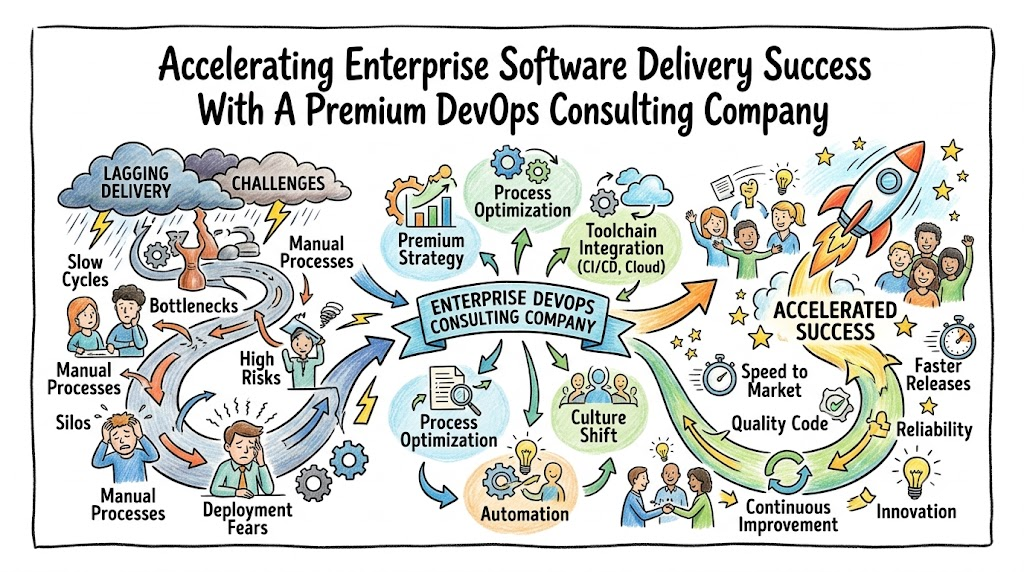
Modern enterprises frequently face severe friction when deploying software updates to production environments. Siloed engineering teams struggle with manual handoffs, broken deployment pipelines, and unpredictable infrastructure failures. Consequently, application development cycles slow down to a crawl while operational overhead skyrockets. Businesses require an experienced partner to eliminate these inefficiencies completely, which is why partnering with an elite team like Cotocus provides the exact technical guidance required to revolutionize software delivery pipelines. Choosing a premier DevOps Consulting Company allows organizations to integrate advanced automation and achieve rapid deployment cycles through specialized DevOps Consulting Services.
Streamlining Core Architecture with Cloud and Automation Strategy
Legacy infrastructure setups routinely delay product feature launches and introduce security vulnerabilities. Therefore, modern enterprises aggressively adopt Cloud Migration Services to transition their workloads to scalable, highly available cloud environments. Experienced architects evaluate legacy codebases, design multi-tenant cloud topographies, and execute seamless migrations without downtime. Furthermore, organizations leverage comprehensive Cloud Consulting Services to optimize resource consumption, prevent cloud sprawl, and control escalating infrastructure bills.
Simultaneously, engineering teams must eradicate manual provisioning to ensure consistency across staging and production environments. Implementing Infrastructure Automation Consulting allows companies to define their entire infrastructure through version-controlled code templates. Consequently, configuration drift disappears entirely because software defines every server, network, and storage bucket. To complement this automated baseline, teams deploy a robust CI/CD Pipeline Consulting framework that instantly builds, tests, and deploys code modifications upon every commit.
Managing Cloud-Native Orchestration and Modern Workflows
Containerized microservices introduce substantial operational complexity that manual tracking cannot handle. To solve this, enterprises integrate specialized Kubernetes Consulting Services to orchestrate container life cycles, manage load balancing, and ensure auto-scaling resilience. Organizations rapidly discover that container orchestration demands advanced engineering expertise to prevent configuration errors. For this reason, leadership teams invest in comprehensive Kubernetes Corporate Training to upskill internal engineering squads on production-grade cluster management.
Moreover, managing these complex environments requires declarative state enforcement to maintain absolute operational transparency. Implementing GitOps Consulting Services aligns the actual infrastructure state directly with a designated Git repository. As a result, any pull request automatically synchronizes cluster configurations, which simplifies rollbacks and audits. Ultimately, this unified approach leads directly to Platform Engineering Consulting, establishing self-service internal developer platforms that allow developers to provision resources independently without waiting for operations teams.
Safeguarding System Reliability and Security Controls
Speed without stability inevitably leads to critical production outages and tarnished brand reputations. Businesses mitigate this vulnerability by procuring SRE Consulting Services to embed proactive monitoring, logging, and tracing across distributed architectures. Engineers establish clear service level objectives to protect user experiences before errors impact the bottom line. Specialized Site Reliability Engineering Consulting ensures that software development teams share operational accountability, creating highly resilient systems that automatically heal from failures.
In parallel, rapid deployment paradigms must never compromise corporate security postures or compliance frameworks. Organizations implement DevSecOps Consulting Services to inject automated vulnerability scanning directly into the earliest phases of development pipelines. Security policies operate as automated code checks rather than manual, delayed gateways. To solidify this shift in engineering culture, customized DevSecOps Corporate Training educates development, operations, and security teams on collaborative threat modeling and real-time risk remediation.
Harnessing Intelligent Workflows and Targeted Corporate Upskilling
Modern software environments generate massive volumes of telemetry data that overwhelm traditional monitoring systems. Enterprises deploy AIOps Consulting Services to utilize machine learning algorithms that detect anomalies and predict system failures before they occur. Similarly, organizations scale their data science initiatives by adopting MLOps Consulting Services to automate the deployment, monitoring, and retraining of machine learning models. Furthermore, integrating DataOps Consulting Services ensures continuous data quality and delivery for advanced analytical processing.
However, advanced tools yield minimal value without a workforce capable of leveraging them effectively. Forward-thinking enterprises prioritize DevOps Corporate Training to align internal skill sets with modern engineering paradigms. Providing tailored DevOps Training for Companies ensures that cross-functional teams master automation frameworks, collaborative workflows, and cloud-native architectures together. This comprehensive educational foundation ensures long-term operational self-sufficiency.
Key Operational Concepts
- Infrastructure as Code (IaC) — Managing and provisioning computing infrastructure through machine-readable definition files rather than manual configuration tools.
- Continuous Integration (CI) — The automated practice of frequently merging code changes into a central repository where automated builds and tests run.
- Continuous Delivery (CD) — A software engineering approach where teams produce software in short cycles, ensuring reliably releasable software at any time.
- Microservices Architecture — An architectural design that structures an application as a collection of small, loosely coupled, and independently deployable services.
- Observability — The measure of how well internal states of a system can be inferred from knowledge of its external outputs, such as logs, metrics, and traces.
- Containerization — A lightweight form of virtualization that encapsulates an application and its dependencies into a single isolated container.
These core operational concepts interconnect to form a cohesive, automated, and highly resilient software delivery ecosystem.
DevOps vs. SRE — What’s the Real Difference?
Organizations frequently confuse cultural philosophies with operational execution methodologies when designing engineering teams. While both paradigms aim to bridge the gap between development and operations, their scope, daily metrics, and structural implementations differ significantly.
| Attribute | DevOps Philosophy | Site Reliability Engineering (SRE) |
|---|---|---|
| Primary Definition | A cultural movement focusing on collaboration, automation, and rapid delivery. | An engineering discipline applying software engineering principles to operations problems. |
| Operational Timeframe | Spans the entire lifecycle from planning and coding to deployment. | Focuses primarily on production availability, latency, efficiency, and capacity. |
| Core Ownership | Shared accountability between development and operations teams. | Dedicated SRE teams managing production platforms and automation tools. |
| Primary Failure Mode | Siloed automation tools without genuine cultural collaboration. | Over-indexing on operational tickets instead of developing long-term automation. |
| Real-World Example | Automating code builds and running security scans within a pipeline. | Defining error budgets and building automated cluster self-healing scripts. |
Conflating these two distinct disciplines causes organizational friction and fragmented engineering ownership. Consequently, companies fail to achieve both speed and stability because they lack clear definitions of operational responsibilities.
Strategic Service Alignments
Selecting the correct operational model requires a clear understanding of corporate objectives and technical requirements. The table below outlines how specific consulting interventions align with enterprise challenges.
| Business Goal | Technical Challenge | Recommended Strategy | Expected Outcome |
|---|---|---|---|
| Accelerate Feature Release | Manual environment builds | Infrastructure as Code | On-demand staging environments |
| Reduce Production Defects | Untested code deployments | CI/CD Automated Testing | Zero-downtime blue-green deployments |
| Maximize Infrastructure ROI | Over-provisioned servers | Cloud Optimization | 30% reduction in monthly cloud spend |
| Improve System Availability | Unpredictable microservice crashes | Automated Orchestration | Self-healing container deployments |
Real-World Use Cases
- Global E-Commerce Platform — Facing massive traffic spikes during seasonal sales, the organization implemented automated scaling protocols and robust container management, which resulted in zero downtime during peak shopping events.
- Financial Services Firm — Struggling with slow compliance audits, the company integrated automated compliance checks directly into their delivery pipeline, reducing audit preparation times from weeks to minutes.
- Healthcare SaaS Provider — Experiencing frequent production outages due to configuration drift, the enterprise adopted declarative environment synchronization, eliminating manual production errors completely.
- Logistics Tech Enterprise — Dealing with fragmented data pipelines, the organization deployed automated data validation workflows, which increased data processing speeds by over forty percent.
Common Mistakes
- Treating Tool Adoption as Cultural Transformation — Buying expensive software licenses without restructuring internal team communication patterns fails because broken processes simply become automated broken processes.
- Neglecting Security Until Final Production Release — Postponing security evaluations until the end of the development lifecycle introduces massive rework delays and expensive code rewrites.
- Over-Engineering Initial Pipeline Configurations — Building highly complex, multi-stage automated workflows for simple applications creates unnecessary maintenance overhead and frustrates developers.
- Failing to Define Clear Error Budgets — Pushing new software updates continuously without monitoring system stability metrics inevitably leads to catastrophic outages and low customer satisfaction.
- Ignoring Regular Post-Mortem Reviews — Overlooking operational failures without conducting blameless post-mortem investigations ensures that teams repeat identical engineering mistakes in future deployments.
- Isolating the Automation Team — Creating a separate, isolated team to manage automation scripts merely introduces a new silo that hinders cross-functional collaboration.
Implementation Roadmap
- Assessment and Culture Alignment — Evaluate current software delivery pipelines, identify structural bottlenecks, and establish collaborative organizational KPIs.
- Foundational Automation Deployment — Implement standard version control configurations, establish automated testing environments, and define infrastructure using code templates.
- Advanced Orchestration and Security Integration — Transition workloads into managed container clusters, implement declarative state enforcement, and inject automated security scanners into active pipelines.
- Intelligent Optimization and Upskilling — Deploy machine learning telemetry monitors, automate analytical data processing pipelines, and run specialized corporate training programs to elevate internal engineering capabilities.
Why Cotocus
Choosing the right partner determines the ultimate success of enterprise modernization initiatives. Cotocus stands out as a premium provider of elite technology solutions, delivering deep architectural expertise and customized corporate educational programs worldwide. The engineering team specializes in transforming fragmented, manual environments into highly automated, secure, and resilient delivery engines. As a premier Digital Transformation Consulting Company, they provide end-to-end guidance that aligns technical architecture directly with core business objectives. Their comprehensive approach guarantees that your organization adopts market-leading engineering standards while cultivating a self-sufficient internal technical culture.
FAQ
- How long does a typical enterprise cloud migration strategy take to complete?The duration depends heavily on the total architecture complexity and the underlying data volume. Small migrations often conclude within a few weeks, whereas massive enterprise transformations require several months of careful planning.
- Can security checks run automatically inside rapid development pipelines without slowing down developers?Yes, modern security scanning tools integrate directly into the background of standard code commit workflows. They flag potential vulnerabilities instantly, allowing engineers to fix code bugs before compilation ends.
- What specific metrics indicate successful automation adoption within engineering departments?Organizations track deployment frequency, lead time for changes, mean time to recovery, and change failure rates. Improving these core metrics directly correlates with higher operational efficiency and software quality.
- Why is declarative configuration superior to manual infrastructure provisioning methods?Declarative configurations define the exact desired state of your systems inside version-controlled code files. This eliminates human configuration errors and guarantees that every environment remains identical.
- How does automated anomaly detection improve standard production environment monitoring?Machine learning algorithms analyze massive streams of system telemetry data to establish baseline performance patterns. They identify subtle system deviations and alert engineers before a complete system outage occurs.
- What is the primary role of internal developer platforms in modern software engineering?Internal developer platforms provide engineering teams with curated, self-service access to infrastructure resources and deployment tools. This eliminates operational handoffs and lets developers ship code independently within safe boundaries.
Final Summary
Achieving long-term engineering velocity requires a systematic blending of cultural alignment, cutting-edge automation, and continuous workforce education. Enterprises must move past fragmented tool implementation and embrace holistic, secure, and highly reliable operational architectures. Please visit Cotocus and start with an expert structural consultation to revolutionize your enterprise software delivery capabilities today.
