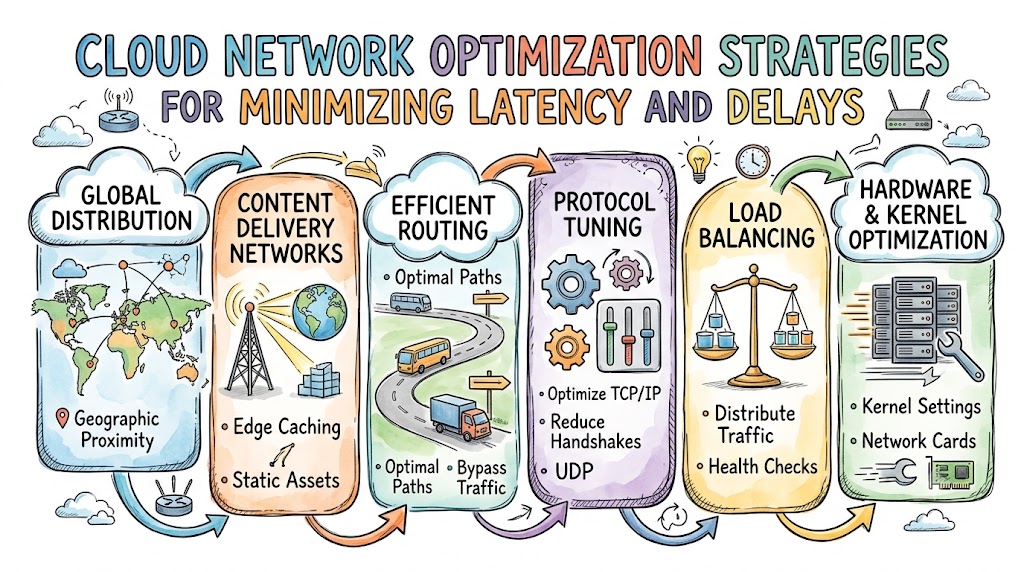
Cloud computing fundamentally changes how businesses deploy software applications worldwide. However, geometric distance and inefficient routing protocols often create unexpected performance barriers. When data travels across distributed global nodes, delays degrade user experience and reduce system efficiency significantly. Understanding these structural delays helps teams build highly responsive digital infrastructures. By implementing strategic architectural adjustments, companies can eliminate data bottlenecks and maintain peak performance levels. Consequently, optimizing your data pathways ensures that modern high-demand services remain stable under heavy traffic conditions.
To achieve superior performance, modern organizations rely on specialized service providers like Cloudopsnow to design seamless virtual environments. Therefore, eliminating structural lags requires a comprehensive approach that combines smart routing, robust caching mechanisms, and localized computing. When systems handle thousands of concurrent requests, even millisecond delays ripple across the entire infrastructure. This guide explores the foundational mechanisms governing cloud performance and outlines how to establish an ultra-low latency architecture.
Key Operational Concepts You Must Know
Understanding the Core Mechanisms of Network Latency
Network latency represents the total time a data packet takes to travel from its origin to its destination across a network. It functions as a critical benchmark for application responsiveness and overall cloud infrastructure health. High latency directly impairs real-time communication, media streaming, and transactional systems. Consequently, identifying the root causes of packet delays allows engineering teams to optimize application delivery effectively.
Several physical and logical factors contribute directly to the total delay experienced by end users. Propagation delay, transmission medium limitations, packet serialization, and switching overhead all compound to slow down data transfers. Additionally, network congestion frequently forces routers to queue packets, introducing unpredictable variable delays. By systematically dissecting these elements, engineers can accurately pinpoint where bottlenecks occur within their network topology.
The Critical Role of Round-Trip Time (RTT)
Round-Trip Time measures the exact duration required for a data packet to travel to a destination and return its confirmation. This metric serves as a foundational baseline for measuring the interactive performance of cloud-hosted software applications. When RTT spikes, application performance drops, creating noticeable lag for end users attempting to interact with the system. Therefore, keeping RTT minimal remains a top priority for distributed software architectures.
Many operational elements influence RTT, including physical distance, routing complexity, and the number of network hops between points. Protocol handshakes, such as those used in TCP and TLS connections, also add multiple round trips before actual data transfers begin. To combat this overhead, modern infrastructures utilize persistent connections and edge computing nodes to handle requests closer to users. Minimizing these round trips directly translates into snappy, responsive user interfaces.
+------------+     Data Packet (Propagation + Hops)      +-----------------+
|            | ----------------------------------------> |                 |
|   Client   |                                           |   Cloud Server  |
|            | <---------------------------------------- |                 |
+------------+   Acknowledgment Packet (Return Journey)  +-----------------+
|============|============= Total RTT ===================|=================|
Bandwidth vs. Latency: Distinguishing Throughput from Speed
Bandwidth and latency represent two distinct dimensions of network performance that engineers must never confuse during system design. Bandwidth defines the maximum volume of data that a communication channel can transmit over a specific timeframe. In contrast, latency measures the time delay before a given data transfer actually begins its journey. Thus, a high-bandwidth connection can still suffer from poor performance if its latency remains high.
- High Bandwidth, High Latency: Ideal for massive, non-urgent data transfers like bulk nightly backups.
- Low Bandwidth, Low Latency: Perfect for instant messaging, voice calls, and real-time financial trading systems.
- High Bandwidth, Low Latency: The gold standard for modern cloud applications, live video streaming, and interactive gaming.
When building cloud systems, expanding bandwidth will not resolve application delays caused by poor propagation or excessive routing hops. If a packet takes too long to travel, adding a wider data pipe leaves the delivery time unchanged. Therefore, optimizing performance requires a dual focus on both expanding capacity and eliminating structural communication delays. Balancing these two metrics helps operations teams deliver consistent, reliable, and lightning-fast user experiences.
Content Delivery Networks (CDNs) and Edge Computing
Content Delivery Networks resolve geographical latency by caching static and dynamic application assets on geographically distributed edge servers. By moving content closer to the physical location of the end user, CDNs bypass long distance data transit. This architecture reduces the load on central origin servers while speeding up asset delivery drastically. As a result, users experience instantaneous page loads regardless of their distance from the primary data center.
Edge computing extends this philosophy by moving actual processing power and computational logic to the periphery of the network. Instead of merely storing static files, edge nodes run microservices, validate API requests, and manipulate data locally. This setup eliminates the need to route every minor transaction back to a centralized cloud data center. Consequently, local data processing slashes response times and reduces the overall traffic traversing core network backbones.
Platform Implementation vs. Culture — What’s the Real Difference?
| Operational Aspect | Platform Implementation Focus | Cultural & Mindset Focus |
|---|---|---|
| Tooling and Infrastructure | Deploying automated CI/CD pipelines, configuring service meshes, and provisioning cloud hardware. | Fostering shared responsibility, encouraging continuous learning, and eliminating operational silos. |
| Monitoring and Observability | Installing APM agents, setting up log aggregators, and creating metrics dashboards. | Defining meaningful SLOs, understanding user experience impact, and prioritizing alerts. |
| Incident Management | Executing automated rollbacks, triggering auto-scaling policies, and alerting on-call engineers. | Conducting blameless post-mortems, analyzing systemic root causes, and improving workflows. |
| Performance Optimization | Tweaking kernel parameters, optimizing database queries, and configuring CDN caching. | Embedding efficiency into design phases, prioritizing performance budgets, and valuing speed. |
Technical Execution vs. Behavioral Alignment
Platform implementation centers squarely on the technical tools, automation frameworks, and software configurations required to run cloud systems. Engineers focus heavily on writing infrastructure as code, setting up load balancers, and orchestrating container environments. While these technical components are essential, they merely represent the foundational mechanics of an organization’s operations. Without proper alignment, even the most sophisticated platform can fail to deliver its intended business value.
Cultural focus, conversely, addresses the human behaviors, communication patterns, and shared mindsets within an engineering organization. A healthy culture encourages teams to take ownership of their services, share knowledge openly, and embrace automated systems. When a culture prioritizes collaboration, developers naturally design software that integrates smoothly with the underlying platform. Therefore, blending technical excellence with a supportive cultural environment creates a resilient operational ecosystem.
Bridging the Gap Between Tools and Processes
To maximize efficiency, organizations must align their technical tools directly with their daily operational workflows and business strategies. Introducing advanced monitoring tools provides little value if the team lacks a defined process for handling alerts. Similarly, automation pipelines remain ineffective if bureaucratic approval layers continuously stall software deployments. Therefore, successful companies design their processes to amplify the power of their technical infrastructure.
   +---------------------------+
   |   Engineering Culture     |  <-- Drives shared mindset and ownership
   +---------------------------+
                 |
                 v
   +---------------------------+
   |   Operational Processes   |  <-- Standardizes workflows and collaboration
   +---------------------------+
                 |
                 v
   +---------------------------+
   |  Platform Infrastructure  |  <-- Automates and executes the technical tasks
   +---------------------------+
Building this bridge requires regular cross-functional communication, standard operating procedures, and continuous training programs for engineering staff. When developers understand how their code affects network latency, they proactively write highly efficient software architectures. This shared understanding transforms automated platforms from restrictive boundaries into empowering tools that accelerate software delivery. Ultimately, integrating technology with human processes leads to sustainable, long-term operational success.
Real-World Use Cases of Modern Operations
High-Frequency Trading Systems and Financial Platforms
In the world of high-frequency trading, a single millisecond of network latency can cause significant financial losses. Financial platforms require ultra-low latency architectures to execute trades ahead of market shifts and competitor algorithms. Operations teams achieve this by deploying specialized private cloud connections, customized kernel network stacks, and bare-metal instances. These technical choices minimize data processing overhead and keep transaction execution speeds near physical limits.
Furthermore, these systems use advanced geographical placement strategies, co-locating cloud infrastructure inside the data centers of major stock exchanges. By reducing physical distance down to meters, they minimize propagation delays to absolute sub-millisecond levels. Engineers also optimize their network routing tables aggressively, removing intermediate hops and using kernel-bypass technologies like SR-IOV. This meticulous optimization ensures that financial transactions process instantly, securing a vital competitive edge.
Global E-Commerce Platforms During Peak Traffic Events
Global e-commerce platforms experience massive surges in user traffic during seasonal holiday shopping events and major promotional sales. During these traffic spikes, high network latency directly reduces sales conversions as frustrated shoppers abandon slow-loading checkout pages. Operations engineers prepare for these events by implementing geo-replicated database clusters and multi-region cloud architectures. This approach distributes the user load evenly across multiple global data centers, maintaining fast response times.
[Global Shoppers]
       |
       +---> [Edge CDN Nodes] ----> (Instant Static Asset Delivery)
       |
       +---> [Geo-Routed Load Balancers]
                     |
                     +---> [Region A Compute Cluster] ---> [Local DB Mirror]
                     |
                     +---> [Region B Compute Cluster] ---> [Local DB Mirror]
To protect core transactional services, these platforms rely on aggressive caching strategies for product catalogs and user sessions. They deploy localized edge compute functions to validate discount codes and filter out malicious bot traffic before it reaches main databases. Additionally, automated auto-scaling policies dynamically provision extra network capacity and compute nodes to handle sudden traffic spikes. This proactive management keeps the user experience smooth, reliable, and fast under heavy loads.
Real-Time Multiplayer Gaming Infrastructure
Modern multiplayer games demand consistent, ultra-low latency connections to synchronize fast-paced gameplay across thousands of simultaneous players. High latency or sudden packet jitter causes jarring visual synchronization issues that ruin the player experience completely. To prevent this, gaming companies deploy dedicated game server fleets at the edge of various consumer networks. This ensures that game state updates travel minimal distances to reach players.
- Anycast Routing: Directs players automatically to the nearest healthy game server instance, minimizing connection length.
- UDP Custom Protocols: Bypasses TCP handshake overhead to transmit state updates rapidly without delivery confirmation delays.
- Edge State Synchronization: Calculates player movements locally at the network edge before syncing back to central databases.
Operations teams continuously monitor network paths between players and servers using sophisticated telemetry systems to catch routing anomalies early. When internet routing paths degrade, the infrastructure dynamically redirects player connections to cleaner, faster alternative network pathways. This real-time traffic management keeps match connectivity stable and provides a fair, seamless environment for competitive players worldwide.
Common Mistakes in Operations Engineering
Misconfiguring Cloud Load Balancers and Traffic Gateways
A frequent and costly mistake in cloud infrastructure design is misconfiguring application load balancers and global traffic gateways. Engineers often routing public traffic through a single centralized load balancer located far away from the actual user base. This poor setup introduces unnecessary geographical loops, forcing data packets to travel thousands of miles out of their way. Consequently, user connection setups slow down significantly, causing artificial delays across the entire application ecosystem.
[User in London] --------> (Incorrectly Routed to US East Load Balancer) --------> [App Server in London]
                                   |                                                 ^
                                   +------------------ Long Network Loop ------------+
Furthermore, failing to enable advanced protocols like HTTP/2 or HTTP/3 on your entry gateways creates severe connection bottlenecks. Older protocols force web browsers to open multiple parallel TCP connections, creating head-of-line blocking and heavy handshake overhead. Operations teams must ensure that their load balancers handle SSL/TLS terminations close to users via distributed edge networks. This technical adjustment drastically shortens connection handshakes and accelerates the delivery of application content.
Neglecting Geographic Proximity and Region Selection
Another widespread error is ignoring geographic proximity when selecting cloud regions for compute resources and primary databases. Development teams often provision their cloud services in default regions without analyzing where their actual user base resides. This lack of planning forces data requests to cross oceans unnecessarily, introducing high physical propagation latency. No amount of software optimization can overcome the physical speed-of-life limits imposed by poor regional placement.
To resolve this issue, operations engineers should carefully analyze user demographics and place core services in matching cloud regions. For globally distributed audiences, implementing a multi-region deployment strategy ensures that data stays close to local markets. Using modern data synchronization tools allows databases to remain updated across various regions without blocking local write actions. This smart geographical placement forms the foundation of any successful low-latency cloud architecture.
Over-Reliance on Default Network Rules and Stock Routing
Many organizations leave their cloud network configurations on default settings, trusting cloud providers to route traffic optimally out of the box. Default routing paths often prioritize cost savings or general provider convenience over raw connection speed. This means your data packets might transit across crowded public internet pathways, suffering from congestion and high jitter. Relying on standard public routes leaves your application vulnerable to the unpredictable performance shifts of the public web.
Public Internet Route:  [App Server] ---> [Public Transit Hops] ---> [Congested Paths] ---> [User] (High Latency)
Optimized Cloud Route:   [App Server] ---> [Dedicated Premium Backbone Network] ------------> [User] (Low Latency)
To achieve reliable performance, teams should leverage premium cloud network tiers that route traffic through private global fiber backbones. These specialized private networks bypass public internet congestion, ensuring stable data delivery and predictable, low-latency performance. Additionally, setting up custom internal routing tables and utilizing specialized transport protocols helps eliminate unnecessary network processing layers. This intentional routing control protects your infrastructure from the performance degradations common to standard internet routing.
How to Become an Operations Expert — Career Roadmap
Mastering Fundamental Networking and Operating System Internals
To become an elite operations expert, you must first build a deep understanding of core networking protocols and operating system internals. You must thoroughly master the details of the OSI model, TCP/IP protocol suites, and modern UDP-based transport layers. Understanding how operating systems handle network sockets, manage memory buffers, and schedule CPU threads is essential for tuning high-performance systems. This foundational knowledge allows you to troubleshoot complex performance issues that superficial abstraction tools often hide.
- Linux Systems: Dive deep into the Linux kernel configuration, learning how to optimize network stack parameters using
sysctl. - Packet Analysis: Master packet capture tools like Wireshark and
tcpdumpto diagnose packet drops and routing issues directly. - Process Architecture: Learn how system interrupts, context switching, and file descriptor limits impact network throughput.
Additionally, spend time learning how modern container runtimes interact with host networking stacks through virtual bridges and namespaces. Understanding these low-level communication pathways helps you design container networks that avoid heavy performance degradation. This deep technical competence separates top-tier operations architects from engineers who rely solely on automated cloud control panels.
Gaining Hands-on Experience with Infrastructure as Code (IaC)
Modern operations rely entirely on code-driven automation; therefore, mastering Infrastructure as Code (IaC) tools is mandatory for career growth. You should become highly proficient in declarative tools like Terraform to define and provision complex cloud environments reliably. Writing clean, modular IaC allows you to deploy reproducible, consistent infrastructure across multiple clouds without manual errors. This practice ensures that network topologies, firewall rules, and load balancers match your performance standards perfectly every time.
+------------------------+      Applies Code      +------------------------+
|   Terraform / IaC      | ---------------------> |  Reproducible, Low-    |
|   Declarative Code     |                        |  Latency Cloud Network |
+------------------------+                        +------------------------+
Beyond basic provisioning, you must master configuration management utilities and automated CI/CD pipeline platforms to streamline your delivery workflows. Learn to build automated verification testing directly into your deployment pipelines to check network configurations before they hit production. This automated approach reduces human configuration errors, guarantees security policy alignment, and shortens deployment cycles. Consequently, engineering teams can iterate rapidly while maintaining a highly stable and performant cloud infrastructure.
Developing Deep Observability and Monitoring Competency
An operations expert must be able to gain clear visibility into complex, distributed software environments through robust observability systems. You need to become an expert at collecting, correlating, and interpreting the three pillars of observability: metrics, logs, and traces. Learn to configure advanced monitoring setups using Prometheus, Grafana, and distributed tracing systems like OpenTelemetry to track data flows. These tools allow you to pinpoint the exact microservice or network link causing performance issues.
             +---------------------------------------+
             |    Observability Dashboard (Grafana)   |
             +---------------------------------------+
               ^                 ^                 ^
               |                 |                 |
        [Metrics Data]     [Distributed Tracing]  [Structured Logs]
        (Prometheus)         (OpenTelemetry)      (Log Aggregators)
Furthermore, focus on establishing clear Service Level Indicators (SLIs) and Service Level Objectives (SLOs) centered around user experience. You must learn to separate background noise from critical alerts, designing notification systems that flag genuine anomalies before they cause outages. This analytical skill ensures that your engineering team focuses on solving high-priority architectural bottlenecks rather than chasing minor false alerts. Ultimately, deep observability turns raw data into actionable insights, keeping your cloud platform running smoothly.
FAQ Section
- What is the difference between network latency and throughput?Network latency represents the time delay encountered as a packet travels across a network, while throughput measures the volume of data moving through that connection per second. High throughput lets you move huge amounts of data at once, but high latency means each individual packet takes a long time to start its journey. Both metrics are critical for comprehensive cloud performance tuning.
- How does Anycast routing help reduce network delays?Anycast routing assigns a single IP address to multiple distributed data centers worldwide, routing user packets automatically to the nearest physical location. This minimizes physical transit distance, reduces network hops, and routes traffic away from congested lines. It provides automatic failover and keeps applications highly responsive for global audiences.
- Why does TCP handshake overhead increase application latency?The traditional TCP handshake requires multiple back-and-forth communication rounds between client and server to establish a secure connection. This round-trip process creates noticeable delay before actual data can transfer, especially over long distances. Modern cloud protocols like HTTP/3 use QUIC to combine connection and encryption handshakes, drastically reducing setup times.
- Can adding more bandwidth fix high latency issues?No, increasing bandwidth only expands your network’s data capacity; it does not accelerate the travel speed of individual data packets. If delays are caused by geographic distance or complex routing hops, widening the network path leaves response times unchanged. To resolve latency, you must shorten physical distances or optimize routing paths.
- What role does a Service Mesh play in internal cloud latency?A Service Mesh manages communication between internal microservices, providing advanced routing, encryption, and telemetry controls. While it adds a minor processing layer via sidecar proxies, it prevents latency spikes through smart load balancing and rapid circuit breaking. This architecture keeps internal service communications predictable, organized, and visible.
Final Summary
Maximizing cloud network performance requires an organized strategy that combines deep technical knowledge with an automation-first engineering mindset. Minimizing application latency requires a thorough understanding of routing protocols, hardware placement, and connection management. By eliminating common configuration errors and leveraging distributed edge architectures, teams can ensure their platforms scale efficiently. Ultimately, treating performance optimization as a core engineering value results in robust, highly responsive applications that deliver superior user experiences.

