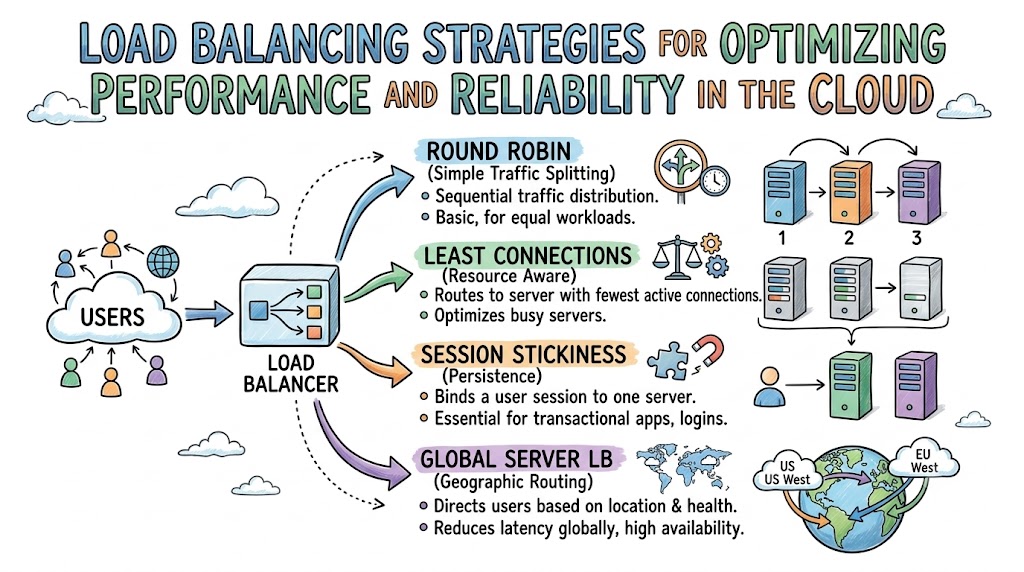
Cloud computing relies on efficient traffic distribution to prevent individual servers from becoming overwhelmed by sudden user demands. When an application receives millions of concurrent requests, a single infrastructure bottleneck can completely disrupt the user experience. Load balancing addresses this structural challenge by acting as an intelligent traffic cop for your network. By spreading incoming requests evenly across multiple healthy computing nodes, it prevents downtime and maximizes data delivery speed. Consequently, integrating advanced distribution mechanisms ensures that modern cloud services remain resilient under heavy operational strains.
To achieve consistent platform speed, forward-thinking organizations leverage specialized services from Cloudopsnow to design seamless virtual network topologies. Eliminating internal performance bottlenecks requires a clear architecture that balances network throughput, prevents node exhaustion, and reroutes faulty data paths automatically. When systems process heavy transaction volumes, structural issues ripple quickly across your entire backend stack. This comprehensive guide explores how load balancing optimizes cloud performance and outlines how to establish an ultra-low latency system.
Key Operational Concepts You Must Know
Understanding Load Balancing in Modern Cloud Infrastructures
Load balancing sits at the heart of distributed computing by systematically routing client requests to optimal backend computing servers. It functions as a critical abstraction layer that shields users from underlying server complexities, hardware upgrades, and infrastructure failures. Without this component, public web traffic would hit single entry points directly, creating major system overloads. Therefore, mastering traffic distribution architectures allows engineering teams to keep modern cloud applications scalable and responsive.
Several operational rules dictate how these distribution systems route packets across local or global cloud environments. The load balancer continuously evaluates backend server capacities, active session counts, and physical network paths in real time. Additionally, it handles SSL/TLS termination, decrypting incoming traffic at the edge to reduce heavy processing workloads on backend nodes. By isolating these infrastructure tasks, operations engineers can scale their computational resources efficiently without interrupting active user connections.
The Role of Layer 4 vs. Layer 7 Routing
Network traffic distribution happens primarily at two distinct layers of the Open Systems Interconnection (OSI) communication model. Layer 4 balancing operates strictly at the transport layer, utilizing protocol data like IP addresses and TCP port numbers to route packets. This method requires minimal computational processing because the load balancer never opens or inspects the underlying application payload. As a result, Layer 4 routing provides blazing-fast packet delivery for high-volume network traffic.
Layer 4 Routing (Transport Layer):
[Client Traffic] ---> [L4 Load Balancer] (Inspects IP & Port Only) ---> [Target Server]

Layer 7 Routing (Application Layer):
[Client Traffic] ---> [L7 Load Balancer] (Inspects HTTP Headers, Cookies, URL) ---> [Specific Microservice]
Layer 7 balancing operates directly at the application layer, giving engineers deep visibility into HTTP headers, cookies, and URL paths. This context allows the system to make smart, content-aware routing decisions, such as sending media requests to image clusters. While Layer 7 routing demands more processing power to decrypt data, it enables complex microservices architectures and granular traffic control. Balancing these two routing methods helps operations teams achieve optimal performance while keeping resource usage highly efficient.
Health Checks and High Availability Mechanisms
High availability depends heavily on automated health checks that continuously monitor the operational status of backend compute servers. Load balancers send periodic requests, such as HTTP pings or TCP handshakes, to verify that servers are responding correctly. If a server fails multiple health checks due to application crashes or resource exhaustion, it is instantly removed from the active routing pool. This automated isolation prevents users from encountering broken links and frustrating system errors.
- Passive Health Checks: Monitors live application traffic to detect sudden server errors without sending extra test requests.
- Active Health Checks: Sends synthetic test packets at set intervals to confirm deep application components are working.
- Graceful Degradation: Safely drains active connections from a failing server before taking it offline for maintenance.
When an isolated server recovers and passes consecutive health checks, the load balancer gradually reintroduces it to incoming traffic. This self-healing process allows cloud architectures to handle unexpected hardware failures without manual engineering intervention. By automating node monitoring, systems maintain continuous availability even during unexpected backend disruptions. Consequently, robust health checks form the baseline of reliable, automated infrastructure management.
Global Server Load Balancing (GSLB) Explained
Global Server Load Balancing (GSLB) extends traffic distribution beyond single data centers by routing users across geographically separated cloud regions. GSLB uses DNS manipulation, Anycast routing, and real-time health metrics to send users to the closest available data center. This geographic routing reduces physical propagation delays by ensuring data packets travel the shortest possible distance. As a result, international users experience snappy response times regardless of where the main application database resides.
                        +----------------------------+
                        |  User Requests (Worldwide) |
                        +----------------------------+
                                       |
                                       v
                        +----------------------------+
                        | Global Server Load Balancer|
                        +----------------------------+
                                /            \
                               /              \
                              v                v
                  +-----------------------+   +-----------------------+
                  + US West Data Center   +   + EU West Data Center   +
                  +-----------------------+   +-----------------------+
Beyond reducing latency, GSLB provides critical disaster recovery protection by acting as a shield against complete regional cloud outages. If a massive storm or fiber cut takes an entire data center offline, GSLB automatically reroutes global traffic to surviving regions. This seamless redirection happens in seconds, protecting businesses from costly extended downtime and maintaining brand reliability. Implementing global distribution ensures that your software platforms remain constantly accessible to a global audience.
Platform Implementation vs. Culture — What’s the Real Difference?
| Operational Aspect | Platform Implementation Focus | Cultural & Mindset Focus |
|---|---|---|
| Traffic Management | Deploying reverse proxies, configuring weighted algorithms, and establishing SSL handshakes. | Embracing data-driven design, prioritizing user experience, and treating capacity as a shared metric. |
| System Resilience | Building redundant load balancer pairs, writing failover scripts, and isolating server zones. | Developing a chaos engineering mindset, accepting failure as inevitable, and running game days. |
| Scaling Strategy | Setting up horizontal auto-scaling triggers, tracking CPU limits, and managing instance pools. | Designing microservices for decoupling, avoiding monolithic dependencies, and mapping tech to growth. |
| Operational Visibility | Exporting access logs, tracking request rates, and setting up real-time latency dashboards. | Building open feedback loops, conducting blameless incident reviews, and valuing operational transparency. |
Technical Architecture vs. Team Alignment
Platform implementation covers the physical deployment of advanced load balancing software, reverse proxies, and cloud infrastructure settings. Engineers focus on fine-tuning network parameters, choosing distribution algorithms, and securing entry connections with valid certificates. These technical foundations are necessary to handle incoming user requests and keep data flowing smoothly across your infrastructure. However, high-tech tools alone cannot protect a system from poorly aligned development practices.
Cultural focus addresses how engineering teams communicate, handle mistakes, and prioritize application performance throughout the development lifecycle. A healthy tech culture encourages developers to understand how their code choices impact network load and resource consumption. When software teams share responsibility for infrastructure stability, they naturally write code that scales cleanly within automated systems. Blending engineering excellence with a collaborative culture turns basic infrastructure into an agile tool for growth.
Integrating Automated Tools with Organizational Workflows
To achieve long-term efficiency, companies must integrate their load balancing tools directly into their daily development and deployment pipelines. Adding an advanced Layer 7 load balancer offers little benefit if manual approval processes delay simple traffic routing adjustments. Similarly, automated scaling systems fail if development teams launch monolithic applications that take twenty minutes to start up. Therefore, organizations must build simple, automated processes that match the agility of their cloud platforms.
   +---------------------------+
   |   Collaborative Culture   |  <-- Encourages performance accountability
   +---------------------------+
                 |
                 v
   +---------------------------+
   |  Standardized Workflows   |  <-- Automates canary tests and traffic shifts
   +---------------------------+
                 |
                 v
   +---------------------------+
   | Automated Load Balancer   |  <-- Executes smooth routing and scaling
   +---------------------------+
Bridging this operational gap requires regular cross-training, shared monitoring dashboards, and unified goals across development and infrastructure teams. When software developers understand how load balancers route traffic, they design stateless services that scale up instantly. This shared knowledge prevents common deployment bottlenecks, enabling clean canary rollouts and automated rollbacks with zero user downtime. Ultimately, combining human collaboration with technical automation creates a modern, resilient cloud network.
Real-World Use Cases of Modern Operations
Media Streaming Platforms with High Concurrent Audiences
Popular media streaming platforms face massive traffic spikes when hit shows launch or major live events broadcast to millions. These platforms use advanced load balancing networks to distribute heavy video data streams across multiple regional content hubs. Layer 7 distribution systems inspect incoming requests to verify user subscription tiers and route traffic to optimized video delivery nodes. This precise management prevents video buffering, maintains clear resolution, and keeps playback smooth for global viewers.
Furthermore, streaming architectures combine internal load balancing with geo-distributed content delivery networks to manage bandwidth consumption effectively. The system tracks real-time network conditions and changes bitrates dynamically based on connection quality and local server loads. If an edge delivery node becomes congested, traffic shifts instantly to an underutilized server nearby without interrupting the video stream. This proactive traffic management keeps the viewing experience stable and reliable even during massive global viewing events.
Enterprise SaaS Applications Handling Variable API Workloads
Enterprise software-as-a-service (SaaS) platforms process highly unpredictable workloads, ranging from light daytime user browsing to massive nightly batch database operations. Operations teams use smart load balancing strategies to separate interactive user traffic from heavy background data integration tasks. By assigning dedicated routing paths to specific API endpoints, they prevent long-running database reports from slowing down front-end applications. This strategic separation keeps the core software snappy and responsive for active customers.
[Incoming API Traffic]
          |
          v
[Layer 7 Load Balancer]
      /         \
     /           \
    v             v
[Interactive UI Services]   [Heavy Batch Job Workers]
(Fast Response Pool)        (Background Processing Pool)
Additionally, SaaS providers use load balancers to implement strict rate-limiting policies that protect internal microservices from intentional or accidental abuse. If a client script malfunctions and floods the API with millions of identical requests, the entry gateway blocks the excess traffic. This isolation keeps the rest of the multitenant cloud infrastructure safe, stable, and performant for all other clients. Using load balancing as a security shield helps software companies provide consistent, reliable service level agreements.
Distributed Financial Transaction Processing Infrastructures
Modern banking and digital payment applications require extreme reliability and ultra-low latency to authorize financial transactions securely. Because a multi-second delay can cause timeout errors or duplicate charges, these platforms use zero-downtime load balancing architectures. Payment systems deploy redundant load balancers across separate availability zones, using active-passive pairings to handle sudden infrastructure failures instantly. This design ensures that payment processing stays online even if a major cloud network segment drops completely.
- Least Connections Algorithm: Routes new transactions to servers with the lightest active load, keeping processing speeds uniform.
- Sticky Session Management: Safely binds a user’s transaction steps to a single backend secure server for the duration of checkout.
- Hardware-Accelerated SSL: Handles complex data encryption at the load balancer layer to save valuable database processing power.
Operations teams continuously monitor connection times and data processing steps using deep network telemetry tools. If a backend database begins to slow down, the load balancer shifts traffic to healthy database replicas automatically. This dynamic adjustment prevents processing bottlenecks, ensuring that digital payments complete securely within fractions of a second. Maintaining this level of traffic control helps financial institutions protect customer trust and prevent revenue loss.
Common Mistakes in Operations Engineering
Using the Wrong Load Balancing Algorithm for Complex Workflows
A frequent mistake in cloud network design is relying on the default Round-Robin algorithm for applications with highly complex workloads. Round-Robin distributes incoming traffic sequentially down the line of servers, assuming every request demands the exact same processing power. However, if a heavy database query lands on a server already handling complex calculations, that node quickly becomes overwhelmed. Consequently, users stuck on that specific server experience severe slowdowns while neighboring instances sit completely idle.
Round-Robin (Inefficient for Mixed Workloads):
[Request 1: Light]  ---> [Server A] (Idle)
[Request 2: Heavy]  ---> [Server B] (OVERLOADED)
[Request 3: Medium] ---> [Server C] (Idle)

Least Connections (Balanced & Optimized):
[Request 1: Light]  ---> [Server A] (Handling 1)
[Request 2: Heavy]  ---> [Server B] (Handling 1)
[Request 3: Medium] ---> [Server C] (Routes here because it has 0 active links)
To avoid these resource bottlenecks, operations engineers should carefully match distribution algorithms to the actual behavioral patterns of their software. For example, using the Least Connections algorithm ensures that new requests route to servers with the lightest active workload. For web applications that rely on persistent client connections, using weighted routing options prevents individual servers from running out of memory. Selecting the right algorithm balances your infrastructure load perfectly, keeping performance stable across all active nodes.
Overlooking Single Points of Failure within Balancing Layers
Another critical vulnerability occurs when teams deploy an advanced multi-node application backend but route all public traffic through a single load balancer instance. If that lone traffic controller crashes due to software bugs, configuration errors, or cloud hardware issues, the entire application dies instantly. Despite having dozens of healthy backend compute servers running, users cannot reach the system because the entry path is broken. This oversight turns a highly scalable architecture into an easily disrupted network layout.
To build a truly resilient system, operations teams must ensure that every single balancing tier features built-in high availability redundancy. This is achieved by deploying load balancers in active-active or active-passive pairings across multiple separate cloud availability zones. Floating virtual IP addresses allow traffic to migrate instantly to the backup node if the primary balancer goes offline. Eliminating single points of failure at the entry gateway protects your cloud application from unexpected infrastructure drops.
Setting Up Poorly Optimized Timeout and Health Check Policies
Configuring aggressive or overly loose health check settings can introduce severe stability issues and trigger false alarms across your network. If health checks run too frequently with strict timeout rules, a brief, normal server CPU spike can cause it to be misclassified as dead. The balancer then drops the healthy instance, forcing remaining nodes to absorb the extra traffic, which often triggers a cascading failure. Conversely, loose health policies keep broken servers in the rotation for too long, exposing users to broken pages.
Aggressive Checks: [Brief Server Spike] ---> [Misclassified as Dead] ---> [Dropped from Pool] ---> [Remaining Servers Overload]
Optimized Checks:  [Brief Server Spike] ---> [Monitored Closely]     ---> [Recovers Safely]   ---> [System Stays Stable]
Engineers must balance their monitoring parameters by thoroughly testing how their specific applications behave under heavy loads. Set connection timeout limits that leave enough room for normal processing delays while catching genuine server hangs early. Additionally, require multiple consecutive successful or failed checks before shifting a server’s status in the active routing pool. Fine-tuning these thresholds protects your network from erratic traffic shifts, ensuring consistent uptime and stable performance.
How to Become an Operations Expert — Career Roadmap
Developing Expertise in Network Protocols and Traffic Engineering
To scale your career as an elite operations expert, you must build a deep understanding of core network routing and traffic protocols. You must master the inner workings of TCP/IP handshakes, flow control mechanisms, and modern UDP-based application delivery options. Understanding how data packets travel across global internet exchanges helps you spot and fix complex performance issues that automated dashboards miss. This technical background empowers you to build highly efficient cloud network architectures from scratch.
- BGP Routing: Study how Border Gateway Protocol directs data paths across major global internet providers.
- Traffic Shaping: Learn how to use rate-limiting and priority queuing to protect core application services.
- Anycast Deployment: Master the art of configuring single IP architectures to direct global users efficiently.
Additionally, spend time exploring how modern operating system kernels manage network socket buffers and handle high-volume packet incoming interrupts. Learning how to modify kernel settings allows you to maximize data throughput and minimize latency on high-traffic entry gateways. This technical mastery elevates your skill set, shifting you from basic configuration tasks to designing top-tier global enterprise infrastructures.
Automating Infrastructure and Traffic Policy Deployments
Modern enterprise operations require complete automation; therefore, mastering infrastructure orchestration and configuration tools is crucial for career progression. You should become highly proficient in using Terraform or OpenTofu to define your load balancers, routing tables, and firewalls as code. Writing clean, declarative scripts ensures your network setups can be reproduced identically across staging, testing, and production environments. This automation cuts out human configuration errors, making deployments safe, fast, and highly predictable.
+------------------------+      Deploys Code      +------------------------+
|   Terraform / IaC      | ---------------------> | Redundant, Automated   |
|   Network Topology     |                        | Cloud Load Balancers   |
+------------------------+                        +------------------------+
Beyond basic provisioning, you must integrate your network infrastructure changes directly into automated GitOps pipelines and software deployment workflows. Learn to use tools like Ansible or automated scripts to dynamic update routing weights during canary or blue-green application updates. This approach allows your platform to shift traffic away from older software versions automatically based on live health performance data. As a result, your team can launch new features rapidly while maintaining a highly stable system.
Mastering Observability Tools and Telemetry Management
An expert operations engineer must maintain total visibility across complex, distributed system networks by deploying advanced telemetry and observability platforms. You need to become fluent in gathering, analyzing, and connecting high-volume system logs, granular metrics, and distributed request traces. Master tools like Prometheus, Grafana, and OpenTelemetry to track exactly how data requests cross your load balancers and microservices. This granular visibility helps you pinpoint the specific database query or network hop causing application delays.
             +---------------------------------------+
             |    Centralized Grafana Dashboard      |
             +---------------------------------------+
               ^                 ^                 ^
               |                 |                 |
        [Gateway Metrics]  [Distributed Tracing]  [Access Logs]
        (Prometheus Data)    (OpenTelemetry)      (Vector / Loki)
Furthermore, learn to set up smart alert systems focused on core user-experience metrics like error percentages and connection response trends. Train yourself to build alerting filters that ignore harmless background noise while instantly catching genuine system abnormalities before users complain. Developing this analytical capability allows your engineering team to address brewing performance issues long before they cause major system outages. Ultimately, deep observability turns raw operational data into clear, actionable system improvements.
FAQ Section
- How does a load balancer help reduce application network latency?A load balancer reduces latency by routing user requests to the closest healthy data center and distributing traffic evenly across backend servers. This strategy prevents individual servers from becoming overloaded, which keeps processing times fast and consistent. It also ends connection bottlenecks at the entry gateway by terminating SSL/TLS encryption close to the user.
- What is the main difference between Layer 4 and Layer 7 load balancing?Layer 4 load balancing routes traffic based strictly on basic network data like IP addresses and TCP ports, requiring very little processing power. Layer 7 balancing operates at the application layer, inspecting HTTP headers, cookies, and URLs to make highly specific, content-aware routing decisions. Layer 4 focuses on raw packet speed, while Layer 7 provides advanced, flexible application routing.
- Why should companies avoid relying solely on Round-Robin routing?Round-Robin distributes incoming traffic sequentially down the line, assuming every application request demands the same amount of CPU and memory power. If heavy data requests hit the same server consecutively, that node can quickly overload while other servers sit idle. Using advanced algorithms like Least Connections balances workloads much more effectively.
- What does SSL termination mean, and where should it occur?SSL termination is the process of decrypting encrypted user traffic at the load balancer level before passing the clean data to internal servers. Handling this intensive decryption at the edge saves valuable CPU power on backend application and database nodes. This architecture speeds up response times and simplifies how you manage security certificates.
- How do automated health checks protect users from web errors?Automated health checks test backend servers at regular intervals using synthetic pings or connection handshakes to confirm they are working correctly. If a server fails these tests due to a crash or overload, the balancer instantly drops it from the active routing pool. This quick action ensures users are never routed to broken or unresponsive pages.
Final Summary
Optimizing cloud network networks requires a smart traffic distribution plan that combines robust automation with clear architectural insights. Utilizing advanced load balancing ensures that application workloads stay uniform, preventing single server drops from causing complete system outages. By choosing the right distribution algorithms and avoiding single points of failure, engineering teams can scale their digital services safely. Ultimately, prioritizing smart traffic management results in highly reliable, fast applications that deliver a consistently excellent user experience.
