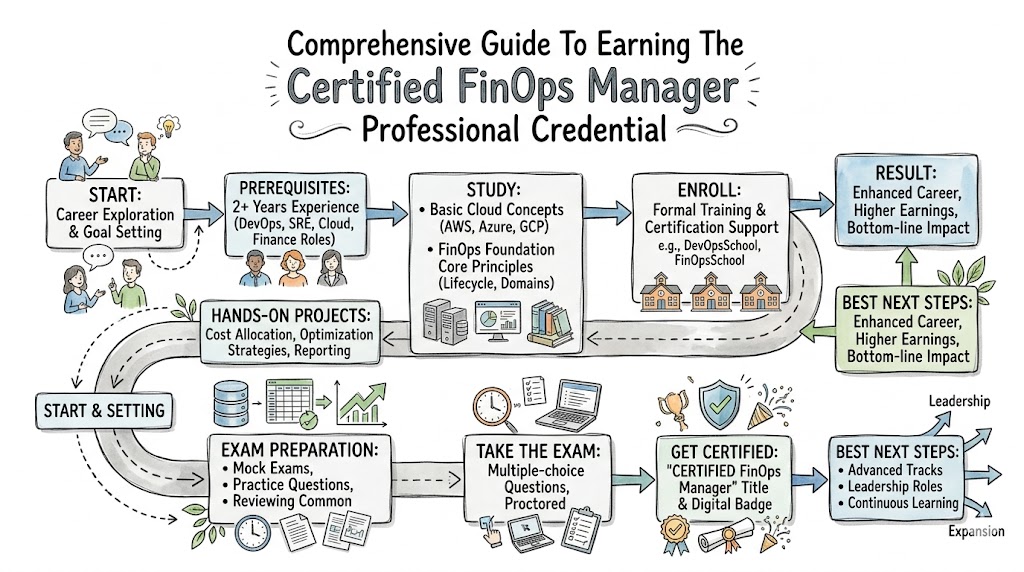
The cloud computing landscape has shifted from simple migration to complex cost optimization and financial accountability. This guide provides a detailed roadmap for professionals aiming to master the Certified FinOps Manager designation. Whether you are an engineer managing infrastructure or a finance leader overseeing cloud budgets, understanding these principles is essential. This curriculum bridges the gap between engineering efficiency and business value within modern platform engineering teams. By following this path at FinOpsSchool, you ensure your career aligns with the highest standards of cloud financial management and operational excellence.
What is the Certified FinOps Manager?
The Certified FinOps Manager represents a specialized professional standard designed to validate an individual’s ability to govern cloud spending across complex enterprise environments. It exists to solve the “bill shock” phenomenon by providing a rigorous framework for cost transparency and accountability. Unlike theoretical courses, this program emphasizes real-world application within production-grade cloud ecosystems and modern engineering workflows. It aligns perfectly with the shift toward decentralizing financial responsibility to the engineering teams who actually consume cloud resources.
Who Should Pursue Certified FinOps Manager?
This certification serves a diverse range of roles, including DevOps engineers, Site Reliability Engineers (SREs), and dedicated cloud financial practitioners. Senior engineering managers and technical leaders who oversee department budgets will find the governance frameworks particularly useful for high-level decision-making. Cloud architects and security professionals also benefit as they learn to balance performance and security with fiscal responsibility. Globally, and specifically within the tech sector, these skills are increasingly required for roles involving large-scale digital transformation and multi-cloud management.
Why Certified FinOps Manager is Valuable and Beyond
The demand for specialized financial management in technology continues to grow as enterprises realize that unmanaged cloud growth is unsustainable. This certification offers long-term career longevity because it focuses on universal financial principles rather than fleeting tool-specific features. It helps professionals remain relevant even as cloud providers change their pricing models or introduce new services. Ultimately, the return on investment for this certification is reflected in higher salary potential and the ability to drive significant bottom-line impact for any organization.
Certified FinOps Manager Certification Overview
The program is delivered via the FinOpsSchool platform and provides a structured approach to mastering cloud economics. The assessment approach focuses on practical competency, requiring candidates to demonstrate ownership over cost-optimization strategies and reporting mechanisms. It covers various organizational levels, ensuring that both individual contributors and executive leaders have a common language for financial discussion. The structure is designed to be modular, allowing learners to build their expertise from foundational concepts to advanced enterprise-wide governance.
Certified FinOps Manager Certification Tracks & Levels
The certification is organized into foundation, professional, and advanced levels to match different career stages. The foundation level introduces core cloud economic concepts, while the professional level dives deep into the technical implementation of cost-saving measures. Advanced tracks are tailored for those moving into strategic leadership or specialized consulting roles within the FinOps domain. These levels align with typical career progression, moving from tactical execution to strategic oversight of global cloud portfolios.
Complete Certified FinOps Manager Certification Table
| Track | Level | Who it’s for | Prerequisites | Skills Covered | Recommended Order |
| Cloud Finance | Foundation | Beginners, Finance Staff | Basic Cloud Knowledge | Cost Allocation, Visibility | First |
| Engineering | Professional | DevOps, SRE, Architects | 2+ Years Cloud Exp | Optimization, Automation | Second |
| Governance | Advanced | Managers, Directors | Professional Cert | Policy, Compliance, ROI | Third |
Detailed Guide for Each Certified FinOps Manager Certification
Certified FinOps Manager – Foundation Level
What it is
This certification validates a candidate’s understanding of basic cloud financial management principles and the FinOps lifecycle. It ensures that the individual can communicate effectively between engineering and finance departments.
Who should take it
This is suitable for junior cloud engineers, procurement specialists, and business analysts who are new to cloud cost management. It is the ideal starting point for anyone entering the field of cloud economics.
Skills you’ll gain
- Understanding of variable cloud spending models.
- Ability to map cloud tags to business units.
- Proficiency in basic cost reporting and dashboarding.
Real-world projects you should be able to do
- Create a monthly cloud spend report for a small department.
- Identify orphaned cloud resources that are wasting budget.
Preparation plan
- 7-14 Days: Focus on terminology and the core FinOps phases (Inform, Optimize, Operate).
- 30 Days: Complete all practice labs and review official whitepapers.
- 60 Days: Not typically required for this level unless the candidate is completely new to tech.
Common mistakes
- Ignoring the cultural shift required for FinOps success.
- Over-complicating early tagging strategies before establishing visibility.
Best next certification after this
- Same-track option: Certified FinOps Manager Professional.
- Cross-track option: Cloud Practitioner (AWS/Azure/GCP).
- Leadership option: Technical Project Management.
Certified FinOps Manager – Professional Level
What it is
The professional level validates the ability to implement automated cost-saving measures and lead cross-functional optimization squads. It confirms that the professional can manage large-scale cloud budgets effectively.
Who should take it
This is designed for experienced DevOps engineers, SREs, and platform engineers who handle production environments. Candidates should have a firm grasp of cloud architecture and automation tools.
Skills you’ll gain
- Designing automated scaling and rightsizing policies.
- Managing Reserved Instances and Savings Plans at scale.
- Developing unit economics for cloud services.
Real-world projects you should be able to do
- Implement an automated “shut-down” policy for non-production environments.
- Negotiate and manage a multi-year enterprise discount agreement.
Preparation plan
- 7-14 Days: Review advanced discount models and commitment strategies.
- 30 Days: Deep dive into automation scripts and API-based cost management.
- 60 Days: Perform a full audit of a simulated enterprise environment.
Common mistakes
- Focusing solely on cost-cutting at the expense of system performance.
- Failing to automate the reporting process, leading to stale data.
Best next certification after this
- Same-track option: Certified FinOps Manager Specialist.
- Cross-track option: Site Reliability Engineer (SRE).
- Leadership option: Engineering Manager Certification.
Choose Your Learning Path
DevOps Path
This path focuses on integrating cost considerations directly into the CI/CD pipeline. Engineers learn to treat “cost” as a first-class metric, similar to performance or security. By mastering these skills, DevOps professionals can ensure that every code deployment is financially optimized from the start. This prevents budget overruns before they reach the production environment.
DevSecOps Path
In this track, the focus shifts to the intersection of security compliance and cost management. Professionals learn how security tools and data retention policies impact the cloud bill. It covers how to optimize security logging costs while maintaining a high posture of defense. This ensures that staying safe doesn’t become prohibitively expensive for the organization.
SRE Path
The SRE path emphasizes the balance between service level objectives (SLOs) and cloud expenditure. Practitioners learn to build highly available systems that are also cost-efficient. They use data-driven insights to determine when to spend more for reliability and when to optimize for savings. This path is critical for maintaining uptime without wasting capital on over-provisioned resources.
AIOps Path
This specialization explores how artificial intelligence can be used to predict future cloud spending patterns. Engineers learn to implement machine learning models that detect cost anomalies in real-time. By automating the response to spend spikes, organizations can prevent massive unexpected charges. This path prepares professionals for the future of automated cloud governance.
MLOps Path
Focusing on the unique challenges of machine learning workloads, this path addresses the high cost of GPU and TPU resources. Professionals learn how to optimize training jobs and inference deployments for maximum financial efficiency. It covers data storage costs and the economics of large-scale model deployment. This is vital for companies scaling their AI initiatives sustainably.
DataOps Path
The DataOps path focuses on the lifecycle of data and the associated storage and processing costs. Engineers learn how to optimize big data pipelines and warehouse queries to reduce daily spend. It includes strategies for data tiering and archiving that align with business needs. This ensures that data-driven organizations can scale their insights without scaling their costs exponentially.
FinOps Path
This is the core path for those dedicated entirely to the discipline of cloud financial management. It covers the full spectrum of the FinOps framework, from cultural change to advanced automation. Practitioners learn to act as the central hub between finance, engineering, and business units. This path is essential for anyone aiming to become a Chief Cloud Officer or FinOps Lead.
Role → Recommended Certified FinOps Manager Certifications
| Role | Recommended Certifications |
| DevOps Engineer | Certified FinOps Manager Professional |
| SRE | Certified FinOps Manager Professional |
| Platform Engineer | Certified FinOps Manager Professional |
| Cloud Engineer | Certified FinOps Manager Foundation |
| Security Engineer | Certified FinOps Manager (Security Track) |
| Data Engineer | Certified FinOps Manager (Data Track) |
| FinOps Practitioner | Certified FinOps Manager Advanced |
| Engineering Manager | Certified FinOps Manager Professional |
Next Certifications to Take After Certified FinOps Manager
Same Track Progression
Once you have mastered the manager level, you should look toward specialized architectural certifications. These allow for a deeper dive into the specific nuances of multi-cloud environments or highly regulated industries. Focusing on advanced automation and policy-as-code will further solidify your status as an expert. This ensures you can handle the most complex financial challenges in the tech industry.
Cross-Track Expansion
Broadening your skills into related areas like SRE or DevSecOps creates a more versatile professional profile. Understanding how cost impacts security and reliability allows you to provide more holistic advice to your organization. This cross-pollination of skills is highly valued in modern, agile companies. It prevents you from becoming siloed in a purely financial or purely technical role.
Leadership & Management Track
For those aiming for executive roles, moving into technical leadership or business administration is the logical next step. Understanding the business impact of engineering decisions is a key trait of successful CTOs and VPs of Engineering. These certifications help you transition from managing tools to managing people and large-scale business strategies. It prepares you to drive organizational change at the highest levels.
Training & Certification Support Providers for Certified FinOps Manager
DevOpsSchool
This provider offers comprehensive training programs that bridge the gap between technical execution and financial management. Their curriculum is updated frequently to reflect the latest trends in the cloud industry, ensuring students learn current practices. They emphasize hands-on labs and real-world scenarios to prepare professionals for actual workplace challenges rather than just passing exams.
Cotocus
A leading provider of specialized cloud training, this organization focuses on high-impact learning for senior professionals. Their approach is data-driven and centers on the practical application of FinOps principles in large-scale enterprise environments. They provide excellent support for those looking to implement cost-saving measures across diverse and complex cloud architectures.
Scmgalaxy
This platform is well-known for its deep community roots and extensive library of technical resources. They offer tailored training for those interested in the intersection of software configuration management and financial accountability. Their courses are designed to help engineers automate the “Operate” phase of the FinOps lifecycle effectively.
BestDevOps
Focusing on the elite tier of engineering practices, this provider delivers high-quality content for SREs and DevOps leaders. Their training modules are concise and focused on delivering immediate value to the learner’s current projects. They are a preferred choice for professionals who need to master cost optimization quickly and efficiently.
devsecopsschool.com
This institution specializes in the integration of security and financial governance. Their programs highlight how to maintain a robust security posture while minimizing the associated costs of logs and monitoring. They are essential for security professionals who need to justify their infrastructure spending to finance departments.
sreschool.com
Dedicated to the principles of reliability engineering, this provider teaches how to balance uptime with expenditure. Their courses show students how to use financial data to make better architectural decisions. It is the go-to resource for engineers who want to build sustainable, high-performing cloud systems.
aiopsschool.com
This school leads the way in teaching how artificial intelligence can transform operational efficiency and cost management. Their curriculum covers the implementation of automated anomaly detection and predictive spending models. They prepare engineers for the next wave of intelligent cloud governance.
dataopsschool.com
Specializing in the economics of big data, this provider helps data engineers manage the high costs of storage and processing. Their training focuses on query optimization and data lifecycle management. They are crucial for organizations that rely on massive data sets for their core business.
finopsschool.com
As the primary host for the Certified FinOps Manager program, this site provides the most direct and authoritative learning path. They offer a complete ecosystem of tools, training, and community support for cloud financial practitioners. Their focus is entirely on mastering the art and science of FinOps.
Frequently Asked Questions (General)
- How difficult is the Certified FinOps Manager exam?
The exam is moderately challenging as it requires both technical cloud knowledge and an understanding of financial reporting. - What is the typical time commitment for preparation?
Most professionals spend between 30 to 60 days preparing, depending on their existing experience with cloud billing. - Are there any mandatory prerequisites?
While not strictly mandatory for the foundation, having a basic understanding of cloud services like AWS or Azure is highly recommended. - What is the expected ROI for this certification?
Professionals often see immediate benefits through internal promotions or by successfully negotiating cost-saving bonuses within their companies. - Does the certification need to be renewed?
Yes, most professional certifications in this field require renewal every two to three years to stay current with cloud changes. - How does this differ from a standard cloud architect cert?
While architects focus on “how to build,” FinOps managers focus on “how to build cost-effectively and accountably.” - Is this certification recognized globally?
Yes, the principles of FinOps are universal and the certification is respected by major enterprises worldwide. - Can finance professionals take this course?
Absolutely, it is highly recommended for finance staff to help them understand the technical side of the cloud bill. - What tools are covered in the curriculum?
The course covers a mix of native cloud provider tools and third-party cost management platforms. - Is there a community for certified individuals?
Yes, holders gain access to exclusive forums and networking events hosted by the certification providers. - Does the exam involve coding?
Some professional levels may require basic scripting knowledge for automation, but the focus is on logic and policy. - Can I take the exam online?
Yes, the certification process is designed to be accessible globally through secure online proctoring services.
FAQs on Certified FinOps Manager
- How does this certification help in a multi-cloud environment?
The curriculum teaches standardized frameworks that apply regardless of whether you use AWS, Azure, or GCP. This allows you to manage costs across different providers using a single, unified strategy and language.
- What specific career paths open up after earning this?
You can move into roles like Cloud Business Manager, FinOps Lead, or Cloud Architect with a focus on economics. It also prepares you for senior leadership roles like Director of Cloud Operations.
- Does the training cover automated remediation?
Yes, the professional and advanced levels focus heavily on using automation to fix cost leaks. This includes automated rightsizing and the deletion of unused resources through policy-as-code.
- Is the focus more on finance or engineering?
It is a balanced mix. The goal is to make engineers more financially aware and finance professionals more technically capable. This bridge is the core of the FinOps movement.
- Are real-world case studies included?
The training uses actual enterprise scenarios to illustrate how large companies have successfully reduced their cloud waste. This provides practical insights that you can apply to your own organization immediately.
- How does this certification align with DevOps?
It integrates cost as a metric in the feedback loop. Just as you monitor for bugs or latency, you learn to monitor for cost efficiency during the development lifecycle.
- What is the pass rate for the exam?
While official rates vary, candidates who complete the full preparation path and labs have a high success rate. The focus is on ensuring you actually understand the material.
- Are there discounts for group certifications?
Many providers offer corporate packages for teams looking to standardize their FinOps practices across a whole department. This is a common way for enterprises to upskill their staff.
Final Thoughts: Is Certified FinOps Manager Worth It?
Investing in the Certified FinOps Manager credential is a strategic move for any professional working in the cloud ecosystem. As companies move away from unchecked spending toward fiscal responsibility, the ability to manage cloud economics becomes a non-negotiable skill. This certification provides more than just a title; it offers a practical toolkit for driving efficiency and proving the value of technology investments to business stakeholders. It removes the guesswork from cloud budgeting and replaces it with data-driven governance. For those looking to future-proof their careers and make a tangible impact on their organization’s profitability, this path is highly recommended.
