Imagine waking up at two in the morning because a sudden spike in traffic completely crashed your application server. Consequently, your customer support queue fills up rapidly, and your engineering team scrambles blindly in the dark to find the root cause of the system failure. This chaotic scenario highlights the exact reason why traditional infrastructure management methods fail under the pressure of modern digital demands. Therefore, organizations require a structured, proactive approach to keep digital environments running smoothly without continuous manual intervention.
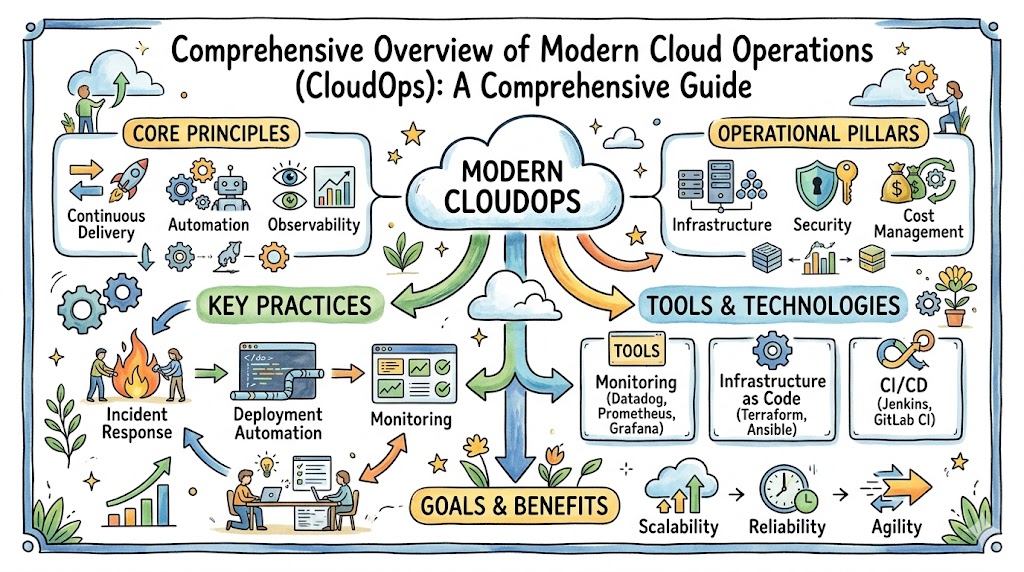
Cloud Operations, commonly known as CloudOps, represents a continuous methodology designed to optimize the performance, availability, and security of cloud infrastructure. Because software architectures transitioned from monolithic data centers to distributed networks, managing these systems manually became entirely impossible. Modern teams require this structured approach to maintain high availability while accelerating deployment speeds. Consequently, this discipline ensures that software ecosystems scale dynamically while remaining cost-effective and highly secure.
This comprehensive guide covers everything from the historical shift in systems infrastructure to the technical core principles that drive cloud reliability. Additionally, you will explore critical performance metrics, common implementation mistakes, and a structured career roadmap for infrastructure professionals. By understanding these concepts, your business can eliminate operational bottlenecks and build resilient software environments.
To achieve seamless infrastructure stability, teams must adopt modern performance methodologies and state-of-the-art engineering practices. You can explore specialized training and architectural guidance through Cloudopsnow to elevate your systems management strategy. Let us dive deep into the foundations of systems infrastructure and examine how modern operations evolved.
The Origin of Systems Infrastructure
The Early Industrial Bottlenecks
During the early days of corporate computing, companies relied entirely on physical on-premise servers tucked away in dedicated server rooms. In those setups, distinct teams managed hardware procurement, software installation, and network security in isolation. Consequently, this siloed approach created massive operational bottlenecks because communication between departments rarely happened smoothly. When software developers finished building an application, they literally handed it over to operations teams without explaining its architectural requirements.
As a result, deployment cycles stretched across months, and unexpected errors occurred frequently during production launches. Because operations engineers lacked visibility into the application code, troubleshooting infrastructure failures required days of manual diagnostic work. Furthermore, physical hardware constraints meant that scaling an application required purchasing new servers, waiting weeks for delivery, and manually configuring networks. This rigid operational model severely crippled business agility and stalled technological innovation across industries.
Moving Toward Unified Workflow Automation
Eventually, the introduction of virtualization software and public cloud computing fundamentally transformed how enterprises viewed infrastructure. Instead of waiting weeks for physical hardware, engineers could suddenly provision virtual instances within a matter of minutes. However, this rapid technological advancement quickly created a massive gap between fast software delivery and slow operational maintenance. To solve this critical bottleneck, progressive organizations began breaking down traditional team silos to build unified workflows.
By integrating automation directly into the deployment process, companies combined development tasks with infrastructure provisioning seamlessly. This structural shift allowed teams to treat infrastructure just like software code, utilizing configuration scripts to manage server environments. Consequently, workflows became highly repeatable, minimizing human errors and establishing a foundational layer for continuous delivery. This transformation allowed enterprises to deploy application updates multiple times a day instead of a few times a year.
Global Expansion Across Commercial Ecosystems
As cloud architecture matured, these unified operational frameworks quickly spread across the global commercial landscape. Large-scale tech enterprises realized that manual server coordination could not support millions of concurrent users distributed worldwide. Therefore, global businesses adopted standardized automation patterns to manage multi-region cloud deployments efficiently.
This commercial expansion turned infrastructure stability into a critical competitive advantage for businesses across every economic sector. Today, digital companies rely on distributed cloud networks to deliver uninterrupted services to consumers globally. As a result, the focus shifted from merely keeping servers running to managing complex, interconnected ecosystems through smart software practices.
Defining Strategic Operations Management
The Core Operational Structure
The foundational architecture of cloud operations relies on continuous data feedback loops running between infrastructure components and centralized management tools. Whenever an application interacts with a database or a network gateway, telemetry data flows instantly into monitoring platforms. Because this structure prioritizes real-time visibility, operations teams can observe exactly how data moves across the cloud environment.
This operational layout ensures that infrastructure automatically adapts to changing workloads through pre-configured policy rules. For example, when system utilization crosses a specific threshold, automated orchestration systems provision additional cloud resources immediately. This continuous cycle of monitoring, analyzing, and scaling forms the backbone of modern strategic cloud management.
Daily Tasks of Systems Coordinators
On a daily basis, systems coordinators and cloud engineers execute a wide variety of engineering and administrative tasks. They actively monitor live dashboards to ensure system components operate within normal performance parameters. Additionally, these specialists configure automated alerts to notify them the moment an anomaly appears in the network traffic.
- Writing infrastructure-as-code scripts to automate resource creation.
- Reviewing system logs to identify potential security vulnerabilities.
- Optimizing cloud spending by terminating idle virtual instances.
- Coordinating with development teams to configure deployment pipelines.
- Conducting routine updates on operating systems and container images.
Localized Control vs. Broad System Architecture
Managing modern systems requires balancing localized component control with broad, macro-level system architecture. Localized control focuses heavily on individual infrastructure elements, such as checking the performance of a single database container. While this granular tracking remains valuable, focusing exclusively on isolated metrics can cause teams to miss larger systemic problems.
Conversely, managing broad system architecture involves observing how distinct cloud services interact with one another across the entire network. For instance, an engineer must understand how a bottleneck in an authentication service impacts downstream payment processors. Therefore, modern operations specialists must constantly switch their focus between micro-level troubleshooting and macro-level system health.
The Efficiency Mindset
Transitioning to cloud operations requires a profound cultural shift that prioritizes long-term system stability over short-term quick fixes. Instead of patch-working infrastructure errors manually, engineers adopt an automation-first mindset to address root causes. This philosophy dictates that if a task must be performed more than twice, it absolutely must be automated.
Furthermore, this cultural shift encourages shared responsibility across both software development and operations engineering teams. Developers design applications with operational reliability in mind, while operations engineers provide platforms that accelerate feature releases. Ultimately, this efficiency mindset transforms infrastructure from a costly operational burden into an agile business asset.
The 7 Core Principles of CloudOps
1. Embracing Risk and Managing Variability
The first core principle acknowledges that software systems are inherently complex, making perfect one hundred percent uptime completely impossible. Instead of chasing an unrealistic goal, operations teams focus on managing acceptable levels of systemic risk. They accept that components will fail eventually due to unpredictable network issues or software bugs.
Consequently, engineering teams design infrastructure to be fault-tolerant, ensuring that individual component failures do not trigger a complete system outage. By defining clear risk parameters, businesses can confidently release innovative features without fear of catastrophic downtime.
2. Establishing Service Level Objectives (SLOs)
To measure systemic success accurately, organizations must establish clear, quantifiable Service Level Objectives for their cloud workloads. These objectives act as internal performance targets that keep engineering teams aligned with actual user expectations. For example, a team might set an objective stating that ninety-nine percent of web requests must respond in under two hundred milliseconds.
By anchoring operational discussions in measurable data, companies eliminate emotional guesswork regarding system performance. These objectives serve as a balancing point between the rapid release of new features and the structural preservation of system stability.
3. Eliminating Toil and Manual Processes
Toil represents repetitive, manual, and administrative work that provides no long-term engineering value to the infrastructure ecosystem. Examples of toil include manually resetting stuck servers, executing routine data backups, or copying log files between directories. If left unchecked, excessive toil bogs down engineering velocity and leads to severe team burnout.
Therefore, cloud operations actively prioritizes identifying repetitive manual tasks and writing software scripts to eliminate them permanently. Engineering away manual work frees up valuable time, allowing specialists to focus on strategic architecture improvements.
4. Monitoring & Observability Across the Pipeline
True operational control requires comprehensive visibility across every layer of the modern application deployment pipeline. Monitoring tells teams exactly when a component fails, while observability allows engineers to understand why that failure occurred. To achieve this, systems gather three core telemetry types: logs, metrics, and distributed request traces.
| Telemetry Element | Primary Function | Operational Value |
| Metrics | Measures numeric data points over time | Triggers real-time alerts for high CPU use |
| Logs | Records time-stamped text entries of events | Provides granular details for root-cause analysis |
| Traces | Tracks request journeys across microservices | Pinpoints exact latency bottlenecks in networks |
This complete data integration prevents operational blind spots, allowing engineers to catch subtle systemic degradations before users notice them. Consequently, teams transition from a reactive firefighting posture to a proactive state of continuous system optimization.
5. Automation Over Manual Coordination
Scaling a massive modern cloud environment using manual human coordination is entirely impossible and highly prone to error. Therefore, operations engineering relies on software systems to manage other software systems autonomously. This principle replaces manual server configurations with automated deployment workflows driven by specialized software engines.
When an infrastructure modification is required, engineers update a centralized code repository instead of logging into servers manually. The automation engine detects the code change, tests it for errors, and applies it safely across production environments.
6. Release Engineering and Deployment Stability
Release engineering focuses on how software applications are built, tested, and deployed into cloud environments consistently and safely. This principle emphasizes the use of predictable, automated pipelines that eliminate variance between development and production setups. By standardizing the release process, organizations minimize the risk of introducing critical bugs into live systems.
Techniques like canary deployments allow teams to roll out new features to a tiny fraction of users initially. If the telemetry data confirms the system remains stable, the deployment engine automatically expands the release to the remaining user base.
7. Simplicity in Network Architecture
Complex infrastructure setups naturally contain more potential failure points, making troubleshooting incredibly difficult during live outages. Therefore, cloud operations advocates for clean, minimal, and highly uniform network and system architectures. Engineers deliberately avoid custom, one-off server configurations that cannot be easily replicated by automated tools.
By keeping environments simple and standardized, teams reduce the overall cognitive load required to understand the system. This architectural minimalism directly shrinks the potential failure surface and accelerates recovery times when incidents occur.
Key Operational Concepts You Must Know
SLA vs. SLO vs. SLI — Explained Simply
Navigating reliability discussions requires understanding the distinct roles of Service Level Agreements, Objectives, and Indicators.
- Service Level Indicator (SLI): This is the precise, real-time measurement of a system’s performance at any given moment. For example, it tracks the exact percentage of successful API requests over a specific hour.
- Service Level Objective (SLO): This represents the internal target goal that the team commits to meeting consistently. For instance, an organization might aim for a success rate of ninety-nine percent over thirty days.
- Service Level Agreement (SLA): This is the formal legal commitment made directly to the external paying customers. It defines the financial penalties or refunds that the company must issue if the system performance drops below a specified threshold.
Error Budgets — The Game Changer for Operational Risk
An error budget represents the exact amount of system downtime or performance degradation that an organization tolerates over a specific timeframe. Mathematically, it is the inverse of your internal Service Level Objective target. If your team commits to a ninety-nine percent SLO, you possess a clear one percent error budget for innovation and updates.
Error Budget = 100% - Service Level Objective (SLO)
This budget completely alters how product development and infrastructure operations collaborate with one another. When the error budget is full, developers can aggressively deploy new features and experimental code into production. However, if unexpected outages consume the budget, the team halts feature releases to focus exclusively on system stability.
Toil — The Silent Productivity Killer in Infrastructure
Toil is the administrative friction that quietly drains engineering velocity and stalls critical system improvements. It consists of tasks that are highly repetitive, manual, scalable linearly with growth, and lack long-term architectural value. For example, manually adding new user accounts to a server database represents clear operational toil.
To eliminate this productivity killer, teams must calculate the percentage of time engineers spend on manual tasks versus creative engineering. If toil exceeds fifty percent of a team’s capacity, management must intervene to prioritize automation projects. Systematically scripting away repetitive workflows ensures that engineering teams retain the mental bandwidth required to build resilient architectures.
Incident Management & Postmortems
When a severe production outage occurs, modern incident management focuses on restoring service rapidly while keeping chaos to a minimum. Teams assign clear operational roles, such as an incident commander to lead the mitigation effort and a communications lead to update customers. Once the system returns to a stable state, the team conducts a comprehensive, blameless postmortem.
A blameless culture assumes that engineers operate with good intentions based on the information they possessed at the time. Instead of pointing fingers at individuals, the analysis focuses on identifying the systemic flaws that allowed the human error to occur. The resulting postmortem document details the root cause and assigns actionable engineering tasks to prevent the incident from ever repeating.
Capacity Planning
Capacity planning is the practice of analyzing current resource utilization trends to forecast future infrastructure needs accurately. Without proper planning, an unexpected surge in business growth can completely overwhelm cloud networks and cause severe performance degradation. Therefore, engineering teams use historical telemetry data to map out hardware and cloud instance requirements well in advance.
Modern cloud setups leverage predictive analytical tools to automate aspects of this planning process seamlessly. This practice allows organizations to provision infrastructure just ahead of major marketing campaigns or seasonal shopping events. Consequently, businesses avoid over-paying for idle cloud resources while completely eliminating the risk of resource starvation during peak hours.
The Four Golden Signals of Pipeline Performance
To understand system health at a glance, operations engineers monitor four foundational metrics known globally as the Golden Signals.
[Image diagram showing the Four Golden Signals: Latency, Traffic, Errors, and Saturation represented as dials on an engineering dashboard]
- Latency: This signal measures the exact time it takes for a system to service a specific request completely. It is critical to track the latency of successful requests separately from failed requests to avoid skewed data.
- Traffic: This tracks the total demand being placed on your infrastructure network at any given moment. For a web service, traffic is typically measured in HTTP requests per second or concurrent network connections.
- Errors: This signal monitors the rate of requests that fail to execute successfully across your cloud environment. These failures are categorized into explicit errors, such as internal server faults, and implicit errors, like incorrect data payloads.
- Saturation: This measures how close your infrastructure resources are to reaching their maximum operating capacity. It tracks metrics like memory utilization or network bandwidth limits to highlight upcoming system bottlenecks before they trigger outages.
Platform Implementation vs. Culture — What’s the Real Difference?
The Philosophy Difference
Many organizations confuse technical platform implementation with the overarching cultural philosophy required to run resilient systems. Platform implementation focuses heavily on the specific software tooling, automated pipelines, and cloud configurations used day-to-day. It deals with the tangible, practical mechanics of deploying code and monitoring system metrics across infrastructure networks.
In contrast, the cultural aspect centers entirely on human mindsets, communication patterns, and organizational shared responsibilities. A team can buy the most advanced observability platform available on the market today. However, if a culture of blame and fear persists, engineers will still hide system mistakes, rendering the tools completely useless.
Roles & Responsibilities Compared
To understand how these areas diverge and intersect practically, we can look at their distinct focuses across daily operational duties.
| Feature Area | Technical Platform Focus | Cultural Philosophy Focus |
| Primary Goal | Building scalable deployment pipelines | Fostering collaboration and shared system goals |
| Tooling Use | Managing infrastructure-as-code and cloud clusters | Utilizing metrics to drive business decisions |
| Error Handling | Executing automated rollbacks during failures | Conducting blameless postmortems to learn |
| Work Focus | Minimizing system latency and data bottlenecks | Eliminating team burnout and manual toil |
Can You Have Both Disciplines?
Modern high-performing technology enterprises do not choose between strong technical platform engineering and a healthy operational culture. Instead, these two dimensions complement each other perfectly to form a balanced, high-velocity engineering organization. The technical platform provides the automated guardrails that allow engineers to experiment safely without fear of destroying production environments.
Meanwhile, the cultural philosophy empowers teams to use those automated tools creatively and transparently. When culture and platforms align, software developers and infrastructure engineers share the same operational goals. This harmony eliminates traditional organizational friction, leading to faster software delivery and rock-solid system stability.
Which One Should Your Team Adopt?
Deciding where to focus your immediate organizational energy depends heavily on your company’s current size and engineering maturity level. Small startups with limited engineering resources should focus primarily on establishing a collaborative, reliability-focused culture first. Because early-stage teams change fast, building complex automated platforms too early can lead to expensive architectural rework.
Conversely, large enterprises with hundreds of developers must invest heavily in standardized platform implementations immediately. Without a central, automated platform, disparate engineering teams will build fragmented, non-compliant infrastructure setups. Therefore, mature organizations require robust software platforms to enforce security and operational compliance uniformly across the entire enterprise.
Real-World Use Cases of Modern Operations
How Tech Leaders Use Operational Metrics
Major global software enterprise organizations rely on real-time operational metrics to make critical, data-driven business decisions. These companies collect billions of telemetry points every hour to analyze user behavior alongside infrastructure performance. For instance, if data shows that a minor increase in latency reduces checkout conversions, engineers optimize those specific pathways immediately.
By connecting technical system metrics directly to business outcomes, technology leaders justify infrastructure investments clearly. This data-driven approach allows organizations to balance infrastructure costs against user satisfaction levels perfectly. Consequently, engineering teams can prioritize performance upgrades that deliver the highest value to the company’s bottom line.
Chaos Engineering Approaches to Resilient Systems
Progressive technology companies utilize chaos engineering to proactively uncover hidden architectural vulnerabilities before they cause real customer outages. This practice involves intentionally injecting controlled failures, such as shutting down a database region, into live production environments.
- Injecting network latency to test application timeout settings.
- Randomly terminating container instances to verify automated healing systems.
- Simulating high traffic surges to validate auto-scaling configurations.
- Disconnecting primary storage units to check secondary failover mechanisms.
- Corrupting configuration files to evaluate system error-handling alerts.
Handling Reliability at Massive Scale
Distributed microservices architectures handling millions of daily transactions require sophisticated reliability engineering patterns to survive. At massive scale, minor network drops happen constantly, meaning applications must be designed to withstand continuous micro-failures. Large enterprises utilize service meshes to manage communication, apply retries, and route around broken nodes automatically.
Additionally, teams implement circuit breaker patterns to prevent localized service failures from cascading across the entire network. If an external payment gateway slows down, the circuit breaker trips, causing the application to return a graceful fallback response. This architectural isolation ensures that the core application remains completely functional even when peripheral systems encounter severe disruptions.
High-Availability in Fintech Operations
Financial technology platforms operate within strict regulatory environments that demand zero tolerance for transaction downtime or data loss. Therefore, fintech operations engineers build highly secure, multi-region active-active architectures that replicate data across geographic distances instantly. This design ensures that if an entire cloud data center goes completely offline, transactions switch to another facility seamlessly.
Furthermore, these organizations implement strict, automated compliance checking within their continuous delivery pipelines. Every single infrastructure modification must undergo automated security scanning and vulnerability assessments before reaching production environments. This rigorous engineering approach allows financial platforms to innovate rapidly while maintaining institutional-grade system integrity and reliability.
Scaled-Down but Essential Systems for Startups
Early-stage startups do not need the massive, complex infrastructure systems utilized by global technology giants. However, applying the core principles of cloud operations remains absolutely vital for their long-term survival. Startups leverage managed public cloud services and serverless architectures to minimize initial operational overhead significantly.
By utilizing managed solutions, small teams offload complex database administration and physical network patching to cloud providers. This strategic decision allows developers to focus entirely on building product features while maintaining baseline system observability. As the startup grows, these foundational practices ensure that the software architecture scales smoothly without requiring a complete structural redesign.
Common Mistakes in Operations Engineering
Mistake 1 — Confusing System Management with Just Being On-Call
A highly prevalent mistake among engineering organizations is treating operational engineering as nothing more than a reactive on-call rotation. In this broken model, engineers spend their entire shifts responding to alerts and applying temporary patches to broken systems. This reactive approach fails to address the underlying architectural design flaws that cause the system failures in the first place.
True operations engineering is a proactive discipline focused on writing software to prevent incidents from happening at all. When engineers are trapped in a continuous firefighting cycle, they lack the time to build sustainable automation. Over time, this neglect increases technical debt, leading to more frequent outages and severe engineering team burnout.
Mistake 2 — Setting Unrealistic SLOs
In an effort to deliver perfect service, management teams often set unrealistic Service Level Objectives, like demanding one hundred percent uptime. While aiming for perfection sounds admirable, it introduces severe operational paralysis across the entire engineering department. Achieving extremely high reliability requires massive financial investments and slows down feature deployment velocity significantly.
When an organization demands near-perfect uptime, engineers become terrified of deploying updates, fearing that any change might cause an incident. Consequently, product innovation grinds to a halt, allowing competitors to move ahead in the market. Teams must set realistic objectives based on actual customer satisfaction thresholds rather than arbitrary perfection.
Mistake 3 — Ignoring Toil Until It’s Too Late
Ignoring repetitive manual tasks allows operational toil to grow quietly until it completely consumes your engineering capacity. When a company expands, the manual work required to maintain infrastructure scales linearly with the growing user base. If engineers do not actively script away these manual processes, they eventually run out of time for creative engineering work.
This accumulation of operational debt slows down development cycles and introduces high human error rates into daily workflows. Furthermore, talented engineers become deeply frustrated when their days are filled with boring, repetitive administrative tasks. Organizations must prioritize continuous automation to keep toil levels below manageable thresholds.
Mistake 4 — Skipping Blameless Postmortems
When a severe system outage occurs, a toxic organizational culture immediately looks for an individual human scapegoat to blame. This punitive approach causes engineers to hide system mistakes, falsify logs, and avoid taking ownership of operational problems. Consequently, the true systemic root causes of the infrastructure failures are never properly analyzed or repaired.
Skipping blameless postmortems guarantees that the exact same operational incidents will repeat themselves in the future. Without an open, transparent environment, organizations miss valuable learning opportunities that could make their systems more resilient. Teams must focus on fixing broken processes and fragile code rather than punishing individuals.
Mistake 5 — Monitoring Without Actionable Alerts
Many operations teams configure hundreds of automated alerts for minor system events that require no immediate human intervention. This practice quickly floods engineers’ communication channels with non-critical notifications, creating severe alert fatigue. When important, critical system failure alerts finally trigger, they are often overlooked amidst the noisy sea of irrelevant data.
Every automated alert sent to an on-call engineer must be actionable and indicate a clear, user-impacting problem. If an alert does not require immediate troubleshooting, it should be logged silently to a dashboard rather than waking up an engineer. Streamlining your alerting systems directly reduces response times and improves the team’s overall mental well-being.
Mistake 6 — Not Involving Operational Engineers in the Design Phase
Software developers frequently design application architectures in complete isolation without consulting operations engineering teams. Consequently, they build systems that run perfectly on a local laptop but fail catastrophically when deployed into production networks. This lack of collaboration leads to expensive, emergency architectural rewrites late in the software development lifecycle.
Operations specialists must be involved in the initial design phase to provide critical input regarding scalability and monitorability. They ensure that applications include necessary telemetry hooks and adhere to cloud-native security guidelines from day one. This proactive collaboration builds a solid foundation for seamless deployments and long-term infrastructure stability.
Essential Infrastructure Tools & Technologies
Monitoring & Observability
Maintaining deep visibility into complex cloud environments requires a robust suite of modern monitoring and observability platforms. Prominent tools like Prometheus specialize in gathering time-series metrics from cloud clusters, while Grafana provides highly customizable visualization dashboards. Datadog and New Relic offer comprehensive, full-stack observability platforms that integrate metrics, logs, and distributed traces into a single workspace. These platforms allow teams to analyze performance trends, trace application requests across networks, and detect system anomalies instantly.
Incident Management
When an unexpected infrastructure outage occurs, teams utilize specialized incident management platforms to coordinate their engineering responses. PagerDuty serves as a critical routing engine, automatically alerting the correct on-call engineers based on automated system triggers. These platforms manage incident timelines, escalate unresolved issues to secondary engineers, and integrate directly with communication tools like Slack. By organizing the response workflow, incident management tools minimize chaos and significantly reduce the time it takes to restore services.
CI/CD & Release Engineering
Automating the building, testing, and deployment of cloud workloads requires powerful continuous integration and continuous delivery engines. Jenkins remains a widely adopted tool for creating complex, custom automation pipelines across enterprise infrastructure environments. Modern cloud-native organizations leverage GitOps controllers like Argo CD and deployment engines like Spinnaker to automate application deliveries. These tools continuously sync live infrastructure states with configurations stored in Git repositories, ensuring fast, predictable, and fully audited software releases.
Chaos Engineering
To build truly resilient systems, organizations employ specialized chaos engineering software to inject controlled failures into production environments. Chaos Monkey, originally created by Netflix, randomly terminates virtual instances to ensure applications automatically recover without user impact. These specialized tools allow engineers to test system fault tolerance, validate auto-scaling rules, and verify that monitoring dashboards catch real-time degradation. By exposing architectural weaknesses safely, chaos tools help teams harden their infrastructure against catastrophic real-world failures.
SLO Management
Tracking reliability targets against actual user experiences requires dedicated Service Level Objective management solutions. Platforms like Nobl9 allow engineering teams to connect diverse data sources and track error budgets automatically over time. These solutions help businesses set realistic performance goals, monitor budget consumption rates, and trigger alerts when budgets deplete too quickly. By quantifying reliability, SLO management tools bridge the gap between technical engineering metrics and high-level product development strategies.
How to Become an Operations Expert — Career Roadmap
Skills Every Specialist Must Have
Entering the field of cloud operations requires a strong foundation in core computer science and systems administration concepts. Aspiring specialists must master the Linux command line, as the vast majority of cloud infrastructure runs on Linux operating systems. Additionally, proficiency in scripting languages like Python or Bash is essential for automating daily administrative tasks.
- Linux Systems Administration: Understanding file permissions, process management, and networking tools.
- Infrastructure-as-Code (IaC): Writing configuration scripts using tools like Terraform or OpenTofu.
- Containerization: Packaging applications and managing environments using Docker technology.
- Cloud Platforms: Navigating core services within major hyperscalers like AWS, Azure, or Google Cloud.
- Networking Foundations: Understanding DNS configuration, TCP/IP protocols, and virtual private networks.
The Professional Learning Path
The professional educational journey begins with setting up simple local environments and gradually scales up to managing complex distributed networks. Beginners should focus on deploying basic web applications on individual cloud instances and manually configuring network firewalls. Once comfortable, learners must transition to containerizing applications and writing basic scripts to automate those deployments.
The next stage involves exploring orchestration frameworks like Kubernetes to manage multi-container applications across cluster environments. Engineers learn to implement continuous integration pipelines that test and package code automatically whenever updates occur. Finally, senior architects master advanced observability patterns, financial cloud cost optimization, and multi-region disaster recovery strategies.
Certifications Worth Pursuing
While practical experience remains King, industry-recognized professional credentials validate your architectural expertise and accelerate career progression significantly. Obtaining credentials from major public cloud providers proves your ability to design secure, highly available cloud systems. Additionally, vendor-neutral certifications focused on modern orchestration and networking technologies are highly valued by global technology enterprises.
Pursuing certifications like the AWS Certified DevOps Engineer or the Azure DevOps Engineer Expert establishes clear technical credibility. For cloud-native environments, completing the Certified Kubernetes Administrator (CKA) credential demonstrates deep proficiency in managing container clusters. These structured certifications help professionals stay updated on modern operational best practices while opening doors to senior engineering roles globally.
Educational Resources with Cloudopsnow
To master these complex technical concepts efficiently, aspiring cloud professionals require structured, hands-on learning resources. Exploring the specialized educational material and courses provided by Cloudopsnow offers deep practical insights into modern infrastructure architectures. These comprehensive programs focus heavily on real-world scenarios, allowing you to build production-grade deployment pipelines and observability dashboards. By learning from experienced industry mentors, you can quickly transition from basic scripting to designing highly resilient, automated cloud ecosystems.
The Future of Systems Management
AI and Automation in System Optimization
Artificial intelligence and machine learning are fundamentally transforming how enterprises manage and optimize complex cloud networks. Modern operational platforms leverage intelligent algorithms to analyze massive streams of telemetry data, detecting subtle system anomalies in real time. This automated analysis allows teams to identify upcoming hardware degradations long before a catastrophic outage occurs.
Furthermore, machine intelligence speeds up root cause analysis during live incidents by automatically correlating disparate system logs. Instead of manually searching through millions of lines of text, engineers receive precise summaries pinpointing the failure source. As these automated systems mature, cloud environments will increasingly self-heal, automatically resolving routine operational problems without human intervention.
Platform Engineering — The Evolution of Infrastructure
Platform engineering represents the next major evolutionary step in the design and management of modern cloud ecosystems. This discipline focuses on creating internal developer platforms (IDPs) that centralize and automate complex infrastructure workflows. These self-service platforms provide software developers with pre-configured, compliant toolchains to provision resources instantly without waiting for operations teams.
[Image diagram showing the relationship between application developers, an Internal Developer Platform, and cloud infrastructure layers]
By treating the platform as a product, dedicated platform teams reduce cognitive load on application developers significantly. Developers can focus entirely on writing business logic while the internal platform handles security, scaling, and compliance automatically. This structural shift accelerates software delivery velocities while maintaining rigorous operational guardrails uniformly across the enterprise.
Management in Cloud-Native & Kubernetes Environments
As organizations migrate heavily toward containerized applications, managing large-scale Kubernetes environments introduces unique architectural challenges. Container clusters are highly dynamic and ephemeral, with individual microservices constantly spinning up and shutting down across networks. Therefore, traditional static infrastructure monitoring tools are completely ineffective in these modern, cloud-native ecosystems.
Operations engineers must implement dynamic service discovery, automated network routing, and advanced mesh architectures to maintain control. Managing security policies and resource allocations across multi-cluster environments requires declarative configuration tools driven by automation. Mastering these container orchestration patterns remains a top priority for teams aiming to achieve high availability at scale.
Operational Skills That Will Matter Most
In the coming years, the role of the infrastructure specialist will shift further away from basic provisioning toward strategic optimization. Financial cost optimization, commonly known as FinOps, will become a critical skill as businesses demand tighter control over cloud spending. Engineers must design architectures that automatically scale down idle resources to minimize waste without compromising application performance.
Additionally, mastering deep data observability across distributed edge networks and serverless architectures will be highly essential. Specialists must understand how to extract actionable intelligence from complex data pipelines to drive continuous performance improvements. Ultimately, professionals who combine deep technical automation expertise with a strong understanding of business metrics will lead the industry.
FAQ Section
- What is the typical career progression for a cloud operations professional?An individual typically starts as a junior systems administrator or cloud support engineer, focusing on monitoring and basic troubleshooting. Over time, they advance to a cloud operations engineer or DevOps specialist role, where they write automation scripts and manage deployment pipelines. With significant experience, professionals progress to senior infrastructure architects or principal platform engineers, designing large-scale distributed cloud systems.
- How does CloudOps differ from traditional IT operations management?Traditional IT operations relied heavily on physical hardware management, manual server configurations, and isolated team structures with slow deployment cycles. In contrast, cloud operations utilizes continuous automation, treating infrastructure entirely as software code to enable rapid, repeatable changes. This modern discipline relies on real-time telemetry, shared team responsibilities, and elastic cloud scaling to maintain system availability automatically.
- What are the average salary trends for infrastructure specialists in the industry?Salaries for cloud infrastructure professionals remain exceptionally high due to the critical global demand for specialized technical expertise. Entry-level engineers can expect competitive compensation, while mid-level specialists command premium salaries across major global technology hubs. Senior architects and principal platform engineers frequently rank among the highest-paid professionals in the entire software engineering industry.
- Why is an error budget considered a game changer for product development?An error budget removes the traditional conflict between software developers wanting fast changes and operations teams wanting perfect stability. By quantifying acceptable risk, it provides a data-driven framework that dictates exactly when to release features or halt updates. This objective mechanism ensures that teams innovate aggressively while safely maintaining the baseline reliability required by users.
- Which scripting languages are most important for automating cloud networks?Python and Bash remain the two most vital scripting tools for creating infrastructure automation and managing cloud workflows. Bash is essential for executing quick commands, managing system configurations, and writing automation scripts directly within Linux terminal environments. Python is highly preferred for building complex automated tools, interacting with cloud provider APIs, and processing large telemetry datasets.
- How can small startups implement these principles without a massive budget?Startups can implement these core principles by leveraging fully managed public cloud services and serverless architectures to minimize overhead. By utilizing managed solutions, small teams avoid complex server maintenance and focus their energy on basic observability and clean workflows. Establishing a collaborative, reliability-focused culture early on ensures the architecture scales smoothly without requiring expensive engineering rewrites later.
Final Summary
Maintaining optimal infrastructure performance requires a comprehensive understanding of automated provisioning, continuous telemetry, and proactive risk management. By shifting away from reactive firefighting, modern organizations build resilient, self-healing cloud ecosystems that sustain high traffic volumes seamlessly. Embracing quantified objectives and eliminating manual toil allows engineering teams to balance rapid software innovation with rock-solid system stability. Ultimately, standardizing your deployment workflows and focusing on architectural simplicity minimizes failure surfaces and ensures long-term operational success.
