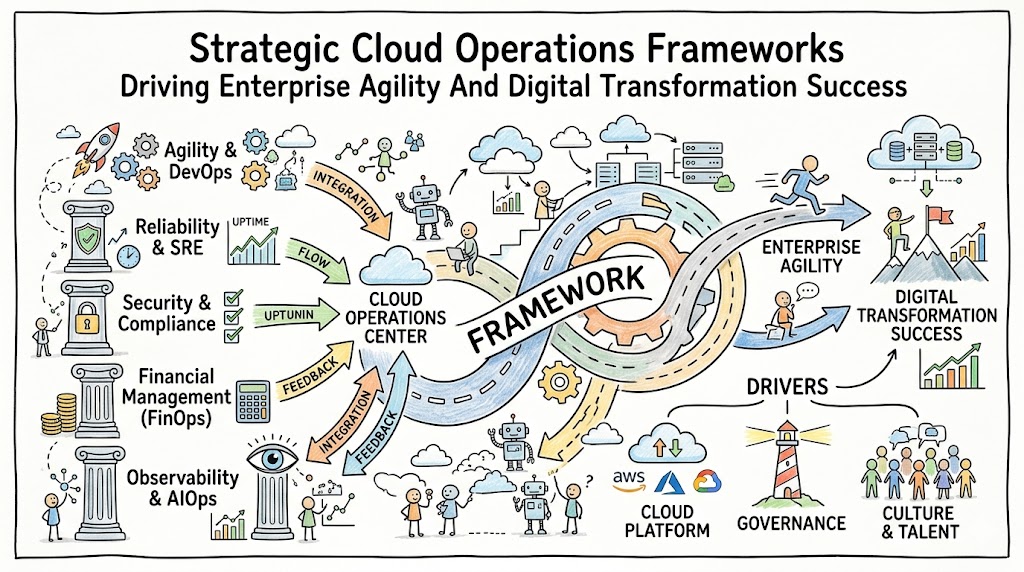
Imagine a major retail platform crashing during a peak seasonal flash sale, costing the enterprise millions of dollars every minute. This chaotic scenario highlights the critical vulnerabilities that modern digital frameworks face daily. Consequently, companies must move away from reactive troubleshooting and embrace proactive infrastructure management. Transitioning to robust cloud environments requires a systematic method to maintain resilience while deploying software rapidly.
Fortunately, modern cloud operations solves this problem by treating infrastructure stability as an ongoing software engineering challenge. This comprehensive guide explores architectural shifts, core reliability principles, and advanced monitoring practices that empower modern systems to scale seamlessly. Furthermore, readers will discover practical methodologies for measuring performance, reducing manual burdens, and aligning engineering workflows with business priorities.
To achieve sustainable growth, organizations must adopt advanced operational methodologies that guarantee continuous availability and smooth system performance. You can unlock the full potential of your infrastructure by leveraging the expert engineering services of Cloudopsnow.
The Origin of Systems Infrastructure
The Early Industrial Bottlenecks
Traditional enterprise data centers relied on isolated systems management teams that operated independently from application developers. Developers focused entirely on writing code, whereas administrators focused exclusively on preventing infrastructure changes to maintain system stability. As a result of this deep separation, software deployments frequently faced long delays and unexpected configuration errors.
Because communication between these separate divisions remained highly constrained, resolving operational bottlenecks became increasingly difficult. Manual provisioning processes slowed organizational velocity, and unexpected failures during production releases caused frequent downtime. Therefore, businesses realized that traditional isolated workflows could no longer support fast-moving market demands.
Moving Toward Unified Workflow Automation
To eliminate these persistent operational boundaries, forward-thinking enterprises began adopting unified configuration systems and infrastructure automation. Engineers introduced programmable infrastructure, which allowed teams to manage hardware resources using repeatable software code files. This fundamental shift allowed operations specialists to collaborate directly with development teams during early product life cycles.
Consequently, automated validation pipelines replaced manual server checklists, which drastically accelerated deployment cycles while maintaining structural integrity. By treating infrastructure as software, companies eliminated human errors and achieved predictable environments across testing stages. Ultimately, this operational transformation allowed businesses to deploy application updates frequently without compromising system reliability.
Global Expansion Across Commercial Ecosystems
As cloud architectures gained rapid global adoption, these advanced automation frameworks quickly expanded across diverse commercial ecosystems. Large-scale tech enterprises realized that manual oversight could not keep pace with thousands of distributed cloud services. As a result, businesses standardized their operational workflows around continuous integration platforms and programmatic resource scaling.
Today, small startups and multinational financial enterprises alike depend on automated infrastructure orchestration to remain globally competitive. By scaling these reliable management practices, modern organizations maintain consistent application performance for millions of users worldwide. Thus, automated infrastructure management has shifted from a competitive advantage to an absolute operational necessity.
Defining Strategic Operations Management
The Core Operational Structure
The foundational architecture of strategic cloud operations relies on continuous data feedback loops between running applications and engineering teams. Telemetry agents continuously collect runtime metrics, application logs, and system traces from every layer of the cloud environment. Afterward, unified data processing systems analyze this information to generate actionable insights regarding overall infrastructure health.
| Structural Component | Primary Operational Role | Feedback Target |
| Telemetry Pipeline | Continuous log and metric aggregation | Processing Engines |
| Automation Layer | Programmatic resource orchestration | Cloud Infrastructure |
This structured visibility ensures that engineers can detect emerging system structural anomalies before they impact end users. By maintaining an open flow of operational data, organizations can optimize resource allocations dynamically. Therefore, this robust structural design transforms traditional chaotic firefighting into a structured, data-driven engineering practice.
Daily Tasks of Systems Coordinators
Systems coordinators spend their daily schedules building automated solutions rather than performing repetitive manual adjustments. On a typical day, these engineers write automation scripts to fix persistent resource constraints and optimize deployment pipelines. Additionally, they review system performance metrics, adjust automated scaling thresholds, and refine application alert configurations.
When system alerts trigger, coordinators lead technical incident responses to restore baseline operations as quickly as possible. Following incident resolution, they conduct comprehensive system reviews to find permanent structural fixes for underlying vulnerabilities. Consequently, their daily efforts balance active incident mitigation with long-term infrastructure engineering projects.
Localized Control vs. Broad System Architecture
Managing microservices requires a careful balance between tracking individual application components and governing the entire distributed infrastructure. Localized control focuses on specific application issues, such as fine-tuning a database connection pool or optimizing a single API endpoint. However, broad system architecture requires analyzing how these interconnected components behave together under heavy production workloads.
| Operational Focus | Granular Component Level | Global Architecture Level |
| Management Scope | Single database or API endpoint optimization | Complete distributed multi-cloud environment |
| Key Objective | Maximizing local performance metrics | Ensuring overall system availability |
While localized optimization protects specific application modules, broad system architecture tracking prevents wider cascading failures across the ecosystem. Operations engineers must navigate both dimensions simultaneously to keep complex enterprise platforms functional and stable. By combining localized insights with global architectural oversight, teams successfully protect large-scale cloud ecosystems from unexpected downtime.
The Efficiency Mindset
Transitioning to modern cloud operations requires a major cultural shift that prioritizes long-term system reliability over short-term feature delivery. Engineers operating with this mindset view system failures as valuable educational opportunities to strengthen software infrastructure. Accordingly, teams invest significant time into building self-healing software mechanisms that automatically remediate recurring system anomalies.
This efficiency perspective encourages developers to design applications with built-in operational visibility and automated fault tolerance. Rather than relying on human intervention, the system utilizes programmatic policies to handle sudden traffic spikes gracefully. Ultimately, this cultural commitment to automated stability helps modern organizations maintain high user trust and sustained business velocity.
The 7 Core Principles of Cloud Operations
1. Embracing Risk and Managing Variability
Modern operational engineering acknowledges that achieving absolute one hundred percent system uptime remains economically impractical and technically impossible. Because complex distributed cloud architectures experience regular component failures, teams must learn to manage systemic risk effectively. Instead of attempting to eliminate all errors, engineers define acceptable risk levels aligned with user expectations.
By accepting managed risk, development teams can continue shipping innovative software features without encountering operational gridlock. This balanced approach guides organizations to invest resource budgets into reliable infrastructure only where it truly impacts user satisfaction. As a result, companies maintain rapid business innovation while keeping system performance within safe operational boundaries.
2. Establishing Service Level Objectives (SLOs)
Organizations must define clear, quantifiable targets for infrastructure performance to align engineering efforts with business expectations. Teams achieve this by establishing target metrics that specify the exact availability and performance goals for any service. These performance objectives act as a vital communication bridge between software product managers and infrastructure stability engineers.
When system performance meets or exceeds these targets, development teams can safely prioritize releasing new software features. However, if performance drops below the specified objective, engineers pivot their focus toward resolving underlying stability issues. This data-driven approach removes emotional bias from operational decisions, ensuring that user experience directly guides technical priorities.
3. Eliminating Toil and Manual Processes
Toil represents repetitive, manual, and administrative tasks that scale directly with infrastructure growth but add no permanent engineering value. Examples include manually restarting failed application servers, manually resetting user permissions, or executing routine database backups by hand. Left unmanaged, excessive operational toil burns out talented engineers and severely restricts organizational development.
Modern infrastructure engineering solves this issue by systematically identifying repetitive tasks and building software code to automate them permanently. By writing robust automation tools, teams ensure that human effort scales efficiently as cloud footprints expand. Consequently, eliminating operational toil frees up system engineers to focus on high-value architecture optimization projects.
4. Monitoring & Observability Across the Pipeline
Comprehensive monitoring provides necessary operational visibility across the entire software delivery pipeline and runtime cloud infrastructure. Teams gather deep system insights by continuously collecting historical trends, interactive distributed traces, and localized application logs. This holistic visibility ensures that engineers can quickly isolate root causes of performance degradations across complex microservices.
Advanced observability platforms process this continuous stream of telemetry data to build real-time visual dashboards. Consequently, engineers can proactively spot microservice bottlenecks, memory leaks, and networking latencies before users notice performance drops. Maintaining deep pipeline visibility enables organizations to defend their digital ecosystems against unexpected production disruptions.
5. Automation Over Manual Coordination
Scaling modern distributed cloud environments successfully requires replacing manual coordination with software-driven automation solutions. Instead of relying on manual operator intervention, companies use intelligent software frameworks to manage infrastructure deployments and updates. This engineering philosophy applies programmatic control to resource provisioning, network configuration changes, and security patch application.
Automated systems execute these operational tasks with high precision, removing the risks associated with human typos or missed checklist steps. Furthermore, automated software infrastructure scales dynamically to handle massive user workloads without requiring additional engineering staff. Relying on programmatic orchestration allows organizations to maintain stable, repeatable environments at any scale.
6. Release Engineering and Deployment Stability
Stable software delivery requires a disciplined engineering approach to compiling, testing, and deploying application code to production environments. Teams implement automated continuous integration pipelines to enforce consistent testing standards before code reaches users. Additionally, engineers leverage advanced canary deployments and blue-green strategies to minimize the blast radius of new software releases.
By rolling out updates gradually to small percentages of active users, operators detect hidden software bugs early without causing widespread outages. If a new deployment displays performance anomalies, automated rollbacks instantly restore the previous functional application state. This rigorous focus on release stability enables organizations to innovate rapidly while protecting the user experience.
7. Simplicity in Network Architecture
Complex, over-engineered network configurations significantly increase the likelihood of human error and unexpected system failures. Therefore, modern operational models emphasize maintaining clean, minimal infrastructure designs with fewer moving components. Engineers avoid bespoke configurations by utilizing standard patterns and uniform architecture templates across all environments.
Keeping system infrastructure simple makes troubleshooting much faster when high-priority production incidents occur. Additionally, minimal environments present a much smaller attack surface for potential cybersecurity threats and operational disruptions. By prioritizing architectural simplicity, teams ensure their cloud infrastructure remains highly maintainable over long-term operations.
Key Operational Concepts You Must Know
SLA vs. SLO vs. SLI — Explained Simply
Understanding system performance requires differentiating between Service Level Agreements, Service Level Objectives, and Service Level Indicators.
- Service Level Agreements (SLAs): Legal commitments made to external customers defining expected system uptime and financial penalties if commitments are missed.
- Service Level Objectives (SLOs): Target operational performance goals set internally by engineering teams to keep systems reliable and users happy.
- Service Level Indicators (SLIs): Specific, quantifiable metrics measured in real time to determine whether the system is meeting its target objectives.
[SLI: Real-time Metric] ──> Compares against ──> [SLO: Internal Target] ──> Protects ──> [SLA: Legal Contract]
Error Budgets — The Game Changer for Operational Risk
An error budget represents the total permissible amount of system downtime or performance degradation over a specific timeframe. For instance, if an internal objective requires a service to maintain ninety-nine percent uptime, the error budget provides a one percent allowance for planned or unplanned disruptions. This metric functions as an operational safety valve that balances engineering innovation with overall platform reliability.
As long as a service retains a positive error budget, development teams can freely deploy new software features. However, if unexpected production incidents consume the entire budget, feature releases halt instantly until engineers fix the underlying stability issues. This programmatic mechanism aligns development and operations priorities around a single, objective mathematical source of truth.
Toil — The Silent Productivity Killer in Infrastructure
Toil manifests as manual, repetitive engineering tasks that provide no long-term improvements to the cloud infrastructure. Left unchecked, excessive toil consumes engineering hours, lowers team morale, and introduces human errors into production environments. Therefore, modern systems management engineering requires tracking toil levels closely to prevent it from overwhelming development teams.
Organizations eliminate this operational burden by setting strict limits, such as restricting toil to under fifty percent of an engineer’s time. Teams spend the remaining time writing automation scripts, optimizing code, and designing architectural improvements to eliminate manual work permanently. This consistent focus on automation ensures that operational capabilities grow efficiently without requiring proportional headcount increases.
Incident Management & Postmortems
When high-priority system disruptions occur, incident management frameworks guide engineering teams to restore baseline services quickly and safely. Teams establish clear technical roles, including incident commanders and communications leads, to ensure organized coordination during active outages. Once normal operations resume, engineers conduct comprehensive, blameless postmortems to analyze the root causes of the failure.
Blameless postmortems focus entirely on discovering structural system vulnerabilities rather than assigning individual human blame or administrative mistakes. This open, transparent environment encourages engineers to share accurate data regarding how the incident occurred. Consequently, teams can implement permanent code fixes that protect the infrastructure against similar operational failures in the future.
Capacity Planning
Proactive capacity planning ensures that underlying cloud infrastructure scale accommodates future transaction growth and sudden seasonal traffic spikes. Engineers analyze historical resource utilization trends, such as processing usage and memory growth, to forecast future hardware demands. Additionally, teams run load tests to verify how distributed systems perform under extreme user workloads.
By anticipating these infrastructural requirements, organizations can purchase resources efficiently and avoid costly emergency upgrades. Modern capacity planning also utilizes cloud auto-scaling policies to handle unexpected demand fluctuations automatically. This strategic preparation prevents performance degradation during high-traffic business events while keeping operational costs optimized.
The Four Golden Signals of Pipeline Performance
Engineers rely on four critical telemetry metrics to evaluate system health and locate performance issues across distributed applications:
- Latency: The total time required to process specific application requests, separating successful operations from failed requests.
- Traffic: A measure of overall system demand, tracking concurrent user requests, network bandwidth, or data transactions.
- Errors: The total rate of requests that fail explicitly, return incorrect data, or encounter system timeouts.
- Saturation: A metric indicating the utilization level of constrained system resources, such as database memory or network storage.
Platform Implementation vs. Culture — What’s the Real Difference?
The Philosophy Difference
While platform implementation focuses on deploying specific cloud tooling, cultural engineering emphasizes team collaboration and shared responsibility for system stability. Platform execution delivers necessary technical capabilities like automated code deployment pipelines, container clusters, and unified dashboard tracking. Conversely, cultural frameworks define how teams communicate, evaluate performance risk, and handle production incidents together.
Deploying advanced monitoring tools provides little business benefit if engineers lack a blameless culture to analyze system failures openly. Similarly, a healthy team culture cannot sustain complex applications without the support of automated cloud platforms. Therefore, organizations must integrate both disciplines to achieve scalable infrastructure management and rapid software delivery.
Roles & Responsibilities Compared
Understanding the distinct duties of platform deployment specialists versus cultural operations leads to better resource allocation across engineering departments.
- Platform Implementation Engineers:
- Build, maintain, and secure automated continuous deployment workflows.
- Provision and optimize multi-tenant container orchestration clusters.
- Develop reusable infrastructure-as-code configuration modules for teams.
- Integrate centralized logging systems with real-time alerting platforms.
- Cultural Operations Engineers:
- Define realistic service level objectives alongside product management teams.
- Facilitate blameless postmortem sessions to address systemic bugs.
- Manage error budgets to balance innovation speed with platform safety.
- Design comprehensive incident response protocols and on-call rotations.
Can You Have Both Disciplines?
Modern enterprises do not need to choose between these two approaches because they naturally reinforce one another. Technical platform automation provides the exact data and mechanisms required to enforce cultural agreements like error budgets and service objectives. Meanwhile, a strong reliability culture motivates engineers to build robust, highly automated self-healing software frameworks.
When organizations merge these disciplines, they create an optimal environment for sustainable development and software infrastructure stability. Developers move faster because automated platforms protect them from making configuration errors in production environments. Concurrently, operations specialists focus on strategic long-term engineering because automation handles repetitive manual work.
Which One Should Your Team Adopt?
The choice between prioritizing platform engineering or reliability culture depends heavily on organizational maturity and engineering scale. Small early-stage startups should focus first on cultural principles by defining basic performance expectations and avoiding complex tooling overhead. As team sizes expand, companies should build dedicated internal platforms to standardize deployments across multiple departments.
Large enterprises managing massive distributed applications typically require fully formed teams dedicated to both disciplines. This structural division ensures that specialized engineers maintain the underlying platforms while others optimize cross-team operational workflows. Evaluating current infrastructure gaps helps organizations invest resources where they will drive the greatest operational improvements.
Real-World Use Cases of Modern Operations
How Tech Leaders Use Operational Metrics
Global software enterprises track hundreds of thousands of concurrent data streams to maintain high platform stability across distributed systems. These technology leaders utilize real-time analytics engines to aggregate performance data from millions of global microservice instances. By connecting distinct monitoring data points, engineers trace specific user requests as they travel across complex networks.
This data-driven approach allows operators to notice minor latency increases before they turn into major system outages. When performance deviations surface, automated systems dynamically route user traffic away from degraded server zones. Relying on continuous metric analysis helps major tech enterprises deliver consistent experiences to massive global audiences.
Chaos Engineering Approaches to Resilient Systems
To uncover hidden infrastructure weaknesses, modern engineering teams intentionally inject controlled failures into production environments. This practice, known as chaos engineering, tests how distributed networks respond when critical dependencies suddenly fail. For example, engineers might programmatically terminate random virtual servers or introduce artificial network delays during normal business hours.
These proactive experiments verify whether automated self-healing mechanisms and fallback paths operate correctly under stress. Discovering system vulnerabilities during a controlled test prevents catastrophic outages during unexpected real-world traffic surges. Ultimately, intentionally testing for failure helps organizations build highly resilient, fault-tolerant digital ecosystems.
Handling Reliability at Massive Scale
Distributed applications serving millions of active users must handle massive transaction volumes without experiencing single points of failure. To achieve this reliability, companies deploy applications across multiple isolated cloud regions and localized edge networks. Automated load balancers continuously monitor regional health, distributing user traffic based on proximity and server utilization.
If a major cloud data center suffers a complete power disruption, traffic dynamically shifts to alternative healthy facilities. Furthermore, applications utilize isolated data layers to prevent localized database errors from disrupting unrelated platform services. This defensive design philosophy allows massive cloud platforms to remain fully functional despite underlying hardware failures.
High-Availability in Fintech Operations
Financial technology platforms operate under strict regulatory compliance rules that require continuous, secure transaction processing availability. Because even a few seconds of downtime can disrupt critical payment processing, fintech companies design architectures with zero-tolerance failure thresholds. These organizations deploy active-active database clusters that replicate transactional records across independent geographical data centers instantaneously.
Additionally, automated compliance engines continuously monitor network security settings to prevent unauthorized access and data breaches. Advanced rate-limiting systems protect payment APIs from malicious traffic spikes and distributed denial-of-service cyberattacks. By combining high-availability architecture with real-time tracking, financial enterprises protect user transactions and maintain consumer trust.
Scaled-Down but Essential Systems for Startups
Early-stage startups do not need complex global architectures, but they still require core operational reliability principles to grow. Small teams implement lightweight automated deployment pipelines to ensure code changes undergo basic validation testing. Furthermore, startups establish basic uptime targets to understand how code deployments impact real user interactions.
By using managed cloud services, early-stage companies minimize manual systems management without hiring large infrastructure teams. These teams set up simple, high-priority alerts for critical errors, avoiding the complexity of multi-layered monitoring dashboards. Implementing these foundational practices early helps startups build a solid engineering base for scaling their software products later.
Common Mistakes in Operations Engineering
Mistake 1 — Confusing System Management with Just Being On-Call
Many organizations mistakenly assume they have implemented modern operational engineering simply by assigning engineers to emergency phone rotations. However, true reliability engineering focuses on proactive software development rather than reactive, 24-hour crisis firefighting. True operational engineering requires dedicating substantial time to designing automated solutions that prevent incidents from occurring.
When teams focus exclusively on resolving active alerts, engineers remain trapped in a continuous cycle of operational disruptions. Consequently, systemic infrastructure weaknesses remain unfixed, leading to frequent platform outages and severe engineering burnout. Companies must treat systems management as an engineering discipline centered on building sustainable, self-healing cloud ecosystems.
Mistake 2 — Setting Unrealistic SLOs
Another frequent mistake involves demanding absolute one hundred percent system availability for internal applications and user services. While aiming for perfect uptime sounds ideal, it requires excessive financial investment and halts engineering velocity completely. Because every single extra digit of reliability requires exponential effort, unrealistic goals drain valuable enterprise resources.
Furthermore, maintaining an overly restrictive performance objective prevents development teams from launching innovative software features. Every minor code deployment introduces slight risk, which quickly consumes an overly tight error budget. Organizations should establish realistic targets based directly on actual user satisfaction and real-world business needs.
Mistake 3 — Ignoring Toil Until It’s Too Late
Teams often ignore minor manual tasks, assuming that executing quick manual fixes takes less time than writing automation code. Over time, however, these manual steps accumulate into a massive wall of operational debt as infrastructure expands. Eventually, engineers spend their entire shifts running manual scripts, leaving zero time for strategic system improvements.
This accumulation of toil slows down software delivery schedules and increases the likelihood of operational mistakes. Because manual processes lack repeatable programmatic validation, human errors eventually trigger severe production outages. Organizations must track manual work closely and dedicate engineering time to automating repetitive tasks out of the ecosystem.
Mistake 4 — Skipping Blameless Postmortems
When a major system failure occurs, cultures focused on individual fault often seek to identify and penalize the engineer who made the mistake. This counterproductive approach causes team members to conceal operational errors and obscure critical data during incident reviews. Consequently, the true systemic flaws remain unaddressed within the architecture, waiting to cause future outages.
Skipping deep technical root cause analysis ensures that the organization misses vital opportunities to strengthen its software environments. Modern systems engineering requires analyzing how technical guardrails failed to prevent human error from impacting production. Embracing blameless postmortems allows teams to build highly resilient systems that withstand normal human operational variance.
Mistake 5 — Monitoring Without Actionable Alerts
Configuring alerts for every minor metric fluctuation creates noisy environments that overwhelm engineering teams with non-critical notifications. When systems generate thousands of daily alerts that require no real engineering intervention, operators quickly develop alert fatigue. As a result, engineers start ignoring notifications, causing them to miss critical warnings during high-priority system failures.
[Excessive Non-Actionable Alerts] ──> [Alert Fatigue] ──> [Ignored Notifications] ──> [Missed Critical Outages]
To prevent this dangerous situation, organizations should only configure alerts for issues that directly degrade user experience. Every triggered notification must arrive with clear documentation and explicit steps required to resolve the problem. Minimizing non-essential system noise helps engineers remain focused and respond rapidly when real emergencies surface.
Mistake 6 — Not Involving Operational Engineers in the Design Phase
Software development teams frequently design new application architectures completely in isolation from operations specialists. Once development wraps up, they hand the software over to operations teams to run and maintain in production. This fractured workflow often introduces highly fragile software designs into live environments, causing frequent stability issues.
Without early operational feedback, software developers may overlook critical requirements like distributed tracing and horizontal resource scaling. Operations engineers should participate in early design phases to ensure applications possess built-in operational visibility. This early architectural collaboration drastically reduces deployment friction and guarantees sustainable long-term system health.
Essential Infrastructure Tools & Technologies
Monitoring & Observability
Maintaining deep infrastructure visibility requires a modern suite of monitoring, logging, and distributed tracing platforms. Teams use specialized metrics engines to collect and store time-series performance data from cloud-native software clusters. Additionally, interactive analysis platforms allow engineers to build customized tracking dashboards and set up complex alert queries.
These observability systems aggregate disparate logs, infrastructure metrics, and application traces into a single, unified interface. Consequently, when performance regressions appear, operators can easily navigate from a high-level graph down to a specific line of code. Maintaining this level of technical visibility is essential for ensuring quick incident resolution across dynamic distributed platforms.
Incident Management
When unexpected production disruptions surface, specialized incident orchestration platforms help distribute on-call notifications to appropriate engineering personnel. These systems integrate directly with infrastructure monitoring tools to route critical alerts based on predefined engineering schedules. Furthermore, modern incident platforms provide centralized channels where response teams coordinate live troubleshooting efforts.
By automating notification paths, these tools drastically reduce the time it takes to assemble key technical experts during outages. They also update business stakeholders automatically, allowing response teams to focus entirely on fixing the technical problem. Implementing structured incident management tooling helps modern organizations minimize downtime and maintain consistent communication.
CI/CD & Release Engineering
Automated continuous integration and continuous delivery engines serve as the core backbone of modern software release workflows. These automation servers pull updated application code, run comprehensive validation tests, and compile clean deployment packages. Afterward, continuous delivery platforms manage the programmatic rollout of these packages across multi-region cloud infrastructures.
These deployment tools support advanced release patterns like canary testing and automated rollbacks of broken software updates. By enforcing strict automated validation gates, they prevent unstable code configurations from reaching active users. Utilizing robust release engineering platforms allows enterprises to ship new features quickly while maintaining high systemic stability.
Chaos Engineering
To validate system fault tolerance programmatically, companies use specialized chaos injection frameworks to disrupt production environments safely. These open-source and commercial tools allow teams to schedule automated disruptions like terminating server nodes or restricting network bandwidth. Advanced chaos platforms include safety controls that immediately halt experiments if system degradation exceeds safe thresholds.
By intentionally stressing cloud infrastructure under controlled conditions, engineers verify whether fallback mechanisms execute properly. These experiments uncover hidden failure patterns, bad timeouts, and configuration flaws before they trigger real-world customer outages. Incorporating chaos engineering tools into normal development cycles helps modern organizations build highly resilient cloud environments.
SLO Management
Tracking system performance against agreed user thresholds requires specialized service level objective management platforms. These tools integrate with existing monitoring pipelines to aggregate reliability indicators and calculate real-time error budgets. Additionally, they provide clear visual analytics showing exactly how fast an application is consuming its allowed downtime allowance.
When error budgets drop dangerously low, these platforms alert product managers to pivot engineering priorities toward platform stability. This automated tracking replaces manual spreadsheet reports and eliminates emotional arguments regarding feature release readiness. Relying on dedicated objective tracking platforms helps organizations maintain a data-driven balance between innovation and reliability.
How to Become an Operations Expert — Career Roadmap
Skills Every Specialist Must Have
Entering the field of cloud operations requires mastering a robust mix of software development and systems engineering skills. Aspiring specialists must develop strong proficiency with terminal commands, shell scripting, and programming languages like Python or Go. Additionally, engineers must understand core networking protocols, domain routing, and modern web security standards.
Candidates must also master infrastructure-as-code frameworks to provision and manage cloud environments programmatically. Understanding containerization technologies and cluster orchestration platforms is equally critical for managing modern microservices. Combining software coding abilities with systems engineering knowledge forms the technical foundation for a successful operations career.
The Professional Learning Path
The journey toward becoming a senior operations architect starts with mastering local systems administration and basic network configurations. Next, engineers should focus on learning public cloud architectures, resource scaling models, and automated deployment pipelines. Once comfortable with basic infrastructure automation, candidates should study telemetry aggregation, logging structures, and distributed tracing implementation.
[Systems Admin & Networking] ──> [Public Cloud & CI/CD] ──> [Telemetry & Observability] ──> [Advanced Architecture]
Advanced practitioners move on to designing global active-active networks, orchestrating chaos experiments, and defining complex service objectives. This progressive educational path ensures that engineers understand how low-level components affect major global systems. Continually expanding technical capabilities allows specialists to design and manage highly resilient enterprise environments.
Certifications Worth Pursuing
Industry-recognized certifications validate technical capabilities and help engineers accelerate their career progression within competitive cloud ecosystems. Candidates should pursue specialized cloud-native administration credentials and public cloud architectural certifications. Additionally, completing specialized training programs focused on site reliability principles and incident response adds great career value.
While practical hands-on experience remains invaluable, earning these credentials demonstrates a structured commitment to master system design. Certifications also ensure that engineers stay updated on the latest platform capabilities, automated tooling, and security practices. Holding recognized credentials helps professionals stand out to enterprise organizations looking for elite systems talent.
Educational Resources with Cloudopsnow
Aspiring specialists and established engineering teams can accelerate their technical growth by utilizing the deep educational resources at Cloudopsnow. The platform offers comprehensive, hands-on instructional materials covering automated cloud infrastructure, advanced monitoring patterns, and reliability engineering. These expert-led learning programs focus on real-world scenarios, ensuring engineers gain practical, applicable skills.
By exploring their advanced training pathways, professionals learn how to build self-healing architectures and eliminate manual toil. Furthermore, enterprises can leverage these specialized educational resources to upskill entire development teams quickly and efficiently. Partnering with a dedicated operational educational leader helps organizations stay ahead of evolving cloud architecture trends.
The Future of Systems Management
AI and Automation in System Optimization
The integration of machine intelligence is rapidly transforming how enterprises track, analyze, and optimize complex cloud environments. Automated anomaly detection engines analyze massive streams of telemetry data to identify hidden performance degradations before human operators notice them. Furthermore, machine learning models accelerate root cause analysis by correlating millions of system logs during major incidents.
Future operational frameworks will leverage predictive analytics to adjust cloud resource allocations ahead of anticipated traffic spikes. These intelligent environments will automatically fix common infrastructure bugs without requiring manual engineering interventions. Embracing machine-assisted automation allows organizations to run highly optimized, self-healing networks at a fraction of traditional operational costs.
Platform Engineering — The Evolution of Infrastructure
Platform engineering represents a major shift toward creating internal self-service developer portals that standardize cloud deployments across enterprises. Rather than forcing application developers to configure complex infrastructure manually, platform teams provide pre-validated architecture templates. These internal portals allow developers to provision databases, repositories, and testing environments instantly using simple interfaces.
This approach reduces cognitive load for software developers, allowing them to focus entirely on writing business application logic. Simultaneously, it ensures that all deployed resources automatically comply with corporate security settings and cost guardrails. Transitioning to platform engineering helps modern organizations accelerate feature delivery while maintaining absolute operational control.
Management in Cloud-Native & Kubernetes Environments
As organizations migrate heavily to dynamic containerized applications, managing multi-cluster orchestration environments introduces unique performance challenges. Microservices scale up and down instantly across hundreds of virtual nodes, creating highly ephemeral networking structures. Consequently, operations teams must implement specialized service meshes to secure and trace inter-container communications.
Engineers must also design robust data storage solutions that preserve stateful information across volatile server infrastructures. Managing these modern environments requires a deep understanding of declarative configuration models and automated scheduling policies. Mastering container orchestration challenges is essential for ensuring high availability across next-generation digital platforms.
Operational Skills That Will Matter Most
As infrastructure management technologies continue to evolve, the most valuable engineering skills will shift toward strategic data architecture and cloud financial optimization. Professionals must learn to manage cloud expenditures closely by designing cost-efficient resource allocations and eliminating waste. Additionally, engineers will need deep skills in data observability to extract actionable business insights from massive telemetry pipelines.
Strong cross-functional communication will also become increasingly critical as operational engineers collaborate closely with product management divisions. Specialists who combine technical automation expertise with clear business strategic alignment will lead the future of enterprise cloud transformation. Developing these multi-dimensional capabilities ensures long-term career success within the evolving digital landscape.
FAQ Section
- What is the standard career path for a cloud operations specialist?Professionals typically begin their careers as junior systems administrators or software developers before transitioning into cloud engineering roles. With experience in automation and monitoring, they advance into senior infrastructure roles and ultimate systems design leadership.
- How does this discipline differ from traditional DevOps models?DevOps provides a broad cultural framework focused on breaking down traditional barriers between software development and infrastructure operations teams. Cloud operations represents a specific, highly technical engineering implementation of those principles to guarantee continuous system reliability.
- What are the average salary expectations for senior engineering professionals?Compensation varies widely by region and industry, but senior operations architects command top-tier salaries due to their specialized skillset. Organizations value these engineers highly because their architectural designs directly prevent costly platform outages and business disruptions.
- Why is eliminating manual toil considered a core engineering priority?Allowing manual toil to grow unmanaged consumes valuable engineering time and introduces severe operational risks through human typos. Automating repetitive tasks ensures that infrastructure capacity can scale efficiently without requiring a proportional increase in operations staff.
- How do error budgets protect organizations from shipping broken software?Error budgets provide a mathematical limit that balances rapid software feature deployment against baseline infrastructure stability goals. When unexpected outages exhaust the budget, teams must halt new software releases to focus entirely on fixing platform vulnerabilities.
- What programming languages are most useful for modern systems automation?Python and Go are the industry-standard languages used to write custom automation tools, cloud scripts, and infrastructure integrations. Aspiring specialists should also master shell scripting to interact efficiently with underlying operating system environments.
Final Summary
Maintaining optimal infrastructure health requires a continuous commitment to automated visibility, disciplined risk management, and collaborative engineering cultures. Modern organizations must look past outdated reactive troubleshooting models and embrace data-driven frameworks that treat reliability as a core feature. By implementing robust service objectives, eliminating manual toil, and leveraging advanced deployment strategies, enterprises protect their digital platforms from catastrophic downtime. Ultimately, combining strong engineering workflows with standardized internal platforms enables businesses to scale sustainably while delivering exceptional user experiences. To ensure long-term architectural success, companies can confidently accelerate their reliability journeys by partnering with the expert systems specialists at Cloudopsnow.
