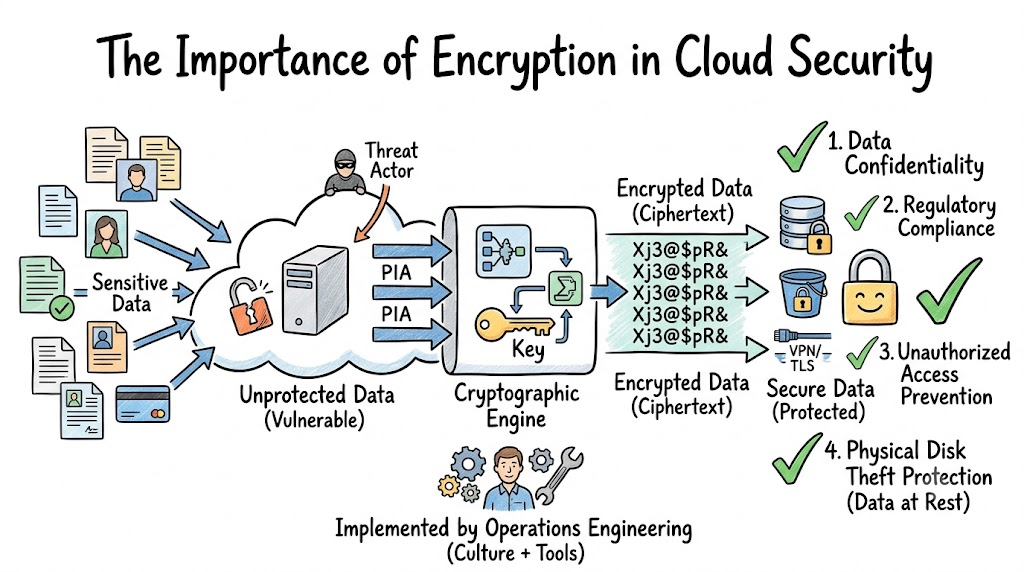
Data breaches challenge every modern business today, making strong digital protection strategies essential for survival. Security teams frequently discover that perimeter defenses alone cannot stop sophisticated threat actors who bypass network firewalls. Consequently, Cloudopsnow delivers advanced data security architectures designed to secure sensitive corporate information assets across distributed environments. Modern organizations rely on data protection frameworks to prevent unauthorized third parties from viewing their private customer logs. By transforming clear text into unreadable ciphertext, this cryptographic process establishes a robust last line of defense. Therefore, implementing systemic mathematical protection shields complex infrastructure platforms even during severe active cloud infrastructure compromises.
Furthermore, dynamic organizations migrating heavy workloads to virtual infrastructure must recognize the inherent vulnerabilities of shared remote hardware. Cloud environments inherently distribute data across multiple physical servers, increasing the potential attack surface for corporate assets. As a result, implementing end-to-end cryptographic frameworks ensures that data remains unreadable even if a physical storage drive is misplaced. This fundamental security pillar allows enterprise teams to safely utilize scalable public infrastructure without risking compliance penalties. Ultimately, establishing strong cryptographic controls builds client trust and maintains operational integrity across all engineering departments.
Key Operational Concepts You Must Know
Symmetric and Asymmetric Architectures
Enterprise architectures rely on symmetric cryptography to process vast amounts of corporate cloud storage efficiently. This specific methodology utilizes a single shared secret key to execute both data encryption and decryption functions. Consequently, engineering teams favor this mathematical approach because it requires minimal computational overhead during massive database reads. However, safely distributing this single key across distributed global networks presents a significant operational challenge for infrastructure teams. Therefore, administrators must pair symmetric pipelines with automated key rotation systems to prevent long-term credential leaks.
Conversely, asymmetric cryptography utilizes a mathematically linked public and private key pair to establish secure communication channels. The public key remains openly available to anyone who needs to encrypt data intended for the organization. Meanwhile, the corresponding private key remains safely hidden within a secure hardware security module to perform decryption tasks. Although this method requires more computational processing power, it solves the fundamental challenge of secure key distribution over public networks. Thus, modern platforms combine both symmetric and asymmetric systems to maximize data processing speed while maintaining strict access boundaries.
Cryptographic States of Cloud Data
Data in transit represents any information moving across public networks or between isolated virtual private cloud systems. During this vulnerable state, malicious actors can intercept packets using sniffing tools if the traffic remains unencrypted. Therefore, engineering teams mandate Transport Layer Security protocols to encrypt every network connection traveling to cloud databases. This continuous protection prevents external adversaries from executing middle-person attacks during critical financial or personal data transfers. As a result, data remains completely secure while traveling through internet routers.
Data at rest refers to static digital assets stored on physical hard drives, solid-state arrays, or object storage buckets. If an attacker gains physical access to the cloud data center, unencrypted storage volumes allow instant data extraction. To mitigate this severe threat, platforms apply block-level storage encryption to convert stored files into unreadable code. Furthermore, this protection ensures that deleted storage blocks cannot be reconstructed or read by subsequent tenant systems sharing the hardware. Consequently, protecting static data protects historical archives from internal leaks and external system compromises.
Data in use presents a unique challenge because applications must decrypt files in system memory to process active transactions. Consequently, traditional systems leave data highly vulnerable to memory scraping malware while processing live records inside random-access memory. To solve this critical vulnerability, modern operations engineering teams implement confidential computing frameworks using secure hardware enclaves. These isolated hardware zones encrypt data even within the central processing unit during active computational execution phases. As a result, unauthorized applications cannot peek into active memory pools during live computations.
Key Lifecycle Management Principles
Secure key generation forms the foundational baseline of any enterprise-grade cryptographic infrastructure inside virtual computing environments. Engineering teams utilize hardware security modules that leverage physical randomness to create highly unpredictable cryptographic keys. If generation processes rely on weak software pseudo-randomness, attackers can predict keys using advanced statistical modeling techniques. Therefore, teams must enforce strict standards during initialization to guarantee the absolute uniqueness of every data key. This rigorous process prevents early vulnerabilities from compromising downstream data assets over time.
[Key Generation] ──> [Secure Storage] ──> [Key Rotation] ──> [Key Destruction]
Following generation, secure storage dictates that cryptographic keys must never reside in clear text on standard file systems. Instead, operations engineers utilize dedicated cloud key management systems that store root keys inside validated hardware appliances. Access to these master keys requires strict identity authorization verified through centralized permission access policies. Moreover, encrypting data-encrypting keys with a master key adds an extra layer of structural protection known as envelope encryption. This isolation ensures that even system administrators cannot easily export raw key files from production platforms.
Regular key rotation minimizes the total volume of corporate data encrypted under a single cryptographic key. If an adversary compromises a single key, automated rotation ensures they only access a tiny fraction of historical data. Therefore, enterprise systems configure automated policies to replace data keys seamlessly without causing operational application downtime. This continuous cycling restricts the utility of stolen credentials and reduces the overall window of vulnerability for cloud environments. Consequently, systematic updates keep security postures ahead of modern cryptographic breaking capabilities.
Finally, secure key destruction ensures that decommissioned or compromised keys are completely erased from all backup media. When an organization terminates a cloud storage volume, destroying the corresponding cryptographic key renders the residual data permanently unrecoverable. This process, known as crypto-shredding, provides a fast method for sanitizing massive cloud data repositories instantly. Operations teams must maintain detailed cryptographic audit logs to verify that keys are completely destroyed according to corporate compliance rules. Thus, structured disposal prevents historical data remnants from leaking years after initial project retirement.
Platform Implementation vs. Culture — What’s the Real Difference?
Structural Comparison of Operations Approaches
To understand how encryption scales, organizations must contrast technical platform implementation with foundational engineering culture. While software tools provide the necessary mechanics, a security-first culture ensures teams actually use those tools correctly during daily work.
| Operational Dimension | Platform Implementation Focus | Engineering Culture Focus |
| Primary Objective | Deploying hardware security modules and automated key management tools. | Instilling a deep security-first mindset within every developer. |
| Success Metric | Achieving 100% encryption coverage across cloud storage buckets. | Reducing human security errors during daily infrastructure updates. |
| Tooling Integration | Integrating automated cryptographic application programming interfaces into code. | Conducting peer-review sessions for infrastructure configuration templates. |
| Error Resolution | Deploying software patches to fix broken key rotation loops. | Running blameless post-mortems to discover root behavioral flaws. |
| Scaling Capability | Increasing computing power to manage high cryptographic workloads. | Educating incoming junior engineering staff on secure coding habits. |
Technical Tooling Implementation
Platform implementation focuses completely on deploying software assets, configuring API gateways, and maintaining cloud security configurations. For example, engineers spend hours writing automation scripts to ensure every new storage bucket enables default hardware-managed encryption. These technical guardrails automatically block any deployment requests that fail to meet strict corporate encryption baselines. However, relying solely on platform tools creates a false sense of security if engineers do not understand the underlying architecture. Software configurations can be accidentally altered or bypassed by developers seeking faster deployment speeds.
Furthermore, technical implementation often introduces significant operational complexity that can overwhelm untrained software development teams. When platforms enforce strict key management policies without providing clear documentation, developers find workarounds to maintain velocity. For instance, an engineer might hardcode a cryptographic key directly into application source code to bypass a complex API connection. This behavior highlights how excellent platform tools fail completely when implemented without proper consideration for developer workflows. Therefore, technical tools require supporting operational structures to achieve lasting security efficacy across enterprise software ecosystems.
Educational Engineering Culture
An educational engineering culture prioritizes human security awareness, continuous learning, and shared responsibility across all corporate departments. In this environment, developers view encryption not as an administrative obstacle, but as a core requirement for quality software. Teams actively discuss cryptographic boundaries during initial system design phases rather than treating security as an afterthought. This proactive mindset helps organizations identify potential data exposure risks long before any code reaches live production environments. Consequently, human-centric security cultures dramatically reduce common configuration mistakes that lead to costly data leaks.
Moreover, a strong engineering culture encourages open communication regarding system vulnerabilities and accidental security misconfigurations. When a developer accidentally exposes an unencrypted database, they feel safe reporting the incident immediately without fear of unfair punishment. This transparent atmosphere allows operations teams to contain security breaches rapidly before external threat actors detect the exposed assets. Blameless post-mortem reviews help teams update training programs to ensure the entire organization learns from individual mistakes. Ultimately, a healthy cultural foundation turns every employee into an active defender of corporate data security.
Balancing Tools and Mindsets
Achieving optimal cloud security requires a continuous balance between advanced platform tools and progressive engineering mindsets. Organizations that over-invest in expensive security software while ignoring developer training remain highly vulnerable to social engineering and basic configuration errors. Conversely, a highly motivated security team cannot protect data effectively if executives refuse to fund modern cryptographic hardware tools. Therefore, leadership teams must treat platform infrastructure and organizational culture as mutually dependent components of a single security strategy. This unified approach ensures that advanced technical tools are supported by intelligent human choices.
To bridge this operational gap, companies should embed automated security checks directly into daily developer workflows. By providing instant feedback inside code repositories, engineers learn secure patterns while building software features. This integration transforms abstract cryptographic policies into concrete engineering actions that developers can easily execute. Furthermore, rewards for identifying security vulnerabilities encourage teams to maintain high standards across all cloud infrastructure modules. Balancing technical tools with cultural support creates a resilient security posture that adapts to emerging threats.
Real-World Use Cases of Modern Operations
Financial Services Architecture
[User App] ──(TLS Link)──> [API Gateway] ──(Tokenized)──> [Database Engine]
A global banking institution migrated its retail transaction engine to a hybrid cloud architecture to improve processing speeds. Because the platform processes millions of sensitive credit card records daily, it requires strict adherence to international security standards. The engineering team deployed an end-to-end encryption framework using asymmetric key pairs to secure user data during transmission. Additionally, they implemented database field-level encryption, ensuring that highly sensitive fields like account balances remain unreadable to database administrators. This architectural design successfully isolates client data from internal threats while meeting rigid financial industry compliance guidelines.
Furthermore, the bank implemented an automated key rotation policy that updates cryptographic keys every twenty-four hours without disrupting live systems. This fast rotation schedule ensures that even a compromised key only exposes a tiny window of transaction data. To maintain high performance, the team utilized specialized hardware acceleration modules to offload the heavy computational processing of encryption algorithms. As a result, the institution maintained sub-second transaction times while processing every payment record through multiple cryptographic layers. This case study demonstrates how advanced encryption protects financial assets without compromising operational system responsiveness.
Healthcare Information Systems
A national healthcare provider transitioned its electronic health record platform to a public cloud environment to improve hospital collaboration. Because patient records contain highly confidential medical histories, the organization faced strict regulatory requirements regarding data privacy. To protect this sensitive data, operations engineers deployed block-level storage encryption across all distributed object storage repositories. This protection guarantees that physical hard drive theft from data centers results in zero readable patient information leaks. Additionally, the system automatically logs every access request to establish an unalterable audit trail for security compliance officers.
Moreover, the healthcare platform utilizes homomorphic encryption techniques to allow researchers to analyze medical trends without viewing individual identities. This advanced cryptographic approach permits mathematical calculations on encrypted data fields without requiring initial decryption to clear text. Consequently, medical research teams extract valuable public health insights while maintaining absolute patient privacy throughout the analytical process. The system also employs secure communication channels between remote medical devices and centralized cloud servers to prevent real-time data interception. This comprehensive deployment illustrates how modern encryption saves lives while safeguarding personal privacy rights.
Global E-Commerce Platforms
An international retail vendor experienced rapid customer growth, prompting a complete redesign of its cloud-based order management system. The platform stores extensive customer profiles, including home addresses, phone numbers, and historic purchasing preferences. To secure this valuable corporate asset, engineers integrated automated cryptographic tokenization into the customer registration microservices. This system replaces sensitive data fields with randomized identification tokens, while storing the actual encrypted data in a separate vault. Therefore, standard web applications only interact with harmless tokens, reducing the risk of massive data leaks during application-level compromises.
[Raw Customer Data] ──> [Tokenization Engine] ──> [Randomized Token]
                               │
                       (Stored Encrypted)
                               ▼
                     [Secure Data Vault]
Additionally, during peak holiday shopping events, the platform scales its computing infrastructure across multiple geographical cloud availability regions. Automated configuration management scripts ensure that every newly provisioned server automatically inherits identical encryption-at-rest policies. This consistent deployment strategy prevents human errors from creating security gaps during rapid infrastructure scaling phases. The organization also runs continuous automated scanning tools to detect any unencrypted data lingering in temporary application logs. Through these strict operational practices, the e-commerce giant maintains customer trust and protects its global brand reputation.
Common Mistakes in Operations Engineering
Hardcoding Cryptographic Keys
One of the most frequent errors in cloud engineering involves saving raw cryptographic keys directly inside application source code repositories. Developers often use this bad habit during early testing phases, intending to replace the cleartext keys before production deployment. However, these keys are frequently forgotten and accidentally pushed to public code sharing platforms, where automated bots scan for credentials. Once an adversary grabs an exposed key, they gain immediate access to the linked cloud storage resources. Therefore, teams must use automated scanning tools within code deployment pipelines to catch exposed secrets before they leak.
To resolve this common vulnerability, organizations must mandate the use of centralized cloud secret storage managers. Applications should fetch required cryptographic keys dynamically at runtime using secure identity roles instead of reading static configuration files. This architecture keeps keys out of git repositories and allows security teams to modify credentials without rewriting software code. Furthermore, implementing strict access logs around secret managers allows security teams to detect unauthorized credential requests instantly. Eliminating hardcoded keys is a critical step toward establishing a reliable security perimeter.
Neglecting Key Rotation Schedules
Many infrastructure teams deploy encryption systems successfully but fail to implement a consistent, automated key rotation schedule over time. Leaving the same cryptographic key active for multiple years increases the total volume of data protected by that single credential. If an attacker slowly extracts data over many months, a single compromised key exposes the company’s entire digital history. Additionally, manual key rotation processes often cause unexpected application downtime because developers forget which systems rely on specific credentials. Therefore, failing to automate this lifecycle process creates long-term operational risks for corporate platforms.
Risky Practice:    [Single Key used for years] ──> (Compromise exposes ALL historical data)

Secured Practice:  [Key A] ──> [Key B] ──> [Key C] ──> (Compromise exposes only ONE short window)
Operations teams must prioritize automated key rotation policies within their centralized key management systems from day one. Modern cloud vendors offer native services that automatically rotate keys at regular intervals without requiring manual human intervention. This background processing ensures that applications continue functioning smoothly while old keys are safely archived for historical decryption needs. Regularly updating keys limits the utility of stolen credentials and forces teams to build adaptable, decoupled software architectures. Automation eliminates human forgetfulness, creating a more reliable data protection strategy.
Insufficient Access Control Policies
Deploying strong encryption algorithms provides little protection if the corresponding decryption keys remain accessible to every user on the network. Many organizations apply broad access policies that grant entire development teams full administrative permissions to root cryptographic keys. This lack of isolation means an attacker who compromises a single developer account gains full access to data decryption pipelines. Furthermore, over-privileged accounts make it incredibly difficult for security analysts to pinpoint the source of internal data leaks. Therefore, loose access control completely undermines the protective value of advanced cryptographic tools.
To correct this operational flaw, security architectures must enforce the principle of least privilege using identity management frameworks. Only specific application service accounts should possess permissions to call decryption functions, while human users should have zero direct access. Additionally, companies should separate the role of storage administrator from the role of cryptographic key manager within the infrastructure. This separation of duties ensures that a compromised storage account cannot automatically decrypt stolen data volumes. Enforcing strict access boundaries maximizes the structural effectiveness of deployed encryption layers.
How to Become an Operations Expert — Career Roadmap
Foundational Skill Acquisition
Aspiring operations engineers must first build a deep understanding of core networking protocols, Linux operating system internals, and fundamental system architecture. You need to master how data moves across public networks by studying the Open Systems Interconnection model thoroughly. Additionally, learning to navigate the Linux command line allows engineers to manage remote cloud servers and inspect running application processes efficiently. Developing strong foundational skills helps professionals understand exactly where encryption needs to be applied within a distributed software environment. This basic knowledge provides the groundwork for all future advanced security specializations.
[Linux & Networking Basics] ──> [Python/Go Automation] ──> [Cloud Security Specialization]
Simultaneously, individuals should learn at least one major programming language, such as Python or Go, to automate daily operational tasks. Writing clean automation scripts allows engineers to configure cloud infrastructure and manage cryptographic keys without relying on manual entry. Understanding data structures and software logic helps operations professionals collaborate effectively with development teams during architectural planning sessions. Furthermore, practicing script writing prepares engineers to build automated compliance checkers that scan for unencrypted cloud resources. Mastering automation is essential for scaling security practices across large enterprise platforms.
Core Industry Certifications
To validate your skills and advance into senior roles, earning respected cloud security certifications can give you a strong competitive advantage. Professionals should focus on certifications that emphasize practical infrastructure management and cryptographic deployment scenarios.
- AWS Certified Security – Specialty
- Focuses on advanced identity management, data protection techniques, and infrastructure encryption within Amazon Web Services ecosystems.
- Ideal for engineers managing large enterprise workloads on AWS platforms.
- Google Cloud Professional Cloud Security Engineer
- Emphasizes designing secure cloud infrastructure, configuring network security parameters, and managing keys via Google Cloud technologies.
- Best for professionals working in hybrid or multi-cloud enterprise environments.
- Certified Information Systems Security Professional (CISSP)
- Covers broad enterprise security domains, cryptographic principles, risk management strategies, and corporate governance policies.
- Designed for experienced engineers moving into security leadership or architectural roles.
- Certified Cloud Security Professional (CCSP)
- Validates deep knowledge of cloud data security principles, platform architectural design, and international compliance requirements.
- Excellent for operations specialists focusing heavily on global data privacy regulations.
Advanced Architectural Engineering
Senior operations professionals must learn to design highly resilient, multi-region cloud architectures that maintain strong security baselines automatically. You should study how to implement zero-trust network architectures where every single microservice connection requires explicit cryptographic validation. This advanced design prevents lateral movement by attackers who manage to breach external network perimeters. Additionally, mastering infrastructure as code tools allows engineers to define encryption policies directly inside reusable configuration templates. This practice guarantees that every environment created matches corporate security requirements precisely.
Furthermore, experts must stay informed about emerging cryptographic trends, such as post-quantum encryption algorithms designed to resist future computing threats. As processing capabilities advance, standard encryption methods become vulnerable to fast brute-force decryption attacks. Therefore, top-tier engineers experiment with quantum-resistant key exchange protocols to future-proof current enterprise data storage platforms. Developing this forward-looking expertise positions professionals as essential assets to organizations managing highly sensitive long-term data archives. Continuous architectural learning ensures your security designs remain effective against evolving technical threats.
Strategic Leadership Integration
Reaching the highest levels of operations engineering requires translating technical cryptographic concepts into clear business value for executive stakeholders. Leaders must explain how robust encryption strategies prevent catastrophic financial fines and safeguard long-term brand equity. By framing security investments as business enablers, engineers secure the necessary funding for modern hardware tools and team training. Additionally, mentoring junior team members helps distribute security knowledge evenly across the entire engineering department, reducing single points of failure. Strategic leaders bridge the gap between technical execution and corporate business goals.
Finally, expert leaders must establish comprehensive incident response frameworks that guide organizations through potential data breach scenarios smoothly. You should design automated monitoring systems that detect anomalous key access patterns and isolate compromised environments instantly. Running regular simulation exercises ensures that engineering and legal teams know exactly how to cooperate during active security crises. This thorough preparation minimizes operational downtime and ensures compliance with international data breach reporting laws. Ultimately, combining technical expertise with strategic leadership creates resilient organizations capable of thriving in complex cloud environments.
FAQ Section
- What is the difference between encryption in transit and encryption at rest?
Encryption in transit protects data while it moves across networks using protocols like Transport Layer Security to stop interception. In contrast, encryption at rest secures static data saved on physical hard drives or object storage blocks from physical theft.
- How does automated key rotation improve cloud security posture?
Automated key rotation regularly replaces active cryptographic keys to limit the total volume of data protected by a single credential. This process ensures that if an individual key is compromised, historical and future data archives remain completely secure.
- Why should developers avoid hardcoding encryption keys in source code?
Hardcoding keys inside source code exposes credentials to anyone with repository access and risks leaks via public code sharing platforms. Instead, applications should fetch keys dynamically at runtime from secure, centralized cloud secret management solutions to ensure safety.
- What role do hardware security modules play in cloud encryption?
Hardware security modules provide physically isolated, tamper-resistant environments designed specifically for generating and managing high-quality cryptographic keys. These devices ensure master keys cannot be exported or read in cleartext by unauthorized system administrators.
- How does envelope encryption protect large-scale cloud datasets?
Envelope encryption encrypts your actual raw data with a specific data key, then encrypts that data key with a master key. This dual-layered strategy allows systems to process data rapidly while centralizing access controls around the master key.
Final Summary
Implementing systematic encryption across all cloud states remains an indispensable requirement for securing sensitive corporate information assets in distributed virtual environments. Organizations must transition away from legacy boundary-focused security models and embrace deep cryptographic defense strategies to defeat sophisticated modern threat actors. By mastering key lifecycle management and enforcing strict access control policies, enterprise engineering teams can safely utilize scalable public cloud infrastructure. Ultimately, combining advanced technical platform tools with an educated, security-first engineering culture creates a resilient digital ecosystem that preserves consumer trust.

