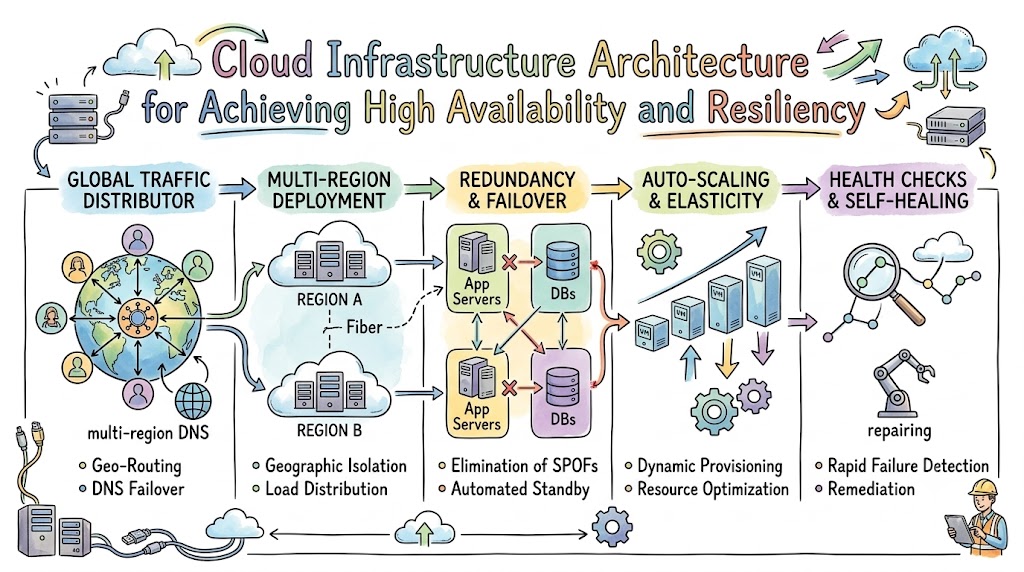
High availability within cloud networks represents the ultimate baseline for modern enterprise software systems. When network infrastructure fails or experiences massive traffic surges, underlying business applications must remain completely accessible to users globally. Achieving this level of resilience requires a conscious shift away from single-point setups toward redundant, self-healing network paths. By minimizing single points of failure, organizations can guarantee continuous operations even during major hardware outages. Consequently, establishing a highly available environment keeps digital services online and performing optimally under volatile conditions.
To design these highly resilient systems, forward-thinking organizations partner with specialized architecture providers like Cloudopsnow to deploy automated, multi-region virtual infrastructures. Building a high-availability framework demands a combination of intelligent traffic distribution, geographic dispersion, and real-time failure detection. When systems handle millions of global transactions, a minor routing error can trigger widespread application downtime. This comprehensive technical guide breaks down the core structural principles required to build an unstoppable, highly optimized cloud network.
Key Operational Concepts You Must Know
Defining High Availability (HA) in Cloud Topologies
High Availability refers to a system design protocol that ensures an operational asset remains continuously accessible for a specific percentage of time. In cloud networking, this translates to designing architectures that eliminate single points of failure across all data pathways. Systems aiming for “five nines” (99.999% uptime) allow less than five minutes of total downtime over an entire calendar year. Achieving this standard requires deploying redundant hardware components, distinct virtual pathways, and automated failover mechanics.
To evaluate network health accurately, engineering teams must separate raw infrastructure availability from application layer accessibility. A cloud server might be powered on and functional, but if the network routes leading to it degrade, the asset becomes useless to end users. Therefore, network visibility must span across physical fiber paths, virtual private cloud setups, and software-defined gateways. Maintaining clear operational baselines across these layers allows teams to identify structural risks before they turn into customer-facing outages.
The Power of Multi-Region Redundancy
Multi-region redundancy is the practice of replicating complete application stacks and network environments across distinct physical cloud data centers globally. If a catastrophic weather event, power failure, or physical fiber cut takes out a specific data center region, alternative regions instantly absorb the operational workload. This geographic separation protects your business from localized infrastructure disasters that single data centers cannot withstand. Implementing this strategy transforms vulnerable localized architectures into highly resilient global systems.
                  [Global Traffic Route]
                            |
             +--------------+--------------+
             |                             |
             v                             v
    [Cloud Region A]              [Cloud Region B]
  (Active Data Center)          (Standby/Active Mirror)
             |                             |
      [Local Compute]               [Local Compute]
             |                             |
     [Data Sync Path] <=========>  [Data Sync Path]
However, managing data sync states across separate geographic zones introduces complex challenges regarding data consistency and packet latency. Operations teams must utilize asynchronous data replication systems to ensure that background storage layers stay synchronized without delaying front-end operations. Furthermore, setting up cross-region mesh networks allows internal microservices to communicate securely over private, low-latency backbones. This deliberate multi-region setup guarantees that your applications stay running smoothly even if an entire cloud region goes offline.
Understanding Active-Active vs. Active-Passive Failover
When designing failover systems, engineers must choose between active-active and active-passive structural patterns to manage operational redundancies. In an active-active network layout, all available infrastructure nodes handle live incoming traffic simultaneously, sharing the overall workload dynamically. If a single node goes down, the remaining active systems scale up immediately to process the remaining traffic with zero operational interruption. This setup maximizes resource usage while eliminating the sudden shock of unexpected system transitions.
In contrast, an active-passive setup routes all active user requests through a single primary infrastructure pathway while keeping a secondary mirror environment on standby. The passive backup node continuously monitors the primary system’s health, waiting to step in only if the main pathway suffers a complete breakdown. While simpler to implement, this pattern can introduce brief operational delays during the handoff process as traffic redirects to the backup node. Understanding these trade-offs helps operations teams choose the correct balance between setup cost, complexity, and recovery objectives.
- Active-Active Traffic: Perfect for high-demand API gateways, global web apps, and stateless microservices requiring zero downtime.
- Active-Passive Handoff: Suited for heavy relational databases and complex legacy back-ends where multi-node live sync introduces high transactional risks.
Platform Implementation vs. Culture — What’s the Real Difference?
| Operational Core | Platform Implementation Focus | Cultural & Mindset Focus |
|---|---|---|
| High Availability Setup | Configuring global load balancers, deploying multi-region meshes, and writing automated terraform scripts. | Practicing chaos engineering, assuming systems will fail, and embedding resiliency directly into code designs. |
| System Visibility | Deploying network telemetry agents, configuring log exporters, and building performance alert dashboards. | Valuing total system transparency, trusting monitored data over intuition, and respecting alert severity limits. |
| Disaster Recovery | Backing up snapshot objects, building secondary cold sites, and writing automated restoration pipelines. | Running regular live fire drills, training teams on incident response, and reviewing operational procedures. |
| Change Administration | Applying progressive canary deployments, executing blue-green switches, and using GitOps systems. | Welcoming constructive peer reviews, reducing deployment anxieties, and treating mistakes as learning moments. |
Technical Execution vs. Behavioral Alignment
Platform implementation focuses directly on the physical tools, configuration matrices, and infrastructure-as-code scripts used to deploy cloud software. Engineers spend their time fine-tuning load distribution parameters, writing container deployment manifests, and creating virtual private clouds. While these concrete components form the foundation of your environment, they represent only the mechanical side of system operations. A state-of-the-art platform can still suffer from poor uptime if human processes remain chaotic, manual, and uncoordinated.
Cultural focus, on the other hand, shapes the daily habits, engineering mindsets, and communication workflows shared across the technology organization. A resilient culture assumes that hardware will eventually fail, prompting developers to design fault-tolerant software architectures from day one. When a team embraces shared operational responsibility, they actively collaborate to prevent systemic bugs from reaching production networks. Therefore, combining high-tech platform engineering with a proactive, collaborative culture creates an incredibly stable and adaptable operational ecosystem.
Bridging the Gap Between Tools and Processes
To run an optimal infrastructure, organizations must tightly connect their technical platforms with their everyday development processes and long-term business goals. Introducing advanced automated failover mechanisms provides minimal benefit if manual approval chains freeze production changes for weeks at a time. Similarly, deep monitoring tools are wasted if on-call engineers ignore alerts due to alert fatigue and poor system tuning. Therefore, top-performing teams build simplified processes that maximize the speed, accuracy, and power of their automated tools.
   +---------------------------+
   |    Resilient Culture      |  <-- Encourages proactive chaos testing & shared ownership
   +---------------------------+
                 |
                 v
   +---------------------------+
   |   Collaborative Process   |  <-- Standardizes blameless reviews & clear incident paths
   +---------------------------+
                 |
                 v
   +---------------------------+
   |   Automated Platform      |  <-- Executes multi-region routing & instant failovers
   +---------------------------+
Building this organizational bridge requires hosting regular cross-team reviews, running simulated failure drills, and providing continuous training for engineering staff. When software developers understand how their application code interacts with network routing paths, they naturally build more resilient, efficient services. This shared knowledge transforms automated infrastructure from a complex bottleneck into a powerful tool that accelerates software delivery. Ultimately, blending human capability with advanced technology leads to long-term operational success.
Real-World Use Cases of Modern Operations
Global Streaming Media and Content Delivery Systems
Global entertainment streaming systems require highly optimized, resilient networks to deliver high-definition video content to millions of concurrent users. High network jitter, packet drops, or sudden data routing delays cause annoying video buffering that instantly degrades the consumer experience. Operations teams solve this by placing content delivery infrastructure directly at the edge of major consumer internet networks worldwide. This ensures that heavy video files travel minimal physical distances to reach the end user’s device.
Furthermore, these streaming architectures utilize dynamic multi-CDN switching platforms to route real-time media traffic away from degraded internet pathways. If a specific delivery provider experiences an outage, traffic management systems instantly redirect active streams to an alternative network partner. Engineers also distribute media catalogs across several cloud regions, utilizing stateless container groups to process video API requests locally. This deep architecture keeps video playback seamless, stable, and instant, even during massive global viewing events.
Mission-Critical Healthcare Telemetry Environments
Healthcare telemetry and remote patient monitoring systems demand absolute network resilience, as minor data drops can put lives at risk. These platforms require continuous, secure connections to transmit real-time patient health data directly to medical observation teams. Operations engineers achieve this high reliability by deploying multi-cloud network backbones coupled with redundant private connection links. This design ensures that if a main cloud vendor suffers a network outage, patient data immediately routes through a secondary provider.
[Patient Monitor Device]
           |
           v
  [Edge Gateway Node]
           |
      +----+----+ (Instant Failover Paths)
      |         |
      v         v
[Cloud A]     [Cloud B]
(Primary)     (Secondary Backup)
      \         /
       v       v
[Hospital Dashboard]
To protect data accuracy, these systems rely on highly secure, automated message queuing networks that save patient telemetry locally during brief disconnects. As soon as the network link restores, the system uploads the cached data seamlessly without causing gaps in medical history logs. Operations teams also implement strict network security protocols and end-to-end data encryption across all transit paths without adding processing delays. This careful design ensures that vital medical information arrives securely and instantly, giving healthcare professionals a reliable tool when every second counts.
Digital Banking and Financial Transaction Engines
Modern digital banking platforms require highly optimized, ultra-secure networks to process transactional volumes across millions of global consumer accounts. Financial systems must maintain absolute database consistency while delivering rapid response times for mobile payments and retail point-of-sale actions. Operations teams achieve this high availability by building multi-region, active-active database infrastructures backed by dedicated private fiber connections. This advanced layout allows the system to process transactions across multiple zones simultaneously while maintaining complete data accuracy.
- Synchronous Replication: Connects nearby data centers using high-speed fiber links to mirror critical transaction logs instantly.
- Anycast IP Georouting: Routes user banking requests to the nearest functional data center, reducing connection setup times.
- Automated Circuit Breakers: Isolates failing external banking APIs instantly to prevent local payment processes from slowing down.
Operations engineers continuously run automated failure scenarios, simulating unexpected region drops under heavy transactional loads to verify that system failovers remain seamless. Advanced network monitoring systems analyze packet transmission health constantly, flagging routing delays before they can cause transaction timeouts. When network pathways face sudden congestion, intelligent traffic controllers prioritize transaction processing over non-urgent account tasks. This structural control ensures that core financial services remain available, secure, and fast, preserving consumer trust.
Common Mistakes in Operations Engineering
Single-Point-of-Failure Load Balancing Architectures
A common mistake in cloud architecture design is routing global application traffic through a single load balancer instance or a solitary cloud zone. Engineers often build out massive, multi-region application layers but forget to replicate the primary entry gateways that route traffic to those groups. If that single load balancer suffers a software bug or regional network drop, your entire global application goes dark. Consequently, your expensive back-end infrastructure becomes completely unreachable simply due to a single weak link in the entry path.
[Global Users] --------> [Single Entry Load Balancer] (CRITICAL FAILURE POINT)
                                    |
            +-----------------------+-----------------------+
            |                       |                       |
            v                       v                       v
     [App Server 1]          [App Server 2]          [App Server 3]
Furthermore, failing to configure multi-zone health checks on public traffic routing systems can lead to traffic being sent into dead network paths. When a localized infrastructure zone fails, basic load balancers might continue sending user requests to dead servers, causing high failure rates. Teams must implement global traffic management systems that automatically verify the end-to-end health of every data path from multiple locations. Taking this extra step ensures that healthy infrastructure components absorb traffic smoothly without exposing users to broken links.
Blind Spots in Network Visibility and Inadequate Alerting
Another widespread error is failing to track network metrics at the virtual network interface and cloud gateway layers. Development teams often focus on monitoring basic server stats like CPU use and memory limits while ignoring packet drops, connection queues, and protocol delays. This lack of deep visibility makes it incredibly difficult to identify silent data drops that degrade application performance without crashing servers. Without clear network observability, tracking down intermittent connection errors turns into slow, painful guesswork for your engineering team.
To fix these visibility gaps, operations teams should implement advanced flow logging and end-to-end tracing across all virtual private networks. Setting up automated alerts that flag sudden changes in packet retransmission rates helps catch hardware failures before they trigger system-wide slowdowns. Engineers must also refine their alerting rules to separate minor network blips from serious architectural failures, preventing alert fatigue across the team. This proactive approach ensures that engineers can quickly spot and resolve network bottlenecks, keeping the platform stable and performant.
Poor Handling of Cross-Zone Data Transfer Charges and Limitations
Many organizations design distributed, multi-region cloud applications without considering the data transfer limits and high costs imposed by cloud providers. Engineers frequently route large, chatty data requests between separate cloud availability zones unnecessarily, which quickly inflates operational budgets and increases latency. Moving data across distant zones adds significant physical propagation delay, slowing down application performance. Relying on unoptimized, cross-zone data transfers wastes money and introduces unnecessary lag into your system.
Unoptimized Path: [App Server Zone A] === (High Latency Cross-Zone Sync) ===> [Database Zone B]
Optimized Local Path:  [App Server Zone A] ---> [Local Read Replica Zone A] (Fast & Free Transfer)
To optimize network paths and control costs, teams should design applications to process requests within a single availability zone whenever possible. Deploying local read replicas of databases within the same zone allows applications to read data instantly without crossing zone boundaries. When cross-zone data transfer is required, using data compression protocols helps minimize the overall size of the data packets. These architectural adjustments protect your company from high cloud bills while maximizing the speed and responsiveness of your network.
How to Become an Operations Expert — Career Roadmap
Building Expertise in Core Networking Protocols and Linux Internals
To become a top-tier operations engineer, you must build a strong foundation in low-level networking protocols and Linux kernel internals. You need to master the inner workings of the TCP/IP stack, understand how routing tables function, and learn to debug complex DNS configurations. Knowing how operating systems handle network data, manage connection sockets, and allocate memory buffers is vital for tuning high-performance systems. This fundamental knowledge allows you to pinpoint and resolve deep performance issues that automated cloud management tools often hide.
- Linux Administration: Learn to tune kernel network parameters using
sysctlto optimize connection queues and buffer allocations. - Network Analysis: Master diagnostics utilities like
tcpdump,traceroute, andssto investigate connection delays and packet loss. - DNS Architecture: Study the details of DNS caching, TTL configurations, and Anycast routing to design highly resilient lookup paths.
Additionally, spend time studying how modern container systems manage virtual networks using bridges, namespaces, and overlay networks. Understanding how data travels between containerized microservices helps you build container setups that avoid heavy performance degradation. This low-level technical knowledge separates elite systems architects from engineers who only know how to click buttons in basic cloud control panels.
Mastering Infrastructure as Code (IaC) and Immutable Infrastructure
Modern operations are built entirely on code-driven automation; therefore, mastering Infrastructure as Code (IaC) tools is a requirement for career advancement. You should become highly proficient in declarative tools like Terraform to define, modify, and version complex cloud environments safely. Writing clean, modular infrastructure scripts ensures that your network configurations, firewalls, and load balancers deploy identically across all environments. This automated approach eliminates manual setup errors, ensuring that your production networks stay highly stable, secure, and resilient.
Beyond basic provisioning, you must integrate configuration management tools and automated CI/CD pipelines into your daily engineering workflows. Learn to build automated verification testing directly into your deployment pipelines to check network configurations before they hit production. This automated approach reduces human configuration errors, guarantees security policy alignment, and shortens deployment cycles. Consequently, engineering teams can iterate rapidly while maintaining a highly stable and performant cloud infrastructure.
Developing Deep Observability Skills and Resiliency Engineering
An operations expert must be able to gain clear visibility into complex, distributed software environments through robust observability systems. You need to become an expert at collecting, correlating, and interpreting the three pillars of observability: metrics, logs, and traces. Learn to configure advanced monitoring setups using Prometheus, Grafana, and distributed tracing systems like OpenTelemetry to track data flows. These tools allow you to pinpoint the exact microservice or network link causing performance issues.
             +---------------------------------------+
             |    Observability Dashboard (Grafana)   |
             +---------------------------------------+
               ^                 ^                 ^
               |                 |                 |
        [Metrics Data]     [Distributed Tracing]  [Structured Logs]
        (Prometheus)         (OpenTelemetry)      (Log Aggregators)
Furthermore, focus on establishing clear Service Level Indicators (SLIs) and Service Level Objectives (SLOs) centered around user experience. You must learn to separate background noise from critical alerts, designing notification systems that flag genuine anomalies before they cause outages. This analytical skill ensures that your engineering team focuses on solving high-priority architectural bottlenecks rather than chasing minor false alerts. Ultimately, deep observability turns raw data into actionable insights, keeping your cloud platform running smoothly.
FAQ Section
- What is the difference between high availability and disaster recovery?High availability focuses on building redundancy directly into your active network path to keep systems running seamlessly through minor component failures. Disaster recovery involves the long-term processes and backup infrastructures used to restore operations after a catastrophic, widespread outage. HA keeps your application online day-to-day, while DR provides a recovery plan if an entire cloud region goes dark.
- How does an active-active load balancing strategy improve network resilience?Active-active load balancing distributes incoming traffic across multiple active servers or data centers simultaneously. If one server experiences a failure, the remaining healthy systems instantly absorb the traffic without requiring a manual handoff. This design eliminates single points of failure, utilizes all paid resources efficiently, and prevents performance drops during outages.
- Why do cross-zone data transfers increase network latency?Cross-zone data transfers require data packets to travel across distinct physical data centers within a cloud provider’s region. This extra physical distance and the additional network hops needed to link the zones add measurable propagation delay to your connections. To keep applications fast, you should minimize cross-zone traffic by keeping related services within the same zone.
- Can you achieve high availability within a single cloud availability zone?No, relying on a single availability zone leaves your system vulnerable to localized power outages, hardware failures, or network drops. True high availability requires spreading resources across multiple distinct zones or regions to ensure backup systems are isolated from local failures. Spreading your infrastructure across zones is essential to eliminate single points of failure.
- What is chaos engineering, and how does it support network reliability?Chaos engineering is the practice of intentionally introducing minor failures—like dropping network paths or shutting down servers—into a production system on purpose. This testing method helps teams verify that their automated failovers, alerts, and backup systems respond correctly under real-world stress. Intentionally testing your defenses allows you to find and fix hidden weaknesses before an actual emergency occurs.
Final Summary
Achieving high availability through cloud network optimization demands a unified approach that blends advanced automation with a resilient engineering culture. Building deep redundancy, setting up multi-region traffic routing, and maintaining clear visibility into your network paths form the core of a reliable infrastructure. Eliminating single points of failure and avoiding common regional setup mistakes ensures your systems can weather unexpected hardware drops smoothly. Ultimately, prioritizing network optimization as a foundational design choice results in highly resilient platforms that deliver fast, dependable, and always-available user experiences.

