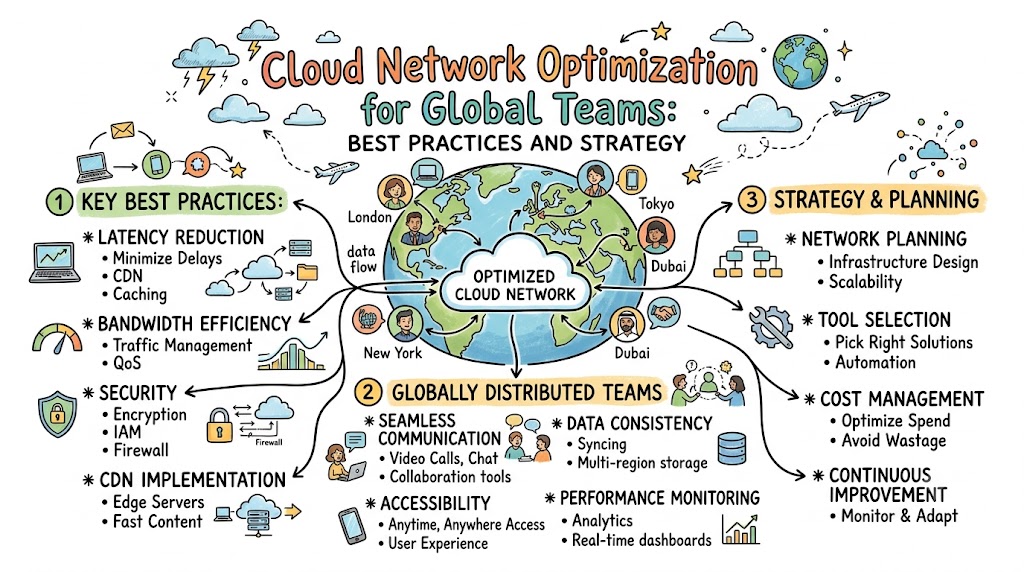
Cloud network optimization for global teams represents the strategic process of enhancing network performance, reducing latency, and ensuring secure, seamless connectivity for distributed workforces. When organizations scale across international borders, standard cloud architectures often suffer from geographic latency, packet loss, and unpredictable bandwidth. Consequently, global teams face frustrating delays while accessing central cloud resources, which severely damages daily collaboration and collective productivity. By implementing advanced routing protocols, localized content delivery networks, and intelligent traffic management, enterprises can establish a fast and resilient virtual infrastructure. Therefore, optimizing your cloud network is no longer a luxury, but a fundamental operational necessity that directly impacts your bottom line.
To achieve top-tier performance, companies require specialized cloud management expertise to navigate these infrastructure hurdles. Working with a dedicated provider like Cloudopsnow enables businesses to deploy high-performance network designs tailored for global operations. Transition words help us understand that without proper network orchestration, even the most sophisticated cloud applications will fail to deliver value to end-users. Organizations must systematically assess their current architecture, evaluate latency bottlenecks, and implement proactive monitoring to maintain peak efficiency. This comprehensive guide will deeply explore the foundational architectures, strategic best practices, and operational shifts required to build a world-class global cloud network.
Architectural Foundation for Global Clouds
Building a resilient global cloud network requires a deep understanding of distributed infrastructure design. Furthermore, engineers must design these networks to withstand localized outages while maintaining low-latency connections for users in different hemispheres. This section breaks down the core structural elements that form the bedrock of modern global cloud networking.
Distributed Multi-Region Deployments
Deploying resources across multiple cloud regions ensures that applications remain physically close to the end-users. First, this strategy drastically reduces the physical distance data must travel, which inherently lowers latency. Second, multi-region setups provide robust disaster recovery capabilities, because traffic can automatically failover if a single region experiences a catastrophic outage.
However, managing data consistency across widely separated geographical zones presents a significant technical challenge. Engineers must carefully balance synchronous and asynchronous data replication models to prevent data corruption while maintaining high performance. Ultimately, a well-designed multi-region architecture forms the primary line of defense against network degradation for global teams.
Anycast Routing and Content Delivery
Anycast routing plays a pivotal role in directing global user traffic to the nearest available network point of presence. By assigning a single IP address to multiple physical servers worldwide, the network naturally routes requests along the shortest path. Consequently, users experience faster initial connection times and reduced website loading delays.
[Global User Request]
         │
         ▼
[Anycast Routing Layer] (Single IP Address Worldwide)
         │
 ┌───────┼───────┐
 ▼       ▼       ▼
[PoP 1] [PoP 2] [PoP 3] (Closest physical location receives traffic)
In tandem with anycast, Content Delivery Networks (CDNs) cache static and dynamic assets at the edge of the network. This combination ensures that heavy media files, scripts, and documents do not need to travel from the origin server every time. Thus, global teams can collaborate on shared assets instantly, regardless of their physical distance from the main data center.
Hybrid and Multi-Cloud Networking
Modern enterprises rarely rely on a single cloud vendor or a purely public cloud environment. Instead, they utilize hybrid architectures that combine private on-premise infrastructure with multiple public cloud providers. Managing connectivity across these diverse environments requires sophisticated software-defined networking solutions to maintain security and speed.
To link these disparate systems successfully, organizations deploy virtual routers and dedicated cloud interconnects. These specialized pipelines bypass the public internet entirely, providing predictable performance and enhanced security. As a result, global teams can access legacy internal systems and modern cloud applications through a unified network fabric.
Strategic Optimization Best Practices
Achieving a high-performing global network demands a systematic approach to traffic management and security orchestration. Without explicit strategies, data bottlenecks will inevitably form at major geographic intersection points. The following methodologies outline how to maximize throughput and maintain tight security across your global cloud layout.
Software-Defined Wide Area Networking (SD-WAN)
SD-WAN technology revolutionizes global connectivity by decoupling the network control mechanisms from the underlying physical hardware. This separation allows administrators to dynamically allocate bandwidth and route traffic based on real-time network conditions. For instance, critical video conferencing traffic can take priority over background file backups automatically.
| Feature | Traditional WAN | Modern SD-WAN |
|---|---|---|
| Traffic Routing | Static, hardware-dependent paths | Dynamic, real-time quality paths |
| Bandwidth Cost | Expensive MPLS circuits | Cost-effective mixed connections |
| Management | Manual per-device configuration | Centralized software control dashboard |
| Cloud Integration | Complex backhauling required | Direct, optimized cloud access |
Additionally, SD-WAN aggregates multiple connection types, including broadband, cellular networks, and traditional MPLS circuits. This redundancy ensures that if one internet service provider experiences a brownout, traffic shifts seamlessly to an alternative path. Therefore, global teams enjoy uninterrupted connectivity even during localized regional telecom infrastructure failures.
Zero Trust Network Access (ZTNA)
Traditional perimeter-based security models are entirely inadequate for modern global teams working from scattered international locations. ZTNA addresses this vulnerability by assuming that every user and device is potentially compromised, requiring continuous authentication. Granting access depends strictly on contextual factors like device health, location, and user identity.
Furthermore, ZTNA establishes micro-perimeters around specific cloud applications rather than granting broad access to the entire network segment. This isolation prevents malicious actors from moving laterally through your cloud infrastructure if they compromise a single endpoint. Consequently, global network performance improves because the system eliminates bloated, backhauled VPN traffic.
Latency Mitigation and Protocol Tuning
Physical distance inevitably introduces latency, but optimized network protocols can significantly minimize its visible impact on global teams. Standard Transmission Control Protocol (TCP) often struggles over long distances due to its rigid windowing and acknowledgement mechanisms. Transitioning to modern protocols like QUIC or optimizing TCP window sizes can drastically improve data throughput.
Standard TCP:  [Client] ──(Syn)──> [Server] ──(Syn-Ack)──> [Client] ──(Ack)──> [Data] (Slow over distance)
QUIC Protocol: [Client] ──(Initial Request + Security Handshake)──> [Server] ──(Data) (Instant connection)
Moreover, implementing aggressive data compression algorithms reduces the overall payload size traveling across international undersea cables. Network engineers should also implement packet aggregation strategies to reduce header overhead on high-latency links. Through these meticulous protocol adjustments, global applications become noticeably snappier and more responsive for remote users.
Key Operational Concepts You Must Know
Managing a global cloud network requires a firm grasp of specific operational metrics and monitoring paradigms. Without these concepts, troubleshooting intermittent international connectivity issues becomes an impossible guessing game. Let us examine the essential operational principles that every cloud administrator must master.
First, performance observability forms the cornerstone of proactive network management. Teams must look beyond basic uptime percentages and focus intensely on granular metrics like jitter, packet loss, and round-trip time (RTT). High jitter ruins real-time communication tools, while even 1% packet loss can degrade database synchronization throughput over long distances.
Second, infrastructure as code (IaC) allows operations teams to define global network topologies through reproducible software scripts. If a network configuration error disrupts connectivity in an overseas region, IaC permits rapid rollbacks to the last known stable state. This automated approach eliminates human configuration errors, which represent a leading cause of major cloud network outages.
Third, traffic shaping and rate limiting prevent specific users or applications from monopolizing precious global bandwidth lines. By enforcing strict quality of service (QoS) policies, operations teams guarantee that mission-critical production systems always receive adequate network resources. This deliberate allocation prevents non-essential tasks from degrading the user experience for distributed global employees.
Platform Implementation vs. Culture — What’s the Real Difference?
Many organizations mistakenly believe that purchasing advanced cloud networking tools will instantly solve their global collaboration struggles. However, technology implementation represents only one half of the equation; operational culture dictates how effectively those tools are actually used. Understanding this distinction prevents costly deployment failures.
Platform implementation focuses entirely on provisioning hardware, configuring software, and establishing technical connections across cloud zones. While this technical foundation is vital, it remains static without a culture that embraces continuous improvement and automated workflows. A poorly trained team will quickly misconfigure an advanced platform, reducing it to an expensive, inefficient network.
Conversely, an operations-driven culture prioritizes blameless post-mortems, cross-department collaboration, and proactive problem-solving. In this environment, engineers do not just build a network; they constantly analyze performance telemetry to optimize the user experience. They actively bridge the gap between software developers and corporate network security officers to keep data moving smoothly.
Ultimately, high-performing global networks emerge when advanced platform implementation aligns perfectly with a collaborative company culture. Organizations must invest equally in training their staff and upgrading their virtual infrastructure to achieve long-term optimization goals. Balancing these two pillars ensures that your cloud network remains both technically superior and organizationally agile.
Real-World Use Cases of Modern Operations
Examining real-world scenarios highlights how cloud network optimization transforms daily business activities for distributed international teams. These practical examples illustrate the concrete benefits of moving away from outdated, centralized network designs.
Collaborative Engineering and Code Synchronization
Consider a software enterprise with large development teams stationed simultaneously in Silicon Valley, Bangalore, and Amsterdam. Initially, engineers faced massive delays when pulling or pushing large repositories to a centralized source control server located in North America. These delays led to code merge conflicts, broken compilation pipelines, and deep team frustration.
Before: [India Team] ──────────(High Latency / Public Internet)──────────> [US Central Git Server]
After:  [India Team] ──> [Local Edge Cache] ──> [Optimized Interconnect] ──> [US Central Git Server]
To resolve this bottleneck, the operations team deployed geographically distributed code caches linked by an optimized cloud interconnect network. They integrated Anycast routing to automatically direct each engineer to their closest local synchronized mirror pool. Consequently, repository sync times dropped from forty minutes to under two, allowing seamless continuous delivery.
Real-Time Financial Data Processing
A global financial services firm required instantaneous synchronization of transaction ledgers across branch offices in Tokyo, London, and New York. Using the public internet resulted in unpredictable packet routing spikes, creating data inconsistencies between regional databases. These network anomalies forced manual reconciliations, stalling daily financial compliance reporting.
The firm implemented an SD-WAN architecture combined with dedicated private cloud network connections to bypass public routing volatility. They applied strict quality of service overrides, ensuring that financial ledger packets always took absolute priority over standard corporate traffic. Because of these changes, global database replication latency fell below fifty milliseconds, ensuring flawless transaction accuracy.
Common Mistakes in Operations Engineering
Even highly experienced engineering teams can fall into subtle traps when designing and maintaining global cloud networks. Recognizing these common missteps allows organizations to avoid costly architectural re-engineering efforts down the line.
- Over-reliance on Public Internet Routing: Assuming the public internet will provide stable connectivity for critical cross-border workflows is a major error. Internet routing paths fluctuate wildly, leading to sudden, unpredictable performance drops for international teams.
- Neglecting Edge Security Protocols: Organizations sometimes maximize raw network speed by bypassing critical security inspections at regional boundaries. This shortcut exposes the global network to localized malware infections that can rapidly spread across the entire corporate infrastructure.
- Ignoring Local Telecommunication Regulations: Network engineers often forget that different nations maintain strict data sovereignty laws and unique telecom operating standards. Failing to account for these legal realities can result in sudden service blocks or severe regulatory financial penalties.
- Inadequate Monitoring at Remote Endpoints: Focusing telemetry monitoring solely on central cloud data centers leaves remote team connections entirely unmonitored. Operations teams cannot fix localized ISP issues if they lack visibility into the last-mile connectivity of their users.
- Over-complicating Network Topology Designs: Creating an excessively complex web of nested virtual private clouds makes troubleshooting nearly impossible during an emergency. Simplicity in network routing design always leads to faster incident response times and higher overall reliability.
How to Become an Operations Expert — Career Roadmap
Navigating a career path into cloud operations requires a deliberate mix of theoretical knowledge, hands-on engineering experience, and specialized certifications. As global network complexity intensifies, companies aggressively hunt for professionals capable of orchestrating these intricate distributed systems.
- Master Core Networking Fundamentals: Aspiring experts must deeply understand standard protocols like TCP/IP, Border Gateway Protocol (BGP), DNS architecture, and subnetting practices.
- Learn Infrastructure as Code: Develop absolute proficiency in automation tools like Terraform or Ansible to deploy and manage global networks programmatically.
- Acquire Major Cloud Certifications: Earn advanced networking specialties from dominant providers, such as the AWS Certified Advanced Networking or Google Cloud Professional Network Engineer credentials.
- Study Modern Security Frameworks: Gain comprehensive expertise in Zero Trust Network Access methodologies, cloud firewalls, and secure access service edge (SASE) platforms.
- Practice Distributed Systems Troubleshooting: Cultivate deep analytical skills by using network packet analyzers like Wireshark to dissect real-world performance bottlenecks.
FAQ Section
- What is the primary cause of network latency for global teams using cloud applications?Physical distance remains the dominant driver of network latency because data packets cannot exceed the speed of light through fiber-optic cables. Additionally, inefficient routing paths across public internet service providers and unoptimized network protocols significantly compound these delays for remote users.
- How does SD-WAN differ from a traditional VPN setup for business connectivity?A traditional VPN routes all traffic through a single static tunnel, often causing severe backhauling delays and single points of failure. In contrast, SD-WAN dynamically manages multiple connection pathways simultaneously, automatically directing traffic along the fastest, healthiest route based on real-time application needs.
- Can content delivery networks optimize dynamic database queries for international users?Standard CDNs excel at caching static assets like images and scripts, but they cannot directly cache changing database records. However, modern advanced CDNs offer dynamic route optimization features that accelerate connection handshakes and streamline data paths back to the primary database origin.
- Why is an operations-driven corporate culture critical for successful cloud network optimization?An operations-driven culture ensures that engineering teams continuously monitor performance, automate routine updates, and rapidly resolve infrastructure bugs. Without this collaborative mindset, expensive network optimization tools are often misconfigured, underutilized, or poorly maintained over time.
- What steps should a company take first when optimizing its cloud network?Organizations should begin by deploying comprehensive monitoring tools to map out their existing traffic patterns and precisely locate latency bottlenecks. Once administrators identify where data delays occur, they can strategically implement localized caching, anycast routing, or dedicated cloud interconnects.
Final Summary
Optimizing a cloud network for global teams demands a comprehensive approach that blends modern architecture, smart traffic routing, and a proactive engineering culture. Organizations cannot rely on basic internet connections to support distributed teams working across different continents. By deploying multi-region architectures, leveraging SD-WAN, and adopting Zero Trust security, businesses can eliminate frustrating latency bottlenecks. These technical improvements directly enhance daily collaboration, accelerate code deployment, and safeguard critical corporate data assets.
Furthermore, true optimization is a continuous operational journey rather than a one-time software installation project. Teams must regularly review network telemetry metrics, refine protocol settings, and update their automation templates to match shifting demands. Investing in a robust network design keeps your enterprise agile, competitive, and fully connected. Ultimately, building a fast and resilient global cloud network empowers your distributed workforce to collaborate seamlessly and drive business growth.

