Introduction
Cyber attacks have become one of the biggest threats facing businesses of every size. Organizations now store critical information, customer records, financial data, applications, and operational systems in cloud environments. While cloud technology offers flexibility, scalability, and efficiency, it also introduces new security challenges that organizations must address carefully.
Cloud security is the collection of technologies, policies, procedures, and controls designed to protect cloud-based systems, data, and infrastructure from unauthorized access, cyber threats, and operational risks. When implemented correctly, cloud security helps organizations reduce vulnerabilities, improve compliance, and maintain business continuity even during security incidents.
Many cyber attacks succeed not because attackers are highly sophisticated, but because organizations overlook basic security practices. Weak passwords, improper access controls, outdated software, misconfigured cloud resources, and insufficient monitoring often create opportunities for attackers to gain access.
This is where Cloudopsnow plays an important role by helping organizations implement modern cloud operations and security strategies that strengthen infrastructure protection and improve operational resilience.
In this comprehensive guide, you will learn how cloud security best practices can help prevent cyber attacks, reduce business risks, protect sensitive information, and create a more secure digital environment for long-term success.
Understanding Modern Cyber Attacks in Cloud Environments
Before discussing prevention strategies, it is important to understand how cyber attacks typically target cloud environments.
Modern attackers look for weaknesses in cloud configurations, user behavior, software vulnerabilities, and access management systems. Their goal may be data theft, financial gain, espionage, ransomware deployment, service disruption, or unauthorized system access.
Common cloud-related cyber attacks include:
- Phishing attacks
- Credential theft
- Malware infections
- Ransomware attacks
- Insider threats
- API exploitation
- Data breaches
- Denial-of-service attacks
- Misconfiguration exploitation
- Privilege escalation attacks
Cloud environments often involve multiple services, users, devices, and integrations. Without proper security controls, managing these moving parts becomes increasingly difficult.
Therefore, organizations must adopt proactive cloud security practices rather than relying solely on reactive security measures.
Why Cloud Security Matters More Than Ever
Businesses increasingly depend on cloud infrastructure for daily operations. Customer interactions, internal collaboration, software development, data storage, and analytics often rely on cloud services.
A successful cyber attack can result in:
- Financial losses
- Reputational damage
- Legal consequences
- Customer trust issues
- Service downtime
- Data exposure
- Regulatory penalties
Strong cloud security minimizes these risks while supporting business growth and innovation.
When security becomes part of everyday operations, organizations can confidently scale their infrastructure without creating unnecessary vulnerabilities.
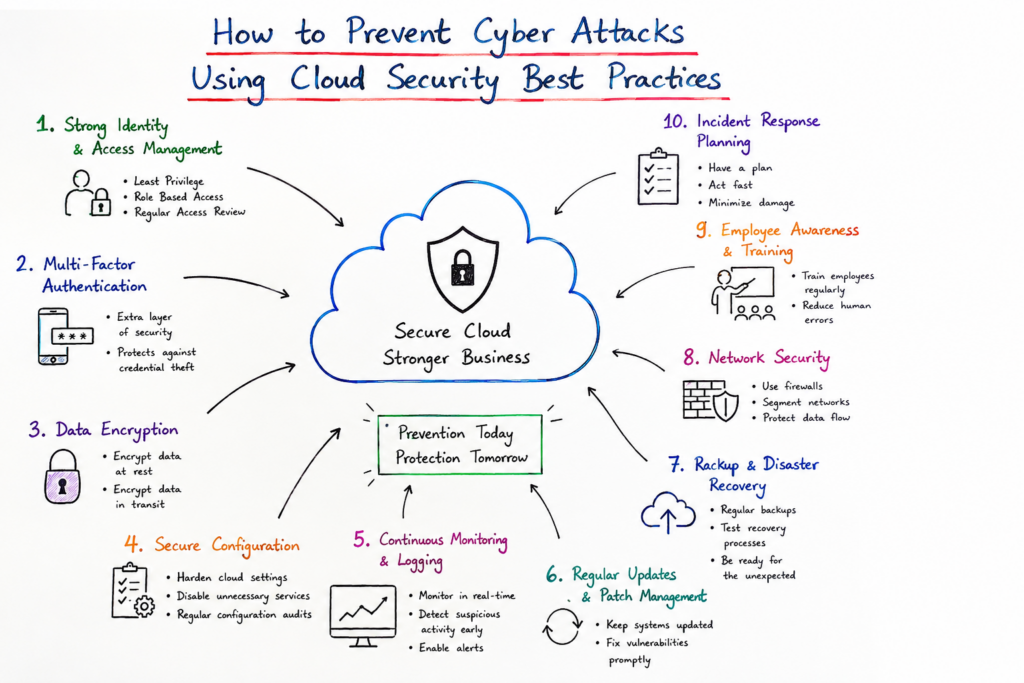
Cloud Security Best Practices to Prevent Cyber Attacks
Implement Strong Identity and Access Management
Identity and Access Management (IAM) serves as the foundation of cloud security.
Every user, application, and service should receive only the permissions necessary to perform required tasks. Excessive privileges increase the likelihood of unauthorized access.
Effective IAM strategies include:
- Role-based access control
- Least-privilege access principles
- Temporary access permissions
- Identity verification procedures
- User activity monitoring
Organizations should regularly review access permissions to ensure users maintain only the privileges they actually need.
Enable Multi-Factor Authentication Everywhere
Passwords alone are no longer sufficient.
Attackers frequently obtain credentials through phishing campaigns, credential stuffing attacks, or data breaches.
Multi-factor authentication adds another layer of protection by requiring users to verify their identity through an additional factor such as:
- Authentication applications
- Hardware security keys
- Biometric verification
- One-time verification codes
Even if attackers obtain passwords, multi-factor authentication significantly reduces the likelihood of successful account compromise.
Encrypt Data at Rest and in Transit
Encryption transforms readable information into coded data that unauthorized users cannot easily understand.
Organizations should encrypt:
- Stored files
- Databases
- Backup systems
- Internal communications
- External data transfers
Encryption protects sensitive information even if attackers gain access to storage systems or communication channels.
A comprehensive encryption strategy should cover both data at rest and data moving between systems.
Maintain Continuous Monitoring and Visibility
Security teams cannot protect what they cannot see.
Cloud environments generate enormous amounts of activity data that provide insight into system behavior.
Continuous monitoring helps identify:
- Suspicious login attempts
- Unusual network traffic
- Unauthorized access requests
- Configuration changes
- Potential malware activity
Real-time monitoring allows organizations to detect threats before they become major incidents.
Regularly Patch and Update Systems
Outdated software remains one of the most common attack vectors.
Software vendors routinely release updates that address security vulnerabilities.
Organizations should establish structured patch management processes that include:
- Vulnerability assessments
- Patch testing
- Automated deployment
- Verification procedures
- Ongoing maintenance schedules
Prompt patching reduces the attack surface available to cybercriminals.
Secure Cloud Configurations
Misconfigured cloud resources frequently cause security breaches.
Examples include:
- Publicly exposed storage buckets
- Open databases
- Unrestricted network ports
- Weak access controls
- Insecure API settings
Configuration reviews should occur regularly to ensure resources align with organizational security policies.
Automated configuration scanning tools can help identify potential weaknesses before attackers discover them.
Implement Network Segmentation
Network segmentation limits the movement of attackers inside cloud environments.
Instead of allowing unrestricted communication between all systems, organizations divide infrastructure into separate segments.
Benefits include:
- Reduced attack spread
- Improved visibility
- Better access control
- Faster incident containment
- Enhanced compliance support
If one segment becomes compromised, attackers face additional barriers before reaching critical systems.
Develop a Strong Backup Strategy
Backups play a crucial role in cyber resilience.
Organizations should maintain secure copies of critical data and systems to support recovery after incidents.
Effective backup practices include:
- Automated backup schedules
- Multiple backup locations
- Encrypted backup storage
- Recovery testing
- Version management
Reliable backups significantly reduce the impact of ransomware and data loss incidents.
Establish Security Awareness Training
Technology alone cannot eliminate cyber risks.
Employees remain one of the most targeted attack points.
Security awareness programs should educate personnel about:
- Phishing emails
- Social engineering tactics
- Password security
- Data handling procedures
- Incident reporting processes
An informed workforce becomes an important line of defense against cyber threats.
Use Security Automation
Modern environments generate more security events than manual teams can manage effectively.
Automation helps improve response speed and consistency.
Organizations can automate:
- Threat detection
- Log analysis
- Incident response
- Compliance checks
- Configuration validation
Automation allows security teams to focus on strategic tasks while reducing human error.
Key Operational Concepts You Must Know
Cloud security and operations are closely connected. Understanding operational fundamentals helps organizations maintain secure and reliable environments.
Reliability
Reliability refers to a system’s ability to perform consistently under expected conditions.
Reliable systems experience fewer outages, disruptions, and unexpected failures.
Security and reliability often support each other because stable systems are easier to monitor and protect.
Scalability
Scalability enables systems to handle increasing workloads without sacrificing performance.
Secure scaling requires:
- Capacity planning
- Resource monitoring
- Automated provisioning
- Security policy consistency
Organizations must ensure security controls expand alongside infrastructure growth.
Observability
Observability provides deep insight into system behavior.
It combines:
- Metrics
- Logs
- Traces
- Event analysis
Strong observability improves both operational efficiency and threat detection capabilities.
Incident Management
Security incidents can occur despite strong preventive measures.
Incident management focuses on:
- Detection
- Analysis
- Containment
- Recovery
- Post-incident improvement
Well-defined incident response procedures reduce business disruption and accelerate recovery.
Change Management
Infrastructure changes introduce potential risks.
Change management ensures modifications undergo review, testing, and approval before deployment.
This process minimizes security gaps caused by rushed or poorly documented changes.
Platform Implementation vs. Culture — What’s the Real Difference?
Organizations often focus heavily on technology while overlooking cultural factors.
Both elements are essential for long-term success.
| Platform Implementation | Organizational Culture |
|---|---|
| Focuses on tools and technology | Focuses on people and behavior |
| Defines technical controls | Defines security mindset |
| Automates processes | Encourages accountability |
| Improves efficiency | Improves consistency |
| Provides infrastructure protection | Supports sustainable security practices |
Platform Implementation
Platform implementation involves deploying technologies that support cloud operations and security.
Examples include:
- Monitoring platforms
- Access management systems
- Security tools
- Automation frameworks
- Infrastructure management solutions
These technologies create the technical foundation for secure operations.
Organizational Culture
Security culture influences how people make decisions.
A strong culture encourages:
- Responsible behavior
- Security awareness
- Continuous learning
- Risk management
- Collaboration
Organizations with strong security cultures typically experience fewer preventable incidents.
Why Both Matter
Technology can enforce rules, but people determine whether security practices are followed consistently.
The most successful organizations combine advanced platforms with a culture that values operational excellence and security awareness.
Real-World Use Cases of Modern Operations
Modern operations practices improve security, efficiency, and business continuity across industries.
Financial Services Protection
Financial institutions handle highly sensitive information.
Modern operations support:
- Fraud detection
- Transaction monitoring
- Regulatory compliance
- Threat prevention
- Secure customer services
These capabilities help protect both organizations and customers.
Healthcare Data Security
Healthcare providers manage confidential patient records.
Operational best practices help maintain:
- Data privacy
- System availability
- Compliance requirements
- Secure access controls
- Recovery readiness
Strong security measures protect sensitive medical information.
E-Commerce Infrastructure Protection
Online retailers depend on uninterrupted service availability.
Operations teams help secure:
- Customer accounts
- Payment systems
- Inventory management
- Website infrastructure
- Transaction processing
Security improvements directly contribute to customer trust and revenue protection.
Software Development Environments
Development teams increasingly rely on cloud-based infrastructure.
Modern operational practices support:
- Secure deployments
- Code integrity
- Vulnerability management
- Access control
- Continuous monitoring
These measures reduce security risks throughout the software lifecycle.
Enterprise Collaboration Platforms
Organizations use cloud-based collaboration systems for communication and productivity.
Operational security ensures:
- Secure file sharing
- User authentication
- Data protection
- Access governance
- Threat monitoring
These controls help maintain secure business operations.
Common Mistakes in Operations Engineering
Many security incidents result from avoidable operational mistakes.
Understanding these common issues helps organizations strengthen defenses.
Ignoring Access Reviews
User permissions often accumulate over time.
Without regular reviews, employees may retain unnecessary privileges that increase security risks.
Periodic audits help maintain appropriate access levels.
Overlooking Configuration Management
Configuration drift occurs when systems gradually deviate from approved settings.
This creates inconsistencies that attackers may exploit.
Organizations should maintain standardized configurations and perform routine validation.
Weak Monitoring Practices
Limited visibility delays threat detection.
Without comprehensive monitoring, security teams may overlook warning signs until significant damage occurs.
Continuous monitoring improves response effectiveness.
Insufficient Documentation
Poor documentation creates confusion during incidents.
Teams should maintain clear records covering:
- Infrastructure architecture
- Security procedures
- Recovery processes
- Operational responsibilities
Good documentation improves coordination and decision-making.
Neglecting Backup Testing
Creating backups is only part of the solution.
Organizations must regularly test recovery procedures to verify backup integrity and restoration capabilities.
Untested backups can fail when needed most.
Treating Security as Someone Else’s Job
Security should not belong exclusively to a dedicated security department.
Every team contributes to organizational protection.
Shared responsibility creates stronger overall security outcomes.
Delaying Incident Response Planning
Waiting until a crisis occurs often leads to poor decisions.
Organizations should prepare response plans in advance and conduct exercises regularly.
Prepared teams respond more effectively under pressure.
How to Become an Operations Expert — Career Roadmap
Operations professionals play a vital role in maintaining secure, reliable, and scalable systems.
Individuals interested in this field should focus on building both technical and strategic skills.
Build a Strong Technical Foundation
Begin by learning:
- Networking fundamentals
- Operating systems
- Cloud platforms
- Security principles
- System administration
These topics provide the knowledge required for advanced operational responsibilities.
Learn Cloud Technologies
Modern operations heavily rely on cloud infrastructure.
Important areas include:
- Cloud architecture
- Identity management
- Storage systems
- Compute services
- Networking services
Hands-on experience accelerates learning and skill development.
Develop Security Knowledge
Operations experts must understand security fundamentals.
Focus on:
- Threat detection
- Risk management
- Vulnerability assessment
- Incident response
- Security governance
Security expertise increases career opportunities and effectiveness.
Master Automation
Automation improves efficiency and consistency.
Useful skills include:
- Infrastructure automation
- Scripting
- Configuration management
- Deployment automation
- Workflow orchestration
Automation knowledge becomes increasingly valuable as environments grow.
Strengthen Monitoring and Observability Skills
Monitoring plays a central role in operational excellence.
Learn how to:
- Analyze logs
- Interpret metrics
- Investigate alerts
- Identify anomalies
- Improve system visibility
These capabilities support both performance and security objectives.
Improve Communication Skills
Technical expertise alone is not enough.
Operations professionals frequently collaborate with:
- Executives
- Developers
- Security teams
- Business stakeholders
- Customers
Strong communication improves teamwork and decision-making.
Adopt a Continuous Learning Mindset
Technology evolves rapidly.
Successful professionals consistently update their knowledge through:
- Training
- Practical projects
- Certifications
- Community engagement
- Industry research
Continuous improvement remains essential throughout an operations career.
Building a Long-Term Cloud Security Strategy
Preventing cyber attacks requires more than isolated security tools.
Organizations should develop a comprehensive strategy that combines:
- Governance
- Technology
- Processes
- Training
- Continuous improvement
A mature strategy aligns security objectives with business goals.
Key components include:
- Executive support
- Risk assessments
- Security frameworks
- Operational standards
- Incident preparedness
When these elements work together, organizations create resilient cloud environments capable of resisting evolving cyber threats.
The Future of Cloud Security Operations
As cloud adoption continues to grow, security operations will become increasingly integrated with business operations.
Organizations will place greater emphasis on:
- Automated threat detection
- Intelligent monitoring
- Risk-based decision-making
- Security analytics
- Operational resilience
Success will depend on balancing innovation with strong security controls.
Businesses that invest in operational excellence today will be better positioned to manage future challenges.
FAQ Section
What is cloud security?
Cloud security is the collection of technologies, policies, and practices used to protect cloud-based systems, applications, and data from cyber threats.
Why are cloud environments targeted by attackers?
Cloud environments often contain valuable business information, making them attractive targets for cybercriminals seeking financial gain, data theft, or system disruption.
How does multi-factor authentication improve security?
Multi-factor authentication requires additional identity verification beyond passwords, making unauthorized access significantly more difficult.
What is the principle of least privilege?
The principle of least privilege ensures users receive only the access necessary to perform their responsibilities, reducing potential security risks.
Why is continuous monitoring important?
Continuous monitoring helps detect suspicious activity early, allowing organizations to respond before threats escalate into major incidents.
Can small businesses benefit from cloud security best practices?
Yes. Businesses of all sizes can reduce cyber risks, improve resilience, and protect sensitive information through proper cloud security implementation.
What role does employee training play in cybersecurity?
Employee training helps users recognize threats such as phishing attacks and social engineering attempts, reducing the likelihood of successful attacks.
Why are backups essential for cybersecurity?
Backups support data recovery after incidents such as ransomware attacks, accidental deletion, or system failures.
What skills are needed for an operations career?
Important skills include cloud computing, networking, security, automation, monitoring, troubleshooting, and communication.
How often should organizations review security controls?
Security controls should be reviewed regularly and whenever significant infrastructure, application, or business changes occur.
Final Summary
Preventing cyber attacks requires a proactive approach that combines technology, processes, and people. Cloud security best practices provide the foundation organizations need to protect sensitive information, maintain service availability, and reduce operational risk.
Strong identity management, multi-factor authentication, encryption, continuous monitoring, secure configurations, automation, employee training, and reliable backup strategies all contribute to a stronger security posture. At the same time, organizations must understand important operational concepts, avoid common engineering mistakes, and foster a culture that prioritizes security alongside innovation.
Modern operations extend beyond infrastructure management. They support business continuity, compliance, customer trust, and long-term growth. By implementing comprehensive cloud security practices and embracing operational excellence, organizations can significantly reduce the likelihood of cyber attacks while building resilient environments capable of adapting to evolving threats.
