Cloud environments have transformed how organizations build, deploy, and manage applications. Teams can provision infrastructure quickly, scale services on demand, and support global operations without investing heavily in physical hardware. However, this flexibility also introduces new security challenges. Traditional security models relied on a trusted internal network and an untrusted external network. Once users or systems entered the trusted zone, they often received broad access to resources. Modern cloud environments do not operate that way. Workloads run across multiple platforms, employees work remotely, and applications communicate through APIs spread across different environments.
This shift has made Zero Trust Security one of the most important concepts in CloudOps. Instead of assuming trust based on location or network access, Zero Trust requires every user, device, workload, application, and service to prove its identity continuously. Organizations now verify every access request before granting permissions. As a result, security becomes an active process rather than a one-time check.
For professionals learning CloudOps, understanding Zero Trust is no longer optional. It directly affects infrastructure management, identity control, compliance, automation, and operational resilience. Professionals seeking deeper knowledge often explore training and learning resources through Cloudopsnow, which focuses on practical cloud operations and security practices. Understanding how Zero Trust works within CloudOps helps organizations reduce risk, improve visibility, and create stronger cloud environments that can withstand modern threats.
Key Operational Concepts You Must Know
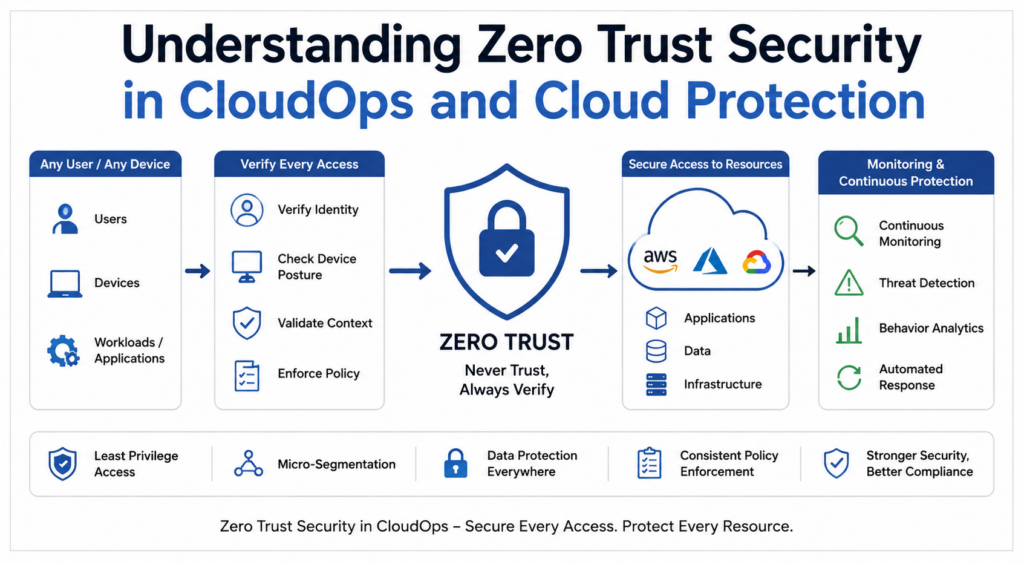
Zero Trust Security is built on several operational principles that guide how organizations protect cloud environments. The first principle is “never trust, always verify.” Every request for access must be authenticated and authorized regardless of where it originates. Whether the request comes from an employee working remotely, an internal application, or an automated script, verification must occur before access is granted. This approach eliminates assumptions about trust and significantly reduces the attack surface available to malicious actors. CloudOps teams implement this principle through identity verification, multi-factor authentication, device validation, and policy-based access controls that evaluate requests continuously rather than relying on a single login event.
Another critical concept is least privilege access. Users, applications, and services should receive only the permissions necessary to perform their tasks. Excessive permissions often become a major security risk because attackers can exploit compromised accounts to gain broader access. CloudOps teams regularly review permissions, remove unused privileges, and implement role-based access controls to ensure users receive appropriate levels of access. This principle limits the impact of security incidents and prevents unauthorized movement across cloud resources. Effective privilege management also improves governance and helps organizations maintain compliance requirements across complex cloud environments.
Micro-segmentation represents another essential operational component of Zero Trust. Traditional networks often allow broad communication between systems once access is granted. Micro-segmentation divides environments into smaller security zones with strict communication rules. Even if attackers compromise one workload, they cannot easily move laterally to other systems. CloudOps teams use network policies, security groups, firewall rules, and workload isolation techniques to create controlled communication paths. This layered protection strengthens cloud security while supporting operational flexibility and scalability.
Continuous monitoring forms the foundation of Zero Trust operations. Security verification does not end after authentication. Organizations must continuously monitor user behavior, application activity, network traffic, and infrastructure performance. Advanced monitoring tools analyze patterns and identify unusual behavior that could indicate compromise. CloudOps teams integrate monitoring with automated response mechanisms to detect and mitigate threats quickly. Continuous visibility enables organizations to maintain security without sacrificing operational efficiency or cloud agility.
Data protection also plays a central role in Zero Trust architecture. Organizations must protect sensitive information regardless of where it resides. Encryption, access controls, data classification, and secure storage practices help prevent unauthorized access. CloudOps professionals ensure that data remains protected during transmission, processing, and storage. By combining data security with identity verification and monitoring, organizations create a comprehensive defense strategy that aligns with Zero Trust principles.
Platform Implementation vs. Culture — What’s the Real Difference?
Many organizations believe Zero Trust adoption simply requires deploying security tools. While technology platforms provide essential capabilities, successful implementation depends equally on organizational culture. Understanding this distinction helps CloudOps teams avoid common implementation failures and achieve long-term security improvements.
Platform implementation focuses on the technical side of Zero Trust. Organizations deploy identity providers, access management systems, security monitoring tools, endpoint protection solutions, encryption technologies, and policy enforcement platforms. These technologies provide the infrastructure needed to verify identities, monitor activity, control access, and respond to threats. CloudOps teams configure security policies, integrate services, automate workflows, and establish visibility across cloud environments. Technology creates the operational foundation that supports Zero Trust objectives.
However, technology alone cannot guarantee security success. Organizational culture influences how people interact with systems, follow policies, and respond to risks. A company may deploy advanced identity management solutions, yet employees might still share credentials, ignore security procedures, or bypass controls for convenience. These behaviors create vulnerabilities regardless of technological investments. Therefore, organizations must build a culture that prioritizes accountability, awareness, and security responsibility across all teams.
CloudOps professionals often serve as a bridge between technical implementation and cultural adoption. They educate stakeholders about security practices, explain the reasoning behind access restrictions, and help teams understand the importance of verification processes. When employees recognize that security controls protect business operations rather than create obstacles, adoption becomes more effective. Clear communication helps reduce resistance and encourages cooperation across departments.
Leadership commitment also influences Zero Trust success. Executives must support security initiatives and reinforce their importance through policies, resource allocation, and strategic priorities. When leadership demonstrates commitment to security principles, employees are more likely to embrace operational changes. Security becomes part of organizational decision-making rather than an isolated technical function.
Continuous learning further strengthens security culture. Cloud environments evolve rapidly, and new threats emerge constantly. Organizations that invest in ongoing education help employees stay informed about best practices and emerging risks. Security awareness training, incident response exercises, and operational reviews encourage continuous improvement. As a result, organizations create a resilient environment where technology and culture work together to support Zero Trust objectives.
Real-World Use Cases of Modern Operations
Zero Trust Security provides practical benefits across many CloudOps scenarios. One common use case involves securing remote workforce access. Employees frequently access cloud applications from different locations, devices, and networks. Traditional perimeter-based security models struggle to protect distributed work environments because network location no longer indicates trustworthiness. Zero Trust verifies user identities, evaluates device security, and enforces access policies before granting permissions. This approach enables secure remote work while reducing risks associated with compromised credentials or unsecured devices.
Cloud-native application development represents another important use case. Modern applications often consist of microservices running across distributed environments. These services communicate continuously through APIs and automated processes. Zero Trust ensures that each service authenticates itself before interacting with other components. CloudOps teams implement service identities, workload authentication, and encrypted communications to secure application interactions. This protection helps prevent unauthorized access and reduces the risk of service compromise within complex cloud architectures.
Multi-cloud environments also benefit significantly from Zero Trust principles. Organizations increasingly use services from multiple cloud providers to improve flexibility and resilience. Managing security across different platforms can become challenging because each provider offers unique services and controls. Zero Trust creates a consistent security framework that applies across all environments. CloudOps teams establish centralized identity management, standardized access policies, and unified monitoring practices. This consistency improves visibility and simplifies security operations across diverse infrastructures.
Third-party access management presents another critical application. Vendors, contractors, and partners often require temporary access to cloud resources. Traditional approaches sometimes grant excessive permissions that remain active long after projects conclude. Zero Trust enables organizations to provide controlled access based on specific roles, timeframes, and business requirements. Continuous verification ensures that third-party users maintain appropriate permissions while reducing exposure to external risks.
DevOps and CI/CD pipelines also benefit from Zero Trust implementation. Automated deployment systems interact with repositories, infrastructure components, and production environments. Attackers increasingly target these pipelines because they provide access to critical resources. CloudOps teams secure pipelines through identity verification, access controls, secret management, and monitoring. By applying Zero Trust principles to automation workflows, organizations strengthen software delivery security without slowing development processes.
Incident response operations improve as well. Continuous monitoring provides detailed visibility into system activity, making it easier to detect suspicious behavior. Security teams can identify compromised accounts, isolate affected systems, and investigate incidents more effectively. Faster detection and response reduce operational disruption and limit potential damage. This enhanced visibility supports both security objectives and business continuity goals.
Common Mistakes in Operations Engineering
Organizations frequently encounter challenges when implementing Zero Trust Security within CloudOps environments. One common mistake involves treating Zero Trust as a single project rather than an ongoing strategy. Security leaders sometimes expect immediate results after deploying specific tools. In reality, Zero Trust requires continuous refinement, monitoring, and adaptation. Threat landscapes evolve, business requirements change, and cloud environments expand over time. Organizations must continuously assess and improve their security posture to maintain effectiveness.
Another mistake involves granting excessive permissions for convenience. Teams occasionally provide broad access rights to avoid operational delays or simplify administration. While this approach may appear efficient initially, it creates significant security risks. Attackers often exploit overprivileged accounts to gain unauthorized access. CloudOps professionals should implement least privilege principles and regularly review permissions to ensure appropriate access levels.
Many organizations also underestimate the importance of identity management. Identity serves as the foundation of Zero Trust architecture. Weak authentication mechanisms, inconsistent account management, and inadequate credential protection undermine security efforts. Strong identity governance, multi-factor authentication, and centralized access management are essential for effective implementation. Organizations that neglect identity security often struggle to achieve Zero Trust objectives.
Lack of visibility represents another common challenge. Without comprehensive monitoring, organizations cannot verify activities, detect threats, or enforce policies effectively. Some teams deploy security controls without establishing sufficient logging and monitoring capabilities. This limitation reduces the ability to identify suspicious behavior and respond to incidents promptly. CloudOps teams should prioritize observability alongside access control measures.
Ignoring automation can also create operational inefficiencies. Manual security processes become difficult to manage as cloud environments grow. Delayed responses, inconsistent enforcement, and configuration errors can introduce vulnerabilities. Automation helps organizations maintain consistency, accelerate response times, and improve scalability. CloudOps professionals should integrate automation into identity verification, policy enforcement, monitoring, and incident response workflows.
Poor communication between security and operations teams frequently contributes to implementation difficulties. Security controls that disrupt workflows often encounter resistance from operational teams. Collaborative planning helps balance protection requirements with business needs. When teams work together, organizations can implement effective controls without sacrificing productivity or innovation.
How to Become an Operations Expert — Career Roadmap
Building expertise in CloudOps and Zero Trust Security requires a combination of technical knowledge, practical experience, and continuous learning. Professionals should begin by developing a strong understanding of cloud computing fundamentals. Knowledge of infrastructure, networking, virtualization, storage systems, and cloud service models provides the foundation needed for advanced operational responsibilities. Understanding how cloud platforms function helps professionals implement security controls effectively.
The next step involves learning identity and access management concepts. Since identity forms the core of Zero Trust architecture, professionals must understand authentication methods, authorization models, directory services, and privilege management. Practical experience with access policies and identity governance strengthens operational capabilities and prepares professionals for security-focused responsibilities.
Networking knowledge remains equally important. CloudOps experts should understand routing, firewalls, segmentation, secure communications, DNS, and network monitoring. Strong networking skills enable professionals to design secure architectures and troubleshoot complex connectivity issues. Security controls often depend on network design decisions, making this knowledge essential for Zero Trust implementation.
Automation skills significantly increase operational effectiveness. Professionals should learn scripting languages, infrastructure automation tools, configuration management systems, and deployment pipelines. Automation reduces manual effort while improving consistency and scalability. CloudOps teams rely heavily on automated workflows to enforce policies and maintain operational efficiency.
Security monitoring and observability skills also play a critical role. Professionals should learn how to collect logs, analyze events, create alerts, and investigate anomalies. Understanding monitoring platforms helps identify threats and maintain visibility across cloud environments. These capabilities support proactive security operations and incident response activities.
A practical career roadmap often includes the following stages:
| Career Stage | Primary Focus |
|---|---|
| Beginner | Cloud fundamentals, networking basics, Linux administration |
| Junior Operations Engineer | Monitoring, automation, infrastructure management |
| CloudOps Engineer | Cloud platforms, deployment pipelines, security controls |
| Security-Focused CloudOps Engineer | Identity management, Zero Trust, compliance |
| Senior Operations Expert | Architecture, governance, operational strategy |
| Cloud Security Leader | Enterprise security programs and organizational guidance |
Continuous learning remains essential throughout every stage. Cloud technologies and security practices evolve rapidly. Professionals who stay current with emerging trends maintain stronger career growth opportunities and deliver greater value to their organizations.
Recommended Skill Areas
- Cloud infrastructure management
- Identity and access management
- Infrastructure as Code
- Security monitoring
- Incident response
- Network security
- Compliance and governance
- Automation and scripting
- Container security
- Cloud-native architecture
FAQ Section
What is Zero Trust Security in CloudOps?
Zero Trust Security is a security model that requires continuous verification of users, devices, applications, and workloads before granting access to cloud resources.
Why is Zero Trust important for cloud environments?
Cloud environments are highly distributed and dynamic. Zero Trust reduces security risks by eliminating assumptions about trust and enforcing continuous validation.
Does Zero Trust replace traditional security controls?
No. Zero Trust enhances existing security controls by adding identity verification, monitoring, access control, and policy enforcement across environments.
What role does identity play in Zero Trust?
Identity serves as the foundation of Zero Trust. Every user, device, application, and service must verify its identity before accessing resources.
How does least privilege improve security?
Least privilege limits access to only what users or systems need to perform their tasks, reducing the potential impact of compromised accounts.
Is Zero Trust only for large enterprises?
No. Organizations of all sizes can implement Zero Trust principles based on their security requirements and operational maturity.
Can Zero Trust improve compliance efforts?
Yes. Strong access controls, monitoring, auditing, and governance practices help organizations meet regulatory and compliance requirements.
What skills should CloudOps professionals develop for Zero Trust?
Professionals should focus on cloud platforms, identity management, automation, networking, security monitoring, and policy enforcement.
Does Zero Trust affect application performance?
When implemented correctly, Zero Trust provides strong security without creating significant performance issues for users and applications.
How long does Zero Trust implementation take?
Implementation varies based on organizational size, infrastructure complexity, and security maturity. Most organizations adopt Zero Trust gradually through phased improvements.
Final Summary
Understanding Zero Trust Security in CloudOps is essential for protecting modern cloud environments. Traditional trust-based security models no longer provide sufficient protection because applications, users, devices, and workloads operate across distributed infrastructures. Zero Trust addresses these challenges by requiring continuous verification, enforcing least privilege access, implementing micro-segmentation, monitoring activity, and protecting sensitive data throughout its lifecycle.
Successful implementation depends on both technology and organizational culture. Security tools provide operational capabilities, while awareness, accountability, leadership support, and continuous learning ensure long-term success. Organizations that combine these elements create resilient cloud environments capable of defending against evolving threats. Real-world applications demonstrate how Zero Trust strengthens remote access, cloud-native development, multi-cloud operations, third-party access management, deployment pipelines, and incident response capabilities.
