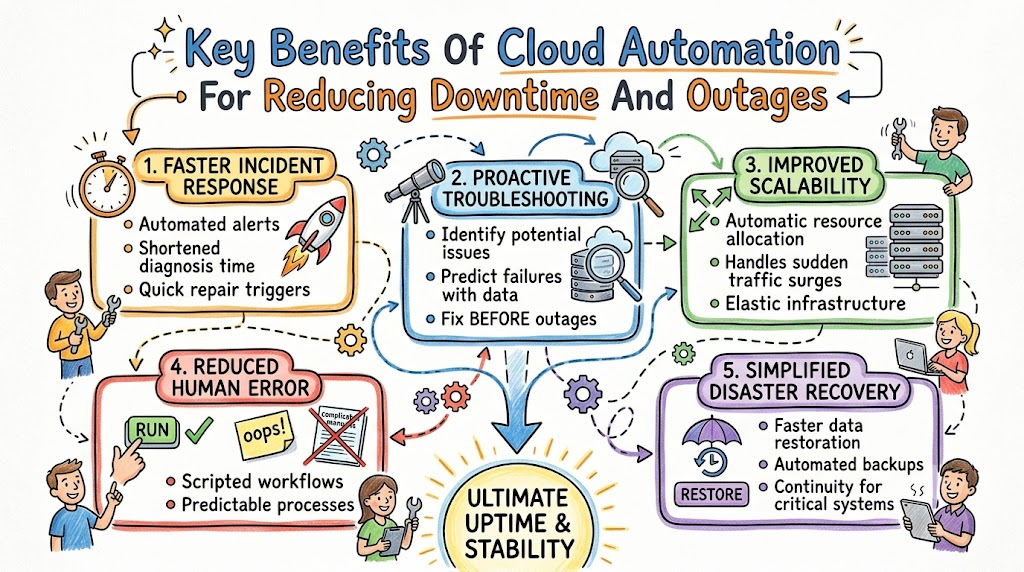
Unplanned outages and infrastructure disruptions can severely impact business revenue, damage customer trust, and derail productivity. Traditional manual maintenance and ad-hoc troubleshooting often fail to catch underlying service degradations before they escalate into catastrophic failures. When human operators must manually diagnose complex distributed errors under intense pressure, recovery times increase exponentially. Adopting automated operational frameworks transforms fragile cloud hosting environments into resilient, self-healing architectures that react instantly to system anomalies. Consequently, eliminating operational guesswork helps modern enterprises maintain maximum uptime and deliver uninterrupted service reliability across their digital platforms.
To achieve continuous resilience, forward-thinking engineering organizations partner with specialized platform experts like Cloudopsnow to implement proactive operations. Establishing an automated environment requires integrating self-healing orchestration, automated failovers, continuous policy enforcement, and predictive telemetry into daily workflows. When systems detect and isolate failing components automatically, recovery times shrink from hours to mere fractions of a second. This deep-dive architectural guide explores how cloud automation systematically eliminates system downtime, protects operational integrity, and keeps critical business applications running smoothly.
Key Operational Concepts You Must Know
Automated Health Probing and Self-Healing Orchestration
Automated self-healing infrastructure relies on continuous, multi-layered health probes that monitor runtime metrics across applications, virtual machines, and container pods. Traditional setups often relied on superficial ping checks, which frequently failed to detect internal thread deadlocks or hung background processes. Modern health monitoring frameworks utilize targeted liveness, readiness, and startup probes to verify genuine functional health across every layer of the software stack. Consequently, the orchestration engine accurately determines whether an instance can handle traffic or needs remediation.
+------------------+       Periodic Health Check        +----------------------+
|  Health Checker  | ---------------------------------> |   Application Node   |
+------------------+                                    +----------------------+
         |                                                         |
         | <---------------- Unhealthy Status (Deadlock) ----------+
         v
+------------------+       Automatic Restart Trigger    +----------------------+
| Orchestrator     | =================================> | Fresh Container Node |
+------------------+                                    +----------------------+
When an application component fails a health check, automated orchestration platforms intervene immediately without requiring manual operator intervention. The platform isolates the malfunctioning node, stops incoming traffic routing, and launches a healthy replacement instance simultaneously. This automated replacement workflow eliminates prolonged service outages caused by memory leaks, runaway CPU spikes, or corrupted system state. Therefore, self-healing automation ensures that transient application errors resolve quickly before impacting downstream user transactions.
Automated Multi-Region Failover Mechanisms
Automated multi-region failover eliminates single-point-of-failure vulnerabilities across centralized data centers and localized availability zones. If an underlying physical cloud facility experiences hardware failures, power interruptions, or network fiber cuts, localized clusters can go dark instantly. Without automation, engineers must spend valuable time manually re-routing DNS records and spinning up backup resources in secondary regions. Automated global traffic managers continuously evaluate regional health and reroute user traffic to healthy backup data centers automatically.
                              [ Global Traffic Router ]
                                          |
                   +----------------------+----------------------+
                   | (Degraded Path)                             | (Active Path)
                   v                                             v
        [ Primary Cloud Region ]                      [ Secondary Cloud Region ]
        * High Latency Detected                       * Healthy Standby
        * Traffic Automatically Drained               * Ingesting Active Traffic
- Global Anycast Routing: Dynamically redistributes user traffic away from degraded regions to the nearest available data center.
- Continuous State Replication: Synchronizes transactional database states asynchronously to prevent data loss during emergency failover events.
- Rapid Traffic Switching: Minimizes DNS caching delays by enforcing low TTL settings combined with intelligent health-probing endpoints.
Furthermore, automated failovers ensure smooth business continuity by coordinating database read-write promotions alongside network re-routing. Once the primary cloud zone recovers and passes all operational health gates, the automation engine manages traffic normalization gracefully. This bidirectional failover automation prevents data corruption and eliminates the chaotic emergency calls traditionally associated with data center outages. Consequently, businesses maintain unbroken service availability even during extensive cloud provider infrastructure disruptions.
Continuous Configuration Drift Detection and Remediation
Configuration drift occurs when unauthorized team members make manual adjustments, hotfixes, or emergency configuration edits directly on production servers. Over time, these undocumented modifications cause live infrastructure to diverge significantly from the version-controlled codebase. When emergency patches, routine software updates, or scheduled autoscaling events occur, drifted systems behave unpredictably and crash unexpectedly. Automated configuration management tools eliminate this operational hazard by running continuous drift-detection loops against all active resources.
[ Git Repository: Target State ] <====== Verified Match ======> [ Cloud Environment: Live State ]
                |                                                              |
                | (Discrepancy Detected: Manual Hotfix)                        |
                v                                                              v
   [ Automation Agent Engine ] --------------------------------> [ Overwrites Drift to Match Git ]
These background automation agents constantly compare live infrastructure parameters against the verified, version-controlled repository state. If the agent detects an unapproved parameter alteration, open port, or modified configuration file, it triggers an immediate remediation event. The platform automatically overwrites the rogue configuration with the approved template, returning the resource to its compliant baseline. Therefore, automated drift remediation maintains strict environmental consistency, preventing unexpected outages caused by undocumented human errors.
Automated Canary Deployments and Instant Rollbacks
Deploying new software updates directly into production has historically represented one of the most frequent causes of catastrophic system downtime. Automated canary deployments mitigate this risk by rolling out new software versions incrementally to a tiny, isolated slice of live user traffic. The platform then tracks real-time operational telemetry, such as HTTP 5xx error codes, database latency, and CPU saturation metrics. As a result, operations teams evaluate software stability using actual production traffic without exposing the entire user base to bugs.
[ Incoming User Requests ]
            |
            +---- (95% Production Traffic) -----> [ Stable Baseline Version (v1.0) ]
            |
            +---- (5% Canary Traffic) ----------> [ New Release Canary (v2.0) ]
                                                                 |
                                                                 v
                                             [ Continuous Telemetry Analysis ]
                                             (If Errors > 0.1% -> Instant Rollback)
- Targeted Traffic Routing: Routes a safe 2% to 5% percentage of real users to the new software release to test real-world behavior.
- Automated Telemetry Evaluation: Continuously verifies latency, throughput, and error rates against predefined service level baselines.
- Zero-Touch Rollback: Triggers instant traffic diversion back to the stable release if the canary deployment breaches any operational threshold.
If the canary build exhibits unexpected anomalies, the deployment pipeline halts further rollout and reverts traffic instantly to the previous stable release. Because this rollback executes automatically within seconds of anomaly detection, end users rarely notice any service degradation. If the canary passes all performance thresholds, the system promotes the release to the entire compute fleet gradually. This systematic rollout framework eliminates high-stress deployment windows and protects overall platform uptime.
Platform Implementation vs. Culture — What’s the Real Difference?
| Operational Focus Area | Platform Implementation Focus | Cultural & Mindset Focus |
|---|---|---|
| High-Availability Strategy | Deploying auto-scaling groups, redundant load balancers, and multi-region databases. | Prioritizing fault-tolerant system architecture and designing software components for failure. |
| Outage Management | Setting up automated alerting channels, PagerDuty rotations, and synthetic monitoring. | Running blameless post-incident reviews and treating every failure as a learning opportunity. |
| Quality & Release Safety | Implementing automated CI/CD canary gates, unit tests, and rollback triggers. | Fostering shared operational ownership between development and site reliability teams. |
| Security & Governance | Enforcing automated Policy as Code guardrails and dynamic secret rotation agents. | Cultivating a proactive DevSecOps mindset that values security as a core operational feature. |
Technical Execution vs. Behavioral Alignment
Platform implementation focuses on assembling tools, automation scripts, and cloud configurations that establish resilient infrastructure foundations. Engineers write code to orchestrate containers, configure private networks, set up automated snapshots, and manage load balancer listeners. While these technical assets are indispensable for platform stability, technology alone cannot prevent outages if team workflows remain fragmented. A sophisticated platform cannot protect uptime if team members routinely bypass established automated processes.
Conversely, operational culture focuses on the behaviors, shared beliefs, and cross-functional habits that guide engineering teams. An uptime-focused culture views failures not as individual mistakes to be punished, but as opportunities to strengthen systemic safeguards. When teams share an automation-first mindset, they naturally write defensive, resilient application code that handles network drops gracefully. Therefore, harmonizing technical tooling with cultural values ensures that platforms remain resilient under high operational pressure.
Bridging the Gap Between Tools and Processes
To maintain consistent uptime, organizations must align automated platform tools with clear, standardized operational processes. Investing heavily in automated recovery tools yields little benefit if organizational processes require manual managerial approvals before engineers can resolve incidents. Rigid bureaucratic hurdles slow down incident response, turning minor transient hiccups into prolonged customer-facing outages. Leadership must therefore empower automated platforms to execute pre-approved remediation actions safely and autonomously.
   +------------------------------------+
   |      Resilient Culture & Mindset   |  <-- Encourages shared ownership and blameless learning
   +------------------------------------+
                     |
                     v
   +------------------------------------+
   |   Streamlined Incident Protocols   |  <-- Grants pre-approved authority for automated fixes
   +------------------------------------+
                     |
                     v
   +------------------------------------+
   |   Automated Infrastructure Tools   |  <-- Executes fast, autonomous healing and recovery
   +------------------------------------+
Building this alignment requires transparent communication, shared reliability goals, and comprehensive training across all technical teams. Platform architects must collaborate closely with product developers to ensure everyone understands how automated failover policies behave during live production anomalies. When developers see how automated guardrails protect their services from outages, they naturally adopt these standards across all projects. Ultimately, bridging technical automation with supportive team processes establishes a sustainable foundation for high platform availability.
Real-World Use Cases of Modern Operations
Automated Database Failover and Self-Healing Data Layers
Modern data-intensive enterprise platforms require continuous, uninterrupted database access to process high-volume customer transactions reliably. In traditional database architectures, a crashed primary database node required manual database administrator intervention to promote a read replica. This slow manual failover process often introduced significant downtime, data inconsistencies, and transaction timeouts. Modern automated database clusters solve this vulnerability by using distributed consensus protocols to execute zero-touch failovers.
[ Application Read/Write Traffic ]
                |
                v
  [ Database Connection Proxy ]
                |
                +---- (Active Route) -------> [ Primary DB Node (Healthy) ]
                |                                         |
                |                             (Continuous Replication)
                |                                         v
                +---- (Standby Route) ------> [ Replica DB Node (Standby) ]
- Consensus Quorum: Monitors database node health continuously and initiates automated master elections when nodes become unresponsive.
- Dynamic Connection Routing: Updates database proxies and connection pools instantly, directing queries to the newly promoted master.
- Automated Data Validation: Verifies replication sequence numbers automatically to preserve transactional integrity and avoid split-brain states.
When a primary database instance fails, automated connection proxies redirect application queries to the newly elected primary node seamlessly. The automation layer provisions a replacement replica in the background, syncs transactional logs, and adds it back into the replication cluster. Because these failover workflows execute in seconds, applications experience only a momentary pause in query processing rather than an extended outage. This automated database resilience ensures that customer transactions complete safely without service interruptions.
Predictive Auto-Scaling for Sudden Traffic Surges
High-traffic digital media platforms and enterprise platforms frequently experience massive, unpredictable traffic spikes during live events and breaking news. If the infrastructure relies on slow manual server provisioning, incoming traffic quickly overwhelms existing capacity, causing server crashes and widespread downtime. Operations teams resolve this challenge by implementing predictive auto-scaling engines driven by automated machine learning algorithms. The platform analyzes historical traffic patterns alongside real-time queue depths to provision capacity proactively.
[ Real-Time Traffic Surge ] ---> [ Predictive Scaling Controller ] ---> [ Pre-Warms Container Clusters ]
                                                |
                                                v
[ Load Balancer Distributes Traffic ] <--- [ Capacity Ready BEFORE Saturation Hits ]
These predictive scaling frameworks spin up pre-warmed container clusters minutes before forecasted traffic waves hit the front-end gateways. When unexpected traffic surges bypass predictions, reactive threshold alarms trigger supplementary horizontal pod autoscalers immediately. Ephemeral worker nodes join the active load balancing pool automatically, process incoming request spikes, and scale down smoothly once demand normalizes. This dynamic elasticity prevents compute exhaustion, keeps latency low, and ensures uninterrupted platform availability during peak traffic events.
Automated Vulnerability Patching and Zero-Downtime Kernel Updates
Unpatched software vulnerabilities represent a severe operational threat that can expose cloud systems to crippling ransomware and security outages. However, traditional security patching often required scheduling disruptive maintenance windows that took critical business services offline. Modern cloud operations overcome this trade-off by implementing automated rolling update pipelines that patch operating system kernels without downtime. The automated engine systematically drains, terminates, and replaces compute nodes one by one while keeping the broader application cluster fully operational.
[ Security Patch Released ] ---> [ CI Pipeline Builds Patched Node Image ]
                                                   |
                                                   v
[ Target Node Drained ] ---> [ Traffic Re-Routed ] ---> [ Old Node Terminated ]
                                                               |
                                                               v
[ Service Health Verified ] <--- [ Traffic Restored ] <--- [ Patched Node Deployed ]
- Connection Draining: Allows in-flight user requests to complete gracefully before taking the target compute node offline.
- Rolling Replacement: Upgrades compute infrastructure sequentially, ensuring sufficient active capacity remains available at all times.
- Automated Smoke Testing: Executes synthetic functional tests on the newly patched node before returning it to the production pool.
If a newly patched node exhibits unexpected regressions or fails synthetic smoke tests, the pipeline halts immediately and alerts the on-call team. The healthy, unpatched nodes continue serving user traffic safely, preventing the buggy update from impacting the entire cluster. Once engineers resolve the underlying patch issue, the automation engine resumes the rolling upgrade cycle safely across remaining nodes. This continuous maintenance model keeps systems secure against emerging exploits while completely eliminating scheduled maintenance downtime.
Common Mistakes in Operations Engineering
Over-Automating Without Manual Override Circuit Breakers
A dangerous mistake in cloud infrastructure design is implementing fully automated recovery workflows without including manual override circuit breakers. When unexpected, multi-layered cascading failures occur, poorly constrained automation scripts can enter continuous, destructive recovery loops. For example, an automated script might continually restart crashing pods that are actually failing due to a downstream database lock. This automated thrashing exhausts CPU cycles, floods log aggregators, and worsens the original outage exponentially.
UNSAFE AUTOMATION LOOP:
[ Downstream DB Locked ] ---> [ Pod Crashes ] ---> [ Auto-Restart Loop ] ---> [ System Resource Exhaustion ]

SAFEGUARDED AUTOMATION:
[ Downstream DB Locked ] ---> [ Pod Crashes ] ---> [ Circuit Breaker Trips ] ---> [ Halts Restarts & Alerts ]
- Circuit Breaker Thresholds: Automatically halts automated remediation actions when retry counts exceed safe operational limits.
- Emergency Kill Switches: Provides on-call engineers with clear, immediate controls to pause background automation routines during complex incidents.
- Backoff Strategies: Implements exponential backoff intervals to prevent automated healing agents from overwhelming recovering dependencies.
To prevent runaway automation loops, engineers must design every automated recovery routine with strict rate limits and exponential backoff mechanisms. Systems must be configured to trip a circuit breaker and alert human operators whenever automated remediation attempts fail repeatedly. Furthermore, operations teams should maintain clear, accessible controls to pause specific automation loops instantly during live troubleshooting. Building these safeguards ensures that automation acts as a reliable safety net rather than an unpredictable liability.
Inadequate Health Check Logic Leading to False Positives
Another widespread operational error is deploying overly simplistic or poorly calibrated health checks that trigger unnecessary failovers. If a health probe’s timeout threshold is set too tight, a momentary, harmless network jitter can trigger a false positive alarm. The automation platform then mistakenly assumes the healthy node has died, draining its traffic and initiating a disruptive replacement cycle. When this happens across multiple nodes simultaneously, the system can enter an accidental, self-inflicted outage.
FLAWED CHECK:
[ Minor 50ms Network Jitter ] ---> [ Aggressive 40ms Timeout ] ---> [ False Alarm: Destroys Healthy Node ]

ROBUST CHECK:
[ Minor 50ms Network Jitter ] ---> [ Multi-Probe Consensus Threshold ] ---> [ Node Retained: No Interruption ]
To avoid false failover storms, engineers must configure multi-layered health check logic that requires consecutive failed probes before taking action. Health checking agents should verify multiple operational dimensions, including deep dependency connectivity, rather than relying on a single network ping. Additionally, implementing distributed health checks across multiple internal vantage points prevents localized network hiccups from triggering false node terminations. Calibrating health-probe sensitivity ensures that automation acts only on genuine system failures.
Ignoring Recovery Time and Recovery Point Objectives in Automation
Engineering teams often build automated backup and disaster recovery scripts without clearly defining their Recovery Time Objectives (RTO) and Recovery Point Objectives (RPO). Teams frequently assume that creating automated daily database snapshots provides complete protection against data loss and catastrophic outages. However, without automated restoration testing, teams often discover during emergencies that recovering massive multi-terabyte snapshots takes hours or days. This lack of planning leads to extended outages that breach customer Service Level Agreements.
UNTESTED BACKUP PITFALL:
[ Daily Snapshot Created ] ---> [ No Automated Restoration Test ] ---> [ Disaster: 14-Hour Unplanned Recovery ]

VALIDATED AUTOMATION:
[ Continuous Streaming Backup ] ---> [ Automated Daily Restore Validation ] ---> [ Disaster: Rapid 5-Min Recovery ]
- RTO Alignment: Ensures that automated failover and rebuild pipelines restore full service operations within acceptable business timeframes.
- RPO Verification: Validates that automated database replication intervals minimize the volume of potential data loss during unexpected crashes.
- Automated Restore Drills: Executes automated sandbox restoration drills weekly to verify that backup snapshots remain uncorrupted and usable.
To prevent extended recovery delays, operations teams must design their disaster recovery automation to meet strictly defined RTO and RPO targets. Build automated pipelines that continuously spin up ephemeral staging environments to test the speed and integrity of backup restoration workflows. If an automated snapshot restoration exceeds target time limits, the platform flags the delay so engineers can optimize snapshot performance. Regularly validating recovery metrics ensures that automated disaster recovery mechanisms perform reliably when real crises occur.
How to Become an Operations Expert — Career Roadmap
Mastering Cloud Resilience Patterns and Distributed Architecture
Building a successful career as an operations resilience expert requires developing a thorough understanding of distributed systems and high-availability architecture. You must master core fault-tolerant design patterns, including bulkhead patterns, circuit breakers, rate limiters, and stateless application layers. Understanding how microservices communicate over unreliable networks allows you to design architectures that absorb localized component failures gracefully. This foundational knowledge enables you to engineer cloud platforms that remain operational even when individual subsystems degrade.
+---------------------------------------------------------------------------------+
|                    DISTRIBUTED RESILIENCE & ARCHITECTURE                        |
|                                                                                 |
|   +--------------------------+  +---------------------+  +------------------+   |
|   | Bulkhead Isolation       |  | Circuit Breakers    |  | Idempotent APIs  |   |
|   | Fault Containment Zones  |  | Cascade Prevention  |  | Safe Retries     |   |
|   +--------------------------+  +---------------------+  +------------------+   |
+---------------------------------------------------------------------------------+
- Fault Isolation: Learn how to segment large-scale cloud architectures into isolated fault domains to contain localized outages.
- Graceful Degradation: Design services that fall back to cached responses or read-only modes when backend databases encounter issues.
- Data Consistency Models: Master the trade-offs between strong consistency and eventual consistency in globally distributed database clusters.
Additionally, study how cloud infrastructure providers design their underlying physical availability zones, transit centers, and power redundancy systems. Understanding these physical hardware constraints helps you place compute workloads and database replicas in configurations that maximize survivability. This architectural expertise allows you to translate business uptime requirements into robust, self-healing cloud deployments. Mastering these concepts establishes the foundation for your journey toward senior technical leadership.
Developing Deep Automation, Chaos Engineering, and IaC Skills
To become an elite operations specialist, you must move beyond basic infrastructure scripting and master advanced automation frameworks and chaos engineering methodologies. Attain complete proficiency with declarative Infrastructure as Code tools like Terraform to define resilient, multi-region environments reliably. Furthermore, learn how to use chaos testing frameworks like Chaos Mesh and Gremlin to inject controlled failures into production-like systems intentionally. This practice helps you discover and remediate subtle operational vulnerabilities before they manifest as unplanned outages.
+---------------------------------------------------------------------------------+
|                     AUTOMATION & CHAOS RESILIENCE MASTERY                       |
|                                                                                 |
|   +--------------------------+  +---------------------+  +------------------+   |
|   | Infrastructure as Code   |  | Chaos Engineering   |  | Self-Healing     |   |
|   | Modular Multi-Region IaC |  | Fault Injection Exp |  | Operator SDKs    |   |
|   +--------------------------+  +---------------------+  +------------------+   |
+---------------------------------------------------------------------------------+
- Chaos Experiments: Intentionally inject network latency, packet loss, and compute terminations to validate automated self-healing mechanisms.
- Custom Orchestration Operators: Build custom Kubernetes operators that automate complex, domain-specific application recovery logic.
- Continuous Testing Pipelines: Integrate automated chaos and resilience testing stages directly into your CI/CD delivery workflows.
Beyond running chaos experiments, focus on building automated remediation runbooks that handle common operational alerts without human intervention. Learn to configure event-driven serverless functions that respond to cloud alerts by recycling stuck instances or clearing temporary disk caches. Automating routine incident response workflows reduces mean time to resolution and minimizes the risk of human error during late-night outages. Developing strong automation capabilities empowers you to build highly autonomous, resilient cloud systems.
Mastering Observability, Anomaly Detection, and SRE Practices
The final phase of your professional growth involves mastering Site Reliability Engineering (SRE) principles, deep telemetry, and automated anomaly detection. You must become an expert at aggregating and analyzing metrics, distributed tracing, and structured logs using tools like Prometheus, OpenTelemetry, and Grafana. Learn to implement automated alerting systems that monitor rate-of-change anomalies and error budget consumption rather than relying on static CPU thresholds. This observability depth lets you detect performance degradations long before they cause customer-facing downtime.
+---------------------------------------------------------------------------------+
|                         SRE OBSERVABILITY & METRICS                             |
|                                                                                 |
|   +--------------------------+  +---------------------+  +------------------+   |
|   | Service Level Objectives |  | Distributed Tracing |  | Anomaly Alerts   |   |
|   | SLI/SLO Error Budgets    |  | OpenTelemetry Spans |  | Predictive ML    |   |
|   +--------------------------+  +---------------------+  +------------------+   |
+---------------------------------------------------------------------------------+
- Error Budget Management: Balance rapid product feature releases against platform stability requirements using mathematically defined error budgets.
- Distributed Tracing: Track individual user requests across multi-tiered microservice architectures to identify hidden network bottlenecks.
- Blameless Incident Reviews: Facilitate structured post-incident post-mortems that identify systemic architectural weaknesses without assigning individual blame.
Furthermore, master the art of capacity planning and predictive telemetry analysis to forecast infrastructure bottlenecks before they cause service degradation. Learn to design clear, role-specific operational dashboards that provide engineering teams with actionable insights during high-pressure incidents. Establishing these mature SRE capabilities helps you transform reactive operations teams into proactive resilience champions. Ultimately, mastering observability and SRE workflows positions you as an indispensable operations authority.
FAQ Section
- How does automated self-healing reduce application downtime during traffic spikes?Automated self-healing platforms monitor workload health continuously and replace failing or unresponsive instances without human intervention. When sudden traffic surges cause memory leaks or thread deadlocks, the orchestrator drains traffic, terminates the stalled container, and spins up a healthy replacement immediately. This rapid remediation keeps service availability high without requiring on-call engineers to diagnose issues manually.
- What is the difference between a blue-green deployment and a canary deployment?Blue-green deployments maintain two identical environments, switching all user traffic from the old version (blue) to the new version (green) at once. Canary deployments roll out the new version to a small subset of real users (e.g., 5%) while monitoring health metrics before upgrading the entire fleet. Canary rollouts provide safer validation because anomalies impact only a tiny fraction of users before an automated rollback triggers.
- Why is automated configuration drift remediation essential for high availability?Configuration drift occurs when engineers make manual, undocumented modifications directly to live production servers over time. These unrecorded changes create environment discrepancies that cause future software updates or automated scaling events to fail unexpectedly. Automated drift remediation continuously compares live servers against version-controlled templates and overwrites unauthorized edits, maintaining consistency.
- How do automated multi-region failovers handle database data integrity?Automated failovers use continuous asynchronous or synchronous database replication combined with distributed consensus proxies to manage database promotions safely. When a primary regional database fails, the proxy verifies transaction log synchronization across standby replicas before electing a new master. This automated validation avoids split-brain scenarios and prevents data corruption during emergency regional switches.
- Can automated chaos engineering experiments cause unplanned production outages?When conducted properly, chaos experiments use strict blast-radius controls, automated stop-conditions, and low initial traffic percentages to prevent outages. The chaos testing framework monitors operational health metrics continuously and terminates the experiment instantly if latency or error rates exceed safe thresholds. Conducting controlled experiments uncovers hidden architectural weaknesses before they cause real-world production downtime.
Final Summary
Achieving high operational availability and minimizing system downtime requires an organized strategy that combines modern automation tools with a resilience-first engineering culture. Implementing self-healing architectures, automated multi-region failovers, and canary deployment pipelines allows organizations to eliminate single points of failure across their cloud systems. Automated drift detection and robust health checking logic ensure that infrastructure remains predictable, compliant, and stable under heavy workloads. Furthermore, adopting Site Reliability Engineering principles and chaos testing practices empowers teams to identify and resolve systemic vulnerabilities proactively. Ultimately, investing in end-to-end cloud automation builds a reliable digital foundation that protects business uptime, safeguards revenue, and delivers superior customer experiences.

