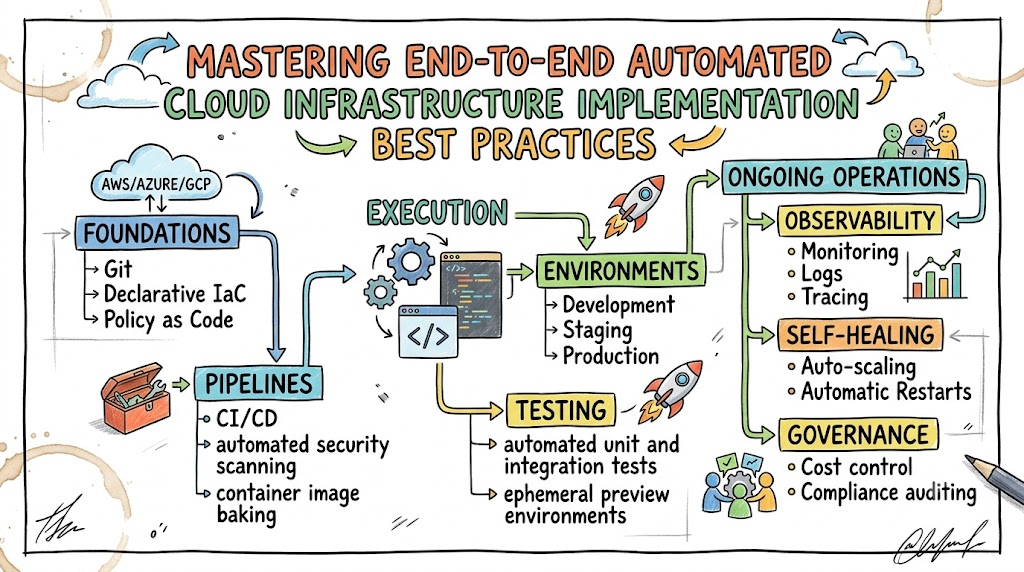
Modern software delivery demands speed, stability, and resilient architecture to keep pace with changing market expectations. However, manual server configuration introduces human error, slows release cycles, and creates unpredictable operational overhead. When engineering teams deploy resources by hand, configuration drift inevitably breaks downstream application dependencies. Consequently, implementing automated workflows transforms unreliable hosting environments into resilient, scalable, and repeatable software platforms. By removing tedious manual interventions, organizations secure predictable performance across their entire cloud portfolio.
To achieve continuous deployment excellence, engineering teams frequently partner with specialized platform specialists such as Cloudopsnow to design unified environments. Establishing complete automation requires a cohesive strategy that connects provisioning, continuous integration, zero-trust security, and real-time observability. Furthermore, automated systems eliminate configuration drift, speed up rollouts, and free developers to focus on core product engineering. This guide breaks down the core architecture required to build a fully automated, production-ready cloud platform.
Key Operational Concepts You Must Know
Declarative Infrastructure as Code (IaC)
Declarative Infrastructure as Code represents the baseline architecture for modern, unattended cloud management workflows. Instead of executing manual CLI commands or writing step-by-step procedural scripts, engineers declare their desired target infrastructure state in configuration files. The automation engine then compares this blueprint against real-world resources, calculating and applying necessary changes automatically. Consequently, teams achieve repeatable deployments while keeping infrastructure specifications tracked directly inside version control systems.
+--------------------------+
|  Declarative Code (Git)  |
+--------------------------+
             |
             v
+--------------------------+       State Comparison       +--------------------------+
|   IaC Engine (Terraform) | <--------------------------> |   Live Cloud Environment |
+--------------------------+                              +--------------------------+
             |
             +-----> Generates Execution Plan -> Applies Target State
Using declarative templates also guarantees predictable, drift-free environments across staging, testing, and production tiers. When a developer changes an infrastructure template, the pipeline executes automated dry-runs to validate configurations before applying them live. This verification mechanism blocks accidental resource deletions and flags misconfigured security parameters early in the deployment cycle. Therefore, declarative code guarantees that every cloud resource remains documented, versioned, and easily reproducible during disaster recovery events.
Immutable Infrastructure and Image Baking
Immutable infrastructure eliminates in-place server patching by replacing running compute instances entirely whenever updates occur. Instead of modifying live production systems via SSH scripts, teams bake updated dependencies and runtime binaries into static machine images. When deploying a new release, the automation pipeline provisions brand-new instances from these golden images and retires the old ones. As a result, systems avoid configuration drift, remaining identical across every single deployed node.
[ Code Update ] ---> [ Automated Image Baking (Packer) ] ---> [ Deploy New VM Instance ]
                                                                        |
                                                                        v
[ Terminate Legacy VM ] <--- [ Health Check Verification Passed ] <------+
- Golden Images: Pre-package all system runtimes, core dependencies, and security patches to accelerate instance boot times.
- Deterministic Scaling: Ensures every new auto-scaled instance boots up in an identical, fully operational state.
- Rapid Rollbacks: Allows instant rollback to previous machine image versions whenever new software releases encounter production anomalies.
Furthermore, this operational model simplifies horizontal scaling, security auditing, and routine maintenance across distributed cloud clusters. Because instances remain untouched after launch, security teams can easily detect unauthorized system modifications as indicators of compromise. If an instance behaves abnormally, the platform terminates and replaces it automatically rather than troubleshooting the transient machine live. This self-healing paradigm minimizes operational overhead and ensures complete environment consistency.
GitOps-Driven Continuous Delivery
GitOps extends declarative infrastructure practices by establishing Git repositories as the absolute single source of truth for application infrastructure. Specialized deployment controllers run directly inside target clusters, continuously watching the repository for merged configuration pull requests. When changes appear in the repository, the controller pulls the state and syncs the live infrastructure to match. Thus, developers manage full infrastructure lifecycles entirely through standard Git branching and review workflows.
+--------------------+     Git Commit      +--------------------+
|  Developer Laptop  | ------------------> |  Git Repository    |
+--------------------+                     +--------------------+
                                                     |
                                                     | Monitored by
                                                     v
+--------------------+     Syncs State     +--------------------+
|  Live Cloud Infra  | <------------------ |  GitOps Controller |
+--------------------+                     +--------------------+
This pull-based delivery architecture enhances operational security by eliminating the need to expose cluster administrative credentials to external CI runners. Instead of external build servers pushing updates into production, internal cluster agents manage synchronization safely from within the private network. If unauthorized personnel make manual adjustments directly to live cloud resources, the GitOps controller automatically detects and overrides the drift. Consequently, GitOps maintains strict compliance boundaries while accelerating software delivery cycles across the organization.
Zero-Trust Policy as Code (PaC)
Policy as Code embeds compliance, governance, and security controls directly into the automated delivery pipeline using human-readable rules. Rather than relying on periodic manual security audits, teams write automated policies that scan infrastructure blueprints before provisioning. If an engineer attempts to create an unencrypted database or open a public security group, the validation policy fails the build immediately. This preventive approach catches structural vulnerabilities long before resources reach live cloud environments.
[ Terraform Blueprint ] ---> [ Policy Engine (OPA/Conftest) ] ---> [ Pass: Deploy Cloud Infra ]
                                      |
                                      +-------------------------> [ Fail: Block Deployment ]
- Automated Guardrails: Prevents engineers from provisioning non-compliant, insecure, or excessively expensive cloud resources.
- Continuous Auditing: Continuously evaluates live cloud configurations against compliance rules to identify drift and exposure risks.
- Standardized Governance: Replaces subjective manual reviews with clear, programmatic validation rules across all development teams.
Integrating policy scanning into pull requests empowers software teams to identify and remediate security flaws independently. Developers receive instant, actionable feedback explaining why their configuration violated security standards, along with suggested fixes. This proactive practice shifts security responsibilities left, embedding compliance into the everyday developer workflow. Ultimately, Policy as Code ensures that rapid automation never compromises enterprise security postures.
Platform Implementation vs. Culture — What’s the Real Difference?
| Operational Dimension | Platform Implementation Focus | Cultural & Mindset Focus |
|---|---|---|
| Automation Strategy | Building CI/CD pipelines, automating IaC scripts, and configuring auto-scaling triggers. | Treating infrastructure as a software product and prioritizing end-to-end automation. |
| Security & Compliance | Implementing automated SAST tools, secret managers, and container scanning agents. | Cultivating a DevSecOps mindset where teams share collective security ownership. |
| Operational Governance | Writing Policy as Code frameworks, cost budgets, and automated IAM policies. | Encouraging blameless collaboration, shared standards, and operational autonomy. |
| System Reliability | Deploying distributed tracing engines, metrics collectors, and alerting systems. | Designing systems for failure, embracing blameless post-mortems, and respecting SLOs. |
Technical Execution vs. Behavioral Alignment
Platform implementation centers on deploying orchestration frameworks, pipeline runners, and infrastructure tooling to automate daily technical operations. Teams focus heavily on provisioning Kubernetes clusters, managing container registries, and configuring dynamic cloud storage volumes. While these technical components form the foundation of a modern platform, technology alone cannot guarantee sustained agility. Without proper organizational alignment, complex platforms quickly become bloated and underutilized by development teams.
Conversely, a mature engineering culture focuses on shared responsibility, continuous improvement, and the elimination of organizational silos. When engineering cultures mature, developers proactively own the runtime health, performance, and resource costs of their applications. They view automated platforms as empowering accelerators rather than bureaucratic roadblocks that restrict technical experimentation. Therefore, combining modern technical tools with cultural alignment creates an adaptable, high-performing organization.
Bridging the Gap Between Tools and Processes
To maximize efficiency, organizations must design their automated platforms to reflect their core business processes and operational models. Introducing advanced automated tools yields little benefit if team workflows require multi-layered manual sign-offs for routine production deployments. Rigid corporate hierarchies often create friction, forcing engineers to find unmonitored workarounds that undermine the platform’s security. Therefore, leadership must continuously optimize approval processes to match the velocity of their automated systems.
   +------------------------------------+
   |     Modern Engineering Culture     |  <-- Encourages ownership, learning, and agility
   +------------------------------------+
                     |
                     v
   +------------------------------------+
   |   Streamlined Approval Processes   |  <-- Eliminates bureaucracy and friction
   +------------------------------------+
                     |
                     v
   +------------------------------------+
   |    Automated Cloud Platform Tools  |  <-- Executes deployments rapidly and reliably
   +------------------------------------+
Bridging this gap requires establishing clear Service Level Objectives, transparent operational metrics, and comprehensive internal training programs. Platform engineers must function as product managers, actively gathering feedback to improve developer experience across the organization. When software engineers find the internal platform easy to use, they naturally adopt standardized deployment workflows. Ultimately, aligning human processes with automation technology creates a sustainable ecosystem for rapid software innovation.
Real-World Use Cases of Modern Operations
Autonomous Disaster Recovery and Multi-Region Failover
Large-scale enterprise platforms require automated disaster recovery systems to survive regional cloud outages without catastrophic data loss. Traditional disaster recovery relied on slow manual runbooks that left systems vulnerable to costly downtime during major incidents. Modern operations solve this by building automated multi-region failover pipelines driven by continuous health probes and dynamic routing. When a cloud region fails, traffic managers automatically redirect user requests to an active secondary region.
                                [ Global Anycast DNS / CDN ]
                                              |
                     +------------------------+------------------------+
                     | (Primary Region: UP)                            | (Standby: Synced)
                     v                                                 v
        [ Primary Cloud Region ]                            [ Secondary Cloud Region ]
        * Compute Nodes Active                              * Compute Nodes Ready
        * Master Database                                   * Replicated Database
- Health Probes: Detect regional infrastructure degradation within seconds without requiring human operator intervention.
- Database Replication: Streams transactional logs continuously to secondary cloud regions to preserve data integrity.
- Automated DNS Routing: Shifts global traffic to backup infrastructure instantly, minimizing downtime and business disruptions.
Simultaneously, the automation platform provisions extra compute capacity in the backup region to absorb the incoming traffic surge. Infrastructure as Code pipelines spin up identical container clusters, applying localized configuration settings automatically. Once the primary region recovers, the system balances data streams carefully before shifting traffic back gracefully. This automated resilience ensures business continuity even during catastrophic cloud provider outages.
Dynamic Fleet Auto-Scaling for Event-Driven Workloads
Media streaming platforms and e-commerce applications experience massive, unpredictable spikes in user traffic during live events and flash sales. Handling these sudden surges manually is impossible, while over-provisioning static resources year-round leads to exorbitant infrastructure bills. Operations engineers resolve this challenge by implementing event-driven auto-scaling policies that scale compute fleets based on real-time application queues. The platform automatically adds capacity within seconds of traffic spikes and scales down when demand drops.
[ Incoming User Traffic Surge ] ---> [ Event Queue Expands (Kafka/SQS) ]
                                                   |
                                                   v
[ Cloud Auto-Scaler ] <--- [ Scale-Out Trigger: Target Threshold Exceeded ]
          |
          +-----> [ Provisions Ephemeral Worker Nodes Instantly ]
These automated scaling architectures combine fast-booting container technologies with serverless compute nodes to process spikes instantly. Ephemeral worker nodes register with the load balancer automatically, process task queues, and terminate safely when queues empty. This elastic approach optimizes application responsiveness while preventing systems from crashing under unexpected loads. Consequently, businesses deliver smooth user experiences during peak demand while paying only for the exact computing capacity consumed.
Automated Ephemeral Environments for Feature Testing
Modern engineering teams often struggle with bottlenecks caused by shared, static staging environments that constantly break during concurrent testing. Automated cloud infrastructures solve this by provisioning temporary, isolated testing environments on demand for every newly opened pull request. The CI/CD pipeline parses the pull request, executes Infrastructure as Code scripts, and deploys an isolated environment. Developers can test their feature branches in isolation without interfering with other active development streams.
[ Pull Request Opened ] ---> [ CI Pipeline Triggers ] ---> [ Provisions Ephemeral Environment ]
                                                                      |
                                                                      v
[ Tear Down Resources ] <--- [ PR Merged / Closed ] <--- [ Automated Integration Tests Pass ]
- Isolated Testing: Guarantees that testing environments reflect production architecture without cross-contamination between features.
- Cost Governance: Destroys testing environments automatically as soon as pull requests close to avoid idle cloud spending.
- Faster Feedback: Provides software engineers with instant preview URLs to validate UI components and backend APIs directly.
These preview environments run comprehensive integration tests, security scans, and performance benchmarks automatically before sending reports to the pull request. Once team members review and merge the code changes, the automation engine destroys the ephemeral environment completely. This lifecycle management eliminates environment drift and prevents forgotten cloud resources from inflating monthly hosting bills. Consequently, development teams ship high-quality features faster while maintaining control over testing costs.
Common Mistakes in Operations Engineering
Hardcoding Secrets and Sensitive Configuration Parameters
A widespread and dangerous mistake in cloud automation is hardcoding API keys, database passwords, and certificates inside infrastructure scripts. Development teams often take shortcuts during early platform setup, embedding sensitive credentials directly within Git repositories. Once committed, these secrets remain visible in the repository history, leaving infrastructure exposed to credential scraping bots. This bad habit introduces severe security vulnerabilities that compromise the entire enterprise cloud network.
INSECURE WORKFLOW:
[ Developer Code / IaC ] ---> [ Hardcoded Secrets in Git ] ---> [ Public Exposure / Security Breach ]

SECURE AUTOMATED WORKFLOW:
[ Developer Code / IaC ] ---> [ Secret Vault Reference ] ---> [ Runtime Secret Injection via IAM ]
- Dynamic Secrets: Generate ephemeral, time-limited credentials on demand rather than storing static passwords permanently.
- Centralized Vaults: Store all sensitive configuration data inside secure, dedicated secret management platforms.
- Automated Rotation: Rotate database passwords and cryptographic certificates automatically without causing service downtime.
To avoid these vulnerabilities, engineers must use dedicated secret management platforms integrated with cloud identity and access frameworks. Applications should fetch credentials dynamically at runtime using secure instance profiles and short-lived authentication tokens. Furthermore, automated security scanners should run across every code commit to block hardcoded secrets from reaching repositories. Taking these steps protects your cloud infrastructure against unauthorized access and credential theft.
Neglecting State File Management and Locking Mechanisms
Another common operational error is mishandling state files within declarative Infrastructure as Code frameworks like Terraform. The state file tracks real-world infrastructure mappings and contains sensitive configuration details regarding your deployment. Storing state files locally on engineer workstations leads to file corruption, configuration overwrites, and security leaks. If two engineers apply updates simultaneously without state locking, the infrastructure can end up in an unrecoverable, corrupted state.
CONCURRENT APPLY HAZARD:
[ Engineer A Apply ] ----\
                           +---> [ Unlocked Local State File ] ---> [ State Corruption / Outage ]
[ Engineer B Apply ] ----/

SECURE STATE LOCKING:
[ Engineer A Apply ] ---> [ Remote State Storage + Distributed Lock ] ---> [ Safe Sequential Update ]
To prevent corruption, teams must store state files in secure remote storage backends equipped with automated distributed locking. Utilizing state locking ensures that only one pipeline can modify infrastructure resources at any given time. Additionally, teams must enable versioning and automated backups on remote state buckets to facilitate fast rollbacks if needed. Proper state management protects infrastructure integrity and supports smooth, collaborative automation workflows across teams.
Over-Automating Without Observability and Rollback Guardrails
Engineering teams often rush to automate deployments without establishing proper observability dashboards, health checks, and rollback safety nets. Deploying infrastructure changes rapidly provides little benefit if you cannot track the system’s operational health in real time. When unverified automation pipelines deploy buggy code, they can destroy thousands of production resources within minutes. Without automated circuit breakers and rollbacks, minor configuration typos can escalate into catastrophic, long-lasting platform outages.
BLIND AUTOMATION HAZARD:
[ Flawed IaC Update ] ---> [ Rapid Automated Deployment ] ---> [ Wide-Scale Production Outage ]

SAFEGUARDED AUTOMATION:
[ Flawed IaC Update ] ---> [ Canary Deployment ] ---> [ Anomaly Detected ] ---> [ Auto Rollback ]
- Canary Deployments: Release infrastructure changes to a small subset of servers first to validate stability safely.
- Automated Circuit Breakers: Halt delivery pipelines immediately when error rates or latency metrics exceed predefined thresholds.
- Automated Rollbacks: Revert infrastructure and application components to their last known stable state automatically upon failure.
To build safe automation pipelines, engineers must integrate continuous automated verification checks at every stage of the deployment process. Implement health-check gates that validate system metrics, database connections, and application latency before fully routing production traffic. If performance degrades following an infrastructure change, the pipeline should roll back the update automatically. Building safety mechanisms into your delivery pipelines ensures you can deploy updates rapidly without risking uptime.
How to Become an Operations Expert — Career Roadmap
Mastering Cloud Platforms, Networking, and Compute Models
Building an elite career in operations engineering starts with developing a deep understanding of core cloud architecture and virtualization. You must master how major cloud providers handle multi-tier networking, Virtual Private Clouds (VPCs), and subnet routing tables. Understanding the trade-offs between virtual machines, containerized workloads, and serverless compute platforms is essential for designing scalable systems. This architectural foundation enables you to build cloud infrastructures optimized for both performance and cost.
+---------------------------------------------------------------------------------+
|                       CORE CLOUD FOUNDATIONS & COMPUTING                        |
|                                                                                 |
|   +--------------------------+  +---------------------+  +------------------+   |
|   | Virtual Private Clouds   |  | Kubernetes Clusters |  | Serverless Tasks |   |
|   | Subnets, Routing, & NAT  |  | Ingress & Sidecars  |  | Dynamic FaaS     |   |
|   +--------------------------+  +---------------------+  +------------------+   |
+---------------------------------------------------------------------------------+
- VPC Architecture: Design secure cloud networks utilizing public and private subnets, NAT gateways, and peering links.
- Container Orchestration: Master container management with Docker and Kubernetes, focusing on ingress routing and pod scheduling.
- Serverless Technologies: Learn when to use serverless compute layers to run event-driven background tasks efficiently.
Furthermore, focus on mastering network security fundamentals, including routing firewalls, security groups, and traffic encryption protocols. Learn how load balancers distribute traffic across container clusters and how private link services secure inter-service communication. This deep technical knowledge allows you to troubleshoot complex networking and performance bottlenecks across distributed environments. Mastering these basics prepares you to tackle advanced automation and systems design challenges.
Developing Deep Infrastructure Automation and CI/CD Expertise
To advance into senior operations engineering roles, you must achieve complete mastery over infrastructure automation and CI/CD pipelines. Transition from running manual CLI commands to writing clean, modular Infrastructure as Code using tools like Terraform and OpenTofu. Learn how to design reusable infrastructure modules that development teams can leverage as standardized, self-service templates. This skill helps you turn complex cloud setups into simple, maintainable software blueprints.
+---------------------------------------------------------------------------------+
|                        AUTOMATION & PIPELINE EXPERTISE                          |
|                                                                                 |
|   +--------------------------+  +---------------------+  +------------------+   |
|   | Modular Infrastructure   |  | GitOps Pipelines    |  | Policy as Code   |   |
|   | Reusable IaC Modules     |  | ArgoCD / Flux Sync  |  | OPA & Conftest   |   |
|   +--------------------------+  +---------------------+  +------------------+   |
+---------------------------------------------------------------------------------+
- Reusable Modules: Build version-controlled, tested IaC components that enforce company security and architectural baselines.
- GitOps Deployment: Implement automated deployment tools like ArgoCD to sync cluster states with Git repositories.
- Pipeline Hardening: Secure delivery pipelines by integrating automated code linting, security audits, and testing stages.
Additionally, gain hands-on experience building declarative continuous deployment pipelines that incorporate automated canary releases and rollbacks. Learn how to configure automated testing suites that validate new infrastructure builds before applying them to production. Understanding how to manage application deployments alongside infrastructure changes is essential for maintaining operational stability. Mastering automated delivery empowers you to accelerate release velocity while keeping systems secure and reliable.
Mastering Site Reliability Engineering and Observability
The final phase in your journey to becoming an operations leader is mastering Site Reliability Engineering (SRE) and advanced observability. You must move beyond simple server uptime monitoring to implement end-to-end distributed tracing across microservice architectures. Learn to configure monitoring platforms like Prometheus and Grafana to track the four golden signals: latency, traffic, errors, and saturation. These operational insights allow you to pinpoint performance issues before they impact end users.
+---------------------------------------------------------------------------------+
|                         SRE & OBSERVABILITY EXCELLENCE                          |
|                                                                                 |
|   +--------------------------+  +---------------------+  +------------------+   |
|   | The 4 Golden Signals     |  | Distributed Tracing |  | Chaos Testing    |   |
|   | Latency, Errors, Traffic |  | OpenTelemetry Spans |  | Fault Injection  |   |
|   +--------------------------+  +---------------------+  +------------------+   |
+---------------------------------------------------------------------------------+
- Distributed Tracing: Deploy OpenTelemetry agents to track requests as they travel across complex microservice architectures.
- Reliability Metrics: Define meaningful Service Level Indicators (SLIs) and Service Level Objectives (SLOs) aligned with user experience.
- Chaos Engineering: Inject intentional infrastructure failures into staging environments to identify and fix system weaknesses proactively.
Furthermore, develop systematic incident response processes that prioritize blameless post-mortems and root-cause analysis. Use incidents as learning opportunities to make structural improvements to automation scripts and system resilience. Learn to calculate error budgets to balance rapid feature releases with the need for platform stability. Mastering these SRE practices transforms you into a trusted technical leader capable of running large-scale cloud operations.
FAQ Section
- What is the primary difference between procedural and declarative Infrastructure as Code?Procedural IaC requires you to write scripts that specify the exact step-by-step commands needed to achieve a target state. Declarative IaC allows you to define the desired end state directly in configuration files, leaving execution details to the tool. Declarative approaches make maintaining and tracking infrastructure drift much simpler over time.
- How does GitOps enhance security in automated cloud deployments?GitOps improves security by using internal cluster agents to pull approved changes from Git repositories rather than relying on external pipelines. This pull-based approach means you do not need to store administrative credentials inside external CI/CD build environments. It also creates a clear, auditable history of all infrastructure modifications directly within your version control system.
- Why is immutable infrastructure preferred over mutable server setups?Immutable infrastructure replaces entire servers rather than updating running machines in place, eliminating configuration drift and software discrepancies across environments. This practice guarantees that your test environments match production setups, drastically reducing unpredictable release issues. It also simplifies rollbacks by letting you switch back to previous machine images instantly.
- What role does Policy as Code play in cloud cost optimization?Policy as Code lets you set automated guardrails that prevent engineers from accidentally provisioning unapproved, oversized, or expensive cloud resources. Policies can enforce mandatory expiration tags on testing environments and block costly instance types before deployments run. This automated governance helps organizations control cloud expenditures without adding manual review bottlenecks.
- How do automated canary deployments reduce production release risks?Canary deployments roll out software updates to a small fraction of your user base before updating the entire infrastructure fleet. The automation system monitors error rates and performance metrics in real time, validating release stability safely. If the system detects anomalies, it rolls back changes automatically before most users encounter issues.
Final Summary
Building a fully automated cloud infrastructure requires a comprehensive operational strategy that pairs modern tooling with a strong engineering culture. Organizations achieve rapid, reliable software delivery by adopting declarative templates, immutable computing, and GitOps-driven pipelines. Eliminating manual configuration errors and embedding policy guardrails protects your infrastructure from security vulnerabilities and operational downtime. Furthermore, establishing clear observability practices ensures that automated platforms remain stable, resilient, and performant as workloads scale. Ultimately, investing in end-to-end automation builds an agile technology foundation that drives long-term business success.

