Introduction
Technology leaders routinely face severe friction when balancing fast product deployments with continuous server availability. Furthermore, software development teams encounter intense operational pressure when managing complex multi-cloud ecosystems alone. Therefore, introducing a structured operational support model empowers engineering organizations to streamline deployments while stopping costly downtime. Additionally, offloading routine system administration, server patching, and build pipeline repairs frees internal developers to concentrate on building revenue-generating product features. Consequently, collaborating with an expert cloud operations team boosts overall engineering velocity and substantially lowers infrastructure costs.
What Are DevOps Support Services?
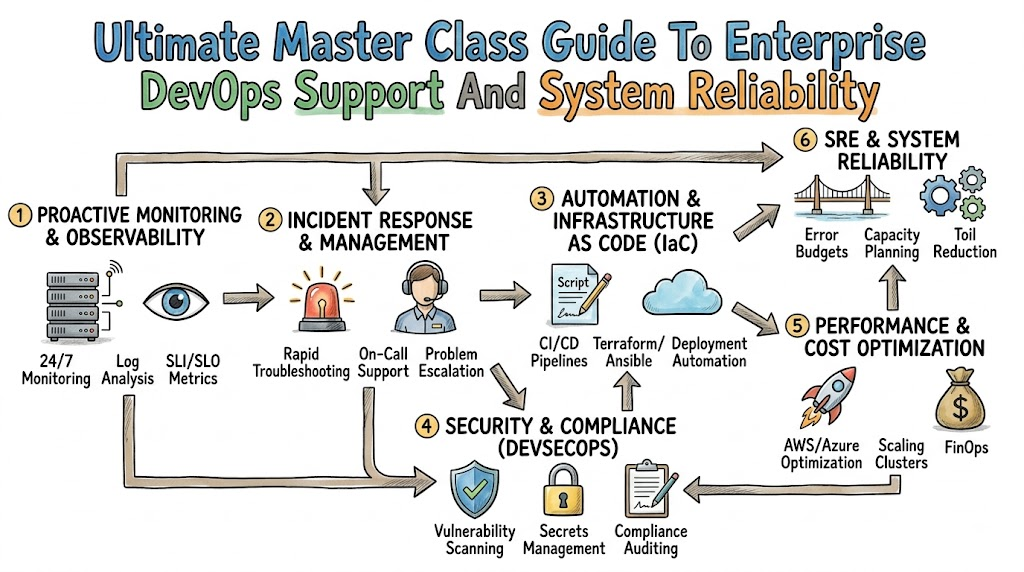
DevOps Support Services provide targeted operational management designed to build, secure, and maintain complex cloud platforms and software delivery systems. Furthermore, these engineering solutions cover real-time server monitoring, continuous deployment management, container orchestration, embedded security controls, and system performance tuning.
Moreover, expanding technology businesses leverage these technical services to bridge the gap between application engineering and infrastructure stability. As a result, software leaders hand over routine system maintenance, emergency incident troubleshooting, and environment upgrades to seasoned cloud experts. Ultimately, this comprehensive operational approach delivers continuous application availability, robust platform security, and predictable software release cycles across the entire organization.
| Support Category | Core Responsibilities | Key Benefits |
| Infrastructure Management | Cloud provisioning, IaC updates, resource scaling | Higher uptime and predictable cloud expenditure |
| Pipeline Support | CI/CD maintenance, release automation, build fixes | Faster feature delivery with minimal release errors |
| Incident Response | 24/7 monitoring, root cause analysis, rapid fix | Reduced mean time to recovery (MTTR) |
| Security & Compliance | Vulnerability scanning, policy enforcement, patching | Enhanced posture and regulatory compliance |
Why DevOps Support Matters
Modern digital platforms demand relentless monitoring, active performance tuning, and immediate bug fixes whenever server anomalies arise. Moreover, running complex architectures across hybrid or multi-cloud environments requires specialized domain mastery that typical development teams lack. Furthermore, neglected infrastructure creates frequent platform outages, mounting technical debt, security breaches, and frustrating delivery delays. Therefore, scaling enterprises and ambitious startups require dedicated operational guidance to safeguard application health. By establishing continuous operational support, businesses keep their mission-critical software resilient, highly performant, scalable, and completely secure.
24/7 DevOps Support Services: When Do They Make Sense?
Global enterprise applications require constant oversight when serving users across multiple international time zones or handling continuous financial transactions. Furthermore, implementing 24/7 DevOps Support Services guarantees that qualified systems engineers monitor platform health, handle automated alerts, and fix live production failures instantly. Consequently, organizations preserve high uptime metrics and honor strict service level agreements without burning out their internal development staff. Additionally, real-time monitoring halts minor technical glitches before they turn into massive system outages. Therefore, growing SaaS providers, e-commerce giants, and digital platforms gain immediate stability from continuous operational management.
Managed DevOps Services vs Internal DevOps Operations
Deciding between external managed support and building an internal operations department marks a critical operational crossroads for growing software companies. However, recruiting and retaining internal cloud engineers requires huge financial investments, long hiring cycles, and continuous training budgets. In contrast, adopting Managed DevOps Services grants immediate access to experienced infrastructure architects, proven automation tools, and established operational playbooks at a predictable monthly investment.
| Operational Aspect | Internal DevOps Operations | Managed DevOps Support |
| Resource Cost | High fixed salaries and overhead | Predictable, flexible monthly investment |
| Coverage Level | Limited to standard business hours | Complete 24/7/365 continuous coverage |
| Tooling & Setup | Built from scratch over time | Pre-established frameworks and workflows |
| Scalability | Slow hiring process during expansion | Instant scaling based on operational demand |
What Should a Good DevOps Support Model Include?
A dependable operational support framework must deliver complete technical coverage across every layer of the modern technology stack. Furthermore, an optimal support structure integrates continuous automated telemetry, immediate alert routing, proactive security patching, and ongoing performance optimization. Additionally, clear service level agreements guarantee rapid emergency response times and transparent communication during critical outages. Moreover, routine architecture reviews, cloud cost analysis, and security audits preserve long-term system stability. Therefore, engineering leaders must choose support partners who provide end-to-end technical capabilities alongside clear documentation and collaborative workflows.
DevOps Support Company India: What Should Businesses Evaluate?
Selecting a DevOps Support Company India requires a thorough evaluation of technical depth, security compliance standards, operational maturity, and communication skills. Furthermore, Indian engineering organizations deliver deep technical expertise, extensive global project experience, and highly cost-effective engagement models. However, technology leaders must confirm that prospective partners follow strict data privacy laws, execute standardized operational playbooks, and maintain transparent reporting. Additionally, analyzing past client case studies and emergency incident protocols helps confirm practical vendor reliability. Therefore, partnering with a premier Indian engineering firm enables enterprises to scale infrastructure efficiently while controlling overall operational costs.
- Technical Skill Depth: Evaluate practical knowledge across major cloud providers, orchestration tools, and automation frameworks.
- SLA Commitment: Verify guaranteed response times for critical production incidents and clear escalation protocols.
- Security Alignment: Confirm adherence to international security standards, data privacy laws, and strict access control guidelines.
- Communication Maturity: Ensure fluent English proficiency, transparent status reporting, and alignment with modern collaboration workflows.
Kubernetes Support Services
Containerized application platforms demand specialized operational care to ensure fast response times, service discovery, and dynamic node scaling across clusters. Furthermore, engaging expert Kubernetes Support Services keeps cluster configurations secure, fully optimized, and up to date. Additionally, container specialists handle automated pod scaling, ingress routing, persistent storage provisioning, and node troubleshooting. Moreover, proactive vulnerability patching prevents security flaws from exposing enterprise data assets. Consequently, software teams run containerized microservices with complete confidence without getting bogged down by complex cluster administration duties.
       +-------------------------------------------------------+
       |               Developer Code / Pipeline               |
       +-------------------------------------------------------+
                                   |
                                   v
       +-------------------------------------------------------+
       |           DevOpsSupport Operations Engine             |
       |  (IaC + Container Management + Security Guardrails)   |
       +-------------------------------------------------------+
                /                  |                  \
               v                   v                   v
     +-------------------+ +-------------------+ +-------------------+
     |   AWS / EKS Env   | |  Azure / AKS Env  | | Hybrid / Bare Metal|
     +-------------------+ +-------------------+ +-------------------+
               \                   |                   /
                v                  v                  v
       +-------------------------------------------------------+
       |           Proactive 24/7 Monitoring & SRE             |
       +-------------------------------------------------------+
AWS DevOps Support Services
Managing Amazon Web Services infrastructure requires deep architectural knowledge and constant performance tuning to keep cloud bills under control. Furthermore, specialized AWS DevOps Support Services assist teams with managing CloudFormation templates, Terraform scripts, EC2 fleets, EKS clusters, and Lambda functions. Additionally, cloud engineers optimize resource utilization to eliminate waste while strengthening disaster recovery readiness. Moreover, structured support aligns deployment pipelines with native AWS tools and third-party security platforms. Therefore, companies operating on AWS maintain highly resilient, performant, and cost-optimized environments continuously.
Azure DevOps Support Services
Microsoft Azure environments require tailored operational support to maximize enterprise tool integrations, automated release pipelines, and cloud governance services. Furthermore, utilizing Azure DevOps Support Services enables engineering teams to streamline Azure Pipelines, manage AKS deployments, and automate enterprise resource provisioning. Additionally, dedicated systems engineers optimize Azure Security Center controls, Active Directory integrations, and governance policies to block unauthorized access. Moreover, continuous pipeline management guarantees fast, error-free software deployments across staging and live production systems. Consequently, enterprise teams achieve higher release efficiency while keeping Azure operations completely safe and stable.
DevSecOps Support Services
Embedding security checks directly into automated build and deployment pipelines remains critical for modern software safety. Furthermore, robust DevSecOps Support Services integrate automated vulnerability scanners, static code analyzers, secret detection tools, and policy enforcement into every release pipeline. Consequently, developers catch and fix security bugs early in the delivery pipeline long before code reaches production servers. Additionally, security engineers implement strict access governance, encrypted network channels, and runtime container defenses. Therefore, businesses maintain strict regulatory compliance while releasing software features rapidly and safely.
SRE Support Services
Site Reliability Engineering transforms passive technical support into a proactive engineering discipline focused on platform resiliency and uptime. Furthermore, adopting SRE Support Services allows teams to establish meaningful Service Level Indicators and Service Level Objectives to track platform health accurately. Additionally, SRE engineers build automated observability dashboards, conduct chaos engineering experiments, and automate routine administrative tasks. Moreover, conducting detailed post-incident reviews ensures continuous learning and eliminates repeating system failures. Therefore, embedding SRE principles guarantees high platform resiliency, efficient resource planning, and exceptional user experiences.
MLOps Support Services
Deploying and scaling machine learning models in live production environments presents unique technical hurdles that traditional DevOps pipelines cannot handle. Furthermore, specialized MLOps Support Services automate model deployment pipelines, training data workflows, feature store integrations, and real-time inference tracking. Consequently, data science teams automate model retraining cycles, prevent data drift, and maintain high prediction accuracy. Additionally, specialized infrastructure engineers optimize expensive GPU compute resources to lower operational overhead. Therefore, companies implementing artificial intelligence scale MLOps frameworks smoothly without hitting platform bottlenecks.
A Practical Example of DevOps Support
Consider a rapidly growing e-commerce brand struggling with frequent checkout crashes and slow release cycles during peak holiday sales events. Internal software developers spent over 50 percent of their working hours manually restarting servers, fixing broken deployment scripts, and debugging database bottlenecks. After partnering with a dedicated external support team, the company transitioned to automated Infrastructure as Code using Terraform, containerized their core applications with Kubernetes, and enabled 24/7 proactive monitoring. As a direct result, platform outages dropped by 90 percent, release speed increased from monthly deployments to daily updates, and developer output doubled within three months.
How to Build a DevOps Support Strategy
Building an effective operational support framework requires a structured strategic roadmap tailored to organizational technical goals. First, audit current cloud setups, deployment frequency, and security gaps to establish realistic performance benchmarks. Next, select suitable automation tools for configuration control, pipeline management, and system monitoring. Afterward, set clear operational metrics, incident management playbooks, and service level agreements to guide support activities. Furthermore, create comprehensive technical documentation, code repositories, and standard operating procedures. Finally, analyze system telemetry continuously, optimize cloud costs, and refine operational processes to sustain long-term efficiency.
+------------------+     +------------------+     +------------------+
| 1. Assessment    |     | 2. Standardize   |     | 3. Automate      |
| Audit workloads, | --> | Select IaC tools | --> | Build CI/CD      |
| identify gaps    |     | and cloud architecture | pipelines & checks|
+------------------+     +------------------+     +------------------+
                                                           |
                                                           v
+------------------+     +------------------+     +------------------+
| 6. Continuous    |     | 5. Proactive SRE |     | 4. 24/7 Monitoring|
| Optimization     | <-- | SLI/SLO tracking | <-- | Alerting, response|
| Cost & performance|    | and incident reviews|   | and patching     |
+------------------+     +------------------+     +------------------+
How DevOps Support Can Reduce Operational Overhead
Running unmanaged cloud infrastructure leads to skyrocketing monthly bills, inefficient server usage, and chronic engineering fatigue. However, partnering with specialized support engineers streamlines operational workflows, purges idle resources, and automates repetitive administrative duties effectively. Furthermore, cloud specialists set up autoscaling rules, reserved instance strategies, and automated storage retention policies to drop monthly expenses sharply. Additionally, delegating operational tasks empowers internal developers to concentrate completely on feature creation and product enhancements. Consequently, companies achieve notable financial savings, superior service uptime, and higher returns on engineering investments.
When Should You Consider External DevOps Support?
Identifying the exact moment to move from internal platform maintenance to external specialized support remains essential for enterprise scaling. Furthermore, business leaders should pursue external assistance when internal developers spend excessive hours troubleshooting server bugs instead of building core product features. Additionally, frequent production outages, delayed software updates, failed compliance audits, and rising cloud spending signal clear operational deficiencies. Moreover, expanding into international markets or launching high-stakes applications demands continuous operational monitoring that internal teams cannot handle alone. Therefore, securing dedicated support specialists delivers immediate technical stability and operational confidence.
Why a Specialized Support Partner Can Help
Teaming up with an experienced engineering partner grants instant access to deep technical expertise without the long-term risks of direct hiring. Furthermore, specialized partners bring vast cross-industry experience gained across hundreds of enterprise deployments, allowing them to solve technical challenges quickly. Additionally, dedicated support providers deliver battle-tested toolkits, automated security rules, and enterprise monitoring frameworks on day one. Consequently, organizations skip trial-and-error experimentation and build resilient, high-performing systems immediately. Ultimately, selecting a specialized engineering partner helps companies innovate faster, scale smoothly, and maintain platform stability over time.
Frequently Asked Questions About DevOpsSupport
- Do external DevOpsSupport teams handle real-time server monitoring and emergency incident responses?Engineers provide 24/7 continuous platform telemetry monitoring, automated alert escalation, and rapid incident mitigation to maintain system availability around the clock.
- Can software enterprises request custom Service Level Agreements for guaranteed incident response speeds?Organizations choose flexible SLA models that guarantee emergency response times under 15 minutes for critical production outages to prevent business disruption.
- Are external support specialists able to collaborate directly with internal development teams?Engineers integrate seamlessly into your existing workflows, functioning as a co-managed extension of your team to oversee cloud infrastructure while your developers build product features.
- Do engineers manage deployments across multi-cloud and hybrid server architectures?Technical coverage spans across major public cloud providers including Amazon Web Services, Microsoft Azure, Google Cloud Platform, as well as private cloud and on-premises server setups.
- Can managed support services reduce monthly cloud infrastructure expenses effectively?Cloud specialists regularly analyze resource usage, purge abandoned instances, implement automated autoscaling, rightsize workloads, and configure reserved instances to reduce cloud spending significantly.
- Are security controls and compliance checks built directly into daily support operations?Engineers enforce strict security standards including end-to-end data encryption, role-based access governance, least-privilege policies, continuous vulnerability scanning, and automated system patching.
- Does dedicated Kubernetes assistance help resolve complex cluster administration issues?Container specialists manage cluster upgrades, node autoscaling, ingress traffic routing, network security policies, persistent storage setups, and node health troubleshooting to guarantee cluster stability.
- Is Site Reliability Engineering support different from traditional IT server management?Site Reliability Engineering applies software automation to system operations, prioritizing proactive infrastructure design, platform telemetry, error budget tracking, and SLO management over manual ticket fixes.
- Can support specialists migrate legacy server setups into modern cloud environments?Cloud architects design and execute full migration roadmaps, containerizing legacy workloads, writing Infrastructure as Code templates, and building automated delivery pipelines with zero operational downtime.
- Do companies need to complete a technical audit before starting a support plan?Engagements begin with a detailed technical assessment of your current cloud setup, release pipelines, and security configurations to create a tailored operational support roadmap.
Final Thoughts
Scaling cloud infrastructure effectively demands continuous technical vigilance, automated security guardrails, real-time monitoring, and proactive system optimization. Furthermore, trying to manage multi-cloud platforms without specialized operational support leads to unexpected downtime, security flaws, and team exhaustion. Consequently, collaborating with an expert cloud operations team allows technology companies to simplify server management, lower monthly cloud expenses, and ship product features faster. Therefore, investing in dedicated support services serves as a powerful strategic driver for sustainable enterprise growth.

