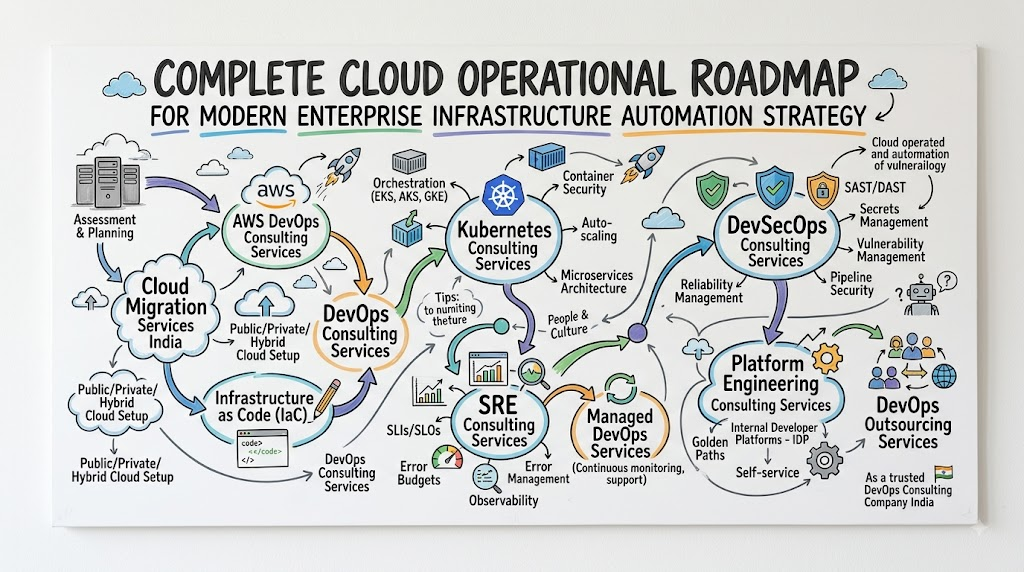
Introduction
Accelerating software delivery velocity stands as a top priority for forward-thinking technical leaders. However, legacy deployment pipelines and manual server configurations frequently cause unexpected downtime, application bugs, and delivery bottlenecks. Consequently, visionary companies partner with specialized advisory teams to modernize their engineering workflows completely.
Through automated CI/CD pipelines, container orchestration, proactive security scanning, and reliable cloud management, external specialists restructure software operations effectively. Furthermore, adopting modern cloud engineering principles reduces deployment friction while increasing overall platform stability. Consequently, technology teams deliver reliable features continuously, eliminate operational overhead, and maintain a competitive edge across fast-moving global markets.
What Is DevOps Consulting?
DevOps consulting transforms traditional IT operations by integrating development workflows, infrastructure automation, and collaborative team cultures into a unified system. Specifically, technical advisors analyze your existing software delivery lifecycle, identify operational bottlenecks, and design custom modernization roadmaps. Consequently, engineering organizations transition from slow manual releases to rapid automated deployments.
Furthermore, technical specialists implement essential practices like continuous delivery pipelines, automated infrastructure provisioning, real-time observability, and automated security controls. In addition, advisors train internal software developers on cloud-native tools and agile operational models. Therefore, technology enterprises achieve higher release frequencies, reduce system failures, and build lasting engineering stability.
Why Organizations Need DevOps Consulting Services
Internal development teams often lack the dedicated capacity or specialized cloud expertise required to re-architect legacy deployment systems efficiently. Consequently, adopting DevOps Consulting Services helps enterprise software teams overcome technical debt and overcome complex platform challenges quickly.
- Faster Software Releases: Automated deployment pipelines reduce feature release times from weeks down to a few minutes.
- Superior Platform Stability: Standardized configuration files and automated testing suites prevent configuration errors in production environments.
- Controlled Cloud Spending: Continuous compute resource audits eliminate idle servers and optimize overall cloud budgets.
- Automated Security Guardrails: Security checks run automatically inside developer workflows to protect corporate software assets continuously.
CI/CD: The Foundation of Faster Software Delivery
Continuous Integration and Continuous Deployment (CI/CD) channels serve as the core engine powering modern high-velocity software engineering organizations. Consequently, developers commit code changes frequently into central Git repositories where automated build systems test every update instantly.
+------------------+     +-------------------+     +--------------------+     +-------------------+
|  Code Commit     | --> |  Automated Build  | --> |  Automated Testing | --> | Continuous Deploy |
| (Git Repository) |     |  & Security Scan  |     | (Unit / Integration|     | (Staging & Prod)  |
+------------------+     +-------------------+     +--------------------+     +-------------------+
Furthermore, automated pipelines evaluate every code commit against strict quality criteria before promotion. Therefore, developers discover and fix software bugs early during initial coding phases rather than managing catastrophic production failures during live user releases.
- Automated Code Validation: Unit tests, integration suites, and security scans run automatically upon every code commit.
- Zero-Downtime Deployment Patterns: Blue-Green and Canary release strategies ensure uninterrupted application access for end users.
- Automated Safety Rollbacks: Deployment engines revert production systems to stable states immediately whenever health checks fail.
Infrastructure as Code Changes Infrastructure Management
Manual server configuration leads to severe environment drift, erratic application performance, and serious security risks. However, adopting Infrastructure as Code (IaC) empowers software engineers to manage hardware, networks, and cloud storage using version-controlled code files.
+------------------------+     +-------------------------+     +------------------------+
| Declarative Templates  | --> | Version Control System  | --> | Automated Provisioning |
| (Terraform / Pulumi)   |     | (Git Tracking & Audit)  |     | (AWS / Azure / GCP)    |
+------------------------+     +-------------------------+     +------------------------+
Consequently, industry-standard tools like Terraform, Ansible, and Pulumi eliminate manual configuration errors completely across all cloud environments. Furthermore, software teams subject infrastructure updates to code reviews, security scans, and automated testing prior to actual cloud deployment.
| Management Aspect | Traditional Manual Administration | Infrastructure as Code (IaC) |
|---|---|---|
| Provisioning Speed | Days or weeks of manual effort | Minutes through automated scripts |
| Environment Parity | High risk of configuration drift | Complete parity across environments |
| Disaster Recovery | Slow, error-prone manual rebuilds | Rapid, automated infrastructure creation |
| Audit Compliance | Fragmented, incomplete system logs | Complete commit history in Git |
Managed DevOps Services for Continuous Operations
Maintaining complex cloud platforms requires continuous monitoring, active optimization, and specialized technical expertise. Therefore, leveraging Managed DevOps Services allows internal product developers to focus strictly on building core business features while external experts manage overall platform health.
Furthermore, managed operations specialists handle 24/7 monitoring, platform updates, security patch management, and automated backup procedures. Consequently, business enterprises reduce operational management costs significantly while securing continuous production availability and system performance.
- Around-the-Clock Incident Mitigation: Dedicated site reliability engineers monitor key metrics and resolve operational anomalies immediately.
- Systematic Expense Reduction: Cloud usage undergoes routine audits to eliminate idle compute resources and lower expenditures.
- Proactive Infrastructure Updates: Technical teams execute scheduled maintenance updates on Kubernetes clusters, pipeline tools, and cloud APIs.
AWS DevOps Consulting Services
Building scalable application platforms on Amazon Web Services requires deep architectural knowledge across various cloud products. Consequently, utilizing specialized AWS DevOps Consulting Services ensures enterprises build secure, highly resilient, and cost-effective cloud platforms.
Furthermore, certified architects deploy native AWS resources including Elastic Kubernetes Service (EKS), Elastic Container Service (ECS), CloudFormation, and CodePipeline. Consequently, businesses maximize cloud infrastructure performance while remaining fully compliant with corporate governance rules.
| AWS Core Component | Operational Role | Key Business Advantage |
|---|---|---|
| AWS EKS | Managed container orchestration | Enterprise-grade Kubernetes cluster management |
| AWS CodePipeline | Automated CI/CD execution | Fast, predictable feature delivery |
| AWS CloudFormation | Declarative cloud resource modeling | Consistent, repeatable infrastructure templates |
| AWS KMS & Secrets | Automated encryption & secrets security | Enterprise compliance and data protection |
DevSecOps Consulting Services
Delaying application security testing until final deployment phases causes massive release delays and exposes production systems to cyber threats. Therefore, engaging DevSecOps Consulting Services embeds security automation directly into early software development cycles.
Consequently, automated static analysis (SAST), dynamic application security testing (DAST), and dependency scans run automatically inside developer workflows. Furthermore, automated policy enforcement systems monitor cloud infrastructure continuously to prevent security drift and unauthorized modifications.
- Automated Security Scans: Build pipelines execute vulnerability checks automatically on every software commit.
- Container Image Security: Security engines inspect container base images before developers publish them to production registries.
- Centralized Credentials Protection: Operations teams store API keys, certificates, and credentials securely inside automated vaults like HashiCorp Vault.
Kubernetes Consulting Services
Container orchestration simplifies microservices management but introduces significant operational complexity around network routing, persistent storage, and access policies. Consequently, enterprise Kubernetes Consulting Services help organizations design, scale, and maintain stable container platforms.
Furthermore, container specialists design multi-region Kubernetes architectures across AWS EKS, Azure AKS, Google GKE, and enterprise cloud environments. Therefore, application development teams deploy microservices effortlessly using automated GitOps delivery engines like ArgoCD and Flux.
+-------------------------------------------------------------------+
|                     Kubernetes Cluster (EKS/GKE/AKS)               |
|                                                                   |
|  +--------------------+   +-------------------+  +-------------+  |
|  | Ingress Controller |   | ArgoCD GitOps     |  | Service     |  |
|  | (Nginx / Istio)    |   | Deployment Engine |  | Mesh        |  |
|  +--------------------+   +-------------------+  +-------------+  |
|            |                        |                   |         |
|  +-------------------------------------------------------------+  |
|  | Microservice Pods (Auto-scaling Workloads & Storage Volumes)|  |
|  +-------------------------------------------------------------+  |
+-------------------------------------------------------------------+
Cloud Migration Services India
Migrating legacy applications from traditional data centers to dynamic cloud environments demands meticulous planning and execution. Consequently, enterprise Cloud Migration Services India provide structured frameworks that eliminate business interruption during cloud transitions.
Furthermore, migration engineers conduct comprehensive application portfolio discovery, workload dependency mapping, and risk assessments before moving workloads. Therefore, organizations transition applications smoothly using re-hosting, re-platforming, or complete cloud-native re-architecting strategies based on business goals.
- Phase 1: Assessment & Inventory: Engineers analyze server inventories, database dependencies, software licenses, and compliance rules.
- Phase 2: Cloud Landing Zone Setup: Architects establish network security topologies, identity governance controls, and policy rules.
- Phase 3: Workload Migration: Technical teams transfer databases and applications with minimal operational disruption.
- Phase 4: Post-Migration Optimization: Specialists fine-tune compute resource sizing and optimize monthly cloud expenses.
Platform Engineering Consulting Services
Software developers frequently spend excessive time managing cloud infrastructure rather than writing core application code. Consequently, adopting Platform Engineering Consulting Services enables enterprises to construct powerful Internal Developer Platforms (IDPs).
Furthermore, platform engineers build standardized self-service workflows, golden paths, and pre-approved application templates. Therefore, software developers provision database instances, temporary preview environments, and deployment pipelines independently without submitting manual infrastructure ticketing requests.
+-------------------------------------------------------------------+
|                    Internal Developer Platform (IDP)               |
|                                                                   |
|  +-------------------------------------------------------------+  |
|  | Developer Self-Service Portal (Backstage / Service Catalog)  |  |
|  +-------------------------------------------------------------+  |
|                                 |                                 |
|  +-------------------------------------------------------------+  |
|  | Golden Paths: Pre-Approved Infrastructure & CI/CD Templates |  |
|  +-------------------------------------------------------------+  |
|                                 |                                 |
|  +-------------------------------------------------------------+  |
|  | Automated Provisioning (Terraform, ArgoCD, Kubernetes)      |  |
|  +-------------------------------------------------------------+  |
+-------------------------------------------------------------------+
SRE Consulting Services
Site Reliability Engineering applies software engineering principles directly to IT operational management to build ultra-scalable systems. Consequently, engaging SRE Consulting Services enables businesses to set clear availability targets, automated incident response, and balanced release speeds.
Furthermore, SRE specialists help teams define Service Level Indicators (SLIs) and Service Level Objectives (SLOs). Consequently, technology leaders evaluate deployment risks scientifically using error budgets to balance rapid feature releases with production platform stability.
- SLI / SLO Framework Setup: Engineers define concrete performance, availability, and throughput targets for critical business services.
- Error Budget Management: Teams regulate release velocity dynamically based on real-time operational availability metrics.
- Automated Incident Response: Technical teams build self-healing scripts and intelligent alert routing to resolve issues instantly.
Observability Is More Than Monitoring
Basic system monitoring tools merely notify engineers when a platform component experiences an operational outage. Conversely, modern comprehensive observability provides deep visibility into why complex distributed microservices suffer performance degradation.
                             +-------------------+
                             |   OBSERVABILITY   |
                             +-------------------+
                                       |
        +------------------------------+------------------------------+
        |                              |                              |
+---------------+              +---------------+              +---------------+
|    METRICS    |              |     LOGS      |              |    TRACES     |
| (Prometheus)  |              | (OpenSearch)  |              | (Jaeger/Tempo)|
+---------------+              +---------------+              +---------------+
Furthermore, combining quantitative metrics, structured logs, and distributed request traces allows operational engineers to identify root causes across complex cloud architectures rapidly.
| Observability Pillar | Primary Data Source | Key Engineering Value |
|---|---|---|
| Metrics | Prometheus, Datadog | Tracks numeric trends, system load, and error rates over time |
| Logs | Fluentbit, OpenSearch | Provides granular diagnostic context for application error events |
| Traces | Jaeger, OpenTelemetry | Maps complete end-to-end user request flows across microservices |
DevOps Outsourcing Services
Expanding internal cloud engineering teams through traditional recruitment demands substantial time and financial capital. Therefore, leveraging DevOps Outsourcing Services allows growing enterprises to onboard certified DevOps, cloud, Kubernetes, and SRE specialists instantly.
Furthermore, flexible outsourcing models empower businesses to scale technical engineering capacity up or down on demand based on changing project scopes. Consequently, organizations maintain high delivery momentum while avoiding permanent staffing overhead and hiring delays.
- Skilled Technical Specialists: Onboard experienced engineers skilled in complex cloud architectures and modern automation tools.
- Flexible Project Engagements: Adapt technical team sizes dynamically for short-term platform migrations or long-term management.
- Reduced Overhead Costs: Eliminate recruitment expenses and internal onboarding costs while retaining top-tier technical expertise.
How to Choose a DevOps Consulting Company India
Selecting the right advisory partner plays a decisive role in the ultimate outcome of your digital transformation journey. Therefore, engineering leaders must thoroughly evaluate potential consulting partners across technical expertise, security standards, and proven execution track records.
Consequently, partner with an established DevOps Consulting Company India that demonstrates verifiable success across multi-cloud platform management, pipeline automation, and round-the-clock operations.
- Verifiable Track Record: Review case studies, client reviews, and actual technical execution achievements.
- Certified Technical Engineers: Confirm that specialists hold recognized credentials across AWS, Azure, GCP, and Kubernetes.
- Security & Compliance Standards: Ensure advisors adhere to standard security frameworks including SOC2 and ISO compliance guidelines.
Common DevOps Mistakes to Avoid
Many technology organizations encounter transformation failures because they treat cloud operational evolution solely as a software procurement task rather than a fundamental organizational shift. Consequently, avoiding common execution traps ensures seamless platform transformation.
- Postponing Security Integration: Delaying security reviews until final release phases creates critical delivery roadblocks.
- Over-Engineering Toolchains: Deploying excessively complex, unnecessary software tools increases long-term system maintenance burdens.
- Neglecting Cultural Alignment: Failing to educate development and operations staff causes friction and slows adoption.
- Ignoring System Observability: Deploying distributed microservices without distributed tracing leads to severe operational blind spots.
A Practical DevOps Transformation Roadmap
A successful cloud modernization journey requires a structured, multi-phase execution strategy. Consequently, implementing a clear transformation roadmap minimizes disruption to active business operations.
- Phase 1: Comprehensive Assessment: Evaluate current software pipelines, operational pain points, and toolchain dependencies.
- Phase 2: Architectural Foundation: Establish secure cloud landing zones and construct automated CI/CD pipelines for pilot applications.
- Phase 3: Migration & Standardization: Standardize Infrastructure as Code templates and migrate core application workloads.
- Phase 4: SRE & Reliability Integration: Implement advanced observability platforms, error budgets, and self-healing operational automation.
When Should You Use Consulting, Managed Services, or Outsourcing?
Determining whether to engage strategic consulting, ongoing managed operations, or technical staffing depends on your organization’s internal technical maturity and immediate operational goals.
- Choose Consulting: When your enterprise requires high-level architectural strategy, pipeline redesign, or initial cloud migration planning.
- Choose Managed Services: When your organization needs continuous 24/7 cloud management, system monitoring, and platform maintenance.
- Choose Outsourcing: When your internal teams need flexible, dedicated cloud engineering bandwidth to execute key projects rapidly.
Frequently Asked Questions About DevOpsConsulting
- Do DevOps Consulting Services help accelerate feature delivery?
DevOps consulting speeds up software delivery, eliminates manual infrastructure provisioning errors, improves application security, and optimizes cloud spending through standardized build automation.
- How do Managed DevOps Services lower corporate operational costs?
Managed DevOps services handle platform monitoring, security patching, system upgrades, and incident recovery, allowing internal developers to focus entirely on building core software products.
- Do global companies prefer working with a DevOps Consulting Company in India?
Indian advisory firms provide senior cloud architectural talent, extensive multi-cloud experience, and 24/7 global support capabilities at highly competitive investment levels.
- Which cloud tools form the core of AWS DevOps Consulting Services?
AWS advisory services cover cloud architecture design, serverless platform setup, Kubernetes orchestration using EKS, Infrastructure as Code via Terraform, and deployment pipelines using AWS CodePipeline.
- Does implementing DevSecOps Consulting Services protect application infrastructure?
DevSecOps integrates automated vulnerability scans, container security checks, secret management, and compliance controls directly into build channels, mitigating security threats before production releases.
- Which specific operational bottlenecks do Kubernetes Consulting Services fix?
Kubernetes consulting resolves complex container management issues including dynamic pod scaling, ingress network setup, multi-region cluster migration, service mesh integration, and GitOps deployments.
- How much execution time do Cloud Migration Services India usually require?
Enterprise migration timelines vary by system scope, but structured projects typically take four to twelve weeks covering discovery, cloud landing zone creation, workload migration, and performance tuning.
- Do Platform Engineering Consulting Services increase developer output?
Platform engineering establishes Internal Developer Platforms that provide self-service infrastructure provisioning and golden paths, eliminating manual IT tickets and increasing release velocity.
- How do SRE Consulting Services protect production application uptime?
SRE consulting sets actionable Service Level Objectives, error budget systems, observability frameworks, and automated incident recovery scripts to ensure platform stability under high user demand.
- When should growing technology businesses adopt DevOps Outsourcing Services?
Businesses should adopt outsourcing services when they need immediate specialized technical capacity, rapid execution on time-sensitive projects, or flexible engineering resources without long-term hiring expenses.
Final Thoughts
Mastering modern enterprise agility requires strong delivery automation, standardized infrastructure provisioning, and resilient cloud architectures. Consequently, adopting modern engineering frameworks empowers technology organizations to scale digital services reliably while enforcing continuous security standards. Furthermore, assessing your current deployment pipelines reveals immediate opportunities for systematic efficiency gains.
Whether your organization seeks strategic advisory, continuous managed platform operations, or flexible cloud engineering capacity, partnering with experienced cloud advisors turns software delivery into a lasting competitive advantage. Therefore, taking proactive modernization steps today positions your technology organization for continuous innovation and long-term operational success.

