Introduction
Modern data ecosystems require more than just storage; they demand seamless integration, speed, and reliability across all pipelines. Consequently, the CDOA – Certified DataOps Architect serves as a vital bridge between traditional data engineering and the agile principles of DataOpsSchool. This guide addresses software engineers and technical leaders who aim to master the complexities of automated data delivery within cloud-native environments. By focusing on practical application rather than mere theory, this resource helps professionals evaluate how this certification aligns with their specific long-term career goals. Mastering these architectural principles ensures that you can lead high-performing teams in an era where data-driven decision-making is the primary competitive advantage for global enterprises.
What is the CDOA – Certified DataOps Architect?
The CDOA – Certified DataOps Architect represents a professional standard for individuals who design and manage automated, high-quality data pipelines. It exists because modern enterprises struggle with data silos and slow delivery cycles that hinder business intelligence. This certification focuses on production-ready skills, moving beyond basic concepts to address how automated testing and continuous integration apply specifically to data sets. Furthermore, it aligns perfectly with modern engineering workflows by treating data as code, ensuring that every change is versioned and validated. Professionals who earn this credential demonstrate they can build resilient systems that support real-time analytics and enterprise-grade scalability.
Who Should Pursue CDOA – Certified DataOps Architect?
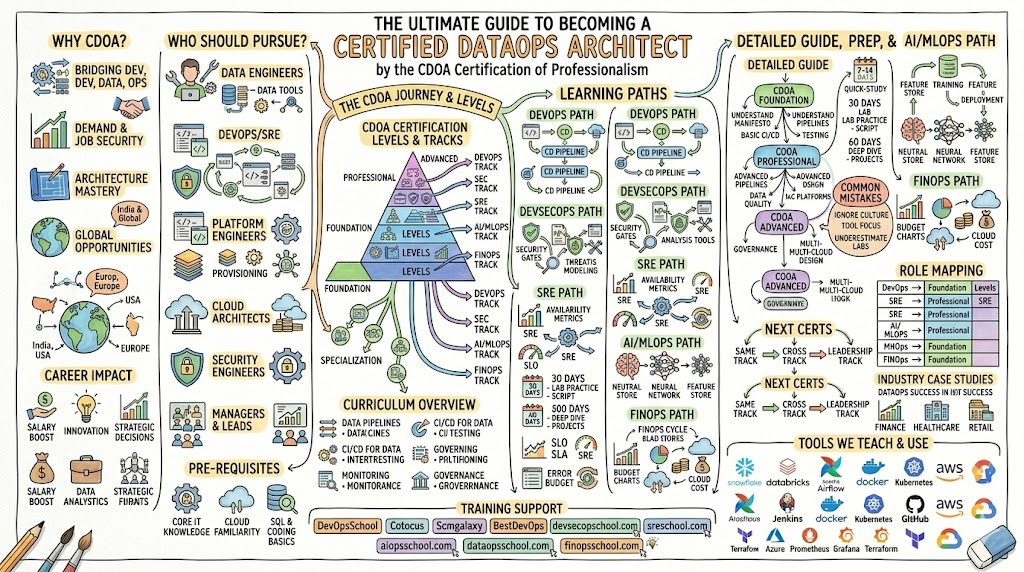
Data engineers and senior SREs who want to specialize in the intersection of data and automation will find this path highly rewarding. Cloud professionals and security experts also benefit significantly, as securing data pipelines is now a top priority for most large organizations. While experienced engineers can use it to formalize their expertise, beginners find it a structured way to enter the specialized field of data architecture. Managers and technical leaders should pursue this to understand the operational requirements of the teams they oversee. Given the rapid digital transformation occurring worldwide, this certification holds immense value for anyone looking to lead global technical initiatives.
Why CDOA – Certified DataOps Architect is Valuable and Beyond
The demand for skilled architects who can manage massive data flows continues to grow as companies adopt sophisticated AI and machine learning models. This certification offers long-term career longevity because it teaches fundamental principles of automation and quality that remain relevant even as specific tools evolve. By mastering the architecture of DataOps, professionals protect themselves against market volatility and tool-specific obsolescence. Many enterprises now prioritize candidates who can demonstrate a holistic understanding of the data lifecycle to ensure a high return on investment. Ultimately, the career impact is significant, as it positions you for high-level roles in platform engineering and strategic technical management.
CDOA – Certified DataOps Architect Certification Overview
The program is delivered via the official certification portal and is hosted on the primary website of the provider. It utilizes a comprehensive assessment approach that prioritizes hands-on competence over rote memorization of technical manuals. The structure is designed to reflect the daily challenges faced by data architects, including pipeline failures, data drift, and infrastructure scaling. Professionals own their learning journey through a series of modules that cover everything from version control for data to automated monitoring. This practical ownership ensures that the certification remains a credible indicator of a candidate’s ability to handle complex, live production environments effectively.
CDOA – Certified DataOps Architect Certification Tracks & Levels
The certification is organized into foundation, professional, and advanced levels to accommodate different stages of professional growth. The foundation level introduces the core philosophy of DataOps, while the professional level focuses on deep technical implementation and pipeline orchestration. Advanced levels are reserved for those designing enterprise-wide strategies and managing multi-cloud data architectures. Specialization tracks allow professionals in DevOps, SRE, or FinOps to tailor the curriculum to their specific domain needs. This tiered approach ensures that your certification status scales alongside your professional responsibilities and leadership capabilities.
Complete CDOA – Certified DataOps Architect Certification Table
| Track | Level | Who it’s for | Prerequisites | Skills Covered | Recommended Order |
| Core Architecture | Foundation | Aspiring Data Architects | Basic SQL/Linux | DataOps Principles, CI/CD Basics | 1 |
| Engineering | Professional | Data Engineers/SREs | Cloud Experience | Pipeline Automation, Data Quality | 2 |
| Strategy | Advanced | Tech Leads/Managers | Professional Cert | Governance, Multi-Cloud Design | 3 |
| Compliance | Professional | Security/Data Officers | Foundation Cert | Encryption, Privacy, Auditing | 2 |
| Optimization | Professional | FinOps/Cloud Leads | Foundation Cert | Cost Management, Resource Scaling | 2 |
Detailed Guide for Each CDOA – Certified DataOps Architect Certification
CDOA – Certified DataOps Architect – Foundation
What it is
This certification validates a fundamental understanding of DataOps methodologies and the cultural shift required to implement them. It confirms that a professional can speak the language of automated data delivery and understands the core components of a modern data stack.
Who should take it
It is ideal for entry-level data engineers, system administrators, or project managers who need to understand the architectural flow of data. It serves as the perfect starting point for those transitioning from traditional IT roles into specialized data operations.
Skills you’ll gain
- Understanding the DataOps Manifesto and core values.
- Basic version control for data schemas.
- Knowledge of automated testing for data pipelines.
- Familiarity with orchestration tools and containerization basics.
Real-world projects you should be able to do
- Create a basic automated pipeline for data ingestion.
- Implement version control for a small database schema.
- Set up basic monitoring alerts for pipeline failures.
Preparation plan
- 7–14 days: Review core definitions and the DataOps lifecycle daily.
- 30 days: Complete all lab exercises and practice basic script automation.
- 60 days: Perform deep-dive research into cloud-native data tools and case studies.
Common mistakes
Many candidates focus too much on specific tools and ignore the underlying architectural principles. Another common error is underestimating the importance of the cultural and collaborative aspects of the DataOps framework.
Best next certification after this
- Same-track option: CDOA – Professional Architect.
- Cross-track option: SRE Professional Certification.
- Leadership option: Engineering Management Foundation.
CDOA – Certified DataOps Architect – Professional
What it is
This level validates advanced technical proficiency in building and maintaining production-grade data environments. It ensures that the architect can handle complex integration challenges and ensure data reliability at scale.
Who should take it
Experienced data engineers, SREs, and cloud architects with at least two years of industry experience should pursue this level. It is designed for those who are responsible for the uptime and performance of critical data infrastructure.
Skills you’ll gain
- Designing complex CI/CD pipelines specifically for large data sets.
- Implementing advanced data quality checks and automated validation.
- Managing infrastructure as code for data platforms.
- Optimizing pipeline performance and cost across hybrid clouds.
Real-world projects you should be able to do
- Build a fully automated, self-healing data pipeline for a large enterprise.
- Implement a comprehensive data masking and security protocol within a CI/CD flow.
- Orchestrate multi-cloud data migrations with minimal downtime.
Preparation plan
- 7–14 days: Focus on advanced orchestration and infrastructure as code concepts.
- 30 days: Build a complete end-to-end project incorporating all professional-level tools.
- 60 days: Engage in peer reviews and practice solving complex architectural scenarios.
Common mistakes
Candidates often fail to account for data drift and monitoring in their designs. Additionally, ignoring the cost implications of high-frequency data processing can lead to poor architectural scores.
Best next certification after this
- Same-track option: CDOA – Advanced Enterprise Architect.
- Cross-track option: FinOps Certified Professional.
- Leadership option: Technical Program Management.
Choose Your Learning Path
DevOps Path
Professionals on this path focus on integrating data pipelines into existing software delivery cycles. You will learn how to apply standard DevOps tools like Jenkins or GitLab to manage data changes seamlessly. This ensures that software and data evolve at the same speed without creating bottlenecks. By following this path, you become the bridge between application developers and data scientists.
DevSecOps Path
The security path emphasizes the protection of sensitive data throughout the entire automated lifecycle. You will master techniques like automated data masking, encryption at rest and in transit, and continuous compliance auditing. This ensures that speed does not come at the cost of vulnerability or regulatory failure. It is essential for those working in highly regulated industries like finance or healthcare.
SRE Path
Site Reliability Engineering for data focuses on the availability, latency, and performance of data platforms. You will learn how to set Service Level Objectives (SLOs) for data quality and pipeline uptime. This path teaches you how to manage toil through automation and how to handle incident response for massive data systems. It is the gold standard for engineers who value system stability above all else.
AIOps Path
This path focuses on using artificial intelligence to enhance IT operations and data management. You will learn how to implement machine learning models that predict pipeline failures before they occur. By automating root cause analysis, you reduce the time spent on manual troubleshooting. It is a forward-looking path for those who want to build self-optimizing infrastructure.
MLOps Path
Machine Learning Operations is about the specialized lifecycle of ML models, from training to production. You will focus on managing model versioning, feature stores, and reproducible experiments. This path ensures that ML models are as reliable and deployable as any other piece of software. It is critical for organizations that rely on high-stakes predictive analytics.
DataOps Path
The pure DataOps path focuses entirely on the flow of data from source to consumer. You will master the orchestration of complex data workflows and the automation of data quality testing. This path emphasizes the reduction of cycle time for data analytics and reporting. It is the core journey for anyone aiming to become a lead architect in the data space.
FinOps Path
FinOps professionals learn to balance the technical requirements of data architecture with cloud cost management. You will focus on monitoring the financial impact of data processing and storage in real-time. This path teaches you how to right-size resources and negotiate cloud spend for large-scale data projects. It is a vital role for ensuring that data initiatives remain profitable and sustainable.
Role → Recommended CDOA – Certified DataOps Architect Certifications
- DevOps Engineer: CDOA Foundation, Professional Engineering Track
- SRE: CDOA Professional, SRE Specialization
- Platform Engineer: CDOA Professional, Infrastructure Track
- Cloud Engineer: CDOA Foundation, Cloud Optimization Track
- Security Engineer: CDOA Professional, Compliance Track
- Data Engineer: CDOA Foundation, Professional DataOps Track
- FinOps Practitioner: CDOA Foundation, FinOps Specialization
- Engineering Manager: CDOA Foundation, Leadership Track
Next Certifications to Take After CDOA – Certified DataOps Architect
Same Track Progression
Once you master the architectural basics, you should pursue deep specialization in enterprise-scale orchestration. This involves learning how to manage global data fabrics and high-availability clusters across multiple continents. Deepening your knowledge in this track makes you an indispensable asset for large-scale digital transformations. You will move from managing single pipelines to overseeing entire organizational data strategies.
Cross-Track Expansion
Broadening your skills into FinOps or DevSecOps allows you to become a more versatile leader. Understanding the financial and security implications of your architectural choices makes your designs more robust and business-aligned. Cross-training ensures that you can communicate effectively with different departments, from finance to legal. This versatility is often the key factor in reaching senior director or VP-level positions.
Leadership & Management Track
For those looking to move away from day-to-day coding, the leadership track focuses on team dynamics and strategic planning. You will learn how to build a culture of automation and how to hire the right talent for a DataOps team. This track prepares you for roles such as Head of Data Operations or Chief Data Officer. It emphasizes the human and organizational aspects of technical success.
Training & Certification Support Providers for CDOA – Certified DataOps Architect
DevOpsSchool
This provider offers extensive resources and expert-led sessions for those looking to master the integration of development and operations. They focus on delivering practical, project-based learning that prepares students for real-world scenarios. Their curriculum is frequently updated to reflect the latest industry trends and toolsets, ensuring that learners remain competitive. With a strong emphasis on hands-on labs, they help bridge the gap between theory and production excellence.
Cotocus
Cotocus specializes in providing high-end technical training for specialized engineering roles including data architecture and cloud operations. They are known for their personalized approach to mentoring, helping professionals navigate complex certification paths with ease. Their trainers are industry veterans who bring years of practical experience into the classroom environment. This ensures that every lesson is grounded in actual challenges faced by modern technology companies today.
Scmgalaxy
As a community-driven platform, this provider focuses on software configuration management and the broader DevOps ecosystem. They offer a wealth of tutorials, forums, and training modules designed to support continuous learning for engineers at all levels. Their resources are particularly helpful for those looking to master version control and automated delivery pipelines. By fostering a collaborative environment, they help professionals stay informed about the latest architectural best practices.
BestDevOps
This platform is dedicated to curating the highest quality training materials for professionals seeking to advance their careers in automation. They provide structured paths that simplify the learning process for complex certifications like the DataOps architect role. Their focus on clarity and practical outcomes makes them a popular choice for busy engineers. They emphasize the importance of mastering core concepts before moving on to advanced technical implementations.
devsecopsschool.com
This organization focuses specifically on the critical intersection of security and automated operations. They provide the necessary tools and knowledge to integrate security protocols directly into the CI/CD pipeline. Their training ensures that safety is never an afterthought in the development lifecycle. Professionals who train here learn how to build resilient systems that protect sensitive data while maintaining high delivery speeds.
sreschool.com
Site Reliability Engineering is the primary focus here, offering deep dives into system availability and performance management. They teach the principles of managing large-scale infrastructure through automation and data-driven decision-making. Their curriculum is designed to help engineers reduce operational toil and improve system reliability. This training is essential for anyone responsible for maintaining the uptime of critical enterprise data platforms.
aiopsschool.com
This provider leads the way in teaching how to apply artificial intelligence and machine learning to IT operations. They help engineers move toward predictive and self-healing infrastructure by leveraging data analytics. Their courses cover the latest AI tools and methodologies that are transforming how modern data centers are managed. It is an ideal destination for forward-thinking professionals looking to automate complex operational tasks.
dataopsschool.com
As the primary hub for DataOps excellence, this site offers the most focused training for data architects and engineers. They provide the official curriculum and resources required to master the DataOps lifecycle from start to finish. Their training modules are built by practitioners who understand the nuances of managing high-volume data pipelines. It is the definitive source for anyone serious about earning their architect certification.
finopsschool.com
This school addresses the growing need for financial accountability in cloud-native environments. They teach engineers and managers how to optimize cloud spend without sacrificing performance or scalability. Their training provides the framework for cross-functional teams to collaborate on cost-effective architectural designs. Mastering these skills ensures that technical projects remain aligned with the organization’s broader financial goals.
Frequently Asked Questions (General)
1. Is the certification difficult for someone without a coding background?
While a basic understanding of scripting or SQL is helpful, the foundation level is designed to teach you these concepts.
2. How long does it usually take to complete the professional level?
Most working professionals find that 30 to 60 days of dedicated study is sufficient to master the professional material.
3. Do I need to know specific cloud providers like AWS or Azure?
The principles are cloud-agnostic, but having experience with at least one major provider will make the practical labs much easier.
4. What is the return on investment for this certification?
Certified architects often see significant salary increases and are eligible for senior-level roles that require specialized automation knowledge.
5. Are there any prerequisites for the foundation exam?
There are no hard prerequisites, although familiarity with basic Linux commands and data concepts will certainly give you a head start.
6. Can I take the exams online?
Yes, the certification exams are designed to be accessible globally through secure online proctoring platforms for your convenience.
7. Does the certification expire?
To ensure that your skills remain current, there is usually a renewal or continuing education requirement every few years.
8. Is this certification recognized internationally?
Yes, it is highly valued by major tech hubs and multinational corporations operating within the global market.
9. How does this differ from a standard Data Engineering certificate?
Standard certificates focus on data manipulation, while this focuses on the architecture and automation of the entire delivery pipeline.
10. Are there hands-on labs included in the training?
Yes, the program emphasizes practical application, providing virtual lab environments where you can build and test real data pipelines.
11. Is there a community for certified professionals?
Earning your certification grants you access to an exclusive network of experts and peers for ongoing support and career opportunities.
12. Can managers benefit from this technical certification?
Managers gain the necessary technical vocabulary and strategic understanding to lead their engineering teams more effectively in high-pressure environments.
FAQs on CDOA – Certified DataOps Architect
1. What specific tools are covered in the architect track?
You will work with orchestration tools like Airflow, container platforms like Kubernetes, and version control systems like Git to manage data flows.
2. Does this certification cover data governance?
Yes, it includes modules on how to automate compliance and maintain high data quality standards throughout the entire automated pipeline lifecycle.
3. How does DataOps improve delivery speed?
By automating testing and deployment, it removes manual bottlenecks, allowing teams to move from monthly updates to daily or even hourly releases.
4. Is there a focus on big data technologies?
The architecture principles apply to any scale, but the labs often use big data frameworks to demonstrate scalability and performance optimization.
5. Can I specialize in a specific industry like finance?
The core certification is broad, but the elective tracks allow you to focus on the unique compliance and security needs of various industries.
6. What is the format of the final assessment?
The assessment typically involves a mix of conceptual questions and a practical “build-a-pipeline” challenge to prove your real-world architectural skills.
7. How does this help with MLOps?
DataOps provides the reliable infrastructure that MLOps requires for model training and deployment, making it a critical prerequisite for advanced AI work.
8. Are the training materials available in multiple languages?
While the primary material is in English, there is growing support for global learners through various local training partners and community resources.
Final Thoughts: Is CDOA – Certified DataOps Architect Worth It?
Investing your time in this certification is a strategic move if you intend to stay at the forefront of the data revolution. It moves you away from being a tool operator and elevates you to a system architect who understands the bigger picture of enterprise efficiency. In a market that increasingly values automation and reliability, having a credential that proves you can build resilient data systems is invaluable. You should view this not just as a badge for your resume, but as a rigorous training program that prepares you for the actual complexities of modern production environments. If your goal is to lead high-impact projects and manage sophisticated data platforms, this path offers the clarity and technical depth required to succeed.
