Introduction
Modern organizations now prioritize high-quality data delivery over simple storage, making CDOE – Certified DataOps Engineer a vital milestone for engineering professionals. This comprehensive guide serves as a roadmap for software engineers and technical leaders aiming to master the intersection of data engineering and agile operations. By following this structured path, you will learn how to automate data pipelines and ensure reliability within cloud-native environments. This resource helps you evaluate the certification’s impact and align your learning journey with current industry demands. Navigating the complexities of modern data architecture requires a strategic approach, and DataOpsSchool provides the necessary framework to excel.
What is the CDOE – Certified DataOps Engineer?
The CDOE – Certified DataOps Engineer represents a shift from traditional database management toward an automated, collaborative approach to data lifecycle management. It exists to bridge the gap between data scientists who create models and the operations teams who must deploy them at scale. Rather than focusing on abstract theories, this program emphasizes production-focused learning and the implementation of automated testing within data workflows. It aligns perfectly with modern enterprise practices by treating data as code and applying DevOps rigor to the entire data supply chain.
Who Should Pursue CDOE – Certified DataOps Engineer?
This certification specifically targets professionals working in data-heavy environments, including SREs, cloud architects, and dedicated data engineers. Beginners looking to enter the field will find a clear entry point, while experienced managers can gain the technical oversight needed to lead large-scale digital transformations. In the context of the global tech market and the rapidly expanding Indian tech sector, these skills are increasingly mandatory for those managing complex cloud infrastructures. Security professionals also benefit by learning how to integrate data governance and compliance directly into automated pipelines.
Why CDOE – Certified DataOps Engineer is Valuable and Beyond
The demand for streamlined data operations is growing as enterprises move away from siloed departments toward integrated platforms. This certification ensures longevity in your career because it focuses on principles that remain constant even as specific software tools evolve. By mastering these methodologies, you stay relevant in an era where data quality determines the success of artificial intelligence and machine learning initiatives. The return on time and career investment is significant, as organizations are actively seeking engineers who can reduce the cycle time of data analytics.
CDOE – Certified DataOps Engineer Certification Overview
The program is delivered via the official platform and hosted on the specialized website. It utilizes a practical assessment approach that moves beyond simple multiple-choice questions to evaluate real-world problem-solving capabilities. The structure is designed to guide a learner from fundamental concepts to advanced architectural design, ensuring a deep understanding of ownership and accountability in data systems. Candidates undergo rigorous evaluation to ensure they can manage the complexities of enterprise-grade data environments effectively.
CDOE – Certified DataOps Engineer Certification Tracks & Levels
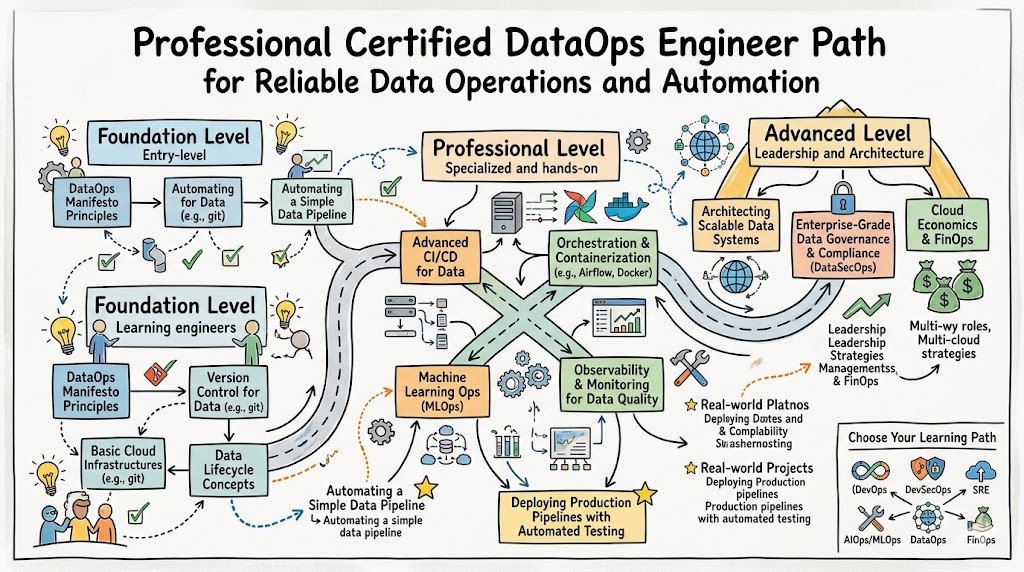
The certification is organized into foundation, professional, and advanced levels to accommodate different stages of career growth. The foundation level introduces the core philosophy, while the professional level dives into specialization tracks such as automation, orchestration, and monitoring. For those aiming for technical leadership, the advanced levels provide the skills necessary to design global data architectures. This progression allows engineers to build a modular skill set that aligns with their specific professional goals and current job requirements.
Complete CDOE – Certified DataOps Engineer Certification Table
| Track | Level | Who it’s for | Prerequisites | Skills Covered | Recommended Order |
|---|---|---|---|---|---|
| Core DataOps | Foundation | Aspiring Engineers | Basic Linux/Cloud | Data Lifecycle, Version Control | 1 |
| Engineering | Professional | Data Engineers | Foundation Level | CI/CD for Data, Orchestration | 2 |
| Architecture | Advanced | Solutions Architects | Professional Level | Scalability, High Availability | 3 |
| Analytics | Professional | Data Analysts | Statistics Basics | Data Quality, Visualization Ops | 2 |
| Governance | Advanced | Compliance Officers | Core DataOps | Security, Policy as Code | 3 |
Export to Sheets
Detailed Guide for Each CDOE – Certified DataOps Engineer Certification
CDOE – Certified DataOps Engineer – Foundation
What it is This level validates your understanding of the core DataOps manifesto and the basic technical requirements for managing automated data flows.
Who should take it It is ideal for junior engineers, fresh graduates, or traditional DBAs looking to modernize their skill set for cloud-native roles.
Skills you’ll gain
- Understanding data pipeline automation
- Basic proficiency in versioning data sets
- Collaborative workflows between data and ops teams
Real-world projects you should be able to do
- Setting up a basic automated data ingestion script
- Implementing version control for a small database schema
Preparation plan A 7-day plan involves reviewing core definitions; a 30-day plan includes hands-on lab exercises; a 60-day plan covers deep-dive theory and mock exams.
Common mistakes Focusing too much on specific tool syntax rather than the underlying architectural principles.
Best next certification after this
- Same-track: CDOE Professional Engineer
- Cross-track: SRE Foundation
- Leadership: Team Lead Essentials
CDOE – Certified DataOps Engineer – Professional
What it is This certification validates the ability to build and maintain complex, production-grade data pipelines using industry-standard orchestration tools.
Who should take it Suitable for mid-level engineers with at least two years of experience who are responsible for daily data operations and system reliability.
Skills you’ll gain
- Advanced CI/CD for data applications
- Monitoring and alerting for data quality
- Containerization of data workloads
Real-world projects you should be able to do
- Deploying a multi-stage data pipeline with automated testing
- Setting up an observability dashboard for data health
Preparation plan A 7-day plan focuses on specific lab scenarios; a 30-day plan involves building a full project; a 60-day plan includes troubleshooting complex failures.
Common mistakes Underestimating the importance of automated testing within the pipeline.
Best next certification after this
- Same-track: CDOE Advanced Architect
- Cross-track: FinOps Certified Practitioner
- Leadership: Engineering Manager Path
Choose Your Learning Path
DevOps Path
Engineers in this path focus on integrating data workflows into existing software delivery pipelines. They prioritize the use of Jenkins, GitLab CI, or GitHub Actions to ensure that data changes are treated with the same rigor as code changes. This path is essential for those who want to eliminate the silos between application development and data management. It emphasizes speed without sacrificing the stability of the production environment.
DevSecOps Path
This path focuses on the critical intersection of data privacy and automated operations. Professionals learn to integrate security scanning and compliance checks directly into the data pipeline. This ensures that sensitive information is handled correctly and that all data movements adhere to international regulations. It is a vital track for engineers working in finance, healthcare, or government sectors.
SRE Path
Site Reliability Engineers use this path to apply operational discipline to data systems. The focus is on maintaining high availability, managing service level objectives, and ensuring that data platforms are scalable. By mastering these skills, SREs can prevent data-related outages and improve the overall resilience of the organization’s infrastructure. It bridges the gap between infrastructure management and data performance.
AIOps Path
This specialization focuses on using artificial intelligence to enhance IT operations. Professionals learn how to feed operational data into AI models to predict system failures and automate incident response. It requires a deep understanding of how to clean and prepare telemetry data for machine learning algorithms. This is the future of proactive infrastructure management and autonomous systems.
MLOps Path
Machine Learning Operations focuses on the lifecycle of ML models, from training to deployment and monitoring. Engineers learn how to automate the retraining of models and manage versioning for both code and data. This path is crucial for organizations that rely on real-time predictions and want to scale their AI initiatives effectively. It ensures that ML models remain accurate and performant over time.
DataOps Path
The dedicated DataOps path centers on the efficiency of the data factory itself. It emphasizes the reduction of cycle time for new data insights and the improvement of data quality through automated testing. Professionals in this track are experts in orchestration and data fabric architectures. This path is designed for those who want to be the primary architects of an organization’s data strategy.
FinOps Path
FinOps professionals focus on the cloud economics of data storage and processing. They learn how to optimize costs associated with large-scale data warehouses and real-time processing clusters. This path provides the tools to align technical spending with business value, ensuring that data initiatives remain profitable. It is an essential skill set for managers overseeing cloud budgets.
Role → Recommended CDOE – Certified DataOps Engineer Certifications
| Role | Recommended Certifications |
|---|---|
| DevOps Engineer | CDOE Foundation, CDOE Professional, CI/CD Expert |
| SRE | CDOE Professional, SRE Practitioner, Observability Specialist |
| Platform Engineer | CDOE Advanced, Infrastructure as Code Professional |
| Cloud Engineer | CDOE Foundation, Cloud Architecture Associate |
| Security Engineer | CDOE Governance, DevSecOps Professional |
| Data Engineer | CDOE Professional, Big Data Specialist |
| FinOps Practitioner | CDOE Foundation, FinOps Certified Associate |
| Engineering Manager | CDOE Foundation, Technical Leadership Program |
Export to Sheets
Next Certifications to Take After CDOE – Certified DataOps Engineer
Same Track Progression
After completing the initial levels, deep specialization involves moving toward advanced architectural certifications. These programs focus on global scale, multi-cloud data strategies, and complex disaster recovery scenarios. Mastering these areas positions you as a high-level subject matter expert capable of leading the most challenging technical projects within an enterprise.
Cross-Track Expansion
Broadening your skills into areas like FinOps or DevSecOps adds immense value to your profile. By understanding the cost and security implications of your data operations, you become a more versatile engineer. This cross-pollination of skills allows you to participate in high-level strategic planning and cross-functional team leadership.
Leadership & Management Track
For those looking to transition away from pure coding, the leadership track focuses on team dynamics and strategic alignment. These certifications teach you how to manage technical debt, hire top talent, and communicate the business value of technical initiatives to stakeholders. It is the natural progression for senior engineers aiming for Director or CTO roles.
Training & Certification Support Providers for CDOE – Certified DataOps Engineer
DevOpsSchool This provider offers extensive resources for engineers looking to master automation and cloud-native technologies. Their curriculum is designed by industry experts to ensure that students gain practical, hands-on experience with modern toolchains. They provide a supportive environment for both individual learners and corporate teams aiming for digital transformation.
Cotocus A specialized training organization that focuses on high-end technical skills in the areas of cloud and automation. They provide customized learning paths that help professionals bridge the gap between theoretical knowledge and production requirements. Their trainers are active practitioners who bring real-world insights into the classroom.
Scmgalaxy This community-driven platform provides a wealth of knowledge on software configuration management and DevOps practices. It serves as a hub for professionals to share experiences and learn about the latest trends in the industry. Their training programs are known for being thorough and aligned with current market needs.
BestDevOps Focused on delivering quality education in the DevOps space, this provider emphasizes the importance of culture and process alongside technical tools. They offer various certification prep courses that help candidates succeed in a competitive job market. Their approach is practical and results-oriented.
devsecopsschool.com This institution focuses exclusively on the integration of security into the modern software development lifecycle. They provide specialized courses that teach engineers how to build secure-by-design systems. Their certifications are highly valued in industries where data protection is a top priority.
sreschool.com Dedicated to the principles of Site Reliability Engineering, this provider helps engineers master the art of system uptime and performance. Their training covers everything from error budgets to incident management. It is a go-to resource for those aiming to manage large-scale cloud environments.
aiopsschool.com This school focuses on the emerging field of AI-driven operations, providing the skills needed to implement intelligent automation. Their courses explain how to use machine learning to improve IT efficiency and reduce manual labor. It is ideal for forward-thinking engineers.
dataopsschool.com The primary authority on DataOps education, offering comprehensive tracks for engineers and managers. They focus on the entire data lifecycle, ensuring that students can deliver high-quality data at speed. Their certifications are recognized globally as a standard of excellence.
finopsschool.com This provider helps professionals understand the financial aspects of cloud computing. Their training enables engineers to collaborate with finance teams to optimize cloud spend. It is a critical resource for organizations looking to maximize their return on cloud investment.
Frequently Asked Questions (General)
- Is the CDOE – Certified DataOps Engineer certification difficult to pass?
The difficulty depends on your prior experience with data pipelines and cloud infrastructure. While the foundation level is accessible, the professional and advanced levels require significant hands-on practice. - How much time is required to prepare for the foundation exam?
Most candidates with a basic technical background find that 30 days of consistent study is sufficient. This includes reviewing the core curriculum and completing lab exercises. - Are there any mandatory prerequisites for the professional level?
Yes, you generally need to have completed the foundation level or demonstrate equivalent industry experience. This ensures you have the necessary base knowledge to tackle advanced topics. - What is the return on investment for this certification?
Professionals often see immediate benefits in terms of job opportunities and salary increases. Organizations value the ability to streamline data workflows, making certified engineers highly sought after. - Can I take the exam online or do I need to visit a center?
The exam is typically offered through a secure online proctoring system, allowing you to take it from home. This flexibility makes it easier for global candidates to participate. - How long is the certification valid?
The certification is usually valid for two to three years. After this period, you may need to complete a recertification process to ensure your skills remain current. - Does this certification focus on specific tools like Airflow or Spark?
While these tools are often used in labs, the certification focuses more on the underlying principles. This ensures your skills are transferable across different technology stacks. - Is this certification recognized by major tech companies?
Yes, many enterprise organizations recognize this program as a benchmark for data operations excellence. It is increasingly appearing in job descriptions for senior data roles. - What is the sequencing for the different tracks?
It is recommended to start with the foundation level and then choose a specialization based on your current role. You can then move into advanced architecture or leadership. - Are there practice exams available?
Official practice exams are usually provided to help you familiarize yourself with the format. These are excellent tools for identifying areas where you need further study. - How does this differ from a standard Data Engineering certification?
Data Engineering focuses on the “what” and “how” of data movement, while DataOps focuses on the “process” and “automation.” DataOps adds operational rigor to the engineering tasks. - Is it suitable for project managers?
Yes, the foundation level is particularly beneficial for managers who need to understand the technical workflows of their teams. It helps in better planning and resource allocation.
FAQs on CDOE – Certified DataOps Engineer
- What core problem does this certification solve?
It addresses the high failure rate of data projects by teaching engineers how to automate quality checks and deployments. This reduces manual errors and speeds up the delivery of insights to the business. - Does it cover data governance and security?
Yes, the curriculum integrates security and compliance as essential components of the data pipeline. This ensures that data is not only fast but also secure and legally compliant. - Is hands-on lab work included in the training?
Absolutely, the program emphasizes practical application over theoretical knowledge. You will be required to build and troubleshoot actual data pipelines as part of your learning. - How does it help with cloud-native transitions?
It teaches you how to leverage cloud services for scalable data processing and storage. You will learn to use containerization and orchestration in a cloud environment effectively. - Can this help me transition from DevOps to DataOps?
Yes, it is the perfect bridge for DevOps engineers who want to apply their automation skills to data-heavy projects. It builds on your existing knowledge of CI/CD. - What industries benefit most from certified engineers?
Finance, healthcare, e-commerce, and any industry relying on large-scale data analytics benefit immensely. These sectors require high reliability and strict data governance. - Are there group discounts for corporate teams?
Most providers offer corporate packages for teams looking to standardize their skills. This is a cost-effective way for organizations to upskill their entire engineering department. - What kind of support is available during the course?
Students usually have access to forums, expert mentors, and comprehensive study materials. This support system is designed to help you overcome technical hurdles quickly.
Final Thoughts: Is CDOE – Certified DataOps Engineer Worth It?
If you are looking to advance your career in a world where data is the most valuable asset, this certification is a strategic choice. It provides a structured path to mastering the complexities of modern data environments without the noise of marketing hype. The skills you gain are grounded in practical reality and are immediately applicable to production systems. By focusing on automation, quality, and collaboration, you position yourself as an essential part of any technical team. Ultimately, the investment in this certification pays off by making you a more effective and versatile engineer in a competitive market.
