INTRODUCTION
Navigating the complexities of international migration requires a robust understanding of the selection criteria that define successful residency applications. Consequently, many prospective migrants feel overwhelmed by the intricate web of regulations and variable score requirements. This guide simplifies the journey by examining the PR points calculator and the underlying logic of human capital evaluation. Since the system prioritizes high-skilled individuals, mastering these metrics becomes a functional necessity for your future success. Furthermore, this roadmap clarifies the essential components of eligibility while providing actionable strategies for score optimization. Ultimately, you will gain the clarity needed to transform a daunting administrative process into a structured, manageable plan. By following these insights, you effectively bridge the gap between your current professional status and your global aspirations.
What Is a Professional Skill Migration Points Assessment?
The skill migration points assessment serves as a transparent and objective mechanism for evaluating the potential contribution of an applicant to the national economy. Thus, authorities utilize this quantitative framework to rank candidates based on specific attributes like age, education, and work experience. Because the system aims to fill critical labor shortages, it remains highly dynamic and responsive to shifting market demands. Moreover, applicants must reach a specific threshold to qualify for invitation rounds or visa processing. Therefore, understanding the interplay between different scoring categories is vital for anyone seeking a permanent transition.
- The Core Purpose of Professional Skill Migration Points:
- This framework ensures that every selected individual possesses the necessary skills to integrate quickly into the workforce and contribute to the local tax base effectively.
- Furthermore, it maintains the integrity of migration programs by applying standardized rules that eliminate subjectivity during the vetting process for residency.
- How the Professional Skill Migration Points System Works:
- The system assigns numerical values to various human capital factors, allowing the immigration department to prioritize the highest-scoring profiles in competitive pools.
- Additionally, candidates receive updates to their scores as they gain more experience or achieve better language test results, reflecting their evolving professional value.
- Eligibility Standards vs. Selection Criteria:
- Eligibility standards represent the minimum mandatory requirements, such as a baseline age or a fundamental qualification, which an applicant must meet to enter the pool.
- In contrast, selection criteria involve the competitive scoring elements where higher performance translates into a faster invitation or a higher probability of success.
Professional Skill Migration Points Components: The Building Blocks
At its core, the points system breaks down an individual’s life and career into measurable data points known as human capital factors. Consequently, every birthday, degree, and job title carries a specific weight that influences the final calculation. While some factors remain static, others offer significant opportunities for improvement through dedicated effort. Hence, candidates must meticulously document every claim to avoid discrepancies during the official verification stage. Understanding these building blocks allows for a realistic self-assessment before committing resources to a formal application.
- Age Factors in Professional Skill Migration Points:
- The system typically awards the maximum number of points to individuals in their late twenties or early thirties, as they represent long-term economic contributors.
- Nevertheless, older applicants can still qualify by compensating for lower age scores with exceptional professional expertise or higher educational credentials in niche fields.
- Educational Evaluation for Professional Skill Migration Points:
- Advanced degrees such as Ph.D.s or Master’s qualifications yield significantly higher points compared to basic diplomas or vocational certificates during the evaluation.
- Moreover, the relevance of the degree to the nominated occupation plays a critical role in determining if the points will actually be granted.
- Language Proficiency Standards:
- Candidates must achieve specific scores in recognized English tests to claim points, with “Superior” or “Proficient” levels offering the most substantial boosts.
- Furthermore, maintaining high language standards ensures that the migrant can navigate the local workplace culture and professional communication requirements without significant barriers.
- Professional Experience Verification:
- Points accumulate based on the number of years spent working in a skilled occupation, particularly when that experience aligns with the applicant’s formal education.
- Additionally, authorities often distinguish between experience gained within the target country and international experience, frequently valuing local work history at a higher rate.
International Pathways for Professional Skill Migration Points
Various visa subclasses and categories utilize the points system to manage different migration streams effectively. Specifically, some pathways focus on independent skilled workers, while others involve state nominations or employer sponsorship. Because each stream has unique requirements, applicants must choose the path that best aligns with their current score and career goals. Moreover, regional pathways often provide additional point incentives to encourage settlement in less populated areas. Therefore, exploring these variations is essential for maximizing your chances of securing a positive outcome.
- Key Categories and Classes:
- The Skilled Independent pathway allows professionals to move without a sponsor, provided they meet a high points threshold in a competitive environment.
- Alternatively, State Nominated visas provide a crucial point boost for candidates willing to live and work in a specific jurisdiction for a set period.
- Comparative Results Summary:
- Data reveals that candidates utilizing regional nominations often achieve residency faster than those waiting in the highly competitive independent pools.
- Furthermore, specialized visa subclasses for researchers or global talent bypass certain traditional point hurdles, focusing instead on exceptional achievements and high-salary potential.
Advanced Regional Requirements for Professional Skill Migration Points
Regional authorities play a significant role in the migration landscape by identifying specific skills needed within their local economies. Consequently, these regions offer nomination programs that grant extra points to candidates who commit to residing outside major metropolitan hubs. This strategy not only helps the applicant reach the passing score but also distributes talent across the country more evenly. Therefore, researching regional demand lists is a tactical move for any serious applicant. By targeting areas with high demand for your specific skill set, you increase both your point score and your employment prospects.
- Regional Study Bonuses:
- Completing a qualification at a regional educational institution often grants extra points, recognizing the candidate’s integration into the local community and economy.
- Additionally, this bonus encourages international students to look beyond major cities, fostering growth in secondary educational hubs and regional service centers.
- Sponsorship Weights:
- State or territory sponsorship adds a significant fixed value to your total points, often bridging the gap for those slightly below the independent cutoff.
- Furthermore, having a family member living in a designated regional area can sometimes provide a similar point advantage under specific visa subclasses.
The Global Landscape of Professional Skill Migration Points
The points-based migration model has gained international recognition as a fair and efficient way to manage labor influx. Indeed, many developed nations have adopted similar frameworks to ensure their migration policies align with economic needs. While the core logic remains consistent across borders, the specific weightings for factors like age or language vary significantly between countries. Thus, a candidate who scores well in one jurisdiction might find a different reception in another. Understanding this global context helps professionals make informed decisions about where their skills are most highly valued.
- Major Global Frameworks:
- Several nations utilize an “Expression of Interest” system where candidates enter a pool and compete based on their points for a limited number of invitations.
- Moreover, these frameworks allow governments to adjust score requirements in real-time, responding swiftly to changes in the global or local economic climate.
- Key International Differences:
- Some countries place a much heavier emphasis on having a pre-existing job offer, while others prioritize general human capital and potential adaptability.
- Furthermore, the definition of “skilled work” varies, with some nations focusing on traditional trades and others emphasizing the high-tech and digital services sectors.
Benefits of Utilizing a Professional Skill Migration Points Calculator
Using a digital calculator provides immediate clarity and allows for “what-if” scenario planning without the need for an expensive consultant at the initial stage. Consequently, you can identify exactly which areas of your profile require improvement to meet the current invitation trends. This proactive approach saves both time and money by preventing applications that are destined for rejection due to insufficient points. Moreover, a calculator serves as a motivational tool, showing how close you are to your goal. Ultimately, it empowers you to take control of your migration journey with data-driven confidence.
- Planning Accuracy:
- Calculators allow you to input precise dates and test results to see an exact representation of your current standing in the migration pool.
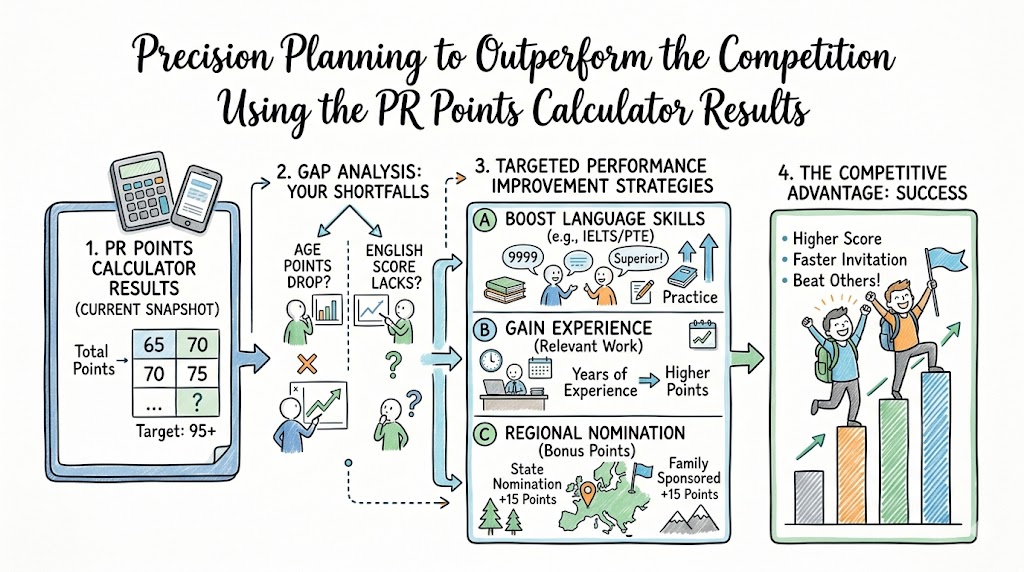
- Additionally, they help in identifying the exact moment your age points might drop, enabling you to submit your application before a birthday reduces your score.
- Strategic Resource Allocation:
- By knowing your score, you can decide whether to invest in further language training or if your current credentials are already sufficient for a successful invite.
- Furthermore, this data prevents the waste of application fees on pathways where your score is significantly below the historical cut-off for your occupation.
Educational Credential Assessment (ECA) Standards
Before you can claim points for your degrees, an authorized body must verify that your international qualifications meet local standards. This process, known as an Educational Credential Assessment, ensures that a degree from abroad is equivalent to one obtained locally. Because this assessment can take several months, it is often the first major step in the migration process. Furthermore, the outcome of this assessment dictates the exact number of points you can claim in the education category. Therefore, selecting the correct assessing authority for your specific profession is a non-negotiable requirement.
| Education Level | Typical Point Value | Equivalence Requirement |
| Doctorate (Ph.D.) | 20 Points | Must be recognized by a relevant local body |
| Bachelor / Master | 15 Points | Must meet the duration and rigor standards |
| Advanced Diploma | 10 Points | Often requires specific trade verification |
| Standard Diploma | 10 Points | Usually linked to vocational occupations |
- Verification Protocols:
- The assessment body reviews your transcripts, course duration, and the accreditation of your university to determine the level of your qualification.
- Moreover, for certain professional trades, the assessment might also involve a practical component or a review of your syllabus to ensure technical competency.
Step-by-Step Guide to Mastering Professional Skill Migration Points
Mastering the points system requires a systematic approach that begins with honest self-reflection and ends with meticulous document preparation. Initially, you must identify your primary occupation on the relevant skilled occupation list to ensure your career is even eligible for points. Subsequently, you should use a calculator to determine your baseline score and identify gaps. Following this, you must gather evidence for every claim, from pay slips to degree certificates. Finally, submitting an Expression of Interest marks the transition from planning to active participation in the migration pool.
- Gathering Necessary Documents:
- You must collect certified copies of your academic transcripts, employment references, and identity documents to support every point claimed in your profile.
- Additionally, ensuring that your employment references include specific details about your duties is essential for proving the skilled nature of your work.
- Practicing Core Assessments:
- Engaging in practice sessions for language proficiency tests can significantly increase your chances of reaching the “Superior” level required for maximum points.
- Furthermore, staying updated on the latest test formats and scoring criteria prevents surprises on the day of the actual examination.
- Checking Market Demand Lists:
- Reviewing the frequently updated occupation lists ensures that your profession is still in demand and eligible for the specific visa you are targeting.
- Moreover, identifying which states or regions have a high demand for your specific skills can lead to a much faster nomination process.
- Calculating the Final Result:
- After collecting all assessments and test results, perform a final calculation to ensure your profile is as strong as possible before submission.
- Additionally, double-checking the dates for your work experience ensures that you are claiming the maximum amount of time permitted under the current rules.
Strategies to Optimize Your Professional Skill Migration Points Score
Optimizing your score is a dynamic process that involves looking for “hidden” points that many applicants overlook. For example, sitting for a community language test can provide a small but vital boost that pushes you above the competition. Similarly, your partner’s skills and language ability can also contribute to your total score if they meet certain criteria. Because competition is high, even a five-point difference can determine whether you receive an invitation in the next round. Therefore, exploring every possible avenue for improvement is a hallmark of a successful migration strategy.
- The Performance Enhancement Strategy:
- Retaking language tests until you achieve the highest possible band is often the fastest way to add ten or twenty points to your application profile.
- Furthermore, gaining just one more year of work experience can sometimes trigger a point increase, making the wait for submission a tactical advantage.
- Bonus Qualification Advantages:
- Completing a Professional Year program in certain fields provides not only extra points but also valuable local work culture insights and networking opportunities.
- Additionally, being an accredited translator or interpreter in a community language offers a specific point bonus that sets you apart from other international applicants.
- Regional Nomination Opportunities:
- Applying for a 491 or similar regional visa provides an immediate fifteen-point boost, which is often enough to secure an invitation for lower-scoring profiles.
- Moreover, these regional pathways frequently have lower overall score requirements compared to the highly contested 189 or 190 visa categories.
Common Mistakes in the Professional Skill Migration Points Process
Errors in the points calculation can lead to a “false” invitation, which will inevitably result in a visa refusal when the case officer reviews the evidence. Consequently, overestimating your work experience or claiming points for an unverified degree are among the most dangerous mistakes an applicant can make. Because the immigration department has a zero-tolerance policy for incorrect claims, accuracy is your best defense. Furthermore, failing to account for the expiration of language tests or skills assessments can lead to a valid invitation becoming void. Therefore, maintaining a calendar of document validity is a critical part of your strategy.
- Overestimating Attributes:
- Applicants sometimes count work experience gained during their studies, which the assessing bodies often exclude from the “post-qualification” skilled experience count.
- Additionally, claiming points for a level of language proficiency you haven’t yet achieved in an official test will result in an immediate rejection upon review.
- Expired Documentation Risks:
- Skills assessments and language test results have specific validity periods, and if they expire before an invitation is issued, your profile becomes ineligible.
- Furthermore, you must proactively renew these documents to ensure your Expression of Interest remains active and truthful within the competitive pool.
Real-Life Case Scenarios Using Professional Skill Migration Points
Analyzing different profiles helps you understand how various factors balance each other out in the real world. For instance, a young graduate with limited experience might rely heavily on their high language scores and local study bonuses. Conversely, a seasoned professional in their forties might focus on their extensive work history and high-level educational qualifications to remain competitive. By looking at these scenarios, you can find a profile that mirrors your own and learn from their tactical choices. This comparative analysis provides a realistic view of what it takes to succeed in the current migration climate.
- The Early Career Scenario:
- A 25-year-old developer with a Bachelor’s degree and superior English scores can reach a high total by utilizing the maximum age points and local study incentives.
- Furthermore, this candidate might benefit from a Professional Year program to gain the final five points needed for a competitive independent visa application.
- The Experienced Professional Scenario:
- A 38-year-old engineer with a Master’s degree and ten years of experience must maximize their language and partner points to offset the lower age score.
- Additionally, targeting a state nomination can provide the necessary buffer to ensure they remain a top candidate despite the biological age curve.
- The Specialized Hero Scenario:
- An applicant working in a niche medical or high-tech field may find that their specific occupation is so in-demand that lower total points still result in an invite.
- Moreover, these individuals often qualify for specialized talent visas that prioritize the impact of their work over a rigid points-based human capital calculation.
Frequently Asked Questions (FAQs)
- How often do the point requirements for an invitation change?The score required for an invitation fluctuates based on the number of applicants in the pool and the government’s current migration targets for each occupation.
- Can I claim points for work experience gained in any country?Yes, you can claim points for international work experience as long as it is relevant to your nominated occupation and verified by the appropriate authority.
- Does my partner’s education affect my total score?If your partner is an applicant on your visa and meets specific age, language, and skill requirements, they can contribute additional points to your total.
- Is there a minimum age to apply for the points-based system?Generally, applicants must be at least 18 years old to enter the pool, while the maximum age for most skilled categories is 45.
- What happens if my points decrease after I submit my interest?You must update your profile immediately if your circumstances change, such as a birthday or a change in employment, to maintain the accuracy of your claim.
- Are points for English proficiency mandatory?While a baseline level of English is usually required for eligibility, you only receive points for achieving “Proficient” or “Superior” levels in a recognized test.
- How long is a skills assessment valid for claiming points?Most skills assessments are valid for three years, but you should check the specific requirements of the assessing body and the immigration department.
- Can I combine points from two different degrees?You usually only claim points for your highest qualification, though having multiple degrees can help you meet the requirements for certain professional assessments.
- Do I get extra points for living in a specific city?Points are generally awarded for living and studying in designated “regional” areas rather than specific major metropolitan cities.
- Is the points calculator an official government tool?While many calculators are highly accurate and based on official rules, you should always verify your final score against the latest legislative guidelines.
- Can I update my profile if I get a better test result?Absolutely, you can and should update your profile as soon as you receive a higher score to increase your ranking in the next invitation round.
- Will a job offer increase my points?In many state-sponsored or employer-sponsored pathways, a valid job offer is either a prerequisite or a source of significant additional points.
FINAL THOUGHT
Successfully navigating the professional skill migration points system requires a blend of meticulous planning and persistent effort. Because the landscape of international migration is constantly shifting, staying informed and adaptable is your greatest asset. By breaking down your profile into its core components—age, education, and experience—you can identify a clear path forward. Remember that while the numbers are important, they represent your hard-earned professional achievements and your potential to thrive in a new environment. Furthermore, using tools like a calculator allows you to visualize your progress and make informed decisions about your future. Do not be discouraged by a low initial score, as many factors are within your control to improve through further study or experience. As you move forward, keep your documentation organized and your goals focused on the long-term benefits of residency. This journey demands patience and precision, but the reward of a global career and a new home is well worth the dedication. You possess the skills and the drive to succeed in this competitive process. Stay committed to your vision, and you will eventually find the pathway that leads to your success.
