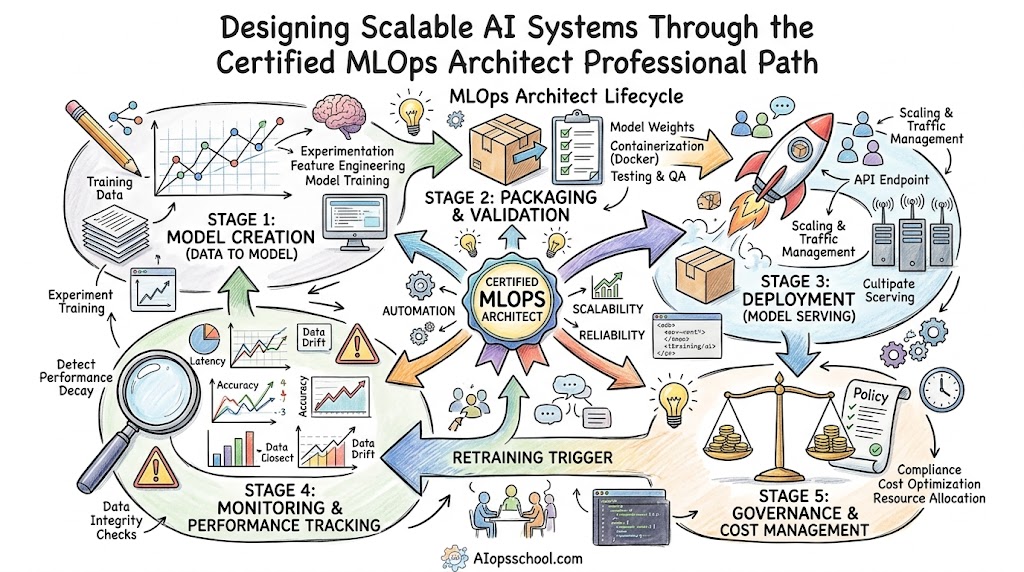
Enterprise organizations currently face a massive hurdle: moving machine learning models from a local developer environment into a stable, production-ready ecosystem. The Certified MLOps Architect program offers a rigorous framework for engineers who want to master this transition. By focusing on the structural integrity of AI pipelines, this certification helps professionals bridge the gap between experimental data science and reliable platform engineering. This guide provides a clear roadmap for anyone looking to advance their career within the AIOpsSchool ecosystem by mastering the automation and orchestration of intelligent systems.
What is the Certified MLOps Architect?
The Certified MLOps Architect designation serves as a professional benchmark for individuals who design and manage the entire lifecycle of machine learning. It moves beyond simple coding and focuses on the high-level architecture required to sustain AI in a corporate environment. This program emphasizes practical, hands-on mastery over abstract theory, ensuring that participants can build resilient systems. It aligns perfectly with modern enterprise practices by teaching engineers how to apply standard DevOps principles to the unique, non-linear challenges of machine learning data flows.
Who Should Pursue Certified MLOps Architect?
Site Reliability Engineers, cloud architects, and platform specialists find immense value in this track as they pivot toward AI-heavy infrastructure. Data engineers and security professionals also benefit by learning how to secure and scale data pipelines from the ground up. The curriculum serves both the Indian market and the global tech landscape, providing a universal language for AI operations. Even engineering managers gain the technical depth needed to oversee complex digital transformation projects and lead high-performing technical teams.
Why Certified MLOps Architect is Valuable in the Future
The tech industry demands experts who can maintain AI systems long after the initial model training ends. This certification focuses on architectural principles that remain relevant even as specific software tools change or become obsolete. It ensures a high return on investment for your time by preparing you to handle the most difficult aspects of AI, such as model decay and automated retraining. Developing these skills positions you as an essential asset in any organization that prioritizes data-driven decision-making and autonomous infrastructure.
Certified MLOps Architect Certification Overview
Candidates access this specialized program through the official training portal hosted by the primary certification website. The assessment methodology favors practical competence, requiring participants to demonstrate their skills in real-world scenarios. It covers everything from foundational pipeline structures to the governance of large-scale distributed systems. By providing a clear ownership model for the entire stack, the certification empowers architects to lead their organizations through the technical complexities of modern AI deployment.
Certified MLOps Architect Certification Tracks & Levels
The program offers a tiered progression through foundation, professional, and advanced levels to support long-term career growth. The foundation level introduces core concepts of versioning, while the professional level explores deep automation and CI/CD for machine learning. Advanced tracks allow engineers to specialize in niche areas like AI security or financial optimization. This structure helps you build a progressive resume that reflects increasing levels of technical authority and leadership capability.
Complete Certified MLOps Architect Certification Table
| Track | Level | Who it’s for | Prerequisites | Skills Covered | Recommended Order |
| Core | Associate | Junior Devs/Managers | Python Basics | ML Basics, Docker | 1 |
| Operations | Professional | SREs/DevOps | Cloud Fundamentals | CI/CD, Monitoring | 2 |
| Data Ops | Professional | Data Engineers | SQL/Data Pipelines | Feature Stores, ETL | 2 |
| Security | Advanced | Security Engineers | Professional Level | Compliance, Auditing | 3 |
| Enterprise | Expert | Principal Architects | Senior Experience | System Design, Drift | 4 |
Detailed Guide for Each Certified MLOps Architect Certification
Certified MLOps Architect – Foundation Level
What it is
This certification validates a candidate’s grasp of the core machine learning lifecycle and basic automation techniques. It provides the essential vocabulary needed to work alongside data scientists.
Who should take it
System administrators, junior developers, or recent graduates who want to specialize in AI operations should start here.
Skills you’ll gain
- Mastery of Git for managing experiment code.
- Basic containerization skills using Docker.
- Understanding of the primary stages of an ML pipeline.
Real-world projects you should be able to do
- Build a reproducible container image for a standard model.
- Implement a version control system for various datasets.
Preparation plan
- 7–14 days: Study DevOps terminology and basic script execution.
- 30 days: Complete laboratory exercises focused on Docker and Git.
- 60 days: Usually unnecessary if the candidate holds a technical degree.
Common mistakes
Focusing on building the models themselves rather than the infrastructure that supports them.
Best next certification after this
- Same-track: Professional MLOps Architect
- Cross-track: Certified DataOps Engineer
- Leadership: Associate Engineering Manager
Certified MLOps Architect – Professional Level
What it is
This level confirms an engineer’s ability to construct fully automated pipelines that transition models from research to a production environment. It highlights the practical application of operations in AI.
Who should take it
Experienced DevOps engineers and SREs who manage high-availability systems for machine learning should pursue this.
Skills you’ll gain
- Designing CI/CD pipelines specifically for ML artifacts.
- Automating data quality checks and performance testing.
- Managing feature stores within a production environment.
Real-world projects you should be able to do
- Create a Jenkins pipeline for automated model retraining.
- Build a monitoring system to track model drift in real-time.
Preparation plan
- 7–14 days: Intensive study of API management and orchestration.
- 30 days: Develop three complete pipelines on major cloud providers.
- 60 days: Deepen knowledge of Kubernetes and serving frameworks.
Common mistakes
Neglecting data validation, which leads to inaccurate model outputs in the live environment.
Best next certification after this
- Same-track: Advanced MLOps Architect
- Cross-track: Certified Cloud Security Professional
- Leadership: Technical Lead (ML Infrastructure)
Choose Your Learning Path
DevOps Path
The DevOps path focuses on the high-level automation of infrastructure and code. You will learn to treat every machine learning model as a software component that requires rigorous testing and deployment. Mastery of Terraform and GitLab ensures that your AI infrastructure remains agile and repeatable. This route produces engineers who can guarantee reliable releases every single time.
DevSecOps Path
This track prioritizes security at every phase of the machine learning journey. You will learn to scan containers for threats and secure sensitive datasets during training and deployment. This path is vital for anyone working in regulated industries like finance or healthcare. It ensures that your AI systems remain compliant and protected against external vulnerabilities.
SRE Path
The SRE path focuses on the stability and performance of the model once it goes live. You will learn how to monitor latency and set up error budgets for your machine learning services. This route teaches you how to maintain high availability even when the model encounters unexpected data. It is the gold standard for engineers who value system uptime and reliability.
AIOps Path
This specialty uses artificial intelligence to optimize traditional IT operations and infrastructure management. You will learn to build models that predict hardware failures and automate the analysis of system logs. It represents a sophisticated approach where technology manages itself through intelligent algorithms. This path helps organizations reduce manual intervention in their daily operations.
MLOps Path
The MLOps path dives into the specific technical challenges of managing machine learning at scale. You will master model lineage and the orchestration of complex data workflows. This track ensures you can manage the unique requirements of AI data alongside traditional code and server resources. It forms the backbone of a successful career in modern AI architecture.
DataOps Path
DataOps focuses on the efficiency and quality of the data supply chain. You will learn to automate data delivery and ensure that your models receive high-quality information. This path is the essential foundation for any MLOps strategy, as it ensures the reliability of the underlying data. It minimizes the time spent on manual data cleaning and preparation.
FinOps Path
The FinOps track teaches you to manage the cloud costs associated with heavy AI workloads. You will learn to optimize GPU usage and track spending across different machine learning projects. This path is crucial for maintaining the financial health of an organization as it scales its AI initiatives. It balances high-performance computing with fiscal responsibility.
Role → Recommended Certified MLOps Architect Certifications
| Role | Recommended Certifications |
| DevOps Engineer | Professional MLOps Architect, Foundation Level |
| SRE | Professional MLOps Architect, SRE Specialization |
| Platform Engineer | Advanced MLOps Architect, Enterprise Ops |
| Cloud Engineer | Foundation Level, FinOps Specialist |
| Security Engineer | DevSecOps Specialist, Professional MLOps Architect |
| Data Engineer | DataOps Specialization, Foundation Level |
| FinOps Practitioner | AI Financials Specialist, Foundation Level |
| Engineering Manager | Foundation Level, Leadership Track |
Next Certifications to Take After Certified MLOps Architect
Same Track Progression
Deepening your expertise in areas like Generative AI operations or high-performance computing represents the next logical phase. These specialized certifications allow you to handle the most cutting-edge AI workloads available today. Staying on this track cements your status as a leading expert in the rapidly growing field of AI infrastructure.
Cross-Track Expansion
Broadening your skillset into cloud security or big data engineering provides a comprehensive view of the modern enterprise. Understanding how the AI pipeline interacts with the broader network and security layers makes you a more versatile architect. This combination of skills is highly sought after by large companies looking for well-rounded technical leaders.
Leadership & Management Track
Moving into an Engineering Manager or Lead Architect role requires a shift in focus toward people and strategy. Certifications in agile management or IT service governance complement your existing technical depth. This allows you to guide teams effectively and align technical AI goals with the broader business objectives of the organization.
Training & Certification Support Providers for Certified MLOps Architect
DevOpsSchool offers a comprehensive suite of training modules for engineers across various technical tracks. Their curriculum focuses on the practical application of automation tools in real-world business environments.
Cotocus provides specialized consulting and training services for teams looking to master modern cloud-native technologies. Their instructors emphasize fast-paced learning and immediate skill application for enterprise projects.
Scmgalaxy serves as an expansive community resource for professionals in configuration management and DevOps. They offer a massive library of tutorials and guides that support the learning process for aspiring architects.
BestDevOps curates high-quality educational content and bootcamps for individuals aiming for elite technical certifications. Their focused approach ensures that candidates are fully prepared for the rigors of professional examinations.
devsecopsschool.com focuses exclusively on the integration of security into the automated development lifecycle. Their deep-dive courses are essential for architects who must protect sensitive AI data and infrastructure.
sreschool.com provides training on the core principles of site reliability and system maintenance. Their materials help engineers ensure that their machine learning models remain available and performant under heavy loads.
aiopsschool.com hosts the official curriculum and platform for the MLOps Architect certification program. They represent the central authority for professionals looking to master the intersection of artificial intelligence and operations.
dataopsschool.com addresses the unique challenges of managing and automating data pipelines for large-scale systems. Their training ensures that the data feeding your AI models is consistently accurate and timely.
finopsschool.com specializes in the economic management of cloud resources and infrastructure spending. Their courses help architects design cost-effective AI systems that align with corporate financial goals.
Frequently Asked Questions (General)
- How difficult is this certification for a beginner?
While the program starts with foundations, you will find it much easier if you possess a basic understanding of Linux and Python.
- What is the typical timeframe for completion?
Most candidates finish the foundation and professional levels within a period of three to six months.
- Does the program require specific prerequisites?
You do not need formal degrees, but practical experience with coding and command-line interfaces will significantly help your progress.
- What kind of career impact can I expect?
Professionals with these certifications often qualify for higher-tier roles and see a marked increase in their earning potential.
- Is it possible to start at the professional level?
Engineers with over three years of experience in relevant fields like DevOps can often skip the introductory foundation level.
- How often must I renew the certification?
The industry moves quickly, so you should update your credentials every two years to stay current with new technologies.
- Does the assessment include hands-on labs?
Yes, the program prioritizes project-based work where you must demonstrate your ability to build and manage actual pipelines.
- Is the curriculum tied to one cloud provider?
The training remains cloud-agnostic, though you will use popular platforms like AWS or Azure to complete your practical assignments.
- Can I access a student community for help?
Yes, most training providers host active forums and groups where you can collaborate with other candidates and experts.
- Does the program cover Large Language Models?
The advanced modules include specific training on deploying and managing the infrastructure required for generative AI and LLMs.
- How many hours per week should I study?
Dedicate between five and ten hours each week to ensure you maintain steady progress through the curriculum.
- Is this designation recognized globally?
The program follows global industry standards, making it highly valuable for recruitment in major tech hubs around the world.
FAQs on Certified MLOps Architect
- What does the architect exam primarily test?
The exam evaluates your ability to design a comprehensive, automated lifecycle for machine learning models from start to finish.
- Must I understand complex math to succeed?
No, this program focuses on the engineering and operations side rather than the mathematical theory of data science.
- Which tools will I use during the labs?
Expect to work with Kubernetes, Docker, MLflow, and various CI/CD tools to build and deploy your project assignments.
- How does this differ from standard DevOps?
Standard DevOps handles static code, while MLOps manages the additional complexity of changing data and model performance drift.
- Are lab environments included in the tuition?
Most providers include access to cloud sandboxes so you can practice your skills without worrying about infrastructure costs.
- Will this help me find work in India?
Yes, the rapid adoption of AI in India has created a massive demand for local architects who can manage these systems.
- Does the course address AI ethics?
The advanced levels include important modules on governance, transparency, and the ethical deployment of machine learning models.
- What is the most difficult section of the exam?
Candidates typically find the orchestration of distributed systems and real-time monitoring of model drift to be the most challenging.
Final Thoughts: Is Certified MLOps Architect Worth It?
Investing in this certification provides a clear advantage in a job market that increasingly prioritizes specialized AI knowledge. The transition from general infrastructure management to specialized MLOps architecture represents a significant step forward in your professional journey. You gain the specific technical skills needed to handle the unpredictable nature of machine learning data and performance. This program transforms you from a traditional engineer into a structural expert capable of leading the next generation of AI initiatives. For anyone aiming to hold a senior technical position in the coming years, mastering these architectural principles is a vital and strategic move.
