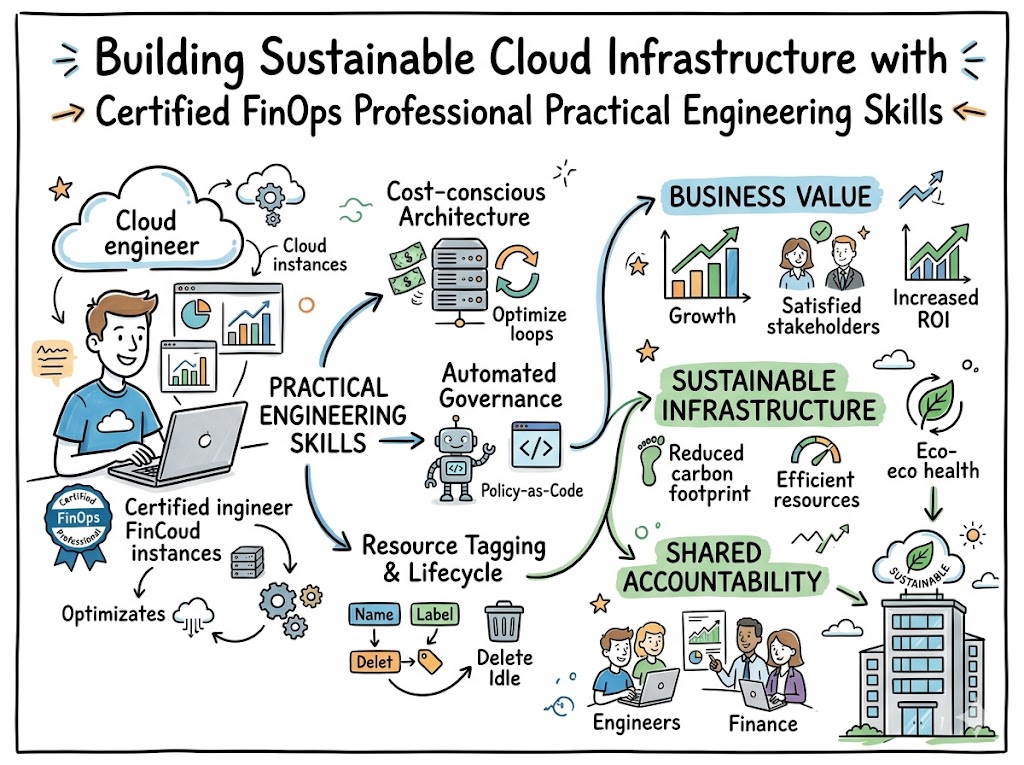
The cloud computing landscape has shifted from simple migration to complex cost optimization and value realization. This guide explores the Certified FinOps Professional designation, a critical credential for engineers and managers navigating the intersection of finance and cloud engineering. As organizations scale their infrastructure, the demand for professionals who can bridge the gap between technical operations and financial accountability has reached an all-time high. This resource is designed to help software engineers, SREs, and platform leads understand how this certification enhances career trajectory and organizational impact. By following this roadmap, technical leaders can make informed decisions about their learning investments and align their skill sets with modern enterprise requirements. FinOpsSchool provides the necessary framework to master these capabilities effectively.
What is the Certified FinOps Professional?
The Certified FinOps Professional represents the gold standard in cloud financial management, moving beyond theoretical knowledge into the realm of production-grade cost governance. It exists to codify the practices required to manage variable cloud spend while maintaining the velocity of engineering teams. Unlike traditional finance certifications, this program is rooted in the reality of modern engineering workflows, focusing on how automation, tagging, and rightsizing integrate into the CI/CD pipeline. It validates an individual’s ability to drive a culture of accountability within decentralized engineering environments, ensuring that every dollar spent on cloud resources yields maximum business value.
Who Should Pursue Certified FinOps Professional?
This certification is highly beneficial for DevOps engineers and SREs who are responsible for the infrastructure budgets of large-scale applications. Cloud architects and platform engineers who design multi-account or multi-cloud environments will find the cost-modeling aspects essential for sustainable growth. Security and data roles also benefit, as storage and egress costs often spiral out of control in data-heavy environments. In both the Indian market and the global landscape, engineering managers and technical leaders are increasingly pursuing this path to better communicate infrastructure ROI to executive stakeholders. Even beginners in cloud operations can use this to gain a competitive edge in the job market.
Why Certified FinOps Professional is Valuable and Beyond
The longevity of this certification is tied to the permanent shift toward cloud-native architectures where spending is dynamic rather than fixed. As enterprises move past the initial “lift and shift” phase, they face massive “cloud shock” bills, making FinOps expertise a high-demand, recession-proof skill. It helps professionals stay relevant by focusing on the economic principles of engineering, which remain constant even as specific cloud tools evolve. The return on time investment is significant, as it positions an engineer as a business-aligned leader rather than just a technical implementer. Organizations are rapidly adopting these practices, creating a sustained need for certified experts who can lead transformation initiatives.
Certified FinOps Professional Certification Overview
The program is delivered via the official portal and hosted on the main platform. It utilizes a practical assessment approach that focuses on the three core phases: Inform, Optimize, and Operate. The certification structure is designed to move candidates through real-world scenarios, testing their ability to analyze billing data and implement cost-saving policies without compromising performance. It emphasizes ownership of cloud spend at the team level, ensuring that practitioners can manage the cultural shift required for enterprise-wide adoption. The assessment ensures that holders are not just familiar with terminology but are capable of executing complex optimization strategies in live environments.
Certified FinOps Professional Certification Tracks & Levels
The certification path is organized into foundation, professional, and advanced levels to accommodate different career stages. The foundation level introduces the core framework and terminology for those new to cloud economics. The professional level dives deep into implementation, policy automation, and advanced forecasting for experienced practitioners. Advanced levels often focus on specialization tracks, such as FinOps for specialized DevOps or SRE workflows, allowing professionals to tailor their learning to their specific job function. This tiered approach allows for a logical career progression, moving from individual contributor roles to strategic leadership positions within a FinOps Center of Excellence.
Complete Certified FinOps Professional Certification Table
| Track | Level | Who it’s for | Prerequisites | Skills Covered | Recommended Order |
|---|---|---|---|---|---|
| Core FinOps | Foundation | Beginners, Managers | Cloud Basics | Lifecycle, Terminology | First |
| Practitioner | Professional | SREs, Cloud Engineers | Foundation | Optimization, Automation | Second |
| Leadership | Advanced | Directors, Leads | Professional | Policy, Governance | Third |
| Specialized | Expert | Architects | Advanced | Multi-cloud Economics | Fourth |
Export to Sheets
Detailed Guide for Each Certified FinOps Professional Certification
Certified FinOps Professional – Practitioner Level
What it is This certification validates an individual’s ability to implement the FinOps framework within an engineering team. It proves mastery over the day-to-day tactical aspects of cost monitoring and resource optimization.
Who should take it It is ideal for cloud engineers and SREs with at least one year of experience managing cloud resources. It is also suitable for finance professionals transitioning into technical cloud management roles.
Skills you’ll gain
- Resource tagging and allocation strategies
- Cloud bill decomposition and anomaly detection
- Implementation of rightsizing and spot instance usage
- Automated cost governance using policy-as-code
Real-world projects you should be able to do
- Build a real-time cost dashboard for a microservices architecture
- Automate the decommissioning of idle non-production resources
- Design a chargeback model for a multi-tenant Kubernetes cluster
Preparation plan The 7-14 day strategy involves reviewing the core framework and official documentation. A 30-day plan includes practicing with sample billing datasets and performing cost audits. The 60-day strategy involves implementing a pilot FinOps project in a sandbox environment to understand the practical hurdles.
Common mistakes Candidates often focus too much on specific cloud provider tools rather than the underlying FinOps principles. Another mistake is ignoring the “Operate” phase, which deals with the cultural change necessary for long-term success.
Best next certification after this
- Same-track: Advanced FinOps Specialist
- Cross-track: Certified SRE Professional
- Leadership: FinOps Strategy and Management
Choose Your Learning Path
DevOps Path
The DevOps path focuses on integrating cost feedback loops directly into the CI/CD pipeline. Engineers learn to treat “cost” as a first-class metric alongside performance and availability. This involves using shift-left cost estimation tools so that developers understand the financial impact of their code before it reaches production.
DevSecOps Path
In this path, the focus is on the intersection of security compliance and cost efficiency. Professionals learn how security scanning and logging overhead can be optimized without compromising the safety of the application. It highlights the financial benefits of secure-by-design architectures that avoid costly emergency remediation.
SRE Path
The SRE path emphasizes the balance between Service Level Objectives and the cost of reliability. SREs learn to determine the “cost of 9s” and make data-driven decisions on whether increasing availability is worth the incremental expenditure. This path bridges the gap between infrastructure stability and fiscal responsibility.
AIOps Path
This path explores how machine learning models can be used to predict cloud spend and detect anomalies automatically. Professionals focus on building intelligent systems that can scale resources up or down based on predictive analytics, ensuring that the infrastructure is always rightsized for the workload.
MLOps Path
MLOps professionals deal with the massive costs associated with GPU usage and data training sets. This track teaches how to manage the lifecycle of machine learning models efficiently, optimizing the cost of experimentation, training, and inference in a scalable cloud environment.
DataOps Path
The DataOps path addresses the unique financial challenges of big data pipelines and storage. It focuses on optimizing data egress, choosing the right storage tiers, and managing the cost of large-scale query processing. This ensures that data-driven insights do not come at a prohibitive price.
FinOps Path
This is the dedicated path for those looking to become specialists in the field. It covers the full spectrum of the framework, from high-level financial reporting to deep technical optimization. It prepares individuals to lead a FinOps team and drive cultural change across an entire enterprise.
Role → Recommended Certified FinOps Professional Certifications
| Role | Recommended Certifications |
|---|---|
| DevOps Engineer | Certified FinOps Professional – Practitioner |
| SRE | Certified FinOps Professional – Advanced |
| Platform Engineer | Certified FinOps Professional – Expert |
| Cloud Engineer | Certified FinOps Professional – Foundation |
| Security Engineer | Certified FinOps Professional – Specialized |
| Data Engineer | Certified FinOps Professional – Data Track |
| FinOps Practitioner | Certified FinOps Professional – All Levels |
| Engineering Manager | Certified FinOps Professional – Leadership |
Export to Sheets
Next Certifications to Take After Certified FinOps Professional
Same Track Progression
Deep specialization within this field involves moving toward architectural roles where you design systems specifically for cost-efficiency. This includes mastering multi-cloud arbitrage and advanced commitment technologies like Savings Plans and Reserved Instances across different vendors.
Cross-Track Expansion
Broadening your skills into SRE or Platform Engineering allows you to implement FinOps principles more effectively. Understanding how Kubernetes or Serverless architectures function at a deep level makes your cost optimization strategies much more impactful and technically sound.
Leadership & Management Track
For those looking to transition into management, focusing on IT Financial Management or Business Administration is a logical step. This path leads to roles such as Head of Cloud Operations or Chief Cloud Officer, where you manage the entire cloud strategy for the company.
Training & Certification Support Providers for Certified FinOps Professional
DevOpsSchool This provider offers comprehensive training programs that cover the entire DevOps and FinOps ecosystem. Their curriculum is designed by industry experts to ensure that students gain hands-on experience with the latest tools and methodologies.
Cotocus A leading provider known for its specialized bootcamps and intensive training sessions. They focus on providing practical knowledge that can be immediately applied in a professional setting, making them a favorite for working engineers.
Scmgalaxy This platform is a community-driven resource that provides extensive tutorials, forums, and training materials. It is an excellent place for professionals to stay updated on the latest trends in software configuration management and cloud operations.
BestDevOps Focusing on quality and depth, this provider offers curated courses that help candidates prepare for high-level certifications. Their training modules are structured to provide a logical progression from basic to advanced concepts.
devsecopsschool.com This organization specializes in integrating security into the DevOps pipeline. Their FinOps training includes a strong focus on how security practices impact the overall cost of cloud infrastructure.
sreschool.com Dedicated to Site Reliability Engineering, this provider helps engineers master the art of maintaining stable and cost-effective systems. Their courses emphasize the use of FinOps to improve system reliability and efficiency.
aiopsschool.com As AI becomes more prevalent in operations, this provider offers training on using artificial intelligence to manage and optimize IT infrastructure. Their programs are at the forefront of technical innovation.
dataopsschool.com Specializing in the data lifecycle, this provider teaches how to manage data pipelines effectively and economically. Their training is essential for data engineers working in cloud-native environments.
finopsschool.com The primary authority on the subject, this site provides the most direct and comprehensive path to becoming a certified professional. Their curriculum is the industry standard for cloud financial management.
Frequently Asked Questions
- How difficult is the Certified FinOps Professional exam? The exam is moderately challenging as it requires a mix of financial understanding and technical cloud knowledge.
- What is the typical time required to prepare? Most professionals with a cloud background spend about four to six weeks preparing for the certification.
- Are there any formal prerequisites for the professional level? While not always mandatory, having a basic cloud certification and the FinOps Foundation certificate is highly recommended.
- What is the typical ROI for this certification? Certified individuals often see significant salary increases and are eligible for specialized roles in high-demand sectors.
- Should I take the exam if I am not in a finance role? Yes, because modern engineering roles require an understanding of cost as a technical constraint.
- Does the certification focus on a specific cloud provider like AWS? No, it is cloud-agnostic and focuses on principles applicable to AWS, Azure, GCP, and others.
- How long is the certification valid? The certification typically remains valid for two or three years, after which renewal is required to stay current.
- Is this certification recognized globally? Yes, it is the most recognized credential for cloud financial management across the globe.
- Can this help me move into a management role? Absolutely, as it demonstrates your ability to manage budgets and align technical projects with business goals.
- What kind of questions are asked in the exam? The questions are usually scenario-based, requiring you to apply the FinOps framework to solve specific problems.
- Are there hands-on labs involved in the training? Most high-quality training providers include labs where you analyze actual billing files and optimize resources.
- Is there a community for certified professionals? Yes, there is a large and active community where practitioners share best practices and job opportunities.
FAQs on Certified FinOps Professional
- What is the core focus of the Certified FinOps Professional curriculum? It focuses on the cultural shift and the three phases of Inform, Optimize, and Operate to drive financial accountability in the cloud.
- How does this certification differ from a standard Cloud Architect path? While an architect focuses on design and performance, this certification focuses on the economic efficiency and value of those designs.
- Can a non-technical manager pass this certification? A manager with a good grasp of cloud concepts can pass, though some technical understanding of infrastructure is necessary.
- What tools are covered during the training? Training covers a variety of native cloud tools and third-party platforms for cost monitoring, reporting, and automated governance.
- Does the program cover Kubernetes cost management? Yes, managing container costs and shared resource allocation is a significant part of the professional-level curriculum.
- Is the exam proctored online? Yes, the exam is typically administered through an online proctoring service, allowing you to take it from anywhere.
- Are there group discounts for enterprise teams? Most training providers offer corporate packages for teams looking to establish a FinOps practice within their organization.
- What is the passing score for the certification? The passing score is generally around 75%, though this can vary depending on the specific version of the exam.
Final Thoughts: Is Certified FinOps Professional Worth It?
Investing in this certification is a strategic move for any professional working in the cloud-native ecosystem. It transitions your profile from a pure cost-center operator to a value-creator who understands the business impact of engineering decisions. The skills gained are not just about saving money but about enabling faster innovation through better resource allocation. As cloud environments become more complex, the ability to manage them with financial discipline will be the hallmark of a senior technical leader. It is a practical, rigorous, and highly respected credential that provides a clear path to career advancement and organizational influence.
