\Introduction
Enterprise software velocity defines competitive success across every modern digital marketplace. High-growth engineering teams constantly look for dependable pathways to modernize technical pipelines, dissolve cross-departmental friction, and eliminate manual release overhead.
Technical directors encounter ongoing friction when balancing rapid feature delivery against infrastructure security and system availability. Building an integrated development ecosystem transforms fragmented engineering departments into focused, outcome-driven powerhouses.
Seasoned technical partners guide enterprises through structural modernization using tested delivery frameworks and operational roadmaps. Ultimately, structured operational blueprints help teams build resilient infrastructure, refine automated release cadences, and deploy software changes with confidence.
Business Value Driven by Continuous Delivery Practices
Systemic automation bridges the traditional gap between product development groups and production infrastructure managers. Because of this integration, software engineers author clean code while systems operators maintain resilient runtimes without operational friction.
Cross-functional engineering practices cut software delivery cycle times from multiple quarters down to single hours. Teams automate continuous integration gates, create standardized dynamic environments, and run automated regression suites across staging and production clusters.
Industry benchmark data confirms that mature organizations release changes hundreds of times faster than legacy competitors. Consequently, embracing automated release workflows directly fortifies system resilience, contracts recovery windows, and enhances business adaptability.
Strategic Pressures Fueling Modernization Initiatives
Fast-moving consumer trends force software teams to launch feature enhancements continuously without inducing unexpected downtime. Conversely, manual deployment workflows introduce configuration drift and cause severe service outages.
Adopting continuous delivery eliminates unpredictable manual handoffs and unverified server modifications entirely. Automated pipelines intercept code defects during initial build stages, allowing engineers to resolve issues before real users encounter them.
Real-world case studies illustrate that automated pipeline stages cut change failure rates by over forty percent. Because of these gains, business leaders treat continuous deployment workflows as a non-negotiable operational standard.
Engineering Modernization via DevOps Consulting Services
Internal development teams rarely possess the bandwidth to rebuild legacy platforms while meeting everyday feature deadlines. Hiring specialized DevOps Consulting Services injects veteran operational expertise to identify and dismantle workflow bottlenecks.
External consultants inspect toolchains, configuration hygiene, pipeline security controls, and cross-team communication habits. Subsequently, they implement automated CI/CD workflows, event-driven release triggers, and repeatable testing frameworks tailored to exact business needs.
| Operational Indicator | Traditional Legacy Model | Modern Pipeline Model |
|---|---|---|
| Release Cadence | Monthly or Quarterly Shipments | Daily Production Updates |
| Commit-to-Deploy Interval | Multiple Weeks or Months | Less Than Sixty Minutes |
| Incident Restoration | Hours of Manual Debugging | Rapid Automated Rollbacks |
| Change Failure Frequency | Above 30% Volatile Events | Under 5% Controlled Updates |
During a recent enterprise engagement, specialized consultants restructured a fragmented banking portal. Consequently, the organization decreased lead time from twenty-eight days to forty-five minutes without incurring additional runtime overhead.
Operational Continuity through Managed DevOps Services
Running continuous delivery systems and cloud infrastructure requires round-the-clock operational supervision. For this reason, organizations engage Managed DevOps Services to handle telemetry monitoring, runtime patching, and production uptime.
Early-stage startups and expanding enterprises often cannot sustain internal operations teams across all time zones. Delegating infrastructure oversight lets application developers focus exclusively on product roadmaps and strategic business logic.
Production telemetry reveals that ongoing managed oversight cuts critical system alerts by sixty percent through proactive health checks. Thus, engineering teams secure high infrastructure availability while preserving their core software delivery focus.
Cloud Computing Patterns in Enterprise Delivery
Programmable cloud platforms replace manual server maintenance with on-demand, API-driven computing capacity. Consequently, engineering groups provision isolated staging topologies in minutes rather than waiting weeks for hardware shipments.
Elastic compute engines scale capacity dynamically during unexpected customer usage surges. This flexible elasticity cuts upfront capital costs because businesses purchase only the computing power they use.
Nevertheless, unchecked cloud usage easily generates massive budget overruns. Modern development teams must enforce disciplined FinOps controls, automated resource downsizing, and transparent resource tagging standards across all accounts.
Identifying the Need for Cloud Consulting Services
Organizations distributing software components across AWS, Azure, and Google Cloud face complicated design challenges. Enlisting expert Cloud Consulting Services guarantees that architectures deliver robust security, maximum availability, and cost efficiency.
Cloud specialists audit infrastructure footprints to uncover latent security vulnerabilities and financial waste. Subsequently, they configure auto-scaling compute pools, automated instance schedules, and multi-region disaster failover mechanisms to protect customer traffic.
- Security Posture Reviews: Auditing access controls, network boundaries, and storage encryption layers to safeguard mission-critical data.
- FinOps Governance: Enforcing scheduled compute shutdowns and terminating idle storage volumes.
- Cross-Cloud Architectures: Building platform-neutral configurations to prevent vendor lock-in across single providers.
Technical Preparation for Cloud Migration Services
Transferring legacy monolithic applications directly into cloud instances replicates outdated architectural problems. Progressive engineering teams use structured Cloud Migration Services to prioritize, re-platform, and migrate applications systematically.
Before initiating workload transfers, infrastructure architects evaluate state dependencies, database clustering needs, and network latency tolerances. Furthermore, engineering teams assemble verified rollback playbooks before redirecting live network traffic.
A telecom provider migrated eighty legacy microservices using a phased re-architecting strategy. Consequently, they completed database synchronization and traffic shifting across six months without experiencing customer-facing service interruptions.
The Critical Function of Kubernetes Container Management
Complex containerized microservices require intelligent platforms to orchestrate service discovery, autoscaling, and self-healing behaviors. Because of these demands, Kubernetes functions as the standard management engine for enterprise container workloads.
Furthermore, Kubernetes abstracts physical infrastructure, delivering identical runtime behaviors across heterogeneous cloud environments. Developers specify desired operational states, while automated controllers continuously remediate runtime configuration drift.
Industry surveys show that container platforms accelerate deployment throughput while maximizing physical server utilization. Therefore, organizations migrate workloads to managed container engines like EKS, AKS, and GKE to run portable services efficiently.
Improving Container Architectures with Kubernetes Consulting Services
Managing production Kubernetes environments requires deep command over overlay networks, storage drivers, and cluster security boundaries. Dedicated Kubernetes Consulting Services resolve operational friction around ingress routing, autoscaling limits, and namespace boundaries.
Consultants deploy production-grade service meshes, horizontal pod autoscalers, and zero-trust security policies. Furthermore, they calibrate pod memory requests and compute ceilings to prevent rogue processes from crashing shared compute nodes.
During an e-commerce platform audit, cluster specialists uncovered improperly configured pod resource requests causing frequent node evictions. Correcting these definitions recovered thirty-five percent of wasted compute resources while eliminating unexpected node failovers.
Unifying Engineering and Security with DevSecOps Consulting Services
Traditional security reviews evaluated applications right before production release. However, this outdated approach delayed project deliveries and forced engineering teams into messy, high-pressure emergency fixes.
Conversely, specialized DevSecOps Consulting Services insert automated testing, package auditing, and compliance checks directly into active pipelines. Developers spot insecure code dependencies and configuration bugs while writing features.
This proactive shift-left methodology transforms security from an operational roadblock into an automated delivery accelerator. Therefore, security specialists and software engineers collaborate seamlessly to defend platform boundaries without compromising delivery velocity.
Securing Pipelines via Automated Verification
Manual security inspections cannot match the pace of automated software deployment pipelines. Engineering organizations must integrate static code analyzers, dependency linters, and configuration validators directly into everyday build processes.
Every code commit triggers tools that inspect third-party dependencies, spot common vulnerabilities, and check compliance definitions. When code violates policy baselines, pipelines abort automatically and return direct mitigation feedback to the committer.
Our internal implementation benchmarks reveal that pipeline-level vulnerability scanning resolves ninety percent of basic security issues before staging deployments. Ultimately, automation ensures consistent policy enforcement across every individual code commit.
Stabilizing Systems via SRE Consulting Services
Site Reliability Engineering treats operational problems as software engineering challenges. Engineering teams employ SRE Consulting Services to establish measurable Service Level Objectives, error budgets, and programmatic recovery workflows.
System outages wipe out commercial revenue and damage customer loyalty across competitive markets. Instead of seeking unattainable zero-downtime records, SRE models balance release velocity against pre-agreed reliability thresholds.
When an application exhausts its error budget, product teams halt risky feature rollouts to focus exclusively on stability improvements. Consequently, this engineering approach establishes shared ownership between business stakeholders and platform engineers.
Gaining Clarity through Deep Observability
Basic server uptime counters fail to reveal intermittent microservice latency and transient network drops. Forward-thinking engineering groups construct robust observability platforms using distributed traces, structured logs, and application metrics.
Correlating these three operational signals enables on-call engineers to isolate application performance bottlenecks within seconds. In addition, distributed tracing highlights slow database queries and failing third-party API dependencies across microservice architectures.
A media streaming platform reduced its mean time to resolution by sixty-five percent after deploying unified distributed tracing. Consequently, incident response teams pinpointed root causes accurately without sifting through disconnected server log files.
Boosting Developer Velocity with Platform Engineering Consulting Services
Application engineers often waste productive hours writing deployment manifests, debugging build configurations, and requesting cloud permissions. Progressive enterprises leverage Platform Engineering Consulting Services to build internal developer platforms that resolve this overhead.
Platform teams manage these systems as internal products designed to improve engineering satisfaction. As a result, software developers provision infrastructure, deploy services, and access monitoring dashboards through simplified interfaces.
- Self-Service Portals: Developers spin up isolated test environments and databases without filing infrastructure support tickets.
- Policy as Code: Guardrails prevent insecure network configurations from provisioning without requiring manual architectural approvals.
- Reduced Cognitive Load: Application teams focus on core business logic rather than complex underlying Kubernetes deployment manifests.
Standardizing Deployment Cadence through Golden Paths
A Golden Path provides a supported, fully automated template for building and deploying production-grade applications. Consequently, developers launch microservices rapidly without debating infrastructure choices or pipeline designs.
These structured templates package base container configurations, standard logging drivers, deployment manifests, and security scanners. When developers follow this path, their software satisfies corporate security, monitoring, and compliance baselines automatically.
Engineering teams using standardized golden paths cut new service onboarding time from two weeks to under two hours. Therefore, platform standardization drives organizational consistency while preserving software delivery autonomy.
Building Workforce Talent with Corporate DevOps Training
Purchasing modern cloud tooling yields minimal return on investment without practical engineering capabilities. For this reason, targeted Corporate DevOps Training trains internal staff in modern cloud architecture, container orchestration, and continuous deployment.
Hands-on training immerses engineering teams in real-world infrastructure failures, cluster troubleshooting, and pipeline construction. As a result, team members gain the operational confidence required to run distributed production systems effectively.
Investing in structured training programs also boosts employee satisfaction and curbs voluntary engineering turnover. Consequently, organizations build high-performing engineering cultures from within rather than relying indefinitely on external assistance.
Aligning Cloud, Kubernetes, Automation, and SRE Disciplines
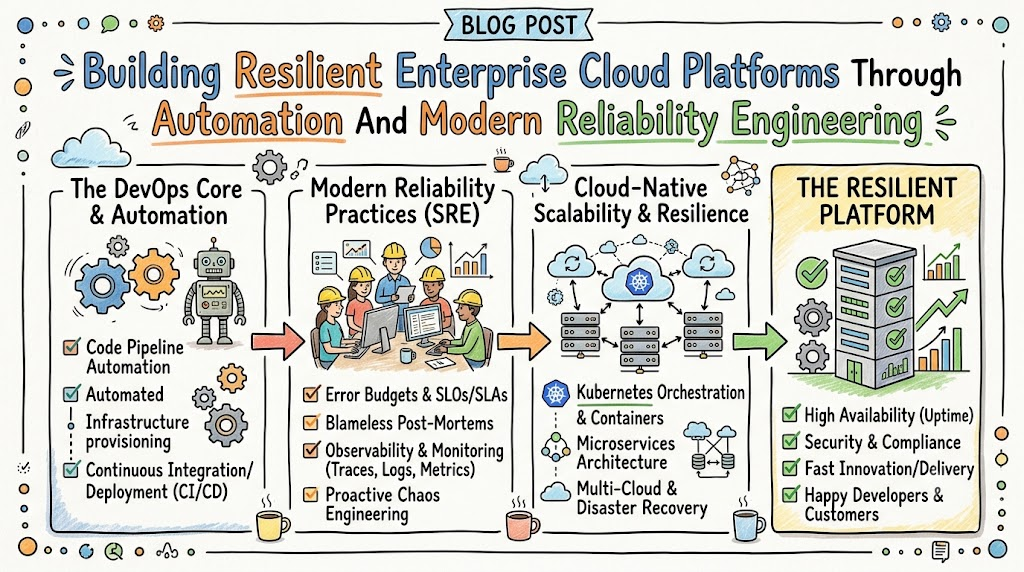
Modern digital platforms succeed when infrastructure disciplines operate as a coordinated, unified delivery ecosystem. Cloud providers provide elastic hardware foundations, while Kubernetes supplies scalable container workload abstractions.
Simultaneously, continuous integration pipelines automate code deployments, and SRE principles govern runtime stability and observability. Without any one of these interconnected disciplines, delivery velocity slows and system architectures become brittle.
| Architecture Tier | Primary Technical Component | Core Engineering Advantage |
|---|---|---|
| Compute Infrastructure | Major Cloud Providers (AWS, Azure, GCP) | Elastic Compute and Storage APIs |
| Container Layer | Managed Kubernetes (EKS, AKS, GKE) | Resilient, Self-Healing Container Scheduling |
| Delivery Automation | Continuous Integration Pipelines | Reliable, Fast Software Deployments |
| System Reliability | SRE Operational Governance | Predictable Availability and Performance |
Synchronizing these operational layers creates a resilient platform capable of sustaining high business agility. Thus, engineering teams release reliable software features continuously with minimal operational overhead.
Overcoming Structural Obstacles in Cultural Modernization
Cultural silos between developers and system operators represent the most common barrier to successful transformation. When organizational leadership mandates new tools without addressing team incentives, operational friction worsens.
Furthermore, attempting to automate broken manual processes merely accelerates failure across modern delivery pipelines. Teams must simplify their release architecture before introducing sophisticated pipeline automation scripts.
Unrealistic project schedules also cause engineers to abandon quality standards in favor of quick fixes. Therefore, executive leaders must grant teams adequate runway to automate testing and build sustainable platform foundations.
Evaluating Platform Maturity using DORA Telemetry
Organizations evaluate engineering transformations by tracking DORA metrics rather than monitoring vanity activity metrics. These indicators include deployment frequency, lead time for changes, change failure rates, and mean time to recovery.
Regularly auditing these performance metrics reveals platform bottlenecks and demonstrates the business value of engineering modernization. Furthermore, tracking developer satisfaction scores shows whether internal platform tooling reduces cognitive burnout.
A financial services firm observed steady drops in change failure rates over consecutive release quarters after implementing automated smoke tests. Consequently, objective performance telemetry validated their investments in modern continuous delivery pipelines.
Execution Milestones for an Engineering Roadmap
Successful transformations advance through disciplined phases rather than attempting total overnight overhauls. First, engineers audit current deployment workflows, map integration bottlenecks, and establish baseline delivery metrics.
Next, teams build automated CI/CD pipelines, containerize application components, and enforce policy guardrails. Finally, organizations launch internal developer platforms and apply advanced SRE observability patterns across production services.
- System Audit: Reviewing legacy delivery pipelines, unifying source code structures, and creating baseline CI workflows.
- Container Standardization: Transitioning applications to container platforms and writing declarative infrastructure definitions.
- Security and Reliability Layering: Adding automated pipeline security checks, tracking SLOs, and centralizing telemetry data.
- Platform Self-Service: Releasing developer portals and Golden Paths to maximize software delivery efficiency.
Strengthening Operational Scale through DevOps Outsourcing Services
Scaling modern digital delivery requires a balanced combination of automation tooling, architectural discipline, and engineering capability. Cotocus works directly with modern enterprises to design, implement, and maintain resilient software platforms.
Organizations access flexible technical capacity through our dedicated DevOps Outsourcing Services, placing senior engineers directly into active sprint teams. Whether building developer platforms or migrating legacy systems, Cotocus ensures measurable operational outcomes.
- Architecting scalable CI/CD pipelines and infrastructure platforms.
- Deploying managed Kubernetes clusters across leading cloud platforms.
- Integrating automated vulnerability security scans inside delivery pipelines.
- Upskilling internal enterprise teams through real-world operational workshops.
Frequently Asked Questions About Modern Platform Engineering
1. Which operational bottlenecks do Cotocus technical specialists eliminate?
Consultants eliminate delivery roadblocks, broken deployment pipelines, uncontrolled cloud spending, compliance vulnerabilities, and compute scaling limits across enterprise software platforms.
2. Where do managed technical services diverge from strategic consulting projects?
Consulting projects focus on strategic architecture, tool assessments, and roadmaps, whereas managed services provide continuous, hands-on operational support and infrastructure maintenance.
3. Which enterprise cloud environments does the engineering team support?
Cotocus engineers design, migrate, optimize, and manage enterprise workloads across Amazon Web Services, Microsoft Azure, and Google Cloud Platform environments.
4. Does the team integrate security into active delivery pipelines?
Yes, engineers integrate automated static code analysis, software dependency audits, container scanners, and compliance checks directly into development pipelines.
5. How do site reliability practices increase consumer uptime?
SRE specialists define clear service level objectives, implement robust observability frameworks, automate incident management, and construct reliable failover workflows.
6. What tangible advantages do internal developer platforms provide?
Internal developer platforms eliminate developer friction by offering self-service infrastructure provisioning, standardized deployment workflows, and automated governance guardrails.
7. How do specialists assist teams managing Kubernetes clusters?
Cotocus guides the configuration, deployment, security hardening, network routing, and autoscaling optimization of clusters on EKS, AKS, and GKE.
8. Can companies augment existing development squads with external engineers?
Yes, businesses add senior cloud, Kubernetes, SRE, and platform engineers directly into internal sprint teams to accelerate critical development milestones.
9. What practical skills do participants learn in corporate training programs?
Engineering teams master real-world container orchestration, CI/CD automation, cloud infrastructure codification, security scanning workflows, and platform troubleshooting techniques.
10. How much time does a typical cloud migration engagement take?
Project timelines depend on workload complexity, application state dependencies, and modernization requirements, typically spanning from several weeks to multiple months.
Final Thoughts
Sustainable software delivery depends on continuous collaboration between skilled engineers, automated pipelines, and resilient cloud architectures. By investing in modern delivery automation, teams eliminate deployment friction and ship features confidently.
Transforming legacy systems into modern platforms requires patience, intentional architecture, and structured execution. With experienced guidance and practical engineering frameworks, organizations turn operational infrastructure into a true competitive advantage.

