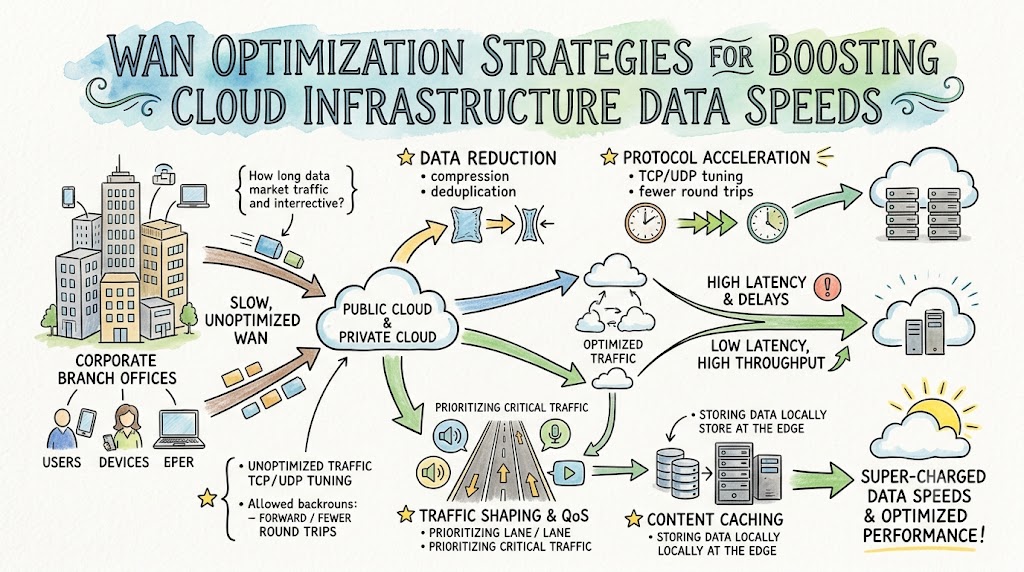
Modern distributed architectures rely heavily on seamless data movement across globally dispersed servers. However, physical distance and network congestion often severely degrade overall cloud network speed. When organizations transmit massive datasets across public or hybrid networks, throughput drops significantly. Implementing targeted WAN optimization strategies helps overcome these latency bottlenecks and stabilizes connection quality. Consequently, businesses can maintain rapid data delivery while maximizing the performance of their cloud-hosted services.
To build ultra-responsive cloud infrastructures, organizations partner with specialized technical service providers like Cloudopsnow to implement high-throughput network architectures. Therefore, addressing systemic transmission delays requires combining localized caching, data reduction protocols, and active traffic shaping. As cloud usage expands across global markets, optimizing wide-area communication becomes essential for sustaining daily productivity. This guide explores the core principles of WAN optimization and demonstrates how to build high-performance network pathways.
Key Operational Concepts You Must Know
Decoupling Latency from Throughput in Wide-Area Networks
Network performance relies on two distinct metrics that engineers must treat differently during system optimization: latency and throughput. Latency represents the total elapsed time required for a packet to travel across a network path. In contrast, throughput measures the total volume of data successfully transmitted over a specific timeframe. Increasing available throughput does not automatically decrease latency across long physical distances.
Understanding this distinction allows operations teams to deploy targeted solutions for specific bottleneck types. For instance, expanding pipe capacity resolves congestion issues, but it cannot overcome physical propagation speed limits. Wide-area network optimization addresses both challenges simultaneously by compressing payload sizes and streamlining protocol handshakes. This balanced approach ensures that data transfers remain fast, consistent, and resilient under heavy utilization.
Data Reduction Techniques: Compression and Deduplication
Data reduction serves as a core mechanism for dramatically increasing effective network speed across wide-area connections. Deduplication identifies recurring data patterns across data streams, replacing repetitive content with small, lightweight reference markers. Consequently, identical files or database entries travel across long physical distances only once, reducing raw data volume dramatically.
Incoming Stream:  [Data Block A] [Data Block A] [Data Block A] [Data Block B]
                                       |
                              (Deduplication Engine)
                                       |
Transmitted Payload: [Data Block A] [Ref A] [Ref A] [Data Block B]  --> (Massive Bandwidth Saved)
Complementing deduplication, advanced byte-level compression algorithms shrink remaining data payloads before transmission occurs. Once compressed packets arrive at the destination edge appliance, they are decompressed back into their original state instantly. Combining deduplication with compression reduces total bandwidth utilization by up to eighty percent on high-volume routes. This efficiency directly speeds up file transfers and application response times.
Protocol Acceleration and Connection Pooling
Standard network transport protocols, such as traditional TCP, suffer from heavy handshake overhead and conservative windowing algorithms. Over long-distance links, waiting for packet acknowledgments creates significant artificial delays, known as TCP window scale limits. Protocol acceleration solves this by proxying TCP sessions locally and using aggressive window management techniques over the WAN link.
- Connection Pooling: Keeps persistent connections open to eliminate repetitive TCP three-way handshakes for every single request.
- Window Scaling: Dynamically adjusts the TCP window size to keep data flowing continuously without waiting for frequent confirmations.
- Selective Acknowledgments: Retransmits only lost packets rather than entire data segments, preserving valuable link bandwidth.
By optimizing how protocols negotiate data transfers, engineering teams can utilize link capacity far more efficiently. These protocol adjustments reduce round-trip chatter drastically, transforming slow, high-latency links into high-speed communication channels. As a result, interactive cloud applications run smoothly even across global distances.
Traffic Shaping, Quality of Service (QoS), and Bandwidth Allocation
Unmanaged network traffic frequently leads to critical business services competing directly with non-essential data transfers. Traffic shaping enforces strict policies that regulate data flows, preventing temporary traffic bursts from choking primary business links. By controlling transmission rates, operations teams maintain stable network performance during peak operational hours.
Raw Mixed Traffic ---> [QoS Priority Classifier] ---> High-Priority Queue (APIs, Voice)  ---> Fast Track
                                                ---> Low-Priority Queue (Bulk Backups) ---> Paced Track
Quality of Service mechanisms classify data packets based on application type, user role, or destination headers. High-priority traffic, such as real-time API calls or transactional databases, receives guaranteed bandwidth and immediate processing priority. Non-urgent tasks, like background system backups, are paced into lower-priority queues during busy periods. This intelligent traffic distribution protects essential cloud functions from experiencing unexpected slowdowns.
Platform Implementation vs. Culture — What’s the Real Difference?
| Operational Aspect | Platform Implementation Focus | Cultural & Mindset Focus |
|---|---|---|
| Network Infrastructure | Provisioning SD-WAN appliances, WAN accelerators, and direct cloud interconnects. | Designing architectures with network efficiency as a foundational priority. |
| Traffic Rules and Policy | Configuring router QoS queues, firewall rules, and protocol compression profiles. | Establishing collaborative data-sharing standards between development and networking teams. |
| Performance Visibility | Deploying network monitoring tools, packet analyzers, and latency dashboards. | Cultivating a proactive performance-driven mindset across all software engineering phases. |
| Incident Resolution | Executing automated failovers, rerouting traffic, and adjusting link capacities dynamically. | Conducting blameless post-mortems to identify structural network design flaws. |
Infrastructure Deployment vs. Organizational Behavioral Patterns
Platform implementation focuses primarily on deploying physical hardware, virtual appliances, and automated network configurations. Network engineers write declarative code, configure SD-WAN routers, and establish dedicated private cloud links. These technical steps build the physical highways that allow data to move efficiently across distant cloud regions. However, hardware deployment represents only one half of a complete network optimization strategy.
Cultural focus addresses how engineering teams design software, consume network resources, and collaborate across operational silos. A performance-minded culture encourages developers to write network-aware software applications that minimize unnecessary API calls. When engineering teams prioritize efficiency during early design phases, the underlying network infrastructure performs far better. Merging modern technical platforms with a strong operational culture creates a sustainable, high-speed cloud environment.
Bridging Technical Control and Team Workflows
To achieve long-term network speed improvements, technical tools must integrate directly with daily team processes. Implementing advanced WAN optimization hardware yields limited results if application developers build bloated, chatty software architectures. Therefore, engineering leadership must align application development standards with network optimization goals.
   +-------------------------------------+
   |    Performance-Focused Culture      |  <-- Encourages lightweight application design
   +-------------------------------------+
                      |
                      v
   +-------------------------------------+
   |    Cross-Functional Operations      |  <-- Establishes network-aware coding standards
   +-------------------------------------+
                      |
                      v
   +-------------------------------------+
   |  Optimized SD-WAN & Network Fabric  |  <-- Accelerates data flows smoothly
   +-------------------------------------+
Creating this alignment requires continuous training, shared performance dashboards, and open lines of communication across departments. When developers understand how packet size impacts WAN latency, they naturally optimize database queries and data payloads. This shared understanding turns raw network capacity into consistently fast user experiences across all corporate locations.
Real-World Use Cases of Modern Operations
Distributed Multi-Cloud Enterprise Data Replication
Global enterprises operating across multi-cloud environments must synchronize huge volumes of database records constantly. Without WAN optimization, continuous cross-cloud data replication consumes massive bandwidth and introduces severe sync delays. By deploying software-defined WAN acceleration appliances at each cloud egress point, engineering teams compress and deduplicate database transactions automatically.
This architectural setup reduces cross-cloud replication lag from hours down to mere seconds, maintaining global data consistency. Furthermore, protocol acceleration mitigates the effects of long-distance latency between geographically distant cloud availability zones. Enterprise applications access real-time data locally, completely eliminating delay issues associated with remote cloud reads.
Remote Workforce Access to Centralized Cloud Applications
Organizations with distributed workforces often face performance complaints from remote employees accessing centralized cloud platforms. High latency over consumer internet connections turns simple data entries into slow, frustrating tasks. Operations teams resolve this issue by routing remote worker traffic through optimized SD-WAN gateways located close to user clusters.
[Remote Worker] ---> [Local SD-WAN Gateway] === (Accelerated & Compressed WAN Link) ===> [Central Cloud App]
These edge gateways compress application traffic, cache repetitive static resources, and maintain persistent connections directly to central cloud platforms. As a result, remote employees experience local-like responsiveness when opening large cloud files or executing database queries. This deployment enhances productivity without requiring costly upgrades to individual home internet connections.
High-Volume Video and Media Streaming Delivery
Media enterprises broadcasting high-definition content globally require ultra-low latency data transmission to prevent buffering issues. Distributing raw video feeds from central processing hubs to regional distribution points strains standard network links severely. Operations engineers use real-time WAN optimization to shape traffic streams and compress video payloads efficiently.
- Dynamic Bandwidth Adjustment: Allocates extra capacity instantly during sudden video traffic surges.
- Edge Caching: Pre-positions popular video segments closer to end-viewer locations to reduce origin requests.
- FEC (Forward Error Correction): Reconstructs lost packets at the destination without requesting slow retransmissions.
These operational controls eliminate choppy video playback and provide stable streams to millions of concurrent viewers worldwide. By minimizing packet loss and managing traffic spikes proactively, media platforms deliver high-fidelity content consistently.
Common Mistakes in Operations Engineering
Treating WAN Optimization as a Pure Hardware Solution
A frequent mistake in network engineering is viewing WAN optimization as merely a matter of purchasing expensive hardware appliances. Engineering teams often install acceleration hardware without analyzing underlying traffic patterns or application behavior. This passive approach wastes resources on optimizing unnecessary background traffic while critical bottlenecks remain unaddressed.
Incorrect Approach:  [Chatty Application] ---> [Expensive WAN Appliance] ---> [High Latency Unchanged]
Correct Approach:    [Optimized Payload]  ---> [Configured SD-WAN Proxy] ---> [Ultra-Fast Link]
Effective optimization requires analyzing data flows, tuning protocol parameters, and redesigning application interaction patterns intentionally. Engineers must combine hardware capabilities with precise traffic rules, data compression policies, and application-level adjustments. Treating network speed as an end-to-end engineering challenge ensures that optimization hardware delivers maximum value.
Ignoring Local Edge Caching and Storage Tiering
Another common oversight is neglecting local edge caching in favor of relying entirely on long-distance network links. Organizations frequently force remote office locations to pull repetitive static files directly from central cloud storage buckets. This creates unnecessary network traffic, clogs wide-area links, and slows down local workflow execution.
To fix this, teams should deploy local caching servers and edge storage nodes that store frequently accessed files locally. Storing static assets at the network edge eliminates redundant WAN transfers and provides instantaneous access for local users. This simple design adjustment frees up valuable WAN bandwidth for critical, unpredictable data transactions.
Over-Compressing Already Optimized Media Files
A technical error made by operations teams is applying generic byte-level compression to already compressed media formats. Formats like JPEG, PNG, MP4, and encrypted ZIP archives are already heavily compressed by design. Running these files through secondary WAN compression algorithms wastes CPU cycles on appliances without yielding any reduction in file size.
Pre-Compressed File ---> [WAN Compression Engine] ---> 0% Size Reduction + High CPU Overhead (Inefficient)
Uncompressed Payload ---> [WAN Compression Engine] ---> 60% Size Reduction + Fast Speed (Efficient)
Operations teams should configure traffic rules to bypass compression engines for pre-compressed file extensions automatically. Disabling redundant processing saves processor cycles, lowers appliance latency, and speeds up packet throughput across the entire network. Smart payload classification ensures that network accelerators focus work only where it yields real speed gains.
How to Become an Operations Expert — Career Roadmap
Mastering Core Transport Protocols and Network Analysis
Building expertise in network operations requires developing a deep understanding of core networking protocols and data packet behaviors. You must master the inner workings of TCP/IP, UDP, BGP, and modern transport protocols like QUIC. Understanding TCP congestion control algorithms, window scaling, and retransmission mechanisms allows you to diagnose complex network delays accurately.
- Packet Inspection: Gain mastery over packet analyzers like Wireshark to dissect frame structures and packet loss patterns.
- Routing Dynamics: Learn how BGP path selection influences data traffic routes across global internet service providers.
- System Tuning: Master Linux kernel network parameter tuning (
sysctl) to optimize socket buffers and memory allocation.
This foundational knowledge enables you to troubleshoot deep network issues that automated tools often miss. Understanding packet mechanics allows you to design custom network topologies optimized specifically for high-speed cloud computing.
Hands-On Proficiency with SD-WAN and Cloud Interconnects
To advance as a modern network architect, you must gain practical experience configuring Software-Defined WAN (SD-WAN) technologies. You should master provisioning dedicated cloud interconnects like AWS Direct Connect, Azure ExpressRoute, and Google Cloud Interconnect. These dedicated private links bypass the unpredictable public internet, offering consistent bandwidth and ultra-low latency profiles.
+------------------------+      Automates Routing      +------------------------+
|   SD-WAN Orchestrator  | --------------------------> |  Multi-Cloud Hybrid    |
|   Policy Controller    |                             |  Private Interconnect  |
+------------------------+                             +------------------------+
Additionally, learn to write automation scripts using Infrastructure as Code (IaC) tools to manage network configurations declaratively. Automating network policy deployments ensures consistent traffic shaping rules across all corporate routers and cloud gateways. This technical proficiency allows you to design scalable, self-healing network infrastructures that adapt dynamically to shifting traffic demands.
Developing Advanced Observability and Performance Analytics
An operations expert must be capable of establishing end-to-end visibility across complex, multi-cloud network environments. You need to become skilled in implementing distributed network observability tools that track synthetic traffic, packet loss, and jitter in real time. Learning to aggregate log data and network telemetry helps you spot emerging bottlenecks before they impact end users.
             +---------------------------------------+
             |    Network Observability Dashboard    |
             +---------------------------------------+
               ^                 ^                 ^
               |                 |                 |
        [Flow Records]    [Synthetic Probes]    [Latency Metrics]
        (NetFlow/IPFIX)    (Active Testing)      (SNMP / Telemetry)
Focus on defining clear Service Level Indicators (SLIs) for network performance, such as maximum acceptable latency thresholds and packet loss limits. Designing automated alerting mechanisms ensures that your team resolves connection degradations instantly. Modern observability transforms raw telemetry into actionable insights, keeping wide-area cloud networks operating at peak speeds.
FAQ Section
- How does WAN optimization differ from simple bandwidth expansion?Expanding bandwidth increases the data pipe’s total capacity, but it does not reduce physical distance latency or protocol overhead. WAN optimization actively compresses data, removes duplicate payloads, and streamlines network protocols to accelerate data speed. It makes existing network links operate far more efficiently without needing endless bandwidth upgrades.
- What role does deduplication play in improving network speed?Deduplication scans network streams for repeated data patterns, replacing duplicate content with tiny reference codes. This prevents identical files or database records from traveling across the network repeatedly. By transmitting only unique data bytes, deduplication reduces link congestion drastically and speeds up file delivery times.
- Can WAN optimization improve performance for encrypted traffic?Yes, modern WAN optimization appliances handle encrypted traffic, such as SSL/TLS streams, by integrating security certificate management securely. The appliance decrypts traffic locally at the edge, performs data deduplication and compression, and re-encrypts the payload before sending. This process maintains strong security standards while delivering optimization performance gains.
- Why is TCP window scaling important for long-distance links?Standard TCP limits the amount of unacknowledged data that can be in flight at any single moment. On long-distance links with high latency, waiting for frequent acknowledgments starves the connection and lowers overall throughput. TCP window scaling expands the memory buffer size, allowing data to flow continuously without pausing for constant confirmations.
- How does SD-WAN technology enhance WAN optimization?SD-WAN adds intelligent software control to network management, dynamically routing application traffic along the fastest, healthiest link available. It measures latency, jitter, and packet loss continuously across multiple paths, steering high-priority traffic away from congested routes. Combining SD-WAN with acceleration techniques maximizes cloud network speed and connection reliability.
Final Summary
Achieving high-speed cloud network performance requires an organized strategy combining intelligent data reduction, protocol tuning, and proactive traffic management. WAN optimization bridges the physical distance gap, transforming sluggish long-haul connections into fast, efficient data pathways. By avoiding common configuration mistakes and leveraging modern SD-WAN technologies, engineering teams can eliminate persistent transmission bottlenecks. Investing in robust network optimization ensures that global cloud applications remain fast, stable, and ready to meet growing business demands.

