Introduction
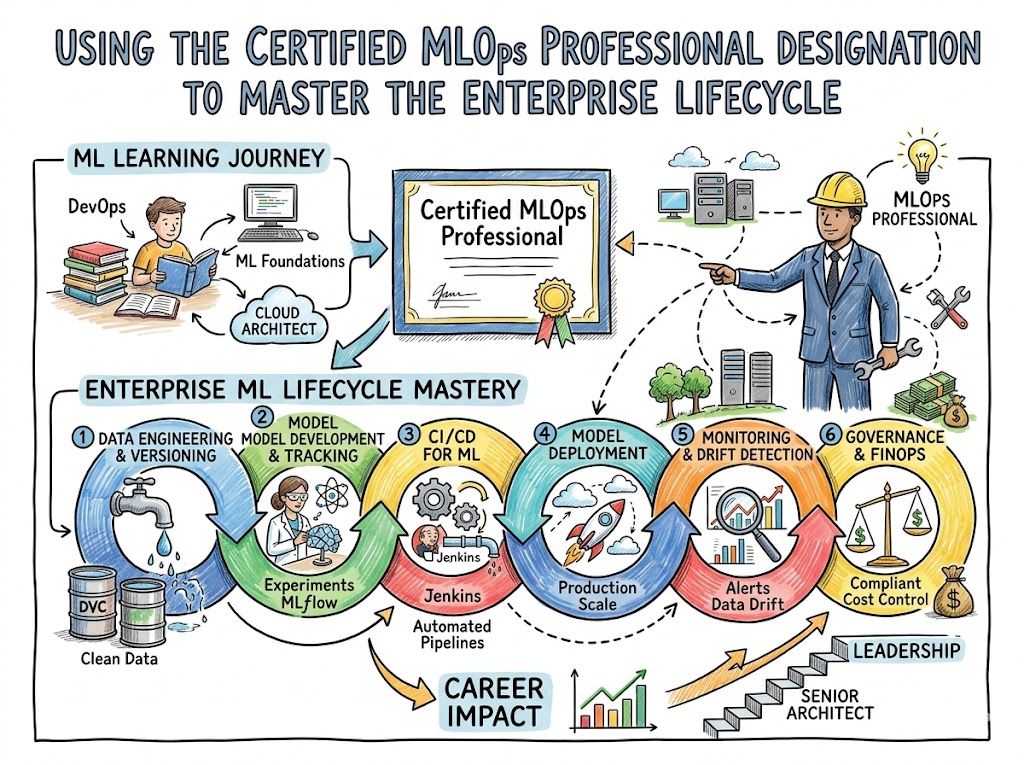
Modern engineering departments often struggle to move machine learning models from experimental notebooks into stable production environments. The Certified MLOps Professional designation establishes a rigorous technical standard for those who must automate and govern these complex AI lifecycles. This guide provides a clear path for DevOps, SRE, and platform engineers to master the intersection of data science and infrastructure. By leveraging the training expertise at AIOpsSchool, professionals can build the reliable delivery pipelines that modern enterprises demand. Navigating this career shift requires a dedicated focus on operational stability and automated retraining.
What is the Certified MLOps Professional?
The Certified MLOps Professional serves as a specialized framework designed to bridge the gap between model development and reliable IT operations. This program exists because standard software delivery methods often break down when they encounter the unique versioning and hardware requirements of machine learning. It prioritizes production-ready expertise over theoretical academic knowledge, ensuring that engineers can handle live traffic.
This certification aligns with modern engineering workflows by treating model artifacts as integral components of the cloud-native stack. Companies today require experts who can manage data ingestion, model registries, and automated deployment with high precision. This credential proves that an individual understands the governance and infrastructure needed to sustain AI performance in commercial settings.
Who Should Pursue Certified MLOps Professional?
Software developers, SREs, and cloud architects who manage AI-heavy workloads gain the most from this certification. It also provides essential context for security and data specialists who must protect the integrity of live model inference. Both early-career engineers and seasoned technical leads find that this roadmap clarifies the complexities of modern ML infrastructure.
The demand for MLOps talent continues to climb as organizations globally move past the initial prototyping phase of AI projects. In India’s competitive technology sector, this certification distinguishes professionals who work in large-scale enterprise environments or high-growth startups. Engineering managers should also follow this path to improve their strategic oversight of technical teams and infrastructure budgets.
Why Certified MLOps Professional is Valuable Beyond the Present
The enduring value of this credential lies in its emphasis on foundational principles rather than specific, fleeting tools. As companies mature their AI strategies, the requirement for stable and reproducible ML systems will only intensify. It helps engineers stay relevant by teaching the architectural patterns that remain consistent across various cloud providers.
Committing time to this certification offers a significant return by placing the individual at the center of a high-growth technical domain. Standard DevOps skills are now baseline requirements, but MLOps expertise remains a high-demand specialty. This program protects your career trajectory against the automation of more basic cloud engineering tasks.
Certified MLOps Professional Certification Overview
The primary portal delivers this program, which the official Website hosts for global candidates. The assessment methodology focuses on the practical application of skills, requiring students to demonstrate how they manage production-grade pipelines. It mirrors the actual daily responsibilities found within a top-tier platform engineering team.
The program structure follows the logical stages of the development lifecycle, from initial data tracking to infrastructure management. It covers critical topics such as GPU resource optimization and infrastructure as code tailored for heavy compute workloads. This practical focus ensures that graduates can immediately contribute to complex enterprise projects.
Certified MLOps Professional Certification Tracks & Levels
The curriculum offers foundation, professional, and advanced tiers to support professionals at every stage of their career. Foundation levels introduce core terminology and basic pipeline automation, while professional tracks emphasize orchestration and drift detection. Advanced levels explore specialized topics like federated learning and high-scale inference.
Individuals from DevOps, SRE, or FinOps backgrounds can use these specialization tracks to pivot their careers toward machine learning. This alignment ensures that your certifications evolve alongside your increasing professional responsibilities. Each tier provides a clear stepping stone toward mastering the complete AI operations lifecycle.
Complete Certified MLOps Professional Certification Table
| Track | Level | Who it’s for | Prerequisites | Skills Covered | Recommended Order |
| Core MLOps | Foundation | Junior Engineers | General DevOps | CI/CD, ML Basics | 1 |
| Core MLOps | Professional | Senior SREs | Foundation Tier | Orchestration, Drift | 2 |
| Data Systems | Specialist | Data Engineers | SQL & Python | Versioning, ETL | 1 |
| Architecture | Advanced | Principal Architects | Professional Tier | Multi-cloud, Governance | 3 |
| Security | Specialist | DevSecOps | Security Fundamentals | Model Safety, Privacy | 2 |
Detailed Guide for Each Certified MLOps Professional Certification
Certified MLOps Professional – Foundation Level
What it is
This level confirms that a candidate understands the basic machine learning lifecycle and its integration with standard automation practices. It provides the necessary vocabulary to communicate effectively with data science teams.
Who should take it
System administrators, junior developers, and aspiring DevOps engineers find this level helpful for entering the AI space. It establishes a strong baseline for those transitioning from traditional software roles.
Skills you’ll gain
- Identification of ML lifecycle stages.
- Basic versioning for datasets and models.
- Creation of automated tests for ML scripts.
- Understanding of basic model registry functions.
Real-world projects you should be able to do
- Setup a basic Git-based training pipeline.
- Deploy a single model as a REST API endpoint.
- Log prediction results for basic performance analysis.
Preparation plan
- 7-14 days: Focus on core ML terminology and basic pipeline concepts.
- 30 days: Practice setting up CI/CD for a simple Python model.
- 60 days: Not necessary if the candidate has prior DevOps experience.
Common mistakes
Many candidates focus exclusively on the code while ignoring the vital role that data quality plays in the model’s success.
Best next certification after this
- Same-track option: Certified MLOps Professional – Associate.
- Cross-track option: DataOps Specialist.
- Leadership option: Technical Lead (ML Infrastructure).
Certified MLOps Professional – Professional Level
What it is
This certification validates the expertise required to design and maintain complex ML platforms in a live environment. It focuses heavily on reliability, scalability, and operational efficiency.
Who should take it
Senior platform engineers, SREs, and DevOps leads with two years of experience should pursue this level. It targets those who own the performance of production models.
Skills you’ll gain
- Deployment of orchestration tools like Kubeflow.
- Management of feature stores for consistent data.
- Implementation of drift monitoring for data and models.
- Allocation of GPU resources for training and inference.
Real-world projects you should be able to do
- Create an automated retraining loop triggered by model drift.
- Reduce inference latency for a global-scale application.
- Perform Canary deployments for machine learning models.
Preparation plan
- 7-14 days: Study containerization and orchestration specifically for AI.
- 30 days: Execute hands-on labs using observability and monitoring tools.
- 60 days: Build a complete MLOps environment using infrastructure as code.
Common mistakes
Candidates often fail to monitor the financial costs of cloud resources or overlook strict data privacy regulations.
Best next certification after this
- Same-track option: Certified MLOps Professional – Expert.
- Cross-track option: DevSecOps Professional.
- Leadership option: Principal MLOps Architect.
Choose Your Learning Path
DevOps Path
Professionals on this path integrate model artifacts into existing CI/CD frameworks. They manage the specific dependencies required by heavy Python libraries and ensure seamless delivery. This path treats models with the same discipline as traditional microservices.
DevSecOps Path
The security track focuses on protecting training data and defending against model-based attacks. Engineers implement strict access controls and scan model files for potential vulnerabilities. This is vital for organizations handling sensitive financial or personal information.
SRE Path
SREs focus on the uptime and observability of the underlying ML infrastructure. They define specific SLIs and SLOs for model latency and prediction accuracy. This path ensures that the hardware can meet the massive compute demands of AI.
AIOps Path
AIOps specialists apply machine learning to improve the performance of IT operations. They use predictive analytics on system logs to catch outages before they occur. This represents a powerful way to use AI to manage infrastructure.
MLOps Path
This core track covers the entire spectrum from data engineering to model monitoring. It offers the most direct route for those wanting to lead comprehensive ML engineering projects. It combines all the necessary skills for operationalizing AI.
DataOps Path
DataOps focuses on the speed and quality of the data pipeline. Without clean data, MLOps cannot produce accurate results. Engineers here apply DevOps principles to data management and cleaning.
FinOps Path
This path manages the significant costs associated with GPU usage and cloud scaling. Professionals learn to optimize cloud spend by choosing the right instances for training and inference. It ensures that AI projects remain financially sustainable.
Role → Recommended Certified MLOps Professional Certifications
| Role | Recommended Certifications |
| DevOps Engineer | Certified MLOps Professional – Foundation |
| SRE | Certified MLOps Professional – Professional |
| Platform Engineer | Certified MLOps Professional – Advanced |
| Cloud Engineer | Certified MLOps Professional – Professional |
| Security Engineer | Certified MLOps Professional – Security Specialist |
| Data Engineer | Certified MLOps Professional – DataOps Track |
| FinOps Practitioner | Certified MLOps Professional – FinOps Track |
| Engineering Manager | Certified MLOps Professional – Foundation |
Next Certifications to Take After Certified MLOps Professional
Same Track Progression
Mastering the professional level allows you to advance into architectural roles. These positions involve designing multi-cloud systems and building custom platforms for internal data science teams. Deep specialization makes you an invaluable asset for complex infrastructure tasks.
Cross-Track Expansion
Adding skills in DevSecOps or FinOps creates a more versatile professional profile. Knowing how to secure a model or lower its operational cost increases your market value significantly. This expansion enables you to lead cross-functional teams effectively.
Leadership & Management Track
Engineers looking to move beyond code can transition into technical leadership. This path focuses on strategy, budget management, and team dynamics within an ML department. It shifts your focus from technical implementation to high-level business goals.
Training & Certification Support Providers for Certified MLOps Professional
DevOpsSchool offers extensive training programs that connect traditional IT practices with modern cloud automation. Their instructors bring years of industry experience to help students solve real-world problems. They provide a balanced mix of theory and practical lab work.
Cotocus provides high-level consulting and training for engineering teams at major enterprises. They target the specific technical hurdles found in high-scale production environments. Their curriculum emphasizes deep technical mastery and automated best practices.
Scmgalaxy maintains a large community and training center dedicated to configuration management and automation. They offer a variety of free guides and structured certification paths for engineers. Their community-focused approach helps students learn from their peers.
BestDevOps focuses on delivering high-impact training for the most popular cloud and automation technologies. Their streamlined courses help busy professionals acquire new skills quickly and efficiently. They prioritize the tools that provide the most immediate value.
devsecopsschool.com helps engineers integrate security into every stage of their automated pipelines. Their training covers everything from static code analysis to runtime protection for containers. They promote a culture where security is a shared responsibility.
sreschool.com teaches the fundamental principles of site reliability engineering in great detail. Students learn to manage error budgets, observability, and incident response for global systems. They provide the framework needed for high availability.
aiopsschool.com leads the industry in teaching how to use artificial intelligence to improve IT management. Their courses focus on predictive analytics and automated root cause analysis. They prepare engineers for the future of autonomous systems.
dataopsschool.com addresses the growing need for disciplined data management in the age of AI. Their training emphasizes the automation of data pipelines to ensure high quality. They help data engineers apply DevOps rigor to their work.
finopsschool.com provides the knowledge required to manage and optimize complex cloud budgets. Their courses teach engineers how to collaborate with finance teams on cloud spending. they focus on maximizing the business value of every dollar spent.
Frequently Asked Questions
- How hard is the Certified MLOps Professional test?
The exam requires a firm grasp of both infrastructure automation and machine learning fundamentals. - What skills do I need before starting?
A basic understanding of Python programming and cloud computing concepts will help you succeed. - How much time does preparation take?
Most working professionals spend about 30 to 60 days studying for the professional level exam. - Do employers worldwide recognize this credential?
Yes, the certification follows industry-standard practices used by leading technology companies around the globe. - Will this help me earn a higher salary?
MLOps experts currently command some of the highest salaries in the technology and engineering sectors. - Can data scientists benefit from this course?
Data scientists gain a better understanding of how to build models that are easy to deploy. - How long does the certification stay valid?
The certification usually remains valid for two to three years before requiring a renewal or update. - Are there practical labs in the training?
Yes, most training providers include hands-on labs to simulate real-world deployment and monitoring scenarios. - Do I need advanced math for this path?
No, the curriculum focuses on the operational side of ML rather than complex mathematical theories. - How is this different from standard DevOps?
It adds specialized training for data versioning, model monitoring, and managing expensive GPU hardware. - What specific tools will I learn?
The program covers popular tools like Kubernetes and Kubeflow along with native cloud AI services. - Can I join a network of other certified pros?
Yes, graduates gain access to alumni groups and forums for networking and career advice.
FAQs on Certified MLOps Professional
- Which sectors show the highest demand for MLOps?
Finance, healthcare, and retail sectors urgently need MLOps to manage their real-time predictive models. - How does MLOps change the development cycle?
It creates a continuous loop where models undergo constant retraining based on incoming live data. - Does the exam require coding?
Yes, candidates must demonstrate proficiency in Python and automation scripting to pass the practical sections. - Is the certification cloud-neutral?
It teaches general principles that apply to all major providers, including AWS, Azure, and GCP. - Why is Kubernetes important for MLOps?
Kubernetes provides the scalable infrastructure necessary to host and manage containerized machine learning models. - How does the course handle model ethics?
It provides technical methods to ensure models remain auditable and comply with international privacy laws. - Can I complete the exam from home?
Yes, the certification offers online proctoring so you can take the exam from any location. - What is the primary benefit of this credential?
It validates your ability to lead complex AI projects that directly impact a company’s bottom line.
Final Thoughts: Is Certified MLOps Professional Worth It?
Bridging the gap between experimental AI and production reality remains the biggest challenge for modern enterprises. Engineers who master this intersection find themselves in high demand with significant career leverage. This certification provides the structured roadmap you need to move beyond generic roles and into a high-value specialty.
Achieving success in this field requires both technical discipline and a willingness to adapt to new patterns. This credential offers a solid foundation for that long-term journey. Ultimately, investing in these skills ensures that you remain at the forefront of the technological landscape for years to come. Focus on building real projects, and the career rewards will follow.
