Introduction
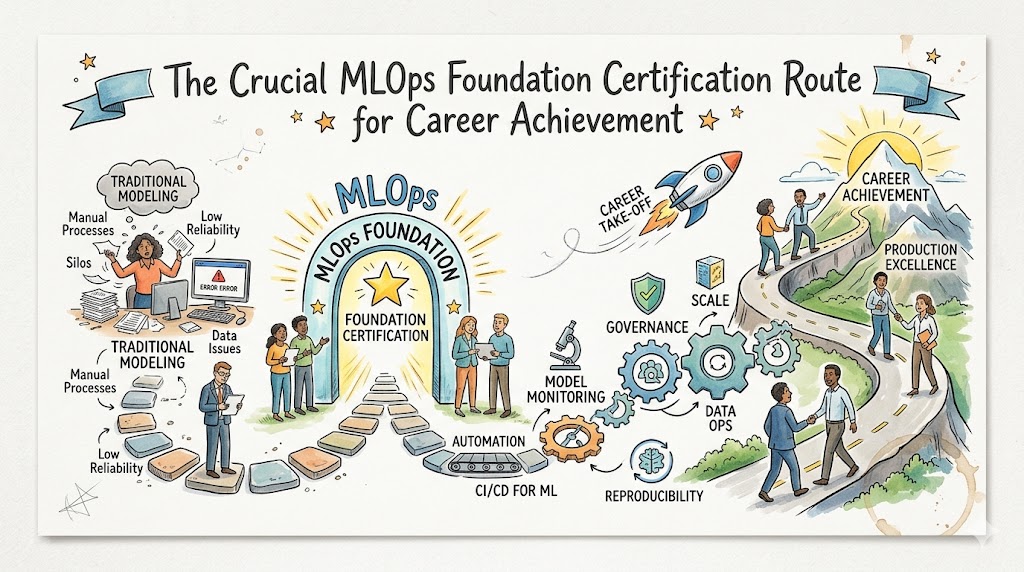
The MLOps Foundation Certification represents a critical bridge between data science and production engineering. This guide serves software engineers and platform specialists looking to master the lifecycle of machine learning models. As organizations scale their artificial intelligence efforts, the AIOpsSchool curriculum provides a structured roadmap for reliability and automation. Navigating this domain requires a shift from static code to dynamic data-driven systems. Our analysis helps professionals evaluate this path within the broader context of DevOps and cloud-native engineering to make informed career investments.
What is the MLOps Foundation Certification?
This certification represents the gold standard for validating knowledge in the convergence of machine learning and operations. It exists to solve the “black box” problem where models fail to move from a notebook to a live environment. The program emphasizes real-world, production-focused learning, moving beyond academic theory into the mechanics of automated retraining and monitoring. It aligns perfectly with modern enterprise practices where model reproducibility and CI/CD for machine learning are mandatory requirements.
Who Should Pursue MLOps Foundation Certification?
Systems engineers, SREs, and cloud architects will find immense value in this certification as they take on more data-centric infrastructure tasks. It is equally vital for data professionals who need to understand how their models interact with Kubernetes, APIs, and cloud resources. Beginners gain a clear entry point into a complex field, while managers learn the vocabulary and metrics needed to lead technical teams. The curriculum carries significant weight for global enterprises and the rapidly growing tech hubs across India.
Why MLOps Foundation Certification is Valuable and Beyond
The demand for professionals who can operationalize machine learning is currently outstripping supply, ensuring long-term career longevity. This certification helps engineers remain relevant even as specific tools change by focusing on core principles like versioning, testing, and scaling. Enterprises are moving away from manual model deployments toward fully automated pipelines, making this skill set a high-return investment. By mastering these workflows, you secure a position at the forefront of the next wave of digital transformation.
MLOps Foundation Certification Overview
The program is delivered via the official course portal and hosted on the primary website. It utilizes a multi-layered assessment approach that combines theoretical understanding with practical application scenarios. The structure is designed to reflect the daily responsibilities of an engineer working on large-scale model deployments. Ownership of these processes is a key theme, ensuring that certified individuals can lead the implementation of governance and compliance standards within their respective organizations.
MLOps Foundation Certification Tracks & Levels
The certification hierarchy begins with the foundation level to establish a common language and set of standards across teams. Professional levels follow, focusing on the deep integration of specific cloud providers and advanced automation frameworks. Finally, advanced levels and specialization tracks allow engineers to pivot into niche areas like FinOps for AI or specialized security for data pipelines. This progression ensures that your educational journey scales directly with your seniority and job responsibilities.
Complete MLOps Foundation Certification Table
| Track | Level | Who it’s for | Prerequisites | Skills Covered | Recommended Order |
| Core Ops | Foundation | Junior Engineers | Basic Linux/Git | ML Lifecycles, CI/CD | 1st |
| Engineering | Professional | SREs / DevOps | Foundation Cert | Model Monitoring, K8s | 2nd |
| Strategy | Advanced | Tech Leads | Professional Cert | Governance, Scaling | 3rd |
| Security | Specialist | Security Ops | Foundation Cert | Adversarial AI, Privacy | 2nd |
| Financial | Specialist | FinOps Leads | Foundation Cert | Cloud Cost Optimization | 2nd |
Detailed Guide for Each MLOps Foundation Certification
MLOps Foundation Certification – Foundation Level
What it is
This certification validates a professional’s understanding of the fundamental principles of machine learning operations. It confirms that the candidate can navigate the transition from model development to deployment using standard industry frameworks.
Who should take it
Entry-level DevOps engineers, data scientists wanting to understand production, and project managers overseeing technical teams should prioritize this level. It requires minimal prior experience but a strong desire to learn automation.
Skills you’ll gain
- Understanding the ML development lifecycle.
- Implementing basic CI/CD pipelines for models.
- Version control for data and experiments.
- Basic infrastructure provisioning for AI workloads.
Real-world projects you should be able to do
- Automate a basic model training pipeline using Git triggers.
- Set up a centralized registry for model versioning.
- Deploy a pre-trained model as a scalable REST API.
Preparation plan
- 7–14 Days: Focus on core vocabulary and the differences between traditional DevOps and MLOps.
- 30 Days: Complete hands-on labs involving Docker and basic Python scripting for automation.
- 60 Days: Deep dive into cloud-specific ML tools and practice full-cycle pipeline builds.
Common mistakes
Candidates often focus too much on the math of machine learning rather than the operational aspects of the infrastructure. Another common error is neglecting the importance of data versioning compared to code versioning.
Best next certification after this
- Same-track option: MLOps Professional Certification.
- Cross-track option: SRE Certification for Platform Stability.
- Leadership option: Engineering Management for Data Teams.
Choose Your Learning Path
DevOps Path
The DevOps path focuses on extending existing continuous integration and delivery practices to include machine learning assets. Engineers learn how to treat models as software artifacts that require testing, linting, and staging environments. This path bridges the gap between traditional software delivery and the unique requirements of non-deterministic ML code. It is ideal for those who want to remain in the heart of the delivery pipeline.
DevSecOps Path
Security is paramount in AI, and this path focuses on securing the supply chain of data and models. You will learn to scan for vulnerabilities in base images and protect against adversarial attacks that could compromise model integrity. This track ensures that compliance and privacy are baked into the automated delivery process. It is the best choice for professionals working in regulated industries like finance or healthcare.
SRE Path
Site Reliability Engineering for machine learning focuses on the “Day 2” operations of models in production. This includes setting up complex monitoring for model drift, ensuring low-latency inference, and managing the high compute costs of GPU clusters. Professionals on this path work to ensure that AI services meet strict service level objectives. It is a highly technical track suited for those who enjoy performance tuning and system stability.
AIOps Path
The AIOps path teaches you how to use artificial intelligence to improve traditional IT operations. You will learn to implement anomaly detection, automated root cause analysis, and predictive scaling for enterprise infrastructure. This is a meta-approach where you use the tools of the trade to optimize the trade itself. It is perfect for platform engineers looking to automate large-scale, complex cloud environments.
MLOps Path
This is the primary specialization focused on the end-to-end lifecycle of machine learning models. It covers everything from data ingestion and feature stores to model deployment and automated retraining loops. You will master the coordination between data scientists and operations teams to reduce the time-to-market for AI products. This path is the most direct application of the foundation certification principles.
DataOps Path
DataOps focuses on the reliability and quality of the data flowing into machine learning models. You will learn to build resilient data pipelines that ensure high-quality inputs, which is a prerequisite for any successful MLOps implementation. This track emphasizes data observability, orchestration, and automated testing of data sets. It is a critical path for those who want to specialize in the “Data” part of Data Science.
FinOps Path
The FinOps path addresses the massive costs associated with running machine learning at scale. You will learn to track, analyze, and optimize the spend on cloud-based training and inference workloads. This involves understanding spot instances, reserved capacity, and right-sizing GPU resources. This track is essential for senior engineers and managers responsible for the bottom-line efficiency of AI projects.
Role → Recommended MLOps Foundation Certification
| Role | Recommended Certifications |
| DevOps Engineer | MLOps Foundation, Professional DevOps |
| SRE | MLOps Foundation, SRE Advanced |
| Platform Engineer | MLOps Foundation, Cloud Architect |
| Cloud Engineer | MLOps Foundation, FinOps Specialist |
| Security Engineer | MLOps Foundation, DevSecOps Specialist |
| Data Engineer | MLOps Foundation, DataOps Specialist |
| FinOps Practitioner | MLOps Foundation, FinOps Advanced |
| Engineering Manager | MLOps Foundation, Leadership Track |
Next Certifications to Take After MLOps Foundation Certification
Same Track Progression
After the foundation, the logical step is to pursue professional-level certifications that focus on specific toolchains like Kubeflow or MLflow. This deep specialization allows you to become the primary architect for AI infrastructure within your company. You will move from understanding concepts to implementing complex, multi-cloud architectures.
Cross-Track Expansion
Broadening your skills by moving into SRE or DevSecOps provides a more holistic view of the production environment. A professional with both MLOps and SRE certifications is incredibly valuable because they can manage both the logic and the stability of AI systems. This prevents siloed thinking and opens up a wider range of high-level job opportunities.
Leadership & Management Track
For those looking to move away from individual contribution, the leadership track focuses on team building and strategic planning. You will learn how to justify AI infrastructure investments to stakeholders and how to structure teams for maximum velocity. This transition is perfect for experienced engineers who want to influence the technical direction of their entire organization.
Training & Certification Support Providers for MLOps Foundation Certification
DevOpsSchool
This provider offers extensive community support and a deep library of resources for engineers transitioning into modern operations. They focus on practical, lab-based learning that mirrors real-world production environments.
Cotocus
They specialize in high-end consulting and training, helping teams adopt complex automation frameworks. Their approach is highly tailored to enterprise needs and the latest industry standards.
Scmgalaxy
A long-standing resource for configuration management and software supply chain professionals. They provide detailed tutorials and community forums that help bridge the gap between legacy systems and modern MLOps.
BestDevOps
This platform focuses on curated learning paths for top-tier engineering roles. They prioritize the most relevant tools and techniques used by industry leaders in the current tech landscape.
devsecopsschool.com
The go-to destination for security-focused automation training. They provide the necessary frameworks to ensure that AI and ML deployments remain compliant and secure against modern threats.
sreschool.com
Dedicated to the principles of site reliability, this site offers deep dives into monitoring, alerting, and system resilience. It is an essential stop for anyone moving into the SRE path of machine learning.
aiopsschool.com
The primary host for the MLOps Foundation Certification, offering a comprehensive curriculum designed by industry experts. They focus specifically on the intersection of AI and operations.
dataopsschool.com
This provider focuses on the data engineering side of the house. They offer specialized tracks that ensure the data underlying your machine learning models is accurate and reliable.
finopsschool.com
As cloud costs spiral, this school provides the necessary training to manage and optimize financial resources. Their courses are vital for anyone responsible for the economic health of technical projects.
Frequently Asked Questions
- How difficult is the MLOps Foundation Certification for a beginner?
The foundation level is designed to be accessible for those with a basic understanding of IT, though some Linux and Git knowledge is recommended to succeed.
- How long does it typically take to complete the training?
Most professionals can complete the core curriculum and pass the exam within 30 to 60 days of consistent study and practice.
- Are there any specific technical prerequisites for this program?
A basic understanding of command-line interfaces, version control, and general software development lifecycles will provide a significant advantage during the course.
- What is the return on investment for this certification?
Certified individuals often see significant salary increases and access to higher-level roles as companies struggle to find qualified MLOps talent.
- Should I learn Data Science or MLOps first?
If your goal is infrastructure and delivery, starting with MLOps is better as it provides the framework for how any model will eventually run.
- Is this certification recognized by global technology companies?
Yes, the curriculum is built on industry-standard practices that are used by major cloud providers and enterprise tech firms worldwide.
- Does the program include hands-on lab work?
The certification emphasizes practical application, requiring candidates to complete various labs that simulate real production scenarios and deployment challenges.
- How does this differ from a standard DevOps certification?
Standard DevOps focuses on code, while MLOps adds the complexities of data versioning, model drift, and non-deterministic outputs into the pipeline.
- What tools will I learn during the certification process?
You will gain exposure to industry leaders such as Docker, Kubernetes, and various model tracking and orchestration frameworks.
- Is there a renewal requirement for the certification?
Most professional certifications in this space require periodic updates or continuing education to ensure skills remain current with rapidly evolving technology.
- Can this certification help me move into a management role?
Absolutely, as it provides the technical vocabulary and strategic understanding needed to lead complex data and engineering teams effectively.
- Is the exam conducted online or at a testing center?
The assessment is typically offered through a secure online platform, allowing professionals to balance the certification with their existing work schedules.
FAQs on MLOps Foundation Certification
- What specific machine learning frameworks are covered in the foundation level?
The program focuses on being framework-agnostic, teaching you the operational principles that apply to TensorFlow, PyTorch, and Scikit-learn equally.
- How does the course address the issue of model monitoring and drift?
It provides practical strategies for setting up automated alerts when a model’s performance begins to deviate from its expected baseline in production.
- Is cloud-specific knowledge required for the foundation exam?
While the principles are universal, the course often uses major cloud providers for labs to demonstrate how these concepts are applied in industry.
- Does the certification cover the ethical and bias aspects of ML?
Yes, the foundation level introduces the importance of governance and ensuring that automated pipelines include checks for fairness and model transparency.
- How much coding is actually involved in the certification labs?
You will need to write basic Python and YAML configurations, but the focus is on the automation scripts rather than deep algorithmic coding.
- Can I skip the foundation level if I have years of DevOps experience?
While possible, it is recommended to start with the foundation to ensure you have a firm grasp of the unique data-centric challenges of ML.
- What is the passing score for the final assessment?
The passing criteria are designed to ensure a high level of competency, typically requiring a score of 70% or higher to demonstrate mastery.
- Are the study materials provided by the certification body sufficient?
The official materials are comprehensive, but engaging with the community and additional lab practice is always encouraged for the best results.
Final Thoughts: Is MLOps Foundation Certification Worth It?
Investing in this certification is a strategic move for any engineer looking to stay relevant in an increasingly automated world. It provides a structured way to gain skills that are currently in high demand across almost every sector. Rather than chasing every new tool that appears on the market, this program anchors you in the fundamental principles of reliability and scale. If you are looking to bridge the gap between engineering and data science, this is the most direct path to achieving that goal. Success in modern technology belongs to those who can manage the full lifecycle of their applications, and machine learning is no exception.
The growth in AI adoption shows no signs of slowing down, making these operational skills a permanent fixture of the technical landscape. By earning this certification, you demonstrate a commitment to professional excellence and a readiness to tackle the most complex challenges in modern software delivery. It is a practical, rigorous, and highly rewarding journey for any dedicated technologist.
