A single minor misconfiguration in a core database cluster can instantly trigger a massive cascading failure, completely taking down global digital services for millions of users. Traditional infrastructure maintenance models consistently break down under the intense, fast-moving pressure of today’s modern application demands. Because services require continuous availability, engineering teams must shift away from outdated, reactive firefighting methodologies.
Therefore, modern companies utilize cloud operations to establish a highly automated, deeply observable, and remarkably resilient environment. This framework translates abstract software engineering principles directly into practical, real-world systems administration practices to guarantee continuous business delivery.
This ultimate deep-dive guide explores the core methodologies, operational principles, and tactical implementations required to master distributed systems management. We will explore how organizations systematically eliminate manual workflows, define strategic performance metrics, and build fault-tolerant networks.
You can rapidly accelerate your organization’s digital transformation journey by leveraging the production-grade expertise and advanced architecture solutions provided by Cloudopsnow.
The Origin of Systems Infrastructure
The Early Industrial Bottlenecks
Historically, classic enterprise IT infrastructure operated within strictly isolated, rigid functional silos that crippled business agility. System administrators managed physical hardware servers manually inside on-premises data centers, completely segregated from the application developers.
Consequently, this sharp division created massive operational bottlenecks, extended deployment cycles, and fostered a culture of mutual blame. When application updates failed in production environments, teams wasted critical hours arguing over whether the code or the underlying operating system configuration caused the error.
Moving Toward Unified Workflow Automation
As virtual machine technology emerged, organizations realized they needed a far more unified approach to managing infrastructure. Software engineers began developing automated scripts to provision compute resources, breaking down traditional organizational walls.
This cultural and technical pivot allowed teams to treat infrastructure identically to application source code. As a result, companies achieved faster iteration cycles, automated testing pipelines, and significantly reduced human configuration errors across environments.
Global Expansion Across Commercial Ecosystems
The explosive growth of hyperscale public cloud providers completely revolutionized the global commercial ecosystem. Modern enterprises quickly transitioned away from static capital expenditures toward highly dynamic, variable operational expenditure models.
Consequently, this massive expansion necessitated a standardized, highly scalable operational framework capable of managing millions of concurrent microservices. Today, these advanced architectural strategies form the backbone of every major global technology corporation.
Defining Strategic Operations Management
The Core Operational Structure
The underlying structural framework of modern cloud infrastructure relies on continuous feedback loops between system telemetry and automated control loops. Telemetry agents continuously collect granular metrics, logs, and distributed traces from every active container and network interface.
Then, this massive data stream feeds directly into central orchestration engines that automatically adjust computing resources based on real-world demand. This proactive structural pattern ensures that the entire platform continuously self-heals before performance degradation impacts end users.
Daily Tasks of Systems Coordinators
On any given day, a dedicated systems coordinator executes a wide variety of highly engineering-focused tasks. They write declarative infrastructure-as-code templates, configure automated deployment pipelines, and design advanced monitoring dashboards.
Additionally, these specialists actively participate in architectural design reviews to ensure new features meet strict scalability requirements. They also systematically investigate minor system anomalies to prevent them from mutating into major production outages.
Localized Control vs. Broad System Architecture
Managing a modern enterprise platform requires a careful, deliberate balance between localized component control and overarching system architecture. Localized control focuses intently on the health of individual microservices, isolated database instances, or specific network gateways.
Conversely, broad system architecture addresses the complex end-to-end interactions, data pathways, and global dependencies across multiple cloud regions. Excellent engineering teams master both perspectives to maintain total operational visibility.
The Efficiency Mindset
Transitioning to a modern operational model requires a deep cultural shift toward an efficiency-first mindset. Engineers must passionately resist the temptation to solve recurring infrastructure problems through manual interventions.
Instead, they view every single system failure as a valuable opportunity to build robust, automated self-healing software mechanisms. This long-term mindset directly prioritizes sustainable systemic reliability over temporary, short-sighted quick fixes.
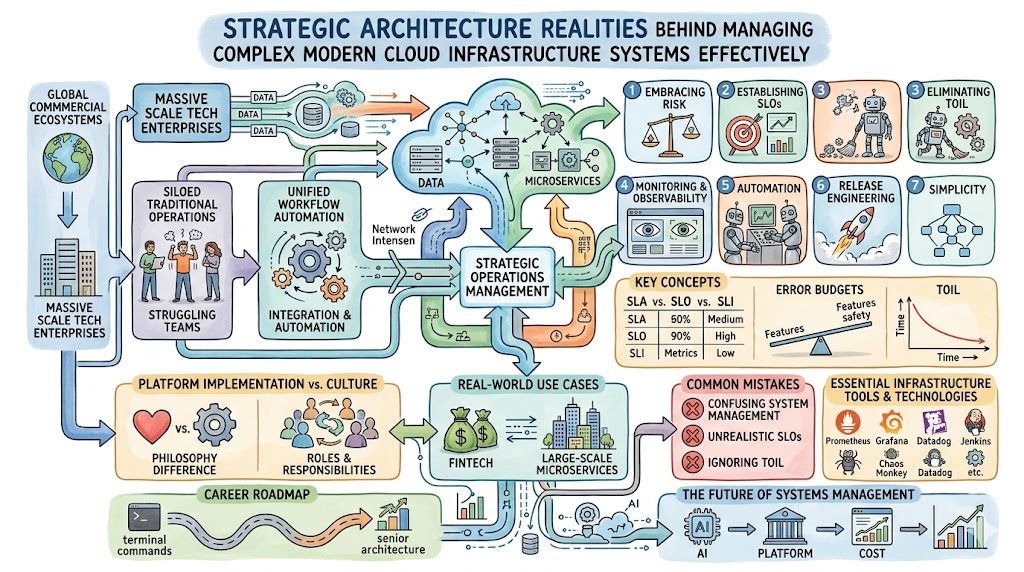
The 7 Core Principles of The Importance of CloudOps in Managing Cloud Infrastructure
1. Embracing Risk and Managing Variability
Modern distributed systems are inherently complex, making the absolute elimination of all infrastructure failures a complete impossibility. Therefore, engineering teams must purposefully embrace risk by defining acceptable levels of service degradation.
By acknowledging that components will occasionally fail, organizations can construct highly resilient software systems that degrade gracefully. This realistic approach allows product teams to maintain a rapid pace of innovation without sacrificing baseline stability.
2. Establishing Service Level Objectives (SLOs)
Organizations must establish precise, data-driven targets that accurately define what constitutes acceptable system performance from the user perspective. These metrics prevent internal teams from chasing unnecessary goals like perfect one hundred percent uptime.
By framing operational success around clearly defined boundaries, teams align their engineering priorities perfectly with actual user satisfaction. Consequently, this strict measurement framework forms the foundation of all data-driven deployment decisions.
3. Eliminating Toil and Manual Processes
Toil represents the repetitive, predictable, and manual operational tasks that do not add any long-term strategic value to an enterprise. Examples include manually provisioning user accounts, restarting stuck services, or running basic database cleanup scripts.
Modern infrastructure management mandates that engineers actively identify this administrative burden and systematically automate it away. This clear focus ensures that valuable engineering hours remain dedicated to building scalable features.
4. Monitoring & Observability Across the Pipeline
Complete visibility across every single layer of the delivery pipeline is absolutely essential for maintaining platform health. Traditional monitoring simply alerts teams when a specific server crashes or a disk reaches full capacity.
In sharp contrast, modern observability enables engineers to ask highly complex questions about system behavior based on deep data analysis. This granular insight allows teams to rapidly pinpoint the exact root cause of intermittent performance anomalies.
5. Automation Over Manual Coordination
Relying on manual human coordination to scale up infrastructure during a traffic spike is an incredibly high-risk strategy. Instead, modern operational models leverage intelligent software algorithms to handle resource allocation completely automatically.
Automated auto-scaling groups, dynamic load balancers, and container orchestrators respond instantly to shifting traffic patterns. This programmatic approach eliminates human latency, guarantees consistent performance, and minimizes operational overhead.
6. Release Engineering and Deployment Stability
Safe, predictable, and highly repeatable application release strategies are vital for protecting the integrity of production environments. Teams utilize advanced deployment techniques like green-blue switches or progressive canary rollouts to minimize blast radiuses.
[Canary Release Pipeline]
  [Source Code] ──> [Build & Test] ──> [Deploy to Canary (5% Traffic)]
                                                │
         ┌──────────────────────────────────────┴──────────────────────────────────────┐
         ▼                                                                             ▼
[If Metrics Pass (Success)]                                                   [If Errors Spike (Failure)]
  ──> Rollout to 100% Production                                                 ──> Automated Rollback (0%)
If the automated monitoring system detects an increase in error rates during a deployment, it triggers an immediate rollback. This disciplined approach ensures that problematic software updates never disrupt the broader user base.
7. Simplicity in Network Architecture
Overly complicated, tangled network designs significantly increase the total attack surface and create hidden failure modes within cloud environments. Therefore, maintaining clean, minimal, and highly modular architectural designs is a paramount operational principle.
Engineers should intentionally design clear microsegmentation boundaries, straightforward routing tables, and explicit firewall rules. Keeping the underlying network architecture simple makes troubleshooting vastly easier during high-pressure incidents.
Key Operational Concepts You Must Know
SLA vs. SLO vs. SLI — Explained Simply
Understanding the precise relationships between these three core metrics is absolutely critical for effective infrastructure management.
- Service Level Indicator (SLI): A specific, quantifiable metric that measures the real-time performance of a service, such as request latency measured in milliseconds.
- Service Level Objective (SLO): A target percentage value defined for an SLI over a specific window of time, such as maintaining latency below two hundred milliseconds for ninety-nine percent of requests.
- Service Level Agreement (SLA): A binding legal contract between a service provider and an end user that defines the severe financial or material consequences if the system fails to meet the agreed SLO.
Error Budgets — The Game Changer for Operational Risk
An error budget represents the exact amount of total downtime or service degradation an application is safely allowed to experience within a given time frame. Calculated mathematically as $1 – \text{SLO}$, this metric serves as a dynamic clearinghouse for organizational decision-making.
When a product team possesses a full, intact error budget, they can confidently deploy high-risk new features rapidly. However, if the error budget burns completely down due to recent outages, all new feature releases stop immediately. The team must then redirect one hundred percent of their engineering focus toward stabilizing the core infrastructure.
Toil — The Silent Productivity Killer in Infrastructure
Toil behaves exactly like financial debt, quietly compounding over time until it completely stalls an organization’s engineering velocity. To qualify strictly as toil, a task must be manual, repetitive, automatable, tactical, and devoid of enduring value.
If your engineering team spends more than fifty percent of their time performing manual tasks, the platform will inevitably suffer. Organizations must regularly calculate toil metrics and assign dedicated sprint tasks to build automated software remedies.
Incident Management & Postmortems
When serious production outages inevitably occur, teams must execute an organized, highly structured incident response plan. Following the resolution of an incident, engineers must conduct a completely blameless postmortem meeting.
The primary objective is to uncover the underlying systemic vulnerabilities rather than pointing fingers at individual human errors. Documenting these valuable lessons learned ensures the organization builds permanent technical guardrails to prevent identical failures from ever happening again.
Capacity Planning
Predictive capacity planning allows modern enterprises to stay comfortably ahead of rapid user growth and sudden seasonal demand spikes. Engineers carefully analyze historical consumption patterns, compute resource trends, and upcoming marketing campaign schedules.
By leveraging advanced statistical models, teams can accurately forecast future infrastructure requirements well in advance. This proactive planning guarantees that the platform always possesses sufficient computing overhead without overspending on idle cloud resources.
The Four Golden Signals of Pipeline Performance
To maintain complete, uncompromised visibility into distributed architectures, engineers must obsessively monitor the four golden signals of system health.
| Golden Signal | Metric Definition | Impact of Neglect |
| Latency | The exact time it takes to successfully service a specific request. | High latency directly causes terrible user experiences and shopping cart abandonment. |
| Traffic | A precise measure of the total demand being placed on the system network. | Unmonitored traffic surges lead to sudden, unexpected backend service collapse. |
| Errors | The total rate of requests that fail completely or return incorrect responses. | High error rates indicate broken application code or severe database corruption. |
| Saturation | A measurement of how full the most restricted system resource fractions are. | Reaching full saturation causes immediate data packet drops and extreme system lag. |
Platform Implementation vs. Culture — What’s the Real Difference?
The Philosophy Difference
While many technology professionals mistakenly use operational terms interchangeably, they represent fundamentally distinct organizational dimensions. Cultural frameworks focus intensely on breaking down human silos, shared operational responsibilities, and rapid organizational feedback loops.
Conversely, technical platform implementations focus heavily on concrete software practices, engineering metrics, and advanced automation tooling. The cultural framework provides the overarching collaborative mindset, while the technical implementation delivers the precise engineering toolkit.
Roles & Responsibilities Compared
Understanding how specific duties divide across these separate engineering paradigms is essential for building a balanced organizational structure.
- Cultural Advocates: Focus heavily on cross-team collaboration, continuous delivery pipeline efficiency, and driving fast business feature iteration cycles.
- Platform Implementers: Focus intensely on system availability, deep infrastructure metrics, automated disaster recovery, and managing systemic error budgets.
- Shared Objectives: Both paradigms work closely together to eliminate manual workflows and maximize cloud delivery velocity.
Can You Have Both Disciplines?
Modern, high-performing enterprise technology organizations do not choose between culture and implementation; they actively leverage both simultaneously. The collaborative cultural principles ensure that application development teams and infrastructure engineers communicate continuously without friction.
Meanwhile, the deep technical operational practices provide the rigorous engineering discipline required to keep massive cloud platforms highly stable. Merging these two philosophies creates a powerful ecosystem where teams innovate rapidly without compromising system reliability.
Which One Should Your Team Adopt?
The specific operational path your team chooses depends heavily on your current organizational scale, technical maturity, and immediate business objectives.
| Organization Size | Recommended Focus | Primary Objectives |
| Early-stage Startups | Cultural Frameworks | Prioritize extreme business agility, fast product iteration, and highly collaborative team mindsets. |
| Mid-market Enterprises | Hybrid Approach | Standardize deployment automation while introducing formal service level objectives across services. |
| Large Scale Scale-ups | Production Implementations | Deploy dedicated reliability engineering teams to manage complex distributed multi-cloud architectures. |
Real-World Use Cases of Modern Operations
How Tech Leaders Use Operational Metrics
Global streaming platforms and massive e-commerce giants utilize sophisticated telemetry frameworks to manage billions of active data points simultaneously. These market leaders configure automated alerting systems that monitor real-time deviations in end-user request latency.
If a specific microservice experiences an anomalous five percent spike in latency, automated remediation scripts instantly spin up additional container instances. This proactive operational pattern isolates and resolves localized performance bottlenecks before a single consumer experiences a service delay.
Chaos Engineering Approaches to Resilient Systems
Prominent cloud enterprises utilize chaos engineering to proactively inject controlled failures directly into live production environments. They run specialized software agents that randomly terminate virtual machines, introduce network latency, or block access to database replicas.
By deliberately forcing systems to fail under controlled conditions, engineers can verify whether their automated self-healing mechanisms function correctly. This rigorous practice uncovers hidden software bugs and structural architectural flaws before they cause major real-world outages.
Handling Reliability at Massive Scale
Managing global distributed microservices that process hundreds of thousands of concurrent transactions requires a highly disciplined operational approach. Modern teams utilize advanced geometric cell-based architectures to completely isolate distinct user populations from one another.
If a catastrophic failure occurs within one specific infrastructure cell, the blast radius remains strictly contained inside that isolated boundary. This advanced architectural containment strategy prevents localized software exceptions from cascading into devastating global platform blackouts.
High-Availability in Fintech Operations
Financial technology and payment processing platforms operate under incredibly strict regulatory mandates that tolerate absolutely zero system downtime. These high-stakes environments utilize real-time multi-region active-active database replication models across independent geographical zones.
Operational engineers implement continuous automated health checking routines that instantly route transactional traffic away from degraded cloud data centers. This elite level of engineering design ensures seamless processing continuity even during total physical infrastructure blackouts.
Scaled-Down but Essential Systems for Startups
Early-stage startups with limited engineering resources can still successfully implement core operational principles without massive financial overhead. Small teams leverage managed cloud services, serverless computing architectures, and out-of-the-box observability platforms.
By automating their basic deployment pipelines from day one, startups completely avoid accumulating crippling technical debt. This foundational operational discipline allows lean organizations to scale up their platforms smoothly as their user base expands.
Common Mistakes in Operations Engineering
Mistake 1 — Confusing System Management with Just Being On-Call
A common, highly destructive mistake is treating your infrastructure operations team as a glorified, twenty-four-hour manual firefighting squad. If your engineers spend their entire shift manually acknowledging alerts and restarting failed servers, they are not practicing true modern operations.
This discipline demands that engineers spend a minimum of fifty percent of their time performing genuine software engineering work. Teams must write code to automate recovery processes, design self-healing frameworks, and optimize long-term infrastructure architecture.
Mistake 2 — Setting Unrealistic SLOs
Many organizations foolishly mandate an arbitrary target of one hundred percent uptime for their newly deployed software applications. This unrealistic expectation introduces massive friction, completely stalls feature release velocity, and rapidly burns out talented engineering teams.
Chasing extreme, unnecessary availability levels exponentially increases infrastructure costs while offering practically zero noticeable benefit to the actual end user. Organizations must design realistic error budgets that strike a healthy balance between product innovation and baseline stability.
Mistake 3 — Ignoring Toil Until It’s Too Late
Allowing manual, repetitive administrative tasks to quietly pile up unchecked within an engineering department completely destroys overall organizational velocity. When engineers become totally bogged down by manual database cleanups and repetitive user provisioning, innovation grinds to a halt.
This operational debt dampens team morale and leads to catastrophic human configuration errors in high-pressure scenarios. Management must aggressively track toil metrics and allocate dedicated sprint cycles to automate these tasks away completely.
Mistake 4 — Skipping Blameless Postmortems
When a major production outage occurs, toxic engineering cultures immediately look for an individual human scapegoat to blame. This defensive approach causes engineers to actively hide mistakes, cover up critical data, and resist transparently investigating system failures.
Failing to conduct a truly blameless postmortem guarantees that the underlying structural vulnerabilities will remain deeply embedded within your platform. Organizations must realize that human error is merely a symptom of flawed system design, never the root cause.
Mistake 5 — Monitoring Without Actionable Alerts
Configuring monitoring dashboards to send out notifications for every minor, non-critical CPU fluctuation creates severe alert fatigue. When engineers receive hundreds of low-priority emails or text alerts daily, they inevitably begin ignoring notifications entirely.
Consequently, this desensitization leads to a major disaster when a genuinely catastrophic system failure alert gets completely overlooked in the noise. Every single alert configured in your system must be highly actionable and require immediate human intervention.
Mistake 6 — Not Involving Operational Engineers in the Design Phase
Treating your operations team as an afterthought that merely receives completed code packages from software developers is a recipe for disaster. When infrastructure experts are excluded from the initial software design phase, applications are frequently built with severe scalability flaws.
These unoptimized systems perform terribly in real-world production environments and prove incredibly difficult to monitor effectively. Operational engineers must actively participate in architectural planning from day one to ensure systems are robust and maintainable.
Essential Infrastructure Tools & Technologies
Monitoring & Observability
To maintain a healthy, reliable cloud environment, engineering teams deploy a robust suite of modern observability tools. Prometheus serves as an industry-standard engine for collecting and processing high-dimensional time-series metric data across containerized clusters.
Meanwhile, Grafana provides powerful, highly customizable visualization dashboards that allow teams to analyze complex performance metrics at a glance. For enterprise-grade, full-stack visibility, organizations leverage comprehensive platforms like Datadog and New Relic to track distributed transactions.
Incident Management
When critical infrastructure components fail, organizations rely on specialized incident management platforms to orchestrate their technical response teams. PagerDuty acts as a centralized routing engine that ingests alerts from monitoring systems and instantly notifies the correct on-call engineer.
These modern platforms automate escalation pathways, establish secure incident communication channels, and track key operational response metrics. Utilizing these tools ensures that high-priority production incidents are systematically managed, reducing the total mean time to resolution.
CI/CD & Release Engineering
Automating the application delivery pipeline is absolutely essential for maintaining deployment stability and protecting live production environments. Jenkins continues to serve as a highly versatile, widely adopted automation server for executing continuous integration workflows.
For cloud-native Kubernetes environments, organizations widely adopt modern GitOps delivery engines like Argo CD and Spinnaker to manage deployments. These tools ensure that infrastructure configurations match the declarative state stored within version control systems, enabling safe rollouts.
Chaos Engineering
Proactively testing system resilience requires specialized chaos engineering tooling designed to inject controlled failures into production environments safely. Chaos Monkey, originally pioneered by industry leaders, automatically terminates virtual machine instances within cloud environments to verify self-healing capabilities.
Modern engineering teams use these automated disruption tools to validate that their load balancers and redundant databases respond correctly to sudden losses. Running these controlled experiments uncovers hidden architectural dependencies before they manifest as real-world customer outages.
SLO Management
As modern organizations mature, tracking compliance against explicit reliability metrics requires dedicated service level objective management platforms. Tools like Nobl9 allow engineering teams to easily integrate multiple data streams from different monitoring tools into a single dashboard.
These specialized platforms mathematically calculate real-time error budget consumption rates and send out early warnings before violations occur. Utilizing these tools helps businesses align their product development velocity perfectly with measured user satisfaction thresholds.
How to Become an Operations Expert — Career Roadmap
Skills Every Specialist Must Have
Launching a successful career in modern cloud infrastructure management requires a deep, well-rounded foundation in several core technical domains. Aspiring specialists must possess absolute mastery over the Linux operating system, including advanced terminal commands, shell scripting, and file system architecture.
Additionally, proficiency in modern programming languages like Python or Go is essential for building robust automation tooling and infrastructure scripts. Engineers must also master core networking concepts, including DNS management, TCP/IP protocols, and subnetwork configuration.
The Professional Learning Path
The educational journey toward infrastructure expertise begins with mastering the basics of local virtualization and standard containerization technologies like Docker. Once comfortable managing isolated containers, engineers should progress to learning complex container orchestration platforms like Kubernetes.
From there, focus heavily on mastering infrastructure-as-code tools like Terraform to programmatically provision cloud resources across public hyperscalers. Finally, study advanced distributed systems architecture concepts, focusing on designing highly available, fault-tolerant global platforms.
Certifications Worth Pursuing
Earning industry-recognized professional credentials provides valuable validation of your technical skills and significantly accelerates career progression. Aspiring experts should target premier cloud architecture certs, such as the AWS Certified DevOps Engineer Professional or Google Cloud Professional Cloud DevOps Engineer.
Additionally, securing Kubernetes-specific certifications like the Certified Kubernetes Administrator (CKA) is highly advantageous in the modern job market. These rigorous exams demonstrate your practical ability to design, build, and maintain production-grade cloud infrastructure.
Educational Resources with Cloudopsnow
Navigating the rapidly evolving landscape of modern cloud infrastructure can feel incredibly overwhelming without structured guidance and expert mentorship. Fortunately, Cloudopsnow provides a comprehensive suite of professional educational materials, deep-dive technical resources, and production-tested architectural guides.
Their specialized training tracks are meticulously designed by industry veterans to help engineers bridge the gap between abstract theory and real-world implementation. Exploring their advanced content empowers technical teams to confidently master the complexities of modern distributed platforms.
The Future of Systems Management
AI and Automation in System Optimization
The integration of advanced artificial intelligence models is rapidly transforming how modern enterprises manage and optimize complex cloud infrastructure. Machine learning algorithms can continuously analyze massive streams of telemetry data to detect incredibly subtle performance anomalies before they impact users.
These intelligent systems automatically forecast resource consumption trends, tune database configurations, and accelerate root cause analysis during incidents. Embracing AI-driven operations allows organizations to move away from static, rule-based alerting toward truly predictive infrastructure management.
Platform Engineering — The Evolution of Infrastructure
Platform engineering is rapidly emerging as the natural evolutionary successor to traditional infrastructure management models. Instead of forcing application developers to manually configure complex cloud resources, dedicated platform teams build centralized self-service portals.
These internal developer platforms provide pre-approved, highly secure, and automated templates for provisioning databases, compute clusters, and CI/CD pipelines. This strategic shift dramatically reduces cognitive load for developers while ensuring consistent architectural compliance across the entire enterprise.
Management in Cloud-Native & Kubernetes Environments
As modern organizations rapidly migrate toward dynamic, containerized microservices architectures, managing infrastructure complexity becomes exponentially more challenging. Orchestrating thousands of ephemeral containers across multiple cloud providers requires sophisticated service meshes, advanced ingress controllers, and dynamic networking policies.
Operational engineers must develop deep expertise in managing complex Kubernetes clusters, tracking cross-cluster communication, and securing distributed workloads. Mastering these cloud-native orchestration patterns is absolutely vital for maintaining systemic stability at massive global scales.
Operational Skills That Will Matter Most
In the coming years, the role of the infrastructure specialist will expand significantly beyond basic resource provisioning and performance monitoring. Engineers must develop deep expertise in cloud financial management, learning to mathematically optimize resource utilization to minimize operational costs.
Additionally, mastering advanced data observability techniques and distributed tracing across hybrid cloud environments will become an absolute necessity. Cultivating these forward-looking skills ensures that engineering professionals remain highly valuable strategic assets within modern digital enterprises.
FAQ Section
- What is the average salary range for an entry-level cloud operations engineer?
Entry-level specialists typically earn between eighty thousand and one hundred and ten thousand dollars annually, depending heavily on location and specific cloud certifications.
- How does this discipline differ from traditional systems administration roles?
Traditional administrators focus heavily on manual hardware maintenance and manual configuration scripts, whereas modern operational specialists treat infrastructure entirely as software code.
- Which programming language is most beneficial for automation in this field?
Python and Go are the most widely adopted languages due to their powerful libraries, excellent cloud SDK support, and efficiency in building automation tools.
- Can a software developer successfully transition into an infrastructure reliability role?
Yes, software developers frequently excel in this role because they already possess the strong programming skills required to build automated self-healing software systems.
- What is the real-world purpose of an error budget in a production environment?
An error budget mathematically balances product deployment velocity with system stability by defining an acceptable level of service degradation over time.
- How often should an engineering team conduct chaos engineering experiments?
Teams should ideally run controlled chaos experiments continuously within automated testing pipelines to proactively uncover hidden architectural flaws before production rollouts.
Final Summary
Maintaining optimal infrastructure health across modern distributed cloud systems requires a rigorous, data-driven commitment to continuous automation, deep observability, and blameless operational cultures. By systematically eliminating manual toil, establishing precise service level objectives, and treating infrastructure entirely as software code, organizations build remarkably resilient platforms capable of scaling seamlessly ahead of business demands. As technologies evolve, embedding these core architectural engineering principles into your organizational DNA remains the ultimate differentiator for driving sustained digital innovation and long-term systemic stability.
