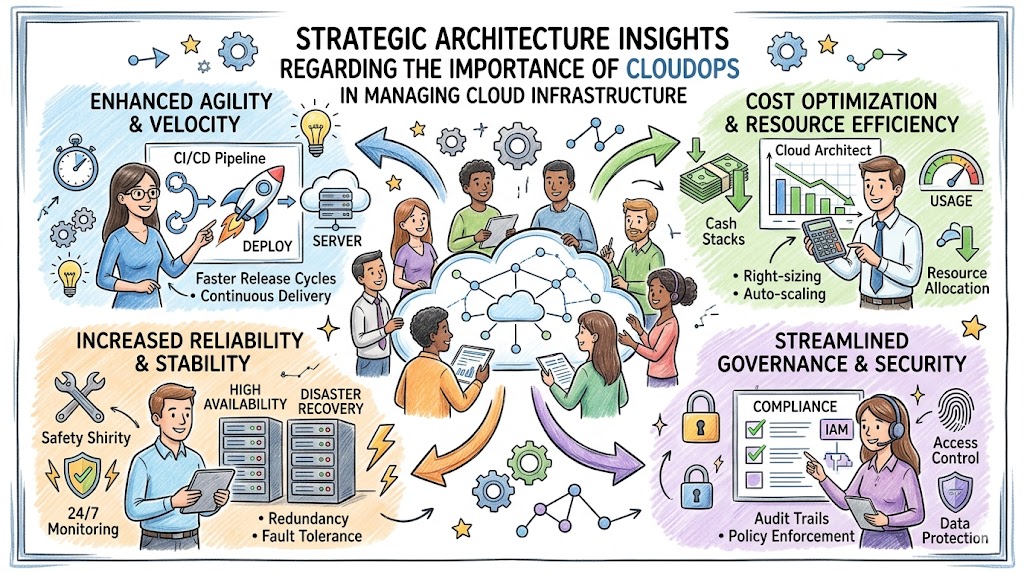
Imagine a sudden operational bottleneck crashing your primary payment gateway during a high-traffic flash sale. Consequently, customer carts stall, revenue drops instantly, and your engineering team scrambles blindly through disjointed server logs. This chaotic system disruption highlights exactly why businesses cannot afford to treat cloud environments like static on-premise hardware. Therefore, organizations require a structured strategy to maintain performance, manage costs, and enforce governance across scaling dynamic networks.
Modern engineering teams need comprehensive CloudOps frameworks to handle multi-cloud deployments without collapsing under immense architectural complexity. By treating cloud infrastructure as a fluid software-driven ecosystem, this discipline bridges the gap between fast application delivery and rock-solid system reliability. This extensive guide provides deep insights into core cloud principles, essential performance metrics, architecture strategies, and proper implementation tactics. If you want to transform your unstable environments into resilient systems, you can achieve your goals by partnering with Cloudopsnow to optimize your enterprise ecosystem.
The Origin of Systems Infrastructure
The Early Industrial Bottlenecks
Traditional operations relied heavily on physical hardware, manual configurations, and isolated data centers. Because infrastructure teams worked completely separately from software developers, massive deployment delays occurred regularly. Engineers would write code and pass it over a metaphorical wall to system administrators who had no visibility into application design.
Consequently, setting up a simple staging environment took weeks of manual provisioning, hardware procurement, and physical network cabling. If an application crashed post-deployment, locating the root cause became a prolonged blame game between isolated units. This fragmented approach severely restricted corporate agility and slowed down business innovation.
Moving Toward Unified Workflow Automation
As virtualization technology matured, businesses realized that software-defined infrastructure could resolve these painful industrial bottlenecks. Therefore, progressive enterprises began breaking down traditional internal silos and unifying their technical workflows. This movement introduced the concept of treating infrastructure exactly like application source code.
As a result, automation engines began replacing manual human intervention for server provisioning and configuration updates. By establishing automated pipelines, companies could rapidly spin up resources, validate dependencies, and deploy changes seamlessly. This cultural and technical shift allowed organizations to treat hardware as flexible, programmable software entities.
Global Expansion Across Commercial Ecosystems
Consequently, these automated operational frameworks quickly expanded across large-scale global commercial tech ecosystems. E-commerce giants, global financial organizations, and digital streaming providers discovered that standard human coordination failed at massive scale. To survive millions of simultaneous user transactions, these businesses had to decentralize their platform operations.
Thus, scalable cloud patterns moved from experimental web companies into highly regulated traditional enterprises. Modern global companies now utilize these standardized architectural strategies to manage thousands of distributed virtual servers worldwide. This widespread adoption proves that unified automated management is mandatory for any enterprise pursuing digital transformation.
Defining Strategic Operations Management
The Core Operational Structure
The foundational architecture of cloud operations relies on continuous data feedback loops running between cloud workloads and monitoring systems. Instead of checking system status manually, specialized telemetry agents constantly stream performance metrics to centralized operational dashboards. This steady flow of information allows teams to observe health indicators in real time.
[Cloud Infrastructure] ---> (Telemetry Agents) ---> [Centralized Dashboard]
         ^                                                   |
         |                                                   v
  (Auto-Remediation) <--- [Automated Alerts / Rules] <--- (Analysis Engine)
Whenever a specific threshold breaks, the analysis engine automatically triggers targeted alerts or scripted remediation routines. This automated feedback loop keeps your cloud platform stable, self-healing, and fully optimized without constant human intervention.
Daily Tasks of Systems Coordinators
Systems coordinators execute diverse technical tasks daily to preserve the integrity of complex cloud ecosystems. First, they review automated resource utilization logs to identify and terminate over-provisioned virtual assets. Next, they adjust automated scaling parameters to match expected daily traffic fluctuations across microservices.
Additionally, these specialists patch operating system vulnerabilities across dynamic container clusters without causing visible service interruptions. They also update access management policies to enforce strict security boundaries across multi-tenant spaces. Finally, they collaborate directly with application engineers to review deployment pipeline metrics and optimize system efficiency.
Localized Control vs. Broad System Architecture
Understanding the difference between granular component tracking and managing an entire multi-system infrastructure is essential for long-term scalability. Localized control focuses heavily on single components, such as debugging an isolated database query or adjusting one virtual machine’s RAM.
Conversely, broad system architecture requires analyzing how interconnected services communicate across multiple cloud zones. Managing full infrastructure means optimizing total data latency, preventing cascading failures, and maintaining network security across various cloud environments. Excellent operations engineers must balance both perspectives to prevent small localized errors from damaging the entire platform.
The Efficiency Mindset
Transitioning to modern cloud management requires a profound cultural shift that prioritizes long-term system stability over short-term feature speed. This unique mindset teaches teams to treat system failures as valuable educational tools rather than reasons to assign blame.
Therefore, engineers dedicate significant creative energy toward designing robust self-healing architectures that mitigate human mistakes. They also resist the urge to deploy unoptimized features rapidly if those components threaten baseline system availability. By embracing this proactive operational philosophy, organizations achieve steady software delivery velocity while maintaining exceptional performance.
The 7 Core Principles of CloudOps
1. Embracing Risk and Managing Variability
Perfect one hundred percent uptime is an impossible and financially impractical goal for modern distributed cloud environments. Because underlying physical components will eventually fail, software systems must expect and tolerate unexpected errors gracefully.
Therefore, cloud operations focuses on managing acceptable systemic risk through calculated error budget methodologies. Teams establish clear definitions of acceptable downtime so they can continue delivering features while maintaining reliable service. This strategic approach removes the immense pressure of chasing absolute perfection while ensuring excellent overall user experiences.
2. Establishing Service Level Objectives (SLOs)
Teams must define clear, measurable targets for systemic success to ensure objective performance evaluations. Service Level Objectives act as the primary operational compass for cloud infrastructure engineering teams.
These precise targets align engineering priorities with actual customer satisfaction metrics, preventing internal disputes over platform performance. By tracking clear metrics, teams easily understand when to pause feature deployment to focus on stabilizing infrastructure. Consequently, these metrics turn vague goals into actionable technical targets.
3. Eliminating Toil and Manual Processes
Toil represents repetitive, manual, operational work that provides no long-term strategic value and can be scaled through automation. Left unchecked, excessive manual toil quickly drains engineering energy and slows down organizational velocity.
Is the task manual and repetitive?
       |
       +---> YES ---> Can it be scripted?
       |                 |
       |                 +---> YES ---> Automate it (Eliminate Toil)
       |                 +---> NO  ---> Standardize via Documentation
       |
       +---> NO  ---> Project-based / Strategic Work (Keep Doing)
Cloud operations explicitly aims to identify, minimize, and systematically engineer away these manual tasks. By replacing manual interventions with smart code, engineers free up valuable time to build resilient, scalable architectures.
4. Monitoring & Observability Across the Pipeline
Total visibility across every layer of your operational environment prevents dangerous technical blind spots from hiding deep infrastructure errors. Teams must collect logs, metrics, and distributed traces from all active cloud services to achieve true observability.
This rich telemetry data allows engineers to pinpoint hidden bottlenecks before they impacts end users. Proactive monitoring transforms teams from reactive fire fighters into strategic operators who predict and resolve systemic anomalies early.
5. Automation Over Manual Coordination
Scaling modern enterprise cloud workflows requires automated software solutions rather than extensive human coordination meetings. Manual server provisioning, manual network configurations, and manual code deployments slow down modern business expansion.
Therefore, organizations must embrace programmatic infrastructure management, automated application testing, and self-contained deployment pipelines. Automation ensures that every single environment setup remains identical, fully compliant, and free from human configuration errors.
6. Release Engineering and Deployment Stability
Delivering application or infrastructure updates must be consistent, predictable, and completely safe to prevent production system disruptions. Release engineering focuses heavily on building automated pipelines that test, validate, and canary-deploy code changes incrementally.
[Code Commit] ---> [Automated Testing] ---> [Canary Deployment (10% Traffic)]
                                                    |
         +------------------------------------------+
         v
   (Check Metrics)
         |
         +---> Anomalies Found ---> [Automated Rollback]
         +---> System Stable   ---> [Full Production Rollout (100%)]
If an anomaly appears during a partial rollout, the system instantly executes an automated rollback to protect users. This precise methodology reduces release anxiety and allows organizations to deploy changes frequently with absolute confidence.
7. Simplicity in Network Architecture
Keeping your cloud environments clean, modular, and minimal directly reduces your overall system failure surfaces. Unnecessary architectural complexity, redundant data paths, and bloated resource configurations create difficult troubleshooting scenarios during outages.
Therefore, cloud operations advocates for elegant, straightforward network designs that engineers can easily map, monitor, and defend. Simple architectures accelerate onboarding speeds, minimize cloud expenses, and allow teams to resolve unexpected issues much faster.
Key Operational Concepts You Must Know
SLA vs. SLO vs. SLI — Explained Simply
To align business promises with real engineering metrics, teams must understand the distinct relationships between SLAs, SLOs, and SLIs.
- Service Level Agreement (SLA): The formal commitment made directly to external customers, detailing financial penalties if the service fails to meet performance expectations.
- Service Level Objective (SLO): The internal target performance metric that teams strive to achieve to keep customers happy and remain safely compliant with the official SLA.
- Service Level Indicator (SLI): The real-time, objective measurement of system performance, representing the actual percentage of successful service requests.
Error Budgets — The Game Changer for Operational Risk
An error budget represents the exact amount of acceptable systemic risk and downtime your system can endure before violating an SLO. For example, if your team establishes a 99.9% availability SLO for a service, your error budget equals 0.1% of acceptable downtime.
This simple metric acts as a balance between engineering innovation and baseline platform stability. When your error budget remains full, development teams can safely ship experimental features rapidly. However, if the error budget runs out due to outages, feature releases pause immediately so engineers can focus exclusively on stabilization.
Toil — The Silent Productivity Killer in Infrastructure
Toil consists of non-creative, repetitive, operational tasks that grow linearly alongside your infrastructure size. Examples include manually resetting user passwords, restarting stuck services weekly, or manually copying log files between servers.
To eliminate this silent productivity killer, teams must calculate time spent on manual operations during every sprint cycle. If manual tasks consume more than fifty percent of engineering capacity, automation initiatives must take immediate priority. Writing self-healing scripts and automated playbooks permanently eliminates these manual roadblocks.
Incident Management & Postmortems
When unexpected outages occur, structured incident management frameworks ensure fast resolution times while minimizing organizational panic. First, on-call responders contain the active incident using pre-established playbooks to restore baseline operations.
Following resolution, the team conducts a blameless postmortem to discover the true systemic root causes. By removing personal blame, engineers openly discuss what failed without fear of administrative punishment. These lessons are then transformed into actionable tickets to ensure the exact failure never happens again.
Capacity Planning
Capacity planning ensures your cloud infrastructure scales smoothly ahead of organic business growth and sudden marketing spikes. Instead of guessing resource requirements, teams analyze historical utilization trends to forecast future compute and storage needs.
Modern capacity management combines automated horizontal scaling with proactive cloud purchasing strategies to control platform expenses. This preventive discipline protects applications from collapsing due to sudden resource starvation during unexpected traffic events.
The Four Golden Signals of Pipeline Performance
To maintain complete infrastructure visibility, teams must constantly monitor the four golden signals of pipeline performance:
+-------------------------------------------------------------+
|                     THE FOUR GOLDEN SIGNALS                 |
+--------------+----------------------------------------------+
| Latency      | The exact time taken to successfully service |
|              | a specific request.                          |
+--------------+----------------------------------------------+
| Traffic      | The total demand being placed on your        |
|              | system, measured in requests per second.     |
+--------------+----------------------------------------------+
| Errors       | The rate of requests that fail or return     |
|              | unexpected error codes.                      |
+--------------+----------------------------------------------+
| Saturation   | The overall fullness of your system's        |
|              | most restricted resources (e.g., CPU, RAM).  |
+--------------+----------------------------------------------+
Platform Implementation vs. Culture — What’s the Real Difference?
The Philosophy Difference
Many organizations struggle to differentiate between cultural philosophies and concrete platform implementations. Culture focuses heavily on breaking down team silos, embracing shared responsibility, and accepting failure as an educational milestone.
Conversely, platform implementation provides the tangible tooling, unified code interfaces, and automated pipelines that realize those cultural ideals. Culture establishes the necessary organizational mindset, while platform engineering delivers the reliable software machinery that empowers engineers to work efficiently.
Roles & Responsibilities Compared
While both areas work toward system reliability, their daily technical focus areas differ significantly.
- Platform Implementation Teams:
- Build and maintain internal developer portals to streamline application delivery workflows.
- Create reusable infrastructure-as-code templates to ensure uniform cloud environments.
- Design centralized logging and monitoring frameworks for multi-cluster environments.
- Optimize network routing rules and cluster security baselines across clouds.
- Culture-Focused Teams:
- Faciliate collaborative blameless postmortem sessions across engineering units.
- Establish shared reliability goals and define reasonable error budgets across products.
- Train traditional system administrators in modern software engineering methodologies.
- Bridge communication gaps between application developers and financial stakeholders.
Can You Have Both Disciplines?
Modern enterprises absolutely can and should implement both disciplines simultaneously to achieve optimal cloud performance. In fact, running platform tooling without a supportive engineering culture often results in expensive, unused automation frameworks.
Similarly, maintaining a healthy collaborative culture without automated self-service platform tools leads to human burnout and delivery delays. When combined correctly, the cultural mindset guides the design of your internal software platform. This harmony ensures your cloud platform remains technically powerful and fully aligned with human workflows.
Which One Should Your Team Adopt?
Choosing where to focus depends entirely on your current organizational size and technical engineering maturity.
+-------------------------------------------------------------+
|                ADOPTION DECISION FRAMEWORK                  |
+----------------------+--------------------------------------+
| Small Startups       | Prioritize cultural principles like  |
|                      | shared responsibility and basic mass |
|                      | automation scripts first.            |
+----------------------+--------------------------------------+
| Large Enterprises    | Invest heavily in platform           |
|                      | engineering teams to build standard, |
|                      | secure self-service cloud portals.   |
+----------------------+--------------------------------------+
Real-World Use Cases of Modern Operations
How Tech Leaders Use Operational Metrics
Global enterprise platforms track real-time telemetry data across millions of active microservice containers simultaneously. By aggregating distributed trace logs, these technology leaders instantly trace user request paths across complex global systems.
This deep observability allows them to pinpoint microsecond delays within internal microservices before users notice sluggishness. Automated alerting thresholds monitor these aggregated metrics, automatically routing critical issues to the correct engineering pods. This continuous telemetry collection keeps massive global networks highly performant under erratic workloads.
Chaos Engineering Approaches to Resilient Systems
Rather than waiting for unexpected infrastructure failures to happen, progressive teams practice proactive chaos engineering. These teams inject controlled faults—like randomly shutting down computing instances or simulating network latency—directly into production environments.
This systematic disruption forces their cloud platforms to test automated failover mechanisms under realistic stress conditions. Consequently, engineers uncover hidden structural weaknesses, unoptimized timeouts, and broken fallback paths safely. This proactive discipline builds immense organizational confidence in the overall self-healing capabilities of the platform.
Handling Reliability at Massive Scale
When microservice environments handle millions of transactions per second, standard load balancing strategies require advanced engineering. Scale-focused teams utilize dynamic service meshes to manage internal network traffic, enforce encryption, and execute smart routing policies.
These advanced layers automatically isolate unhealthy service instances, preventing localized failures from causing widespread system outages. Furthermore, by utilizing circuit-breaker patterns, the platform gracefully downgrades non-essential features during severe resource shortages. This isolation strategy preserves core transaction pathways and maintains system availability.
High-Availability in Fintech Operations
Financial transaction platforms operate under zero-tolerance rules for system downtime, data corruption, and payment processing latency. Therefore, fintech operations utilize multi-region active-active architectures where transactions process across separate cloud regions concurrently.
Database clusters leverage synchronous replication models alongside strict consistency algorithms to prevent financial ledger discrepancies. Additionally, real-time anomaly detection engines monitor transaction pipelines to block fraudulent activity without slowing down legitimate payments. This rigorous design keeps critical monetary systems available through localized cloud region disruptions.
Scaled-Down but Essential Systems for Startups
Early-stage startup companies do not require the massive multi-region architectures used by giant global software enterprises. Instead, small teams implement simplified cloud operations principles by leveraging managed serverless services and basic deployment pipelines.
By utilizing managed container services, startups minimize infrastructure maintenance overhead while retaining automated scaling benefits. They also configure basic automated alerts for critical errors and budget thresholds to avoid unexpected cloud bills. This lean setup allows small teams to focus on rapid feature validation while maintaining baseline system health.
Common Mistakes in Operations Engineering
Mistake 1 — Confusing System Management with Just Being On-Call
Many companies mistakenly assume they have adopted modern operations simply by equipping their engineers with pager applications. True cloud operations is an engineering discipline focused on building software to manage infrastructure, not just enduring stressful on-call rotations.
If your engineers spend their days manually responding to repetitive alerts, they are managing a reactive system, not an optimized environment. Teams must dedicate significant time to writing automation code that fixes common issues without human intervention. Moving away from manual firefighting is essential to building an efficient, scale-ready cloud ecosystem.
Mistake 2 — Setting Unrealistic SLOs
Demanding perfect one hundred percent system availability is an expensive mistake that stalls software release velocity and burns out personnel. Chasing unnecessary uptimes forces engineers to build overly complex multi-layered redundancies that inflate cloud expenditures drastically.
Furthermore, a rigid focus on absolute uptime prevents developers from deploying new product features due to constant error budget violations. Teams must set realistic reliability targets based on actual user satisfaction and business requirements. Maintaining this balance ensures smooth software delivery without sacrificing baseline platform stability.
Mistake 3 — Ignoring Toil Until It’s Too Late
Allowing manual, repetitive tasks to pile up creates massive operational debt that destroys long-term engineering velocity. When engineers spend their days manually fixing data synchronization errors, they lose the time needed to build scalable infrastructure.
Over time, this accumulation of manual chores causes severe team fatigue, increases human configuration errors, and delays major business deployments. Organizations must proactively measure manual workloads and empower engineers to script away repetitive tasks immediately. Eliminating manual toil early keeps your cloud operations running smoothly as your platform expands.
Mistake 4 — Skipping Blameless Postmortems
When teams search for a human scapegoat after a system outage, they create a culture of fear and secrecy. In punitive environments, engineers hide configuration mistakes, delete error logs, and avoid taking the calculated risks necessary for innovation.
Consequently, the underlying technical flaws remain unaddressed, guaranteeing that identical system outages will happen again. Organizations must conduct truly blameless postmortems that investigate systemic gaps rather than individual human actions. Treating outages as valuable learning opportunities transforms technical failures into robust platform upgrades.
Mistake 5 — Monitoring Without Actionable Alerts
Configuring alarms for every minor system metric variation results in overwhelming alert fatigue across your engineering teams. When on-call engineers receive notifications for harmless CPU fluctuations, they eventually ignore incoming notifications completely.
As a result, critical system warning signs are missed, leading to major undetected production outages. Every alert must point directly to an actual, system-impacting problem that requires immediate, specific human intervention. Cleaning out non-actionable notifications keeps your monitoring system reliable and ensures your team responds quickly during real emergencies.
Mistake 6 — Not Involving Operational Engineers in the Design Phase
Excluding cloud operations specialists from initial application architecture discussions leads to fragile production software deployments. When developers design applications without considering cloud resource limits, network constraints, or monitoring needs, problems arise post-release.
Consequently, operations teams inherit complex software systems that are difficult to monitor, scale, or troubleshoot effectively. Organizations must include operational engineers from the very beginning of the product design phase. This collaboration ensures new software features are built for high availability, easy observability, and efficient cloud scaling.
Essential Infrastructure Tools & Technologies
Monitoring & Observability
To maintain complete control over complex cloud environments, teams rely on advanced monitoring and observability suites. Platforms like Prometheus collect deep time-series performance metrics from containerized applications, while Grafana visualizes this data on clean dashboards.
Additionally, Datadog and New Relic provide comprehensive full-stack visibility by tracing user requests across distributed microservice infrastructures. These tools help teams discover hidden application performance bottlenecks before they degrade user experiences. Using robust monitoring infrastructure ensures your engineering teams remain fully aware of system health changes.
Incident Management
When critical production incidents occur, specialized incident management platforms coordinate response efforts and accelerate resolution times. PagerDuty acts as a smart dispatcher, analyzing incoming telemetry alerts and routing critical pages to the correct on-call engineer.
These systems integrate with enterprise communication tools to instantly create dedicated incident chat rooms and video bridges. They also surface relevant runbooks and historical incident data to help responders diagnose problems efficiently. Using organized incident tools minimizes confusion and significantly reduces your mean time to resolution (MTTR).
CI/CD & Release Engineering
Automating software release processes requires robust Continuous Integration and Continuous Deployment engines that remove risky manual copy-pasting. Jenkins remains a widely adopted foundation for building flexible automated testing and application compilation pipelines.
For modern containerized platforms, Spinnaker and Argo CD provide advanced git-driven continuous delivery patterns. These declarative tools automate progressive rollouts, monitor deployment health, and execute immediate rollbacks if errors appear. Using reliable automation code ensures your applications deliver smoothly without causing manual configuration errors.
Chaos Engineering
Building truly resilient cloud platforms requires specialized chaos engineering tools designed to test system boundaries under controlled stress conditions. Tools like Chaos Monkey randomly terminate virtual server instances within production environments to validate automated self-healing mechanisms.
Modern open-source chaos frameworks allow engineers to safely inject specific network delays, disk failures, and CPU stress into individual containers. These experiments help engineering teams uncover hidden software dependencies and unoptimized timeout settings before real outages occur. Practicing proactive chaos testing transforms theoretical infrastructure resilience into verified operational reliability.
SLO Management
Tracking reliability metrics against user satisfaction thresholds requires dedicated Service Level Objective management software platforms. Solutions like Nobl9 connect directly to existing monitoring tools to continuously aggregate real-time performance indicators.
These specialized tools calculate your remaining error budgets and forecast exact depletion timelines based on current system behavior. They also trigger warning alerts when error budgets burn down too quickly, giving teams time to pause feature updates. Using explicit tracking platforms brings objective clarity to engineering priorities and product release decisions.
How to Become an Operations Expert — Career Roadmap
Skills Every Specialist Must Have
Aspiring cloud operations specialists must build a diverse set of technical skills spanning multiple computing disciplines. First, you must master the Linux command-line terminal to navigate file systems, manage processes, and troubleshoot networks comfortably.
- Core Scripting Languages: Python, Bash, Go
- Infrastructure as Code: Terraform, OpenTofu
- Container Orchestration: Kubernetes, Docker
- Network Fundamentals: DNS, TCP/IP, Load Balancing
- Cloud Architecture: AWS, Azure, Google Cloud
The Professional Learning Path
Your educational progression should begin by setting up basic web applications on local virtualized environments. Next, transition to automating your deployments by writing simple shell scripts and configuring basic infrastructure-as-code templates.
Once comfortable, learn to manage containerized applications using Kubernetes clusters, focusing heavily on configuring network ingress and storage volumes. Afterward, dive deep into advanced observability by setting up distributed tracing and custom dashboard alerts. Finally, study large-scale architecture patterns, capacity planning, and multi-region disaster recovery strategies to reach senior engineering levels.
Certifications Worth Pursuing
Earning industry-recognized credentials validates your cloud architecture knowledge and accelerates your professional career growth.
- Certified Kubernetes Administrator (CKA): Validates your practical skills in configuring and managing production-ready Kubernetes container clusters.
- AWS Certified DevOps Engineer – Professional: Demonstrates your expertise in automating, provisioning, and operating complex workloads on Amazon Web Services.
- Google Cloud Professional Cloud DevOps Engineer: Attests to your ability to build balance-driven, observable, and highly efficient Google Cloud platforms.
- Microsoft Certified: Azure DevOps Engineer Expert: Confirms your proficiency in designing and implementing robust release pipelines on Microsoft Azure.
Educational Resources with Cloudopsnow
Navigating the vast ecosystem of modern cloud tools requires structured, practical guidance from seasoned industry professionals. To accelerate your professional development, explore the comprehensive, real-world educational courses offered directly by Cloudopsnow.
Their expert-led programs focus heavily on hands-on lab exercises, deep architectural breakdowns, and real production engineering scenarios. By learning through these comprehensive courses, you gain the practical experience needed to architect resilient enterprise systems. Invest in your technical engineering skills today to position yourself at the forefront of the modern cloud management industry.
The Future of Systems Management
AI and Automation in System Optimization
The integration of machine intelligence is rapidly transforming cloud infrastructure management from a reactive discipline into a predictive science. Advanced machine learning algorithms analyze streams of system telemetry data to detect subtle performance anomalies before human operators notice them.
These intelligent systems automatically uncover the true root causes of complex, cross-service performance bottlenecks during unexpected outages. Furthermore, AI-driven operations platforms adjust resource allocations dynamically to match changing traffic demands perfectly. This emerging technology helps organizations minimize infrastructure costs while maintaining exceptional application performance.
Platform Engineering — The Evolution of Infrastructure
Platform engineering is quickly becoming the standard operational framework for organizations looking to scale software delivery safely. Instead of requiring developers to provision individual cloud components manually, dedicated teams build centralized internal developer platforms.
These self-service portals provide pre-configured, secure, fully compliant infrastructure templates that developers can deploy with a single click. This approach removes cognitive load from software engineers, allowing them to focus entirely on writing business code. By establishing clear guardrails, platform engineering enables accelerated development velocity without compromising enterprise security baselines.
Management in Cloud-Native & Kubernetes Environments
As organizations migrate toward highly dynamic containerized environments, traditional infrastructure monitoring practices are becoming completely obsolete. Managing dynamic Kubernetes clusters requires advanced, native orchestration strategies designed to handle ephemeral microservice lifecycles.
Engineers leverage advanced service meshes to secure internal pod-to-pod communications and gather deep network telemetry data automatically. They also adopt automated autoscaling tools that adjust physical compute footprints based on real-time application resource demands. Navigating these multi-layered cloud environments requires deep expertise in cloud-native networking and declarative configuration management.
Operational Skills That Will Matter Most
The cloud engineers of the future must expand their technical focus beyond basic server configuration and simple automation scripting. Financial cost optimization—often called FinOps—is becoming a critical priority as enterprises look to eliminate wasteful cloud spending.
Engineers must learn to design budget-conscious architectures that balance high availability with smart resource utilization. Additionally, mastering deep data observability and cross-cloud networking will be essential as multi-cloud environments become the corporate standard. Cultivating these advanced competencies ensures you remain highly valued in an evolving technology market.
FAQ Section
- What is the primary difference between standard DevOps and modern CloudOps practices?DevOps is a broad cultural philosophy that bridges the gap between software development and IT operations teams. CloudOps is a specialized implementation of those principles focused specifically on optimizing, securing, and scaling cloud-native infrastructure environments.
- How do error budgets help balance rapid product innovation with platform stability?An error budget defines the exact amount of acceptable system downtime your application can experience before impacting users. When the budget is full, developers can release features quickly; when it drains, focus shifts entirely to fixing infrastructure.
- What are the most critical metrics to monitor according to the four golden signals?The four golden signals of infrastructure performance are latency (response time), traffic (demand), errors (failure rate), and saturation (resource fullness). Monitoring these four core pillars ensures complete visibility into the health of your operational pipelines.
- Why is absolute one hundred percent system uptime considered an unrealistic operational goal?Chasing perfect uptime is financially impractical because building zero-failure redundancies inflates cloud infrastructure expenditures exponentially. Furthermore, strict uptime restrictions prevent development teams from shipping product updates due to fear of minor errors.
- What practical steps should a team take to eliminate repetitive manual toil?Teams must first track time spent on manual operations during every development sprint cycle to identify recurring tasks. Once documented, engineers write automation scripts and self-healing playbooks to permanently eliminate those manual steps from workflows.
- How do blameless postmortems improve the overall resilience of enterprise software systems?Blameless postmortems focus on identifying systemic process gaps and technical flaws rather than punishing individual human mistakes. This open approach encourages engineers to share accurate data, allowing the team to implement permanent platform upgrades.
Final Summary
Maintaining optimal cloud infrastructure health requires moving away from manual system configurations and embracing programmatic, automation-driven management practices. By implementing clear service level objectives, monitoring the four golden signals, and systematically eliminating manual toil, organizations build highly resilient platform ecosystems. These proactive engineering habits protect digital services from unexpected system disruptions while allowing software teams to ship innovations confidently. As cloud networks expand in complexity, mastering these automated delivery patterns becomes essential for every modern enterprise. If you want to transform your cloud performance and implement modern engineering standards, start your optimization journey today with Cloudopsnow.
