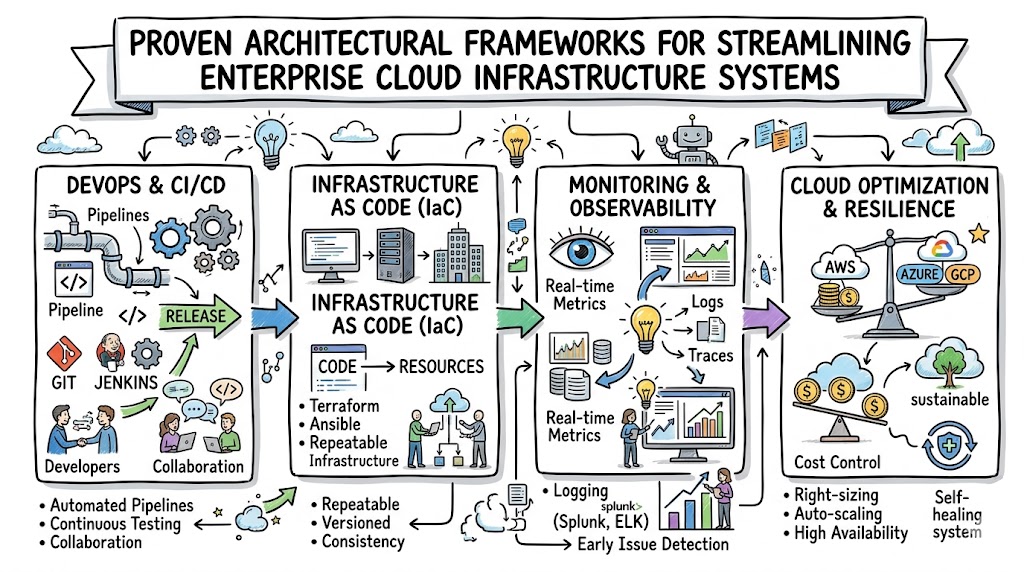
Imagine your core application dropping offline right during a peak traffic surge while your engineering teams scramble blindly through fragmented log files trying to find the root cause. Traditional monitoring setups fail to capture these modern microservices failures, leaving infrastructure teams buried under an avalanche of chaotic alerts and rising operational costs. True systemic stability requires a fundamental shift toward automated, resilient, and highly observable environments. Relying on manual intervention to fix system bottlenecks simply cannot support rapid deployment schedules. Modern teams must integrate deep automated feedback loops directly into their infrastructure pipelines to maintain consistent performance and keep user experiences seamless.
Optimizing cloud operations for maximum efficiency means converting manual infrastructure workflows into predictable, software-driven systems. This modern engineering approach treats operational challenges as software problems, substituting human coordination with programmatic resilience. Teams need this methodology to scale reliably because manual server management breaks down entirely when managing hundreds of distributed microservices. By enforcing strict performance targets and automating routine maintenance, companies protect their development velocity without sacrificing platform stability. This discipline ensures that your infrastructure automatically adapts to changing workloads while maintaining strict cost boundaries.
This comprehensive guide serves as an operational roadmap, breaking down the essential architectural steps required to build resilient cloud systems. You will explore the historical shift from isolated administrative silos to unified, automated deployment pipelines. The chapters below detail the core metrics used to balance fast feature releases with absolute platform safety. We will also dissect common architectural pitfalls, practical incident management protocols, and the cultural shifts required to eliminate repetitive operational toil. Every section provides concrete strategies to transform unstable, reactive setups into proactive, self-healing platforms.
Achieving this level of architectural efficiency requires a structured approach to learning and implementation. Partnering with seasoned industry mentors simplifies this complex transition and accelerates your team’s operational maturity. Discover how the comprehensive resources at Cloudopsnow can help you master advanced infrastructure engineering and optimize your ecosystem. Let us begin by analyzing where modern systems infrastructure originated and how early bottlenecks shaped our current methodologies.
The Origin of Systems Infrastructure
The Early Industrial Bottlenecks
Traditional corporate computing relied entirely on isolated system administrators who spent their days manually configuring physical hardware servers inside private data centers. These early infrastructure teams operated completely separately from software development groups, creating a massive organizational bottleneck. Developers focused exclusively on shipping new features quickly, while administrators prioritized keeping the existing environment stable and unchanged. Because these groups rarely shared data or strategic goals, software deployments frequently caused unexpected production outages. This old operational model turned every deployment into a high-risk event that required hours of manual troubleshooting.
These structural silos severely restricted business agility and increased the time required to deliver software updates to customers. When an application failed, developers blamed the underlying server configurations, while system administrators blamed unoptimized application code. This continuous finger-pointing lengthened system recovery times and left critical underlying architectural vulnerabilities completely unaddressed. Manual infrastructure provisioning created deep inconsistencies between testing setups and production environments, leading to unpredictable system behavior. Organizations realized that human-dependent operations could never support the rapid scaling demands of modern web applications.
Moving Toward Unified Workflow Automation
The birth of large-scale cloud providers forced an architectural evolution from manual physical setups toward programmatic infrastructure management. Organizations realized that infrastructure needed to be treated as software, leading to the development of unified workflow automation. Developers and operational specialists began sharing tools, code repositories, and common stability metrics to align their engineering goals. This cultural transformation replaced slow, manual server setups with automated scripts that could provision entire environments instantly. Consequently, teams drastically reduced human error and established identical environments across development, staging, and production zones.
This integration of software engineering principles into daily operations laid the baseline groundwork for modern cloud reliability frameworks. Automated pipelines began handling code testing, artifact building, and infrastructure deployments smoothly without needing manual handoffs between teams. Code reviews started applying to infrastructure templates just as they did to standard application features. This structural shift allowed teams to catch deployment errors early in the delivery lifecycle rather than during live production outages. Ultimately, unified automation transformed infrastructure from an unpredictable cost center into a scalable business advantage.
Global Expansion Across Commercial Ecosystems
As web architectures grew into distributed global systems, these automated operational frameworks quickly expanded across the entire commercial technology enterprise. Global enterprises realized that standard administrative practices could not sustain platforms handling millions of simultaneous user interactions. Therefore, companies adopted advanced telemetry architectures to observe system behavior across multiple geographic cloud regions in real time. Automated self-healing protocols began replacing manual restart procedures, allowing distributed platforms to survive localized hardware outages without human intervention. This global expansion turned localized automation experiments into industry-standard operating procedures for modern digital corporations.
Today, this systematic approach to reliability influences every major sector, from digital entertainment platforms to global e-commerce systems. Organizations utilize centralized orchestration engines to distribute workloads dynamically across vast clusters of virtual machines. This widespread commercial adoption has created an intense industry demand for specialized cloud architects who understand systemic efficiency. Companies that adopt these advanced operational frameworks scale their user bases smoothly while maintaining low overhead. This global standard proves that systemic stability remains directly tied to deep architectural automation and continuous performance optimization.
Defining Strategic Operations Management
The Core Operational Structure
Strategic operations management functions as a data-driven discipline that applies rigorous software engineering practices to infrastructure pipelines. The structural core of this methodology relies on continuous feedback loops between running applications and centralized orchestration platforms. Telemetry data moves constantly from individual software containers into distributed analytical engines that monitor overall system health. This continuous data flow allows infrastructure components to scale automatically based on pre-defined resource thresholds and real-world user demands. Consequently, the core architecture remains highly adaptive, preventing resource exhaustion before it impacts the end-user experience.
This operational structure shifts the engineering focus from reactive troubleshooting to proactive platform design and continuous optimization. Engineers build automated validation guardrails directly into the deployment pipelines to prevent unstable code from reaching live environments. System configurations are fully version-controlled, meaning every single architectural adjustment remains completely traceable, testable, and reversible. This structured flow ensures that any changes to the network layout, security policies, or storage layers occur through programmatic code changes. By treating the environment as a compiled application, organizations achieve complete predictability across their entire cloud footprint.
Daily Tasks of Systems Coordinators
Systems coordinators spend their daily shifts writing automated software to manage infrastructure rather than manually adjusting system configurations. These specialists design resilient deployment pipelines, construct comprehensive observability dashboards, and write self-healing scripts to remediate common platform errors. They actively participate in architecture design reviews to ensure new software features meet strict scalability and security requirements. When production anomalies happen, coordinators lead structured incident responses, focusing on restoring user services quickly through automated failovers. They spend a large portion of their day optimizing resource utilization to minimize unnecessary cloud infrastructure expenditures.
Furthermore, these professionals dedicate significant effort to analyzing performance telemetry to discover hidden architectural bottlenecks within distributed networks. They build automated testing suites that simulate heavy traffic surges to validate system behavior under extreme operational conditions. Coordinators also collaborate directly with product development teams to help them understand the infrastructure impact of new code paths. By continuously refining alert thresholds, they eliminate irrelevant system notifications and preserve the engineering team’s focus for critical issues. Their ultimate objective centers on building an autonomous infrastructure platform that requires minimal manual intervention during normal operations.
Localized Control vs. Broad System Architecture
Effective cloud optimization requires an explicit understanding of the balance between localized component control and broad multi-system architecture. Localized control focuses on fine-tuning individual microservices, optimizing specific database queries, or adjusting memory allocations inside separate containers. While this granular optimization matters, it can lead to isolated fixes that fail to improve the overall platform. Conversely, broad system architecture analyzes how these independent microservices communicate, exchange data, and handle failures across the entire network. True operational efficiency happens when engineers align localized configurations with the performance requirements of the complete end-to-end system.
| Operational Dimension | Localized Component Control | Broad Multi-System Architecture |
| Primary Engineering Focus | Individual microservices and containers | End-to-end network traffic and service interactions |
| Optimization Target | Specific database queries and memory allocation | Global data replication and system failover paths |
| Failure Resolution | Localized service restarts and isolated patches | Circuit breaking and multi-region traffic redirection |
| Telemetry Analysis | Single container logs and CPU utilization metrics | Distributed tracing and cross-pipeline performance |
Managing a complex modern cloud environment means understanding that optimizing an isolated component might accidentally bottleneck an upstream service. For instance, increasing the connection pool of a single microservice could easily overwhelm a shared backend database. Therefore, operations engineers utilize distributed tracing tools to visualize how data transitions across separate architectural boundaries. This global perspective helps teams design effective decoupling mechanisms, such as asynchronous message queues, to isolate component failures. Balancing localized engineering adjustments with macro-level architectural awareness creates a highly resilient cloud ecosystem that scales without systemic degradation.
The Efficiency Mindset
Transitioning to an efficient cloud framework requires a profound cultural shift from firefighting to long-term systemic engineering. Teams with an efficiency mindset treat every operational failure as a structural design flaw rather than an individual human mistake. They actively resist quick manual patches, preferring to invest time into building permanent, automated software remediations. This engineering culture prioritizes platform predictability, repeatable deployment workflows, and deep visibility across the entire software delivery pipeline. Consequently, engineers do not spend their days manually resolving repetitive errors, allowing them to focus entirely on scaling systemic capacity.
This mindset also requires a shared organizational comfort with managing acceptable systemic risks based on clear data metrics. Teams acknowledge that demanding perfect, unbroken uptime remains counterproductive and stalls necessary software innovation. Instead, they leverage data-driven error margins to make objective decisions about deployment speeds and architectural changes. This cultural shift encourages healthy experimentation, as developers know automated guardrails will contain failures before they impact customers. Ultimately, the efficiency mindset transforms operational reliability from an ambiguous goal into a precise, measurable engineering discipline.
The 7 Core Principles of How to Optimize Cloud Operations for Maximum Efficiency
1. Embracing Risk and Managing Variability
An efficient cloud strategy begins with the realistic architectural acknowledgment that no complex distributed system will ever run perfectly. Components fail, network latencies fluctuate, and third-party dependencies drop offline unexpectedly despite your best engineering efforts. Therefore, teams must focus on managing risk rather than chasing an impossible goal of zero system errors. Engineers design systems with built-in redundancy, utilizing graceful degradation strategies to ensure minor failures do not trigger catastrophic platform outages. Embracing risk programmatically allows organizations to innovate rapidly while maintaining a highly reliable core user experience.
To manage this operational variability, teams calculate precise acceptable risk levels based on user satisfaction and business goals. This approach helps engineers avoid over-engineering systems for uptimes that their users do not actually require or notice. For example, a internal reporting service does not need the same multi-region redundancy as a primary checkout system. Aligning infrastructure investments with realistic reliability targets allows organizations to distribute engineering resources efficiently across their applications. This calculated acceptance of risk forms the architectural foundation for rapid software delivery and cost-effective cloud operations.
2. Establishing Service Level Objectives (SLOs)
Service Level Objectives function as the precise metric targets that define whether a cloud infrastructure platform is running successfully. These objectives convert vague business desires for reliability into concrete, measurable engineering targets that guide daily operational decisions. Teams analyze user expectations to set realistic thresholds for critical metrics like api response times and system availability. By anchoring operations to clear targets, organizations remove emotional arguments from engineering discussions regarding deployment speeds. Every team member understands exactly what constitutes acceptable performance and when a system requires immediate stabilization.
Maintaining precise objectives requires a continuous review of user interaction patterns and overall platform health metrics. If an application consistently meets its performance targets, development teams can safely accelerate the release of new software features. However, if performance dips below the agreed objective, the organization shifts engineering focus away from features toward architectural stabilization. This automated balancing mechanism ensures that platform stability remains protected during aggressive product scaling phases. Well-defined objectives protect long-term infrastructure health by providing an objective data baseline for operational tradeoffs.
3. Eliminating Toil and Manual Processes
Toil represents the repetitive, manual, operational work that lacks long-term strategic value and scales directly with system size. Examples include manually restarting stuck servers, running routine database cleanup scripts, or executing repetitive configuration updates by hand. Left unchecked, toil quickly consumes an engineering team’s schedule, blocking them from working on critical scalability projects. Efficient cloud operations demand that teams actively identify this repetitive work and write software to automate it away entirely. Minimizing manual tasks ensures engineering capacity grows faster than the underlying infrastructure footprint.
[Identify Repetitive Task] ──> [Measure Engineering Hours] ──> [Develop Automation Code] ──> [Deploy Self-Healing Pipeline]
Eliminating manual operational tasks requires a deliberate commitment to treat operations as an engineering problem. Teams track the hours spent on manual activities and prioritize automation work that yields the highest time savings. Writing a self-healing script to manage automated database cleanups frees up valuable engineering cycles for deep architectural optimizations. This systematic elimination of manual tasks prevents operational debt from accumulating and slowing down your deployment velocity. Reducing toil keeps engineering teams engaged in creative problem-solving rather than repetitive, exhausting maintenance routines.
4. Monitoring & Observability Across the Pipeline
True cloud efficiency requires comprehensive monitoring and observability across every stage of the software delivery pipeline. Monitoring tracks specific system failures, alerting engineers when a particular metric crosses an unsafe pre-defined threshold. Observability goes deeper, allowing teams to infer a system’s internal state by analyzing its external outputs, like logs, metrics, and traces. Combining these practices ensures that infrastructure teams possess full visibility into how complex, distributed microservices interact during live operations. This deep visibility allows engineers to pinpoint the root causes of strange performance degradations before they cause widespread outages.
Building an effective observability pipeline means standardizing log collection, metric aggregation, and transaction tracing across all deployed applications. Engineers leverage distributed tracing to follow separate user requests as they travel through multiple network layers and backend databases. This granular visibility exposes hidden latencies, unoptimized database queries, and failing third-party integrations across the ecosystem. Consequently, teams avoid wasting hours guessing which component caused an error, relying instead on clear visual telemetry data. Comprehensive observability transforms troubleshooting from an unorganized guessing game into a precise, evidence-based engineering process.
5. Automation Over Manual Coordination
Scaling modern cloud environments requires prioritizing software automation over human operational coordination at every layer of the infrastructure architecture. Manual interventions, such as adjusting load balancer rules through a web console, introduce human errors and lack repeatability. Efficient organizations use declarative infrastructure code to define network layouts, firewall rules, and compute resources completely inside software repositories. This methodology ensures that every single infrastructure modification undergoes automated testing and validation before deployment to live environments. Programmatic automation allows teams to replicate complex environments instantly across separate cloud zones without manual friction.
[Code Commit] ──> [Automated Policy Check] ──> [Dry-Run Execution] ──> [Programmatic Cloud Provisioning]
Automating workflows allows your cloud ecosystem to scale dynamically in response to changing real-time user demands. Automated scaling protocols provision additional compute resources during traffic spikes and terminate them when demand drops, keeping costs low. Similarly, automated deployment pipelines handle progressive rollouts, testing new software versions on small user groups before full deployment. If the automation detects an elevation in application errors, it executes an immediate rollback without needing human intervention. Prioritizing software solutions over manual human administration forms the backbone of scalable, cost-efficient cloud operations.
6. Release Engineering and Deployment Stability
Release engineering focuses on the tools, practices, and architectural strategies used to compile, test, and deploy software reliably. An unoptimized deployment process introduces continuous instability into production, regardless of how well your application code is written. Efficient release engineering enforces absolute consistency by utilizing immutable deployment artifacts, ensuring identical packages run across all testing stages. Teams leverage automated continuous integration pipelines to run security scans, unit tests, and structural validations on every single code adjustment. This automated gatekeeping guarantees that only stable, secure, and fully verified configurations reach your live cloud environments.
To maintain production stability, release engineers utilize advanced deployment strategies like blue-green rollouts and canary deployments. Canary rollouts direct a tiny slice of live user traffic to the new software version while monitoring performance telemetry closely. If the canary release maintains stable error budgets and latency metrics, the pipeline automatically routes more traffic to the update. Conversely, if anomalies emerge, the deployment infrastructure instantly cuts off traffic to the unstable version, protecting the broader user base. This disciplined approach to release engineering allows organizations to ship updates frequently while maintaining exceptional system uptime.
7. Simplicity in Network Architecture
An essential yet frequently overlooked principle of cloud optimization centers on maintaining radical simplicity throughout your network architecture. Complex, convoluted environments with tangled routing tables, unnecessary microservices, and redundant data paths create massive failure surfaces. Every additional layer of architectural complexity introduces potential security vulnerabilities, configuration mistakes, and difficult-to-track performance bottlenecks. Teams optimize cloud operations by aggressively eliminating unused resources and keeping service communication paths as clean and direct as possible. Clean, minimal environments are significantly easier to monitor, secure, troubleshoot, and scale over the long term.
Enforcing architectural simplicity requires strict design discipline and continuous cleanup of legacy infrastructure components. Engineers should leverage clear decoupling patterns, avoid deeply nested service dependencies, and use standardized, well-documented API contracts across teams. Simplifying network zones and security groups makes it straightforward to isolate component failures and contain potential security issues. This focus on minimalism ensures that telemetry data remains clean and actionable, preventing critical alerts from getting lost in background noise. Ultimately, a simple cloud architecture directly reduces operational costs and improves overall system reliability.
Key Operational Concepts You Must Know
SLA vs. SLO vs. SLI — Explained Simply
Navigating modern cloud operations requires a clear, practical understanding of the distinctions between SLAs, SLOs, and SLIs. These three acronyms represent the separate layers of measurement used to track reliability, user satisfaction, and business commitments. Failing to differentiate these terms leads to confused engineering priorities and misaligned business expectations during product rollouts.
- SLI (Service Level Indicator): The precise metric that measures a specific aspect of system performance in real time. Common indicators include the exact percentage of successful API requests or the latency of a database call measured in milliseconds.
- SLO (Service Level Objective): The target reliability goal agreed upon by engineering and product teams, expressed as a specific percentage over time. For example, a team might state that their API success rate must remain above 99.9% over any rolling thirty-day window.
- SLA (Service Level Agreement): The overarching legal contract between a service provider and the end-user defining the financial consequences of system unreliability. If the system fails to meet this high-level commitment, the provider issues financial refunds or credits to the customer.
Error Budgets — The Game Changer for Operational Risk
An error budget represents the exact margin of acceptable unreliability a system is permitted to experience over a specific timeframe. Calculated directly from your Service Level Objective, it represents the inverse of your stability target. For instance, if your application commits to a 99.9% uptime SLO, your corresponding error budget allows for exactly 0.1% downtime. This metric functions as a clear architectural balancing mechanism, managing the natural tension between shipping features fast and maintaining platform safety. It removes subjective arguments, providing an objective data baseline that guides development speeds.
+--------------------------------------------------------+
|                 TOTAL OPERATIONAL TIME                 |
+------------------------------------+-------------------+
|  System Uptime Target (SLO: 99.9%)  | Error Budget (0.1%)|
|  [Focus: Feature Development]      | [Focus: Risk/Inno]|
+------------------------------------+-------------------+
When an engineering team possesses a completely full error budget, they can safely take calculated risks and deploy new features aggressively. However, if a series of production outages completely drains the error budget, the team must halt feature releases immediately. The entire engineering focus then shifts toward stabilizing infrastructure, optimizing queries, and rewriting brittle code paths to restore systemic safety. This automated organizational control mechanism prevents companies from prioritizing short-term product features over long-term platform health. Embracing error budgets transforms risk management from an abstract, stressful conversation into an automated engineering workflow.
Toil — The Silent Productivity Killer in Infrastructure
Toil acts as a silent drain on engineering velocity, slowly pulling specialized cloud architects away from strategic scalability work. To qualify as toil, an operational task must be repetitive, manually executed, easily automatable, and lacking in long-term engineering value. If a task scales linearly as your customer base grows, it represents clear structural toil that requires software remediation. Left unaddressed, heavy workloads of manual toil cause engineering burnout, lower team morale, and increase configuration mistakes in production. Organizations must actively track and measure time spent on manual activities to protect their long-term engineering capacity.
Eliminating infrastructure toil requires a structured, multi-step engineering approach to ensure repetitive work is permanently removed from the system layout. Teams must first document manual workflows clearly before writing code to hand those responsibilities over to automated orchestration engines.
| Step | Core Phase | Practical Execution Strategy |
| 1 | Identification | Log daily engineer activities to isolate repetitive, manual tasks that scale with system size. |
| 2 | Quantification | Calculate the exact engineering hours consumed by these manual tasks over a standard thirty-day window. |
| 3 | Automation Design | Write clean, version-controlled scripts or build automated pipelines to handle the manual workflow. |
| 4 | Deployment & Validation | Integrate the automation code into production and verify that human intervention is no longer required. |
Consistently applying this remediation workflow allows teams to keep operational workloads manageable even as their underlying infrastructure footprint grows exponentially. This disciplined approach ensures that engineers spend less than half of their time on operational maintenance, preserving the rest for system improvements. Minimizing toil allows your organization to scale up infrastructure capacity smoothly without requiring a linear increase in engineering headcount.
Incident Management & Postmortems
When severe production outages occur, efficient organizations leverage highly structured, blameless incident management workflows to restore services rapidly. Teams assign clear, defined roles during a live issue, isolating the incident commander from the engineers focused on active technical mitigation. This clear separation prevents chaotic communications and allows the mitigation team to focus completely on resolving the failure path. The primary objective during a live incident centers entirely on restoring user services, not finding out who caused the error. Once the platform returns to a stable state, the team transitions into the comprehensive analysis phase.
The blameless postmortem process assumes that well-intentioned engineers make choices based on the information available to them at the time. Instead of assessing blame, the analysis dissects the underlying architectural flaws and tool limitations that allowed the issue to happen. Teams construct an exact, evidence-based timeline of the event, analyzing metrics, logs, and communication patterns to locate the core vulnerability. The postmortem concludes with a set of concrete, tracked action items designed to eliminate that entire class of failure permanently. This healthy operational culture encourages open transparency, ensuring teams uncover systemic flaws and continuously harden their environments.
Capacity Planning
Capacity planning represents the data-driven process of forecasting future resource requirements to ensure infrastructure survives upcoming user traffic surges. Efficient teams analyze historical utilization trends, organic business growth vectors, and upcoming marketing initiatives to build precise resource models. This predictive approach helps organizations avoid over-provisioning expensive, idle compute resources or suffering catastrophic resource exhaustion during sudden usage spikes. By tracking baseline growth metrics, teams make proactive adjustments to their cloud architecture well before performance degradation affects customers.
Modern capacity planning combines regular historical data analysis with automated, real-time cloud elasticity tools to manage unexpected traffic. Engineers execute rigorous stress tests, simulating extreme user volumes to locate the exact break points within their network layouts. These tests help teams optimize auto-scaling rules, ensuring database connection limits and container limits expand smoothly before bottlenecks form. This strategic foresight allows organizations to minimize cloud spend by maintaining lean baselines that expand dynamically only when required. Effective capacity planning transforms scaling from an expensive emergency into a predictable, automated operational workflow.
The Four Golden Signals of Pipeline Performance
To maintain a highly optimized cloud infrastructure, teams must continuously track the Four Golden Signals of system performance. These four metrics provide a complete view of platform health, helping engineers diagnose complex anomalies across distributed environments.
- Latency: The precise time it takes to service a specific request, separating successful requests from failed ones to prevent distorted data. High latency serves as an early indicator of resource exhaustion or unoptimized database interaction paths.
- Traffic: A direct measure of systemic demand, tracking metrics like HTTP requests per second or concurrent network connections. Monitoring traffic trends helps teams evaluate whether auto-scaling rules are triggering fast enough to handle user loads.
- Errors: The rate of requests that fail explicitly, such as internal server errors or dropped network connections. Tracking error spikes allows operations engineers to isolate failing software builds and initiate immediate automated rollbacks.
- Saturation: The measurement of how full a specific system resource is, tracking constraints like memory limits or disk input-output capacity. Saturation metrics flag upcoming architectural bottlenecks before they trigger severe platform degradation.
Platform Implementation vs. Culture — What’s the Real Difference?
The Philosophy Difference
Optimizing cloud operations requires a clear understanding of the difference between high-level cultural frameworks and concrete platform implementations. Cultural frameworks focus primarily on breaking down organizational silos, encouraging team collaboration, and driving rapid feature delivery. This methodology establishes the shared values, communication patterns, and business alignment necessary to ship software updates quickly and safely. However, culture alone cannot configure a cluster, monitor a network, or automate an infrastructure failover path. Organizations need a structured technical discipline to translate these collaborative philosophies into reliable, running production environments.
Platform implementation provides the concrete engineering practices, software tools, and precise data metrics required to run stable systems. This discipline focuses on treating operational workflows as software engineering challenges, utilizing version-controlled code to manage infrastructure platforms. While cultural frameworks encourage collaboration, platform implementations define the exact error budgets and reliability targets that manage development speeds. Cultivating a shared philosophy gets teams talking, but deploying robust engineering implementations gives them the automation to scale safely. Blending these approaches allows companies to build an organizational culture backed by resilient, automated cloud platforms.
Roles & Responsibilities Compared
While both disciplines focus on improving the software delivery lifecycle, their day-to-day engineering responsibilities target different layers of the platform. Understanding these operational differences helps organizations structure their teams effectively and avoid overlapping responsibilities that slow down deployment velocity.
- Cultural Collaborators: Focus primarily on optimizing application delivery velocity, building continuous integration pipelines, and improving feature deployment workflows across teams.
- Platform Engineers: Concentrate on maximizing system availability, writing automated self-healing scripts, and managing global cloud infrastructure capacity boundaries.
- Cultural Collaborators: Spend daily shifts working directly alongside product teams to package features and streamline code delivery workflows.
- Platform Engineers: Spend shifts building shared core infrastructure, refining alerting architectures, and leading blameless postmortem analyses after production incidents.
- Cultural Collaborators: Prioritize breaking down human communication barriers and establishing consistent release patterns across the entire development organization.
- Platform Engineers: Prioritize tracking error budgets, engineering out repetitive toil, and hardening distributed system architectures against unexpected traffic surges.
Can You Have Both Disciplines?
Modern enterprise tech organizations do not need to choose between these two approaches; they actively combine them to build high-performing engineering ecosystems. Cultural collaboration strategies lay the groundwork by aligning product development goals with core infrastructure requirements. Meanwhile, platform engineering groups provide the scalable tools, automated guardrails, and observability infrastructure that make that collaboration practical. When these methodologies coexist, development teams deploy code independently through secure, automated platforms engineered by infrastructure specialists. This structural integration allows organizations to accelerate software release cadences while improving overall system reliability.
To blend these approaches successfully, organizations build self-service internal developer platforms that abstract away complex cloud infrastructure configurations. Platform engineers build these automated environments, incorporating security policies, cost boundaries, and monitoring baselines directly into the core code. Software developers then leverage these pre-verified platforms to spin up isolated testing environments instantly without manual intervention. This approach eliminates old administrative handoffs while ensuring all deployments conform to strict operational safety standards. Combining shared cultural ownership with automated infrastructure engineering allows companies to scale rapidly without accumulating systemic chaos.
Which One Should Your Team Adopt?
Choosing how to balance these operational philosophies depends directly on your company’s scale, architectural complexity, and engineering maturity. Early-stage startups managing simple environments should focus on embedding collaborative cultural workflows across their small product teams. At this size, developers can handle their own basic deployments using managed cloud services without needing dedicated platform engineering groups. Forcing rigid infrastructure structures onto a small team introduces unnecessary overhead and slows down initial product-market fit validation. The initial priority centers on shipping software changes rapidly while maintaining basic system visibility.
As your cloud footprint expands into complex microservices architectures, establishing a dedicated platform engineering discipline becomes critical for survival. Large distributed platforms with high transaction volumes require specialized infrastructure architects to manage error budgets, data pipelines, and capacity constraints. If your developers spend significant time troubleshooting cloud configurations rather than writing feature code, you need platform automation. Transitioning toward software-driven infrastructure management protects engineering efficiency and ensures your systems survive heavy user traffic. Aligning your operational structure with your architectural complexity guarantees sustainable organizational growth.
Real-World Use Cases of Modern Operations
How Tech Leaders Use Operational Metrics
Major global technology corporations leverage real-world operational metrics to automate their deployment cycles and manage massive user traffic surges. These software enterprises use highly accurate observability engines to track millions of system signals across global data centers simultaneously. For example, when traffic rises during a global broadcast event, their infrastructure tracks saturation metrics to trigger automatic cluster expansion. If data latencies elevate slightly within an isolated network zone, intelligent routing layers redirect user requests to healthier regions. This data-driven automation keeps their global digital platforms responsive under unpredictable workloads.
These industry leaders also use performance telemetry to enforce release guardrails across their software engineering groups. Automated delivery pipelines track error budget consumption during new feature rollouts to catch hidden performance issues early. If a code change triggers an elevation in database exceptions, the platform halts the deployment automatically. This automated enforcement prevents local code bugs from expanding into widespread system outages that impact millions of concurrent users. Grounding daily operations in objective performance metrics allows these enterprises to maintain exceptional service uptimes while shipping code thousands of times daily.
Chaos Engineering Approaches to Resilient Systems
Top tier cloud organizations use chaos engineering to uncover hidden architectural vulnerabilities by intentionally injecting controlled failures into production environments. Instead of waiting for a critical system outage to happen unexpectedly, teams proactively disable virtual servers, drop network lines, or corrupt data blocks during normal business hours. This controlled experimentation validates whether the underlying infrastructure detects failures and executes automated failovers correctly. By observing how distributed microservices handle artificial stress, engineers locate single points of failure before they impact customers. Chaos engineering transforms reliability validation from a series of theoretical assumptions into an empirical science.
[Define Steady State] ──> [Inject Controlled Failure] ──> [Monitor Telemetry Signals] ──> [Harden System Architecture]
Implementing chaos experiments requires strict guardrails to ensure artificial stress remains contained and does not cause accidental user outages. Teams start with small, localized injections inside isolated staging environments before moving up to live production systems. They leverage automated blast-radius controls that instantly terminate an experiment if overall system error metrics cross safe thresholds. The data gathered from these controlled failures helps engineers build better circuit breakers and graceful degradation paths into their code. Intentionally breaking your systems during safe windows builds deep institutional confidence in your platform’s self-healing capabilities.
Handling Reliability at Massive Scale
Distributed microservices architectures handling millions of daily transactions depend on automated resilience patterns to survive localized infrastructure outages. At massive scale, hardware components fail continuously, meaning the underlying software layout must be designed to expect constant component loss. Engineers deploy advanced traffic routing layers that leverage active health checks to bypass unresponsive application containers instantly. Distributed caching layers are integrated across multiple geographic zones to reduce direct database load and protect core data stores. These integrated architectural layers isolate failures, ensuring a single broken component cannot cascade across the entire platform.
To maintain system responsiveness during massive traffic spikes, engineers build rate-limiting and shedding protocols directly into their API gateways. When user demand threatens to saturate compute resources, the platform sheds non-essential traffic, prioritizing core checkout and payment workflows. Asynchronous message queues handle heavy data ingestion tasks, allowing background processing to scale independently from user-facing frontends. These approaches prevent resource exhaustion, ensuring the core platform remains completely functional even under extreme, unpredictable workloads. Operating successfully at scale requires moving away from manual recovery procedures toward autonomous, self-healing network structures.
High-Availability in Fintech Operations
Financial technology platforms operate within zero-tolerance environments where even a few seconds of platform downtime can trigger significant financial losses and compliance penalties. These transaction platforms leverage high-availability multi-region architectures, replicating critical ledger data across separate cloud regions in real time. Engineers use synchronous database configurations alongside strict consensus algorithms to ensure financial data remains accurate across all data stores. Automated network monitoring loops track transaction drop rates continuously, alerting on-call response teams the moment anomalies emerge. This strict engineering focus guarantees absolute data safety and platform availability for critical payment systems.
Fintech operations also demand absolute consistency and auditability across all infrastructure adjustments and deployment pipelines. Every modification to network access policies, data encryption keys, or banking integrations must undergo automated compliance scanning and security validation. Continuous deployment pipelines run automated security vulnerability tests on every software package before it reaches live systems. If an infrastructure change fails a security check, the delivery platform blocks the rollout automatically. This integration of compliance testing directly into automated workflows allows fintech firms to move fast while maintaining institutional security.
Scaled-Down but Essential Systems for Startups
Early-stage startups do not need to deploy massive multi-region architectures, but they must apply core reliability principles to prevent early business disruption. Small engineering teams leverage managed cloud solutions that offer built-in auto-scaling, automated database backups, and simplified monitoring frameworks out of the box. By utilizing these managed platforms, startups gain foundational resilience without the engineering complexity of building custom orchestration tools. The priority centers on setting up clean, automated continuous integration pipelines to catch obvious application errors before they reach customers. This lean approach allows small teams to focus on building features while maintaining baseline system safety.
Startups apply the efficiency mindset by tracking a few essential performance signals, like API error counts and core page load latencies. Establishing basic automated alerts ensures the team uncovers critical production issues before their customers do, protecting early user retention. As the startup’s customer base grows, engineers systematically replace manual database cleanups and server adjustments with automated scripts to prevent operational debt. Starting with clean, version-controlled infrastructure code ensures the startup’s platform scales smoothly when traffic accelerates. Applying lightweight operational discipline early prevents structural chaos from slowing down future engineering velocity.
Common Mistakes in Operations Engineering
Mistake 1 — Confusing System Management with Just Being On-Call
A frequent architectural mistake companies make when scaling operations is treating this discipline as a modern name for a traditional on-call support team. When organizations fall into this trap, they bury their engineers under an endless stream of manual tickets, server alerts, and late-night troubleshooting sessions. This reactive firefighting leaves teams with zero time to write automation code or analyze the structural root causes of frequent failures. This misunderstanding turns your engineering group into a high-stress operational bottleneck, blocking long-term system optimization and platform stability.
True operations engineering is a proactive software engineering discipline focused on building autonomous infrastructure that minimizes on-call escalation events. Specialists design self-healing systems that automatically detect, isolate, and remediate common production errors without human intervention. If an engineer must manually intervene to resolve an alert, they treat that intervention as a system bug that requires automation. The primary objective is to allocate more than half of the team’s capacity to writing engineering code that hardens the platform. Shifting focus from reactive firefighting to proactive software automation ensures your cloud ecosystem scales efficiently.
Mistake 2 — Setting Unrealistic SLOs
Many engineering organizations mistakenly demand perfect, 100% uptime targets for their applications, believing that higher stability goals always produce better user experiences. However, chasing absolute perfection creates major engineering challenges, as every additional decimal point of reliability requires exponential infrastructure investment. Demanding zero errors forces teams to build highly complex, multi-region setups that are difficult to maintain and expensive to run. Furthermore, a zero-tolerance policy for failures halts software delivery velocity completely, as developers become afraid to deploy new code.
[Demand 100% Uptime] ──> [Halt Software Delivery] ──> [Stagnate Feature Innovation] ──> [Burn Out Engineering Teams]
Unrealistic reliability targets slow down business innovation without providing any noticeable value to your actual end-users. If a customer accesses your platform over a weak mobile connection, they cannot perceive the difference between 99.9% and 99.999% server availability. Teams must ground their Service Level Objectives in realistic user expectations and real-world business performance requirements. This empirical approach establishes healthy error budgets that provide clear boundaries for managed risk and rapid software experimentation. Setting achievable targets allows your organization to balance fast feature innovation with sustainable platform stability.
Mistake 3 — Ignoring Toil Until It’s Late
Ignoring small, repetitive manual tasks early in a platform’s lifecycle allows operational debt to accumulate quietly across your infrastructure. In the early stages, running a manual script to fix a stuck background process seems like a minor inconvenience that takes only a few minutes. However, as your infrastructure footprint grows to meet rising user volumes, these manual interventions multiply exponentially. Eventually, your engineers spend their entire shifts running manual fixes, leaving them with no time to work on scalability projects. This heavy workload causes severe team burnout and introduces frequent configuration mistakes into live environments.
Organizations must actively measure time spent on manual operations and prioritize automation tasks to prevent toil from overwhelming their teams. If a routine maintenance activity happens frequently, engineers must build an automated, programmatic pipeline to handle it permanently. Writing software to manage repetitive tasks ensures that your operational workload remains flat even as infrastructure capacity expands. This engineering discipline protects your team’s schedule, allowing them to focus on high-impact architectural improvements. Addressing manual overhead early keeps your deployment velocity fast and your cloud operations cost-effective.
Mistake 4 — Skipping Blameless Postmortems
When companies respond to production outages by looking for an individual engineer to blame, they severely damage their operational health. Punishing an engineer for making a configuration mistake creates an organizational culture of fear, where team members actively hide system vulnerabilities. Engineers stop reporting near-misses and avoid making necessary architectural updates out of fear of triggering an unexpected error. This lack of transparency leaves underlying systemic flaws completely unaddressed, setting the stage for more severe, widespread production outages down the road.
[Accuse Individual Engineer] ──> [Cultivate Team Fear] ──> [Hide Systemic Flaws] ──> [Trigger Catastrophic Outage]
To optimize cloud systems, organizations must run truly blameless postmortems that focus entirely on technical and process failures. Analyses must explore why the deployment pipeline allowed an invalid configuration to reach live environments without automated validation. Teams focus on improving monitoring thresholds, building better staging validation guardrails, and hardening automated rollback paths. This constructive approach transforms every production failure into a valuable learning event that strengthens the overall architecture. Eliminating finger-pointing ensures that teams collaborate openly to locate and fix deep systemic vulnerabilities.
Mistake 5 — Monitoring Without Actionable Alerts
A major source of infrastructure inefficiency centers on configuring monitoring dashboards that generate alerts for non-actionable metric fluctuations. When systems send notifications for minor, self-correcting CPU spikes or normal memory variations, engineers quickly develop severe alert fatigue. On-call specialists become desensitized to constant notifications, leading them to ignore alerts or delay their responses during live events. This noise level often results in teams missing critical early indicators of genuine, widespread platform outages until it is too late.
[Non-Actionable Alerts] ──> [Severe Alert Fatigue] ──> [Ignored System Signals] ──> [Delayed Outage Mitigation]
To eliminate alert fatigue, organizations must ensure that every single automated notification requires a clear, immediate human engineering response. If an alert does not require urgent intervention, it belongs on an internal analytical dashboard rather than an active paging system. Teams tie notifications directly to real-world user degradation metrics, such as elevated API error rates, rather than isolated server signals. Every alert should link directly to an automated runbook that outlines the exact steps required to diagnose and mitigate the issue. Refining your alerting architecture preserves your team’s focus for genuine production emergencies.
Mistake 6 — Not Involving Operational Engineers in the Design Phase
A common structural mistake in technology companies is keeping operational specialists completely isolated from early software design discussions. Product developers often build complex application features without considering network latencies, database constraints, or deployment scaling behaviors. When they hand these unoptimized features over to operations teams for deployment, the infrastructure frequently struggles to support the workload. This disconnect leads to emergency production patches, low system performance, and friction between development and infrastructure groups.
Organizations must involve cloud operations architects in the initial software design phase to build reliable, cost-efficient platforms. Operational specialists provide critical input on system decoupling, caching strategies, log structures, and automated failover requirements from day one. This proactive collaboration ensures that new features integrate cleanly with existing observability pipelines and scaling rules. Designing software with built-in operational awareness reduces delivery friction and prevents stability issues from reaching live environments. Building reliability directly into the application layout ensures smooth, predictable product scaling.
Essential Infrastructure Tools & Technologies
Monitoring & Observability
Building an efficient cloud environment requires standardizing on advanced monitoring and observability platforms to maintain full visibility across your ecosystem. Teams utilize metric collection engines like Prometheus to gather real-time performance data from distributed microservices clusters. These granular metrics move into centralized visualization platforms like Grafana, allowing engineers to build comprehensive dashboards tracking global system health. Enterprise options like Datadog and New Relic combine these metrics with distributed tracing and log aggregation inside a single interface. This deep visibility helps infrastructure teams pinpoint performance anomalies before they impact the end-user experience.
| Tooling Category | Open-Source Core Solutions | Specialized Enterprise Platforms |
| Monitoring & Observability | Prometheus, Grafana, Jaeger | Datadog, New Relic, Dynatrace |
| Incident Management | Dispatch, Alertmanager | PagerDuty, Opsgenie, xMatters |
| CI/CD & Delivery Automation | Jenkins, Argo CD, Tekton | GitLab CI, Spinnaker, Harness |
| Chaos Engineering | Chaos Mesh, LitmusChaos | Gremlin, Steadybit |
Selecting the right observability mix depends on your architectural complexity, compliance requirements, and engineering team size. Open-source solutions provide exceptional flexibility and data control but require significant engineering hours to configure, scale, and maintain. Enterprise platforms simplify this setup by providing instant, unified visibility out of the box, freeing up your team to focus on core automation code. Regardless of the tools you choose, the primary goal remains establishing clear visibility across your entire delivery pipeline. Comprehensive telemetry data removes guesswork from troubleshooting, turning incident mitigation into an objective, evidence-based process.
Incident Management
When severe platform outages occur, infrastructure teams leverage specialized incident management platforms to organize real-time responses and accelerate service recovery. Platforms like PagerDuty and Opsgenie integrate directly with your monitoring tools to route critical alerts to the correct on-call engineer instantly. These systems feature customizable escalation paths, ensuring that if a primary engineer does not acknowledge an alert quickly, it moves to a backup specialist. This automation guarantees that critical system anomalies receive immediate human attention, reducing your overall mean time to resolution.
Modern incident management platforms also feature unified communication spaces, automated status page updates, and immediate runbook delivery during live events. These features help teams collaborate smoothly, preventing fragmented communications from slowing down technical mitigation efforts. By logging every notification and response action automatically, these platforms provide clean, objective data timelines for post-incident reviews. Utilizing centralized incident coordination tools helps organizations handle high-stress production outages with structure and discipline. Hardening your response framework ensures your team restores services rapidly and protects the core user experience.
CI/CD & Release Engineering
Automating software delivery workflows requires deploying robust continuous integration and continuous deployment engines to handle testing and rollouts. Teams leverage automation servers like Jenkins to compile code, run security vulnerability scans, and build immutable container packages. Progressive delivery platforms like Argo CD and Spinnaker automate cloud deployments, ensuring production environments match version-controlled configuration repositories. These engines support advanced rollout patterns, including canary releases and automated rollbacks based on live performance metrics. Centralizing your release engineering workflows removes manual human error from the deployment pipeline entirely.
Integrating automated validation guardrails into your deployment engines prevents unstable configurations from reaching live production systems. If a new application package causes an unexpected surge in error codes during a canary phase, the delivery engine initiates an immediate rollback. This programmatic protection minimizes the blast radius of software bugs, keeping the broader platform stable and secure. Automating release pipelines allows organizations to deploy software updates frequently and confidently throughout the day. Robust delivery automation transforms software deployment from a high-risk manual chore into a predictable, non-event.
Chaos Engineering
To proactively discover hidden architectural vulnerabilities, modern operations teams integrate advanced chaos engineering tools directly into their infrastructure pipelines. Platforms like Gremlin and Chaos Mesh allow engineers to inject controlled failures, such as network latencies, disk saturation, or server blackouts, into live environments. These tools help teams verify whether their applications handle real-world infrastructure failures smoothly without dropping user transactions. By testing failure paths under safe, controlled conditions, organizations validate the effectiveness of their circuit breakers and auto-scaling setups.
Using specialized chaos platforms ensures that engineering experiments remain safely contained and do not cause accidental, widespread outages. These tools feature instant abort switches that immediately stop an experiment if core system metrics cross safe pre-defined boundaries. Teams leverage this automation to run regular failure simulations without disrupting the core business operations. The data collected from these controlled experiments helps engineers systematically harden code pathways and optimize infrastructure configurations. Proactively testing your platform’s resilience builds deep confidence in its ability to survive unpredictable real-world outages.
SLO Management
Tracking service reliability against strict user thresholds requires deploying dedicated Service Level Objective management tools across your cloud footprint. Platforms like Nobl9 integrate directly with your existing observability setups to collect performance indicators and calculate error budgets continuously. These specialized tools provide clear, unified dashboards showing exactly how much error budget remains across various business applications. This real-time visibility helps engineering leaders make objective, data-driven trade-offs between shipping new features and stabilizing infrastructure.
Centralizing your reliability objectives inside a dedicated platform prevents separate product teams from using inconsistent metrics to define system success. These tools feature automated alerting rules that notify teams well before an error budget is completely drained by a persistent issue. This early warning allows engineers to shift focus to stabilization projects before performance degradations breach external customer agreements. Grounding daily operations in automated objective tracking removes emotion from engineering roadmaps and protects long-term infrastructure health.
How to Become an Operations Expert — Career Roadmap
Skills Every Specialist Must Have
Building a successful career in modern cloud operations requires mastering a blend of core software engineering skills and deep systems knowledge. Aspiring specialists must possess strong capabilities in shell scripting languages like Bash alongside advanced programming languages such as Python or Go. This programming foundation allows engineers to build custom automation tools, construct data pipelines, and interact directly with cloud APIs. Professionals must also master terminal commands and understand Linux internals, including process management, memory allocation, and file systems.
+--------------------------------------------------------+
|               CORE OPERATIONS SKILLSET                 |
+--------------------------------------------------------+
|  Programming/Scripting: Bash, Python, Go               |
|  Systems Mastery: Linux Internals & Networking Core   |
|  Infrastructure Control: Containers & Declarative IaC  |
+--------------------------------------------------------+
|               ADVANCED ARCHITECTURE LEVEL               |
+--------------------------------------------------------+
|  Global Scaling, Multi-Cloud Design, Deep Observability|
+--------------------------------------------------------+
|               STRATEGIC ENTERPRISE LEVEL               |
+--------------------------------------------------------+
|  Error Budget Governance, Financial Cost Optimization  |
+--------------------------------------------------------+
In addition to core programming, specialists must understand networking concepts, including TCP/IP protocols, DNS configurations, load balancing strategies, and routing tables. They need extensive experience with containerization technologies like Docker and orchestration platforms such as Kubernetes to manage modern microservices. Professionals must also master declarative infrastructure-as-code tools like Terraform to deploy cloud environments programmatically. Combining strong software development skills with comprehensive systems knowledge allows engineers to design resilient, highly automated cloud platforms that scale smoothly.
The Professional Learning Path
Transitioning into an operations expert requires following a structured educational path that builds technical capabilities systematically over time. Beginners should start by configuring standalone Linux servers, managing local networks, and writing basic automation scripts to handle routine tasks. Once they master these foundational systems, they should transition to learning cloud computing basics, including virtual machines, object storage, and identity access rules. This initial phase establishes the core technical background required to handle basic cloud environments confidently.
The next step on the learning path involves mastering containerization workflows, distributed tracing architectures, and automated continuous deployment pipelines. Engineers should practice deploying multi-container microservices applications, configuring centralized logging tools, and setting up real-time performance alerts. They must study advanced reliability concepts, including error budget management, automated canary rollouts, and blameless postmortem execution. Moving into senior architectural roles requires mastering global data replication, multi-cloud networking, chaos engineering, and infrastructure financial optimization. Continuous learning ensures that your technical capabilities keep pace with evolving cloud architectures.
Certifications Worth Pursuing
Earning industry-recognized certifications helps validate your specialized infrastructure knowledge and accelerates your career progression in cloud operations. Aspiring professionals should pursue credentials from major cloud providers, such as the AWS Certified DevOps Engineer Professional or the Google Cloud Professional Cloud DevOps Engineer. These intensive exams test your ability to design automated deployment pipelines, manage infrastructure code, and configure advanced monitoring systems. Achieving these certifications proves to organizations that you understand how to run stable, secure, and cost-efficient cloud platforms.
[AWS Certified DevOps Pro] ──> [Google Cloud DevOps Engineer] ──> [Certified Kubernetes Administrator]
Engineers working deeply with containerized systems should also prioritize earning the Certified Kubernetes Administrator (CKA) credential. This practical, performance-based exam validates your real-world ability to deploy, configure, and secure complex container clusters under tight timelines. In addition, pursuing security-focused certifications helps engineers understand how to integrate threat detection protocols directly into automated delivery workflows. While hands-on project experience remains essential, these respected industry credentials serve as powerful career accelerators. Validating your technical expertise expands your professional options and connects you with top-tier technology enterprises globally.
Educational Resources with Cloudopsnow
Mastering advanced cloud operations requires access to comprehensive, structured educational material designed by seasoned industry experts. Navigating these complex deployment pipelines, container clusters, and observability frameworks independently can quickly feel overwhelming for growing engineers. Aspiring specialists need high-quality courses that blend theoretical architectural concepts with real-world, hands-on production labs. Choosing a structured training provider ensures you learn production-ready infrastructure best practices while avoiding outdated operational habits.
To accelerate your technical development and master these critical disciplines, explore the comprehensive educational courses available at Cloudopsnow. Their specialized curriculum provides deep immersion into advanced automation, container orchestration, infrastructure-as-code engineering, and modern observability frameworks. Learning from experienced infrastructure mentors gives you the practical insights required to transform fragile architectures into highly resilient systems. Investing in your professional training ensures you build the concrete engineering capabilities needed to optimize large-scale cloud ecosystems successfully.
The Future of Systems Management
AI and Automation in System Optimization
The evolution of cloud operations is driven by integrating machine intelligence directly into distributed telemetry pipelines. Traditional threshold alerts often fail to catch complex, slow-moving performance anomalies across heavily distributed microservices environments. Modern artificial intelligence engines analyze vast streams of metrics, logs, and traces in real time to uncover hidden architectural degradation patterns early. These intelligent platforms can forecast resource saturation events, optimize load balancing paths, and identify the root causes of system issues within seconds. This automation shifts the engineering focus away from tedious manual log analysis toward rapid, high-level structural optimization.
In addition to advanced anomaly detection, intelligent automation engines are taking on active roles in real-time system self-healing and remediation. When a cloud platform experiences an issue, automated systems can evaluate past postmortems to execute immediate corrective actions safely. This includes adjusting memory configurations, isolating failing application instances, or scaling database connection pools without human intervention. By handling routine incident mitigation automatically, machine intelligence eliminates human delay and minimizes your mean time to recovery. This evolution turns infrastructure management from a series of manual troubleshooting tasks into a highly optimized, autonomous system.
Platform Engineering — The Evolution of Infrastructure
Platform engineering represents the next major architectural shift in systems management, focusing on building self-service internal developer platforms. In many old corporate structures, software developers spend excessive time navigating complex cloud configurations, security policies, and deployment setups. This complexity slows down feature delivery velocity and creates friction between development and infrastructure groups. Platform engineering solves this problem by packaging infrastructure tools, security templates, and monitoring configurations into a single, cohesive developer portal. This approach allows software teams to build, test, and deploy applications independently through pre-verified automated systems.
+--------------------------------------------------------+
|               INTERNAL DEVELOPER PORTAL                |
|       (Self-Service Environment Provisioning)          |
+--------------------------------------------------------+
|  Automated CI/CD  |  Security Guardrails  | Monitoring |
+--------------------------------------------------------+
|              PLATFORM ENGINEERING LAYOUT               |
|      (Core Cloud Infrastructure & Automation Code)      |
+--------------------------------------------------------+
Internal platforms incorporate compliance policies, cost controls, and architecture best practices directly into the automated delivery templates. Platform engineers focus on building and maintaining these scalable core systems, treating internal developers as their primary customers. Software teams gain the ability to provision isolated testing zones instantly via simple API calls or unified web interfaces. This approach eliminates old deployment handoffs while ensuring all cloud infrastructure complies with strict corporate stability standards. Platform engineering allows modern technology enterprises to scale up software development velocity while lowering overall infrastructure management overhead.
Management in Cloud-Native & Kubernetes Environments
The widespread adoption of dynamic, containerized microservices architectures inside Kubernetes clusters introduces unique orchestration and scaling challenges for modern operations teams. Cloud-native setups are highly ephemeral, with containers spinning up and shutting down continuously across vast pools of virtual compute instances. This constant variability makes traditional server monitoring tools obsolete, requiring teams to adopt cloud-native observability frameworks designed for dynamic environments. Engineers leverage service meshes to manage network traffic, enforce encryption policies, and collect granular communication metrics across all running microservices.
[Dynamic API Requests] ──> [Service Mesh Routing] ──> [Dynamic Container Clusters] ──> [Automated Scale Adjustment]
Orchestrating infrastructure at this layer demands moving toward declarative configuration management and automated GitOps continuous delivery workflows. Teams store their entire cluster state, network policies, and application setups inside version-controlled repositories that serve as the single source of truth. Automated agents running inside the cluster track these repositories continuously, correcting any unauthorized configuration drift automatically. This approach guarantees that production environments remain consistent, auditable, and easy to replicate across separate cloud regions. Managing cloud-native systems successfully requires utilizing deep automation to control the complexity of large-scale container orchestration.
Operational Skills That Will Matter Most
As infrastructure becomes more automated and self-healing, the essential skillsets required for cloud optimization are shifting toward higher-level engineering disciplines. Specialized engineers must look beyond basic server configuration to master cloud financial management and cost optimization strategies. As global cloud architectures grow, unoptimized resource utilization can quickly lead to massive financial waste for expanding tech corporations. Professionals need to analyze infrastructure spend data alongside performance metrics to ensure cloud footprints run as cost-effectively as possible.
+--------------------------------------------------------+
|              UPCOMING ENGINEERING PRIORITIES           |
+--------------------------------------------------------+
|  Cloud Financial Control: Aligning Performance & Cost |
|  Data Pipeline Engineering: Managing Telemetry Streams |
|  Architectural Security: Automated Compliance Coding   |
+--------------------------------------------------------+
Specialists must also build deep capabilities in managing large-scale data pipelines and distributed telemetry storage architectures. Processing terabytes of logs, metrics, and tracing signals daily requires highly efficient data architectures to prevent monitoring infrastructure from becoming cost-prohibitive. Furthermore, engineers need to incorporate security engineering principles directly into automated deployment pipelines, ensuring compliance policies are written as code. Developing these advanced technical capabilities ensures that operations professionals continue to drive significant value within modern technology enterprises.
FAQ Section
- What is the typical career progression for a cloud operations specialist?Professionals generally enter the field as systems administrators or junior software developers who show a strong interest in infrastructure automation. They progress into dedicated operations roles, mastering container orchestration, declarative infrastructure-as-code platforms, and distributed telemetry pipelines over time. Senior specialists eventually step into cloud architectural positions, where they design multi-region failovers, manage error budgets, and lead organizational transformations. Continuous education and gaining hands-on project experience remain critical drivers for advancing through this engineering career path.
- How do modern operational frameworks differ from traditional system administration?Traditional systems management relied heavily on manual hardware adjustments, physical server access, and reactive troubleshooting workflows executed by isolated teams. Modern operational disciplines apply strict software engineering principles to infrastructure challenges, managing entire environments through version-controlled code repositories. Operations groups collaborate closely with development teams, leveraging automated deployment guardrails, clear error budgets, and self-healing software architectures. This programmatic approach replaces slow, human-dependent maintenance routines with scalable, automated infrastructure pipelines.
- What are the standard salary trends for platform and reliability engineers?Due to the critical role infrastructure stability plays in digital revenue generation, specialized reliability and platform architects command premium compensation packages globally. Entry-level specialists earn highly competitive salaries, while senior architects with deep automation expertise frequently secure premium executive compensation. Compensation scales directly with your ability to manage complex container environments, optimize infrastructure budgets, and minimize production outage durations. Organizations prioritize investing in skilled infrastructure professionals to protect their digital operations from expensive system downtime.
- Why are error budgets considered critical for modern software deployment cycles?Error budgets provide an objective, data-driven mechanism that balances the need for rapid feature delivery with platform stability requirements. This metric removes emotional arguments between product development teams and infrastructure groups by defining a clear margin of acceptable risk. If a platform maintains a healthy error budget, developers can safely accelerate feature rollouts and take calculated deployment risks. However, when an error budget drains, teams must instantly pivot their focus toward stabilizing infrastructure and fixing unoptimized code.
- Which programming languages are most valuable for cloud infrastructure automation?Specialists should prioritize mastering Python and Go alongside foundational shell scripting languages like Bash to build robust infrastructure automation. Bash remains essential for writing quick terminal commands and managing basic operating system tasks inside isolated container environments. Python provides an excellent ecosystem for writing clean automation scripts, interacting with cloud APIs, and processing log data. Go has become the industry standard for building modern cloud-native tools, orchestration engines, and high-performance microservices platforms.
- How can organizations effectively measure and eliminate infrastructure toil?Teams eliminate operational debt by logging daily engineer activities to identify manual, repetitive tasks that scale linearly with system growth. Once identified, engineers calculate the exact hours consumed by these manual workflows over a standard thirty-day window to prioritize automation projects. They write version-controlled automation scripts or construct self-healing deployment pipelines to hand those responsibilities over to software systems. This systematic methodology ensures that operational workloads remain flat even as the underlying cloud footprint expands exponentially.
Final Summary
Maintaining long-term cloud operational efficiency requires a disciplined commitment to deep software automation, continuous observability, and data-driven risk management. Organizations must look past old manual infrastructure provisioning methods, choosing instead to manage their entire environment through version-controlled code. Grounding daily engineering decisions in objective targets like Service Level Objectives and error budgets balances fast software delivery with system stability. Actively identifying and eliminating manual toil allows companies to scale up infrastructure capacity without overwhelming their technical groups. Hardening your platform through blameless postmortems and proactive chaos engineering transforms unexpected outages into valuable structural improvements.
The future of systems management belongs to highly integrated developer platforms, intelligent anomaly detection engines, and automated cloud-native orchestration frameworks. As environments grow more complex, investing in specialized infrastructure engineering education becomes vital to sustaining a clear competitive business advantage. Building a culture that values architectural simplicity, robust release engineering, and proactive capacity planning ensures your platform scales reliably. Discover how the structured training and professional mentoring programs at Cloudopsnow can empower your team to master these modern cloud management methodologies. Embracing an automated, software-driven approach to infrastructure security guarantees long-term platform resilience, minimal overhead, and exceptional digital user experiences.
