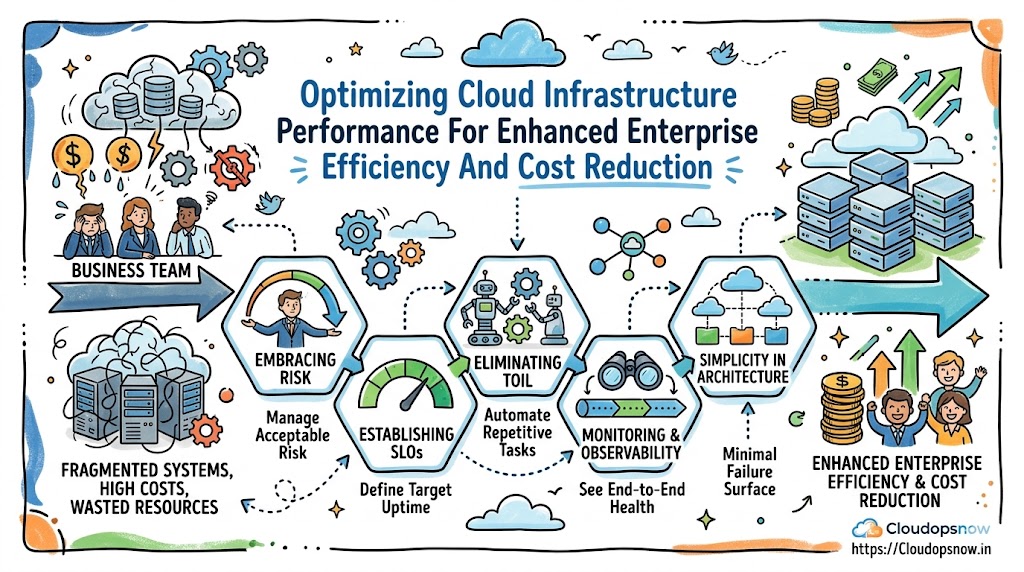
Picture this specific nightmare scenario: a sudden traffic spike hits your primary application during peak hours, and the system crashes instantly. Your engineering team scrambles, logging into separate servers, manually parsing log files, and debating the root cause while revenue drops by the second. This operational bottleneck highlights the deep fragility inherent in legacy infrastructure strategies.
Traditional IT management relies heavily on reactive interventions, which inevitably create massive financial waste and ongoing system instability. Fortunately, modern organizations use cloud operations to transition from a state of constant firefighting into a model of continuous, automated optimization.
Cloud operations refers to the strategic practice of managing, optimizing, and scaling cloud-native workloads to maximize application availability while minimizing structural expenses. As enterprises scale their digital footprints, managing cloud environments manually becomes entirely impossible. Modern teams require unified, software-driven frameworks to balance rapid software deployment with stringent financial control.
This comprehensive guide covers everything from foundational architectural principles to advanced financial management strategies. Read on to discover how your engineering organization can build highly resilient, cost-effective infrastructure.
Transforming your infrastructure requires a deliberate mix of advanced automation, cultural realignment, and deep environment visibility. Partnering with professional platform specialists helps your engineering organization streamline complex workflows, eliminate waste, and deploy software with total confidence. Explore the dedicated cloud management strategies and structural frameworks available at Cloudopsnow to elevate your delivery systems.
The Origin of Systems Infrastructure
The Early Industrial Bottlenecks
Historically, enterprise infrastructure management depended almost entirely on physical hardware housed inside local data centers. Procurement cycles lasted for months, forcing organizations to over-provision computing power based on hypothetical future capacity needs. When applications experienced unexpected traffic drops, expensive physical servers sat completely idle in climate-controlled server rooms.
Furthermore, separate engineering and operations teams worked in total isolation, communicating through rigid, slow ticketing systems. Developers focused exclusively on shipping new application features as quickly as possible, rarely considering production environment limitations. Meanwhile, traditional system administrators focused entirely on maintaining system uptime, making them deeply resistant to any code changes.
This structural disconnect created a highly combative work environment where software deployments felt inherently dangerous. Manual server configuration tracking led to extreme configuration drift across staging and production environments. Consequently, resolving minor software defects required hours of manual debugging, stalling overall business velocity.
Moving Toward Unified Workflow Automation
The arrival of cloud computing fundamentally changed the relationship between software applications and physical infrastructure components. Computing power transformed instantly into an on-demand utility, enabling teams to spin up complex virtual environments within minutes. However, this sudden elasticity introduced massive operational complexity that legacy tracking methods could not handle.
To survive, forward-thinking organizations began treating infrastructure components exactly like application software code. Teams started replacing manual server configurations with unified, automated deployment scripts that ensured absolute environmental consistency. This shift allowed developers and systems engineers to cooperate within a single, continuous delivery pipeline.
Breaking down these historic corporate silos completely transformed how enterprises build and maintain digital infrastructure. Automation replaced manual validation steps, allowing organizations to deploy software updates frequently without risking systemic crashes. As a result, companies achieved faster time-to-market metrics while maintaining high infrastructure reliability.
Global Expansion Across Commercial Ecosystems
As cloud adoption accelerated worldwide, digital enterprises realized that simple automation scripts were no longer sufficient. Managing thousands of distributed microservices across multiple geographical regions required a formal, highly structured operational framework. This demand triggered the global expansion of specialized cloud operations teams across major commercial ecosystems.
Today, global financial platforms, massive e-commerce networks, and rapid-growth technology startups all leverage these advanced methodologies. Operating with a uniform framework allows distributed teams to maintain consistent governance and security compliance standards. Modern infrastructure management is no longer a hidden background task; it is a core business driver.
[Legacy Data Centers] ──(Cloud Migration)──► [Elastic Infrastructure] ──(Workflow Automation)──► [Global Cloud Operations]
The widespread adoption of cloud architectures has fundamentally redefined the modern technical career landscape. Organizations now actively seek specialized professionals who possess deep software engineering skills alongside advanced infrastructure knowledge. Consequently, this operational paradigm has become the standard operational model for any enterprise pursuing digital transformation.
Defining Strategic Operations Management
The Core Operational Structure
Strategic operations management relies on a deeply integrated, highly resilient data architecture that spans across an entire enterprise cloud ecosystem. Data flows continuously from low-level cloud resources up to unified, central observability dashboards. This clear data pipeline ensures that engineering leaders always maintain complete visibility into system health.
[Cloud Infrastructure Components] ──► [Telemetry Data Aggregation] ──► [Observability Dashboards] ──► [Automated System Response]
The underlying technical structure connects system telemetry directly with automated infrastructure optimization mechanisms. When workloads experience load fluctuations, the control plane responds programmatically by scaling resources in real time. This architecture completely eliminates the need for manual capacity adjustments, protecting application performance during unexpected traffic spikes.
Daily Tasks of Systems Coordinators
Systems coordinators execute a diverse mix of software engineering tasks and proactive infrastructure optimization work. On any given day, these specialists design automated deployment pipelines, configure infrastructure-as-code files, and build observability frameworks. They treat infrastructure as a software problem, writing clean code to manage and scale cloud environments.
Additionally, these professionals spend significant time reviewing system telemetry data to identify hidden performance degradation patterns. They analyze application latency trends, optimize resource allocation parameters, and adjust cloud autoscaling boundaries. By focusing on proactive engineering, coordinators systematically prevent infrastructure failures before they impact end users.
Localized Control vs. Broad System Architecture
To implement this effectively, organizations must understand how localized component control differs from broad system architecture management. The table below details these fundamental structural variations:
| Operational Dimension | Localized Component Control | Broad System Architecture Management |
| Primary Scope | Individual virtual instances and microservices | Entire multi-region cloud infrastructures |
| Monitoring Focus | Specific server metrics and process logs | Comprehensive end-to-end data pipelines |
| Scaling Strategy | Manual or basic reactive scaling policies | Dynamic, predictive multi-resource scaling |
| Risk Management | Resolving isolated single-point failures | Architecting complete system disaster recovery |
Balancing these two distinct perspectives allows enterprise engineering teams to maintain high operational agility. While localized control ensures individual services run efficiently, broad architecture management guarantees long-term stability. Successful organizations integrate both viewpoints into their daily operational workflows.
The Efficiency Mindset
Transitioning to modern operations requires a deep cultural shift that prioritizes long-term system stability over short-term fixes. Engineering teams must adopt an efficiency mindset, viewing every manual intervention as an operational failure. If a system requires human assistance to recover from an outage, the underlying automation requires immediate redesign.
This mindset encourages engineering groups to embrace sustainable work patterns, eliminating the constant stress of recurring production emergencies. Teams allocate significant time to optimizing resource usage, cleaning up idle environments, and lowering cloud expenditures. Ultimately, operational efficiency becomes a shared organizational value that guides every architectural decision.
The 7 Core Principles of CloudOps
1. Embracing Risk and Managing Variability
Modern systems engineering acknowledges a fundamental, undeniable reality: achieving absolute, 100% infrastructure uptime is completely impossible. Component failures, network drops, and software bugs will always occur in complex, distributed cloud environments. Therefore, teams focus on managing acceptable systemic risk rather than chasing an unrealistic goal of flawless perfection.
Organizations quantify this acceptable risk by defining clear operational parameters for every user-facing application. By embracing risk explicitly, engineering teams can make informed decisions regarding software feature velocity and overall system stability. This balanced approach ensures that fear of infrastructure failure never paralyzes product innovation.
2. Establishing Service Level Objectives (SLOs)
Service Level Objectives serve as the primary foundational compass for modern infrastructure performance management. These specific, measurable targets define exactly how reliable an application must be from the perspective of the end user. For instance, a team might establish an SLO stating that 99.9% of user requests must return within 200 milliseconds.
[Raw System Metrics (SLI)] ──► [Target Goals (SLO)] ──► [Business Contracts (SLA)]
Establishing clear objectives removes emotional bias from technical decision-making when production issues emerge. If an application meets its target metrics, product teams can confidently ship risky new software features. Conversely, if metrics drop below the target, engineering priorities pivot immediately toward improving baseline system stability.
3. Eliminating Toil and Manual Processes
Toil represents any administrative, repetitive, and manual work that provides no long-term strategic value to an organization. Examples include manually provisioning virtual servers, resetting user passwords via command terminals, or running repetitive database cleanup scripts. Left unchecked, toil quickly overwhelms engineering departments, crushing overall morale and stalling product delivery.
[Identify Repetitive Tasks] ──► [Measure Engineering Time Spent] ──► [Develop Automation Scripts] ──► [Toil Eliminated]
Modern operational frameworks dictate that engineering teams must systematically automate these repetitive tasks away. Engineers spend their time designing robust software solutions that handle routine infrastructure management tasks independently. Eliminating toil ensures that human capital remains focused on high-value architectural improvements.
4. Monitoring & Observability Across the Pipeline
Simple infrastructure monitoring merely alerts a team when a specific component fails or stops responding entirely. In contrast, deep observability allows engineers to understand the internal state of a complex system based on external outputs. This approach relies on gathering three primary data streams: metrics, distributed request traces, and system logs.
Maintaining comprehensive visibility across the entire deployment pipeline ensures that engineering groups never operate with blind spots. Teams track how data moves through various microservices, isolating performance bottlenecks within seconds. This deep insights capability minimizes the time required to diagnose complex, intermittent application issues.
5. Automation Over Manual Coordination
Scaling modern cloud infrastructure requires a strict, unwavering commitment to software automation over human coordination. Manual configuration adjustments introduce human error, create documentation gaps, and drastically slow down incident response times. Therefore, teams build self-healing infrastructure systems that adapt programmatically to changing environmental conditions.
[System Anomaly Detected] ──► [Automated Policy Triggers] ──► [Resource Restructured] ──► [Normal State Restored]
Automated software agents handle everything from load balancing adjustments to security patch applications across server clusters. By replacing human intervention with programmatic workflows, organizations ensure absolute operational consistency across environments. This relentless focus on automation allows small engineering groups to manage massive, multi-region infrastructures smoothly.
6. Release Engineering and Deployment Stability
Release engineering focuses entirely on how software applications are built, tested, and deployed into live production environments. Teams implement continuous integration and continuous deployment pipelines to make software releases completely routine and boring events. Automated validation testing checks every code update, ensuring no defective software reaches end users.
Additionally, modern release engineering strategies rely on advanced deployment patterns like canary testing and blue-green environments. These techniques allow teams to route a tiny fraction of live user traffic to new software versions initially. If the update introduces any performance degradation, the deployment system routes traffic back automatically, preventing widespread user disruption.
7. Simplicity in Network Architecture
Complex, convoluted network architectures represent a major hidden breeding ground for catastrophic operational failures. As environments grow, sprawling configurations make it incredibly difficult to isolate performance bottlenecks or secure sensitive data paths. Therefore, modern systems management prioritizes clean, minimalist network design across all cloud environments.
Engineers focus on decoupling independent systems, minimizing inter-service dependencies, and keeping routing tables simple. Embracing clean architectural design directly reduces the overall system failure surface, making environments far easier to maintain. Simplicity ensures that when an infrastructure issue occurs, teams can isolate and fix the root cause rapidly.
Key Operational Concepts You Must Know
SLA vs. SLO vs. SLI — Explained Simply
To build a reliable cloud infrastructure, teams must understand the distinct definitions and relationships between SLAs, SLOs, and SLIs.
- Service Level Indicator (SLI): This represents a specific, quantifiable metric that measures the real-time performance of a service, such as request latency or error rate.
- Service Level Objective (SLO): This is a target reliability goal set for an SLI over a specific period, such as maintaining a 99.5% success rate monthly.
- Service Level Agreement (SLA): This is the legal, commercial contract that defines the financial consequences if the system fails to meet its SLO targets.
[SLI: What is the current metric?] ──► [SLO: What is our internal goal?] ──► [SLA: What are the commercial consequences?]
Understanding this clear hierarchy helps technical teams align their daily engineering efforts with real business outcomes. Engineers track SLIs to ensure systems meet internal SLO targets, which inherently protects the company from costly external SLA penalties.
Error Budgets — The Game Changer for Operational Risk
An error budget represents the exact amount of acceptable downtime or system instability an application can tolerate over time. Calculated mathematically as $1 – \text{SLO}$, this concept acts as a dynamic tension balance between software innovation and system safety. For example, if your application has a monthly SLO of 99.9% uptime, your available error budget is exactly 0.1%.
$$Error\ Budget = 100\% – SLO$$
Product owners and infrastructure engineers share this budget to drive strategic, data-backed operational decisions. As long as the error budget remains positive, software developers can aggressively ship new features into production. However, if an unexpected outage completely exhausts the error budget, feature releases halt instantly, and the team pivots to stability fixes.
Toil — The Silent Productivity Killer in Infrastructure
Toil acts as a silent drain on engineering productivity, gradually consuming valuable innovation time with repetitive manual work. To successfully identify and eliminate toil, engineering organizations follow a structured four-stage programmatic framework:
- Audit Routine Activities: Track all recurring operational tasks executed by systems engineers during each sprint cycle.
- Quantify Time Expenditures: Calculate the exact percentage of working hours consumed by repetitive, non-strategic tasks.
- Design Automated Alternatives: Write dedicated software scripts or leverage infrastructure tools to handle tasks programmatically.
- Validate Process Elimination: Monitor the operational pipeline to confirm that human intervention is no longer required.
Systematically applying this framework prevents administrative work from overwhelming your engineering talent. Organizations that limit toil to less than 50% of an engineer’s time ensure their staff remains energized, creative, and focused on strategic architecture.
Incident Management & Postmortems
When unexpected production outages occur, modern infrastructure teams resolve them using structured incident management processes. Engineers utilize automated alerting systems to assemble response teams instantly, assigning clear operational roles to handle the crisis. The primary objective during an active incident is always to restore normal system operations as quickly as possible.
[Outage Occurs] ──► [Automated Triage] ──► [Service Restoration] ──► [Blameless Postmortem]
Once the system stabilizes, the engineering team conducts a comprehensive, completely blameless postmortem review. This practice focuses entirely on discovering systemic, technical, or process flaws rather than pointing fingers at individual human mistakes. Documenting these lessons ensures that the organization updates its automation and prevents the identical issue from ever recurring.
Capacity Planning
Modern capacity planning balances real-time demand forecasting with strict infrastructure cost controls across cloud environments. Instead of manually purchasing hardware, teams analyze historical utilization trends to predict future compute resource needs. This data-driven approach ensures that applications scale seamlessly ahead of major traffic events.
Furthermore, capacity planning involves configuring intelligent autoscaling parameters that dynamically contract infrastructure during low-demand windows. Engineers run regular load testing simulations to verify that scaling rules trigger correctly under heavy stress. Effective capacity management guarantees high application performance while preventing unnecessary infrastructure spending.
The Four Golden Signals of Pipeline Performance
To maintain complete operational awareness, engineering teams monitor the four golden signals of pipeline performance:
- Latency: The exact time it takes to service a specific request, distinguishing successful requests from failed ones.
- Traffic: A direct measure of system demand, such as HTTP requests per second or network bandwidth consumption.
- Errors: The rate of requests that fail explicitly, return incorrect data, or time out entirely during execution.
- Saturation: A metric defining how full your system resources are, highlighting memory or CPU bottlenecks.
Tracking these four critical signals allows infrastructure specialists to spot system anomalies before they impact users. For instance, a sudden spike in saturation often serves as an early warning sign of impending application latency issues. Continuous visibility into these metrics forms the foundation of proactive, automated infrastructure management.
Platform Implementation vs. Culture — What’s the Real Difference?
The Philosophy Difference
Many organizations struggle to understand how broad cultural frameworks differ from concrete platform implementations. While some philosophies focus heavily on shifting corporate culture, other methodologies emphasize the engineering principles used to manage infrastructure. Culture encourages open communication, shared organizational empathy, and the total breakdown of historical corporate silos.
In contrast, platform implementation focuses on applying rigid software engineering practices directly to infrastructure operations. It provides the specific technical blueprints, metrics, and automated tools required to make those cultural goals achievable. Cultivating the right philosophy provides the core desire for collaboration, while implementation delivers the actual mechanics.
Roles & Responsibilities Compared
To understand how daily operational workloads are distributed, consider the following role-based recommendations and breakdowns:
- Cultural Collaborators
- Focus on optimizing end-to-end software delivery speed.
- Encourage continuous feedback loops between developers and operators.
- Promote shared organizational ownership of the production environment.
- Prioritize flexible workflow methodologies across different departments.
- Platform Engineers
- Build and maintain self-service developer platforms.
- Focus intensely on managing error budgets and systemic risk.
- Write software code to automate repetitive infrastructure tasks.
- Design and enforce strict, measurable application reliability targets.
Can You Have Both Disciplines?
Enterprise tech organizations do not need to choose between cultural philosophies and concrete platform implementations. In fact, modern engineering groups achieve maximum efficiency by combining both approaches within their operational structures. A strong collaborative culture creates the perfect environment for advanced platform engineering principles to thrive.
When these disciplines coexist, cultural frameworks define the high-level collaborative goals, while platform engineering handles execution. Developers write features confidently because platform engineers provide them with highly stable, automated deployment systems. This operational harmony allows enterprises to ship innovative features rapidly without sacrificing underlying system reliability.
Which One Should Your Team Adopt?
Choosing where to focus your engineering resources depends entirely on your current organizational size and technical maturity. The table below provides a clean decision framework to guide your infrastructure management strategy:
| Organizational Context | Cultural Philosophy Focus | Platform Implementation Focus |
| Small Startup (<20 Engineers) | High priority to establish collaborative habits | Minimal; use basic managed cloud services |
| Mid-Market Company (20-100 Engineers) | Medium priority; maintain communication | High priority; start automating core infrastructure |
| Large Enterprise (>100 Engineers) | Continuous reinforcement across siloed units | Critical; build dedicated platform engineering teams |
Smaller engineering teams should prioritize building an open, collaborative culture while keeping their infrastructure simple. As an organization scales past one hundred engineers, building a dedicated platform implementation team becomes absolutely essential. Aligning your strategy with organizational size prevents over-engineering while ensuring sustainable technical growth.
Real-World Use Cases of Modern Operations
How Tech Leaders Use Operational Metrics
Major software enterprises leverage real-time operational metrics to maintain global service availability around the clock. These industry leaders aggregate petabytes of telemetry data across distributed server networks into centralized analysis engines. Advanced tracking systems flag minor performance variations instantly, long before they escalate into widespread outages.
By correlating system metrics with business KPIs, these organizations can make data-driven infrastructure decisions. For example, if a latency increase correlates with dropped shopping carts, engineers optimize those specific microservices immediately. This data-driven operational approach directly protects company revenue while optimizing infrastructure investments.
Chaos Engineering Approaches to Resilient Systems
Top-tier engineering organizations do not sit around waiting for infrastructure failures to happen unexpectedly. Instead, they practice chaos engineering, intentionally injecting controlled failures into live production environments. Engineers deploy automated tools that randomly disable virtual servers, simulate network drops, or corrupt database connections.
[Inject Controlled Failure] ──► [Observe System Behavior] ──► [Identify Weaknesses] ──► [Harden Automation]
This proactive disruption practice allows teams to verify that their self-healing automation systems respond correctly. If a system fails to recover automatically during a simulation, engineers fix the architectural weakness immediately. Chaos engineering transforms unexpected production failures into completely predictable, controlled technical events.
Handling Reliability at Massive Scale
Managing distributed microservice architectures that process millions of concurrent transactions requires advanced architectural design. Large-scale enterprises rely on deep observability to trace individual user requests across hundreds of independent services. If a single downstream database slows down, the system isolates it instantly to prevent cascading failures.
These massive environments utilize intelligent traffic routing to distribute workloads dynamically across multiple geographic cloud regions. If a localized power outage hits a data center, automated control systems shift traffic away seamlessly. Users experience completely uninterrupted application access, completely unaware of the underlying infrastructure disruption.
High-Availability in Fintech Operations
Financial technology platforms operate within rigid regulatory environments that demand zero tolerance for transaction downtime or data loss. Fintech infrastructure teams implement multi-region active-active architectures that process financial transactions simultaneously across isolated cloud environments. Every single component features complete structural redundancy to protect critical transactional data paths.
                            ┌──► [Cloud Region A (Active)] ──┐
[Incoming Transaction] ────┼                                ┼──► [Consensus Data Store]
                            └──► [Cloud Region B (Active)] ──┘
These platforms utilize advanced consensus algorithms to ensure absolute data consistency across distributed ledger networks. Automated security compliance engines scan configurations continuously, blocking any unauthorized modifications instantly. This blend of high availability and automated compliance ensures maximum transactional safety and trust.
Scaled-Down but Essential Systems for Startups
Early-stage startups lack the massive budgets and engineering headcount of global tech enterprises. However, these agile teams still apply core operational principles efficiently by leveraging managed cloud services. Startups use automated infrastructure-as-code templates to deploy reproducible environments without manual intervention.
By establishing clear SLOs early, small teams avoid wasting precious engineering hours chasing unnecessary perfection. They automate simple code testing and deployment pipelines, allowing developers to ship features safely. Applying these lightweight practices early builds a highly scalable architectural foundation for future business growth.
Common Mistakes in Operations Engineering
Mistake 1 — Confusing System Management with Just Being On-Call
A major, widespread error organizations make is assuming that operations engineering simply means having developers take turns answering emergency alerts. True operations management is an active engineering discipline focused on designing software solutions to optimize system reliability. Simply forcing exhausted engineers to triage recurring production fires fixes absolutely nothing long-term.
When teams focus exclusively on incident response rather than proactive engineering, structural technical debt accumulates rapidly. Engineers spend their shifts applying temporary patches rather than fixing root architectural flaws. To succeed, organizations must give engineers dedicated time to build sustainable automation.
Mistake 2 — Setting Unrealistic SLOs
Inexperienced product owners often demand 100% uptime, assuming that aiming for anything less represents an operational failure. However, pursuing absolute perfection drastically stalls feature deployment velocity and dramatically escalates infrastructure costs. Every extra decimal point of availability requires massive structural redundancy and deep engineering overhead.
$$99\% \rightarrow 99.9\% \rightarrow 99.99\% \quad \text{(Exponential Cost Curve Over Time)}$$
Demanding unrealistic uptimes quickly burns out your engineering staff and frustrates product teams who want to innovate. Organizations must establish rational, data-driven goals that align with actual customer satisfaction metrics. Uptime targets should be high enough to satisfy users, yet flexible enough to permit regular development.
Mistake 3 — Ignoring Toil Until It’s Too Late
When engineering leadership ignores repetitive manual tasks, operational toil grows exponentially alongside infrastructure expansion. Eventually, engineers spend their entire working days manually executing server restarts, provisioning environments, and cleaning database logs. This administrative burden completely stalls strategic engineering initiatives and halts product innovation.
Neglecting toil also causes high staff turnover, as skilled engineers grow frustrated performing boring, repetitive tasks. Organizations must monitor toil metrics closely, ensuring it never consumes more than half of an engineer’s time. Treating toil as an active technical liability protects team velocity and engineering morale.
Mistake 4 — Skipping Blameless Postmortems
When an organization embraces a toxic culture of blame, engineers actively hide mistakes to protect themselves from corporate punishment. When production outages occur, teams focus on finding a human scapegoat rather than analyzing systemic technical vulnerabilities. Consequently, the underlying architectural flaw remains completely unaddressed, guaranteeing the failure will happen again.
[Blame Culture]   ──► [Engineers Hide Mistakes] ──► [System Flaws Remain] ──► [Catastrophic Outage]
[Blameless Culture] ──► [Transparent Analysis]  ──► [Automation Hardened]  ──► [Resilient Infrastructure]
Skipping honest, transparent postmortems dooms an engineering organization to repeat identical operational mistakes indefinitely. Building a truly blameless culture allows teams to examine system failures with total honesty. Identifying the true root cause is the only path toward hardening automation frameworks.
Mistake 5 — Monitoring Without Actionable Alerts
Configuring monitoring systems to blast notification channels for minor, non-critical events creates massive alert fatigue. Engineers bombarded with hundreds of noisy, irrelevant warnings daily quickly learn to ignore notifications entirely. Consequently, when a critical, system-threatening outage actually occurs, the vital warning goes completely unnoticed.
[Excessive Alert Noise] ──► [Engineers Deaden Responsiveness] ──► [Critical Alert Missed] ──► [Extended Downtime]
Every configured alert must point directly to an actionable issue requiring human engineering intervention. If an alert requires no immediate action, it belongs in a log file, not an emergency notification channel. Refining your alerting criteria keeps response teams sharp and drastically lowers system restoration times.
Mistake 6 — Not Involving Operational Engineers in the Design Phase
Excluding operational specialists from early application architectural design sessions represents a recipe for production instability. Software developers often design complex features without considering real-world network latency, data replication limits, or scaling constraints. When deployed, these unoptimized applications quickly buckle under actual production workloads.
System architectural design requires deep operational input from day one of the product development lifecycle. Operational specialists ensure that applications are built for easy monitoring, smooth scaling, and rapid deployment. Involving them early prevents expensive structural redesigns later down the road.
Essential Infrastructure Tools & Technologies
Monitoring & Observability
Maintaining complete operational awareness across complex cloud deployments requires a robust stack of specialized software tools. Engineers utilize advanced observability engines to track infrastructure performance and isolate errors instantly. The table below lists the primary tools used across the industry today:
| Technology Name | Primary Category | Core Operational Function |
| Prometheus | Monitoring & Observability | Scraping and storing time-series metric data |
| Grafana | Monitoring & Observability | Visualizing infrastructure metrics via dashboards |
| Datadog | Monitoring & Observability | Enterprise cloud monitoring and log aggregation |
| New Relic | Monitoring & Observability | Full-stack application performance monitoring |
Implementing these technologies ensures that your engineering groups never operate blindly in production environments. These platforms aggregate telemetry data, allowing teams to spot performance regressions within seconds. Comprehensive visibility forms the necessary starting foundation for all automated self-healing workflows.
Incident Management
When critical outages strike, organizations rely on PagerDuty to orchestrate their technical incident responses. This platform integrates directly with monitoring tools, routing critical alerts to on-call engineers based on custom rotation schedules. PagerDuty ensures that the correct specialists assemble instantly to triage systemic emergencies.
The platform tracks response metrics, helping leadership evaluate overall incident resolution efficiency over time. Using structured coordination tools minimizes communication chaos during complex, high-pressure infrastructure failures. Efficient incident management allows teams to restore normal application operations before widespread customer disruption occurs.
CI/CD & Release Engineering
Automating application delivery requires robust continuous integration and deployment platforms like Jenkins, Spinnaker, and Argo CD. Jenkins serves as a core automation engine, compiling code, running tests, and packaging software artifacts seamlessly. It eliminates manual intervention from the early stages of the software release pipeline.
For Kubernetes-native environments, teams leverage Argo CD and Spinnaker to manage complex application deployment patterns. These tools enforce GitOps principles, ensuring live cluster configurations match version-controlled code repositories exactly. Automated release engines make deployments routine, safe, and easily reversible if issues emerge.
Chaos Engineering
To uncover hidden infrastructure weaknesses proactively, modern systems engineers leverage Chaos Monkey. Developed to test cloud resilience, this tool intentionally disables production servers in a completely randomized fashion. Forcing regular disruptions ensures that underlying architectures tolerate individual component losses without failing completely.
Using chaos engineering tools shifts an organization’s mindset from reactive firefighting to proactive system hardening. Engineers design software components to fail gracefully, knowing that automated disruptions occur constantly. This practice builds highly resilient, self-healing software ecosystems that handle real-world emergencies effortlessly.
SLO Management
Tracking service reliability against user expectations requires specialized objective management platforms like Nobl9. This software integrates with existing monitoring tools to calculate error budgets and track SLO compliance continuously. Nobl9 gives engineering leaders clear, real-time data regarding system risk tolerances.
[Data Inputs: Prometheus/Datadog] ──► [Nobl9 Analytics Engine] ──► [Real-Time Error Budget Status]
Centralizing your reliability objectives removes emotion from feature release planning and infrastructure investment choices. When error budgets deplete, Nobl9 alerts teams, triggering automated workflows to halt deployments and prioritize stability. Managing objectives programmatically aligns engineering focus with customer experience goals.
How to Become an Operations Expert — Career Roadmap
Skills Every Specialist Must Have
Breaking into this specialized engineering field requires mastering a diverse mix of software and systems competencies. Aspiring professionals must develop deep familiarity with Linux terminal commands, shell scripting, and network protocol fundamentals. You must feel completely comfortable navigating remote server environments and diagnosing network configurations using command-line utilities.
Additionally, specialists must master modern programming languages like Python or Go to write clean infrastructure automation tools. You need to understand how to build containerized applications and manage them using Docker and Kubernetes. Combining core software development skills with deep networking knowledge forms the bedrock of expertise.
The Professional Learning Path
The journey toward senior systems architecture begins with mastering basic operating system concepts and manual server administration. Next, transition into studying infrastructure-as-code principles, learning to provision cloud environments programmatically using code configuration files. This step teaches you how to eliminate manual server adjustments entirely.
[SysAdmin Basics] ──► [Infrastructure-as-Code] ──► [Observability Pipelines] ──► [Senior Enterprise Architect]
Once you master automated provisioning, focus on building comprehensive observability pipelines and advanced deployment strategies. Learn to configure distributed tracing systems and manage shared error budgets across product teams. Reaching the senior architect level requires a deep understanding of multi-region system design and disaster recovery.
Certifications Worth Pursuing
Earning industry-recognized credentials validates your specialized technical expertise and opens advanced career opportunities worldwide. Aspiring engineers should target foundational certifications from major public cloud providers to demonstrate core platform mastery. Additionally, specialized credentials focusing on container orchestration are highly valued by enterprise tech employers.
                             ┌──► [AWS Certified DevOps Engineer]
[Cloud Infrastructure Path] ──┼──► [Google Cloud Professional DevOps]
                             └──► [Certified Kubernetes Administrator (CKA)]
Achieving these certifications proves you understand how to design, build, and maintain secure, scalable cloud ecosystems. These technical credentials serve as an objective benchmark of your practical engineering abilities. Continuous professional credentialing keeps your technical skill set sharp and aligned with modern industry trends.
Educational Resources with Cloudopsnow
Navigating the complex, rapidly evolving landscape of modern cloud infrastructure requires structured, expert-led technical guidance. Aspiring specialists and enterprise teams can accelerate their learning curve by leveraging the comprehensive resources available through professional engineering platforms. Accessing structured learning paths saves months of frustrating, unguided trial and error.
By engaging with the curated technical material and enterprise frameworks at Cloudopsnow, you gain deep operational insights. Their specialized educational content covers everything from foundational automation paradigms to advanced cost optimization models. Investing in structured professional development equips your team with the skills necessary to manage modern digital ecosystems.
The Future of Systems Management
AI and Automation in System Optimization
The next generation of infrastructure management relies heavily on incorporating machine learning models into telemetry data pipelines. AI-driven operations platforms analyze massive streams of system metrics to detect subtle operational anomalies ahead of time. These smart systems predict impending hardware resource exhaustion, triggering automated scaling fixes before a crash occurs.
[Telemetry Stream] ──► [AI Anomaly Detection Models] ──► [Predictive Mitigation] ──► [Zero-Downtime Operation]
Furthermore, machine intelligence speeds up root cause analysis during complex, multi-service production outages. Instead of humans reading log files for hours, AI engines isolate defective code changes within seconds. This integration of intelligence lowers system repair times, freeing engineers to focus entirely on innovation.
Platform Engineering — The Evolution of Infrastructure
Platform engineering represents the next logical phase in the ongoing evolution of enterprise cloud infrastructure management. Instead of configuring separate environments for developers, platform engineers build centralized internal developer portals. These self-service portals allow software developers to provision secure, compliant workspaces independently with one click.
This shift treats infrastructure as an internal software product designed specifically to maximize developer velocity. Portals bake security policies and resource constraints directly into the automated provisioning templates. Consequently, developers ship applications faster, while the enterprise maintains complete governance over cloud spend.
Management in Cloud-Native & Kubernetes Environments
As organizations migrate toward large-scale containerized applications, managing multi-cluster Kubernetes deployments introduces unique challenges. Dynamic container environments scale rapidly, generating highly complex networking topologies and transient telemetry paths. Modern operations specialists design advanced mesh networks to manage data security across clusters.
[Global Load Balancer] ──► [Service Mesh Layer] ──► [Dynamic Container Clusters (Kubernetes)]
Future systems engineering demands absolute mastery of declarative configuration patterns and state-reconciliation mechanisms. Teams build automated software operators that constantly monitor live cluster states against code configurations. This automation layer maintains absolute infrastructure consistency, allowing environments to self-heal continuously.
Operational Skills That Will Matter Most
Looking forward, the absolute most valuable operational skill sets will revolve around financial optimization and deep observability design. Engineers must evolve beyond simply ensuring application uptime; they must guarantee that availability is achieved cost-effectively. Financial engineering skills will become a core requirement for senior infrastructure architects globally.
Additionally, mastering distributed data tracing and deep telemetry pipeline architecture will differentiate top-tier engineering talent. Specialists who can map complex data interactions across hybrid cloud environments will remain in high demand. Cultivating this balance of financial awareness and deep technical insight ensures long-term career growth.
FAQ Section
- What is the typical career path for someone entering this technical field?Most professionals begin their journey as traditional system administrators, network engineers, or junior software developers. Over time, they acquire specialized skills in automation, cloud computing platforms, containerization tools, and infrastructure-as-code principles. This specialized training allows them to transition smoothly into roles like platform engineer, reliability specialist, or senior infrastructure architect.
- How do these modern methodologies differ from traditional IT operations frameworks?Traditional IT operations rely heavily on reactive manual troubleshooting, rigid siloed teams, and separate ticketing systems. Modern engineering frameworks treat infrastructure as a software problem, relying on continuous automation and deep observability. Teams prioritize shared risk management through error budgets, systematically eliminating manual toil to maximize overall software delivery velocity.
- What are the average salary trends for infrastructure automation specialists?Due to the massive global demand for cloud optimization expertise, certified specialists command excellent compensation packages worldwide. Senior platform engineers and reliability architects frequently earn premium salaries that match or exceed senior software developer compensation. Exact figures vary by region and experience, but the financial trajectory remains exceptionally strong across tech sectors.
- Why is an error budget considered a game-changer for software engineering teams?An error budget mathematically balances the natural tension between shipping new features rapidly and maintaining system stability. It provides an objective, data-driven framework that removes emotional arguments between product developers and infrastructure operators. This clear metric guides feature deployment velocity dynamically based on real-time application performance data.
- Can small startups benefit from these principles without massive engineering overhead?Absolutely, because these core architectural principles scale down efficiently to match any organizational footprint perfectly. Startups leverage fully managed cloud services and simple infrastructure automation scripts to minimize manual administrative overhead. Establishing basic observability habits early builds a highly resilient foundation, preventing future technical debt as the business expands.
- What specific technical certifications help validate infrastructure architecture expertise?Professionals should focus on earning advanced DevOps or architecture credentials from major cloud platforms like AWS, Azure, or Google Cloud. Additionally, achieving the Certified Kubernetes Administrator designation from the Cloud Native Computing Foundation is highly respected across the tech industry. These rigorous credentials formally demonstrate your practical ability to design and manage complex cloud environments.
Final Summary
Maintaining optimal infrastructure health requires a continuous, data-driven balance between rapid software innovation and proactive environmental stabilization. Modern cloud operations completely replaces outdated reactive habits with a unified framework of automated deployment pipelines, clean network architectures, and deep observability. Prioritizing objective reliability metrics ensures that your digital applications scale efficiently while maintaining absolute financial control. Ultimately, building resilient infrastructure is an iterative engineering journey that directly empowers your organization to innovate with confidence. Exploring advanced cloud management frameworks through Cloudopsnow provides your team with the structural expertise needed to optimize performance and reduce expenditures.
