Introduction
Cloud computing and distributed applications have changed how organizations build, deploy, and operate IT systems. Workloads now span virtual machines, containers, managed databases, microservices, and multi-region networks that scale dynamically in response to user demand.
Keeping modern systems running smoothly requires two closely related goals: managing the underlying cloud infrastructure well and maintaining dependable application reliability for users. If infrastructure is poorly governed or insecure, applications face instability; if application reliability is left unmeasured, frequent outages and slow responses can erode trust even when servers are online.
CloudOps (cloud operations) focuses on managing, securing, and optimizing cloud infrastructure, platforms, and services. Site Reliability Engineering (SRE) applies software engineering principles to operational challenges to maintain measurable service reliability, resilience, and efficiency.
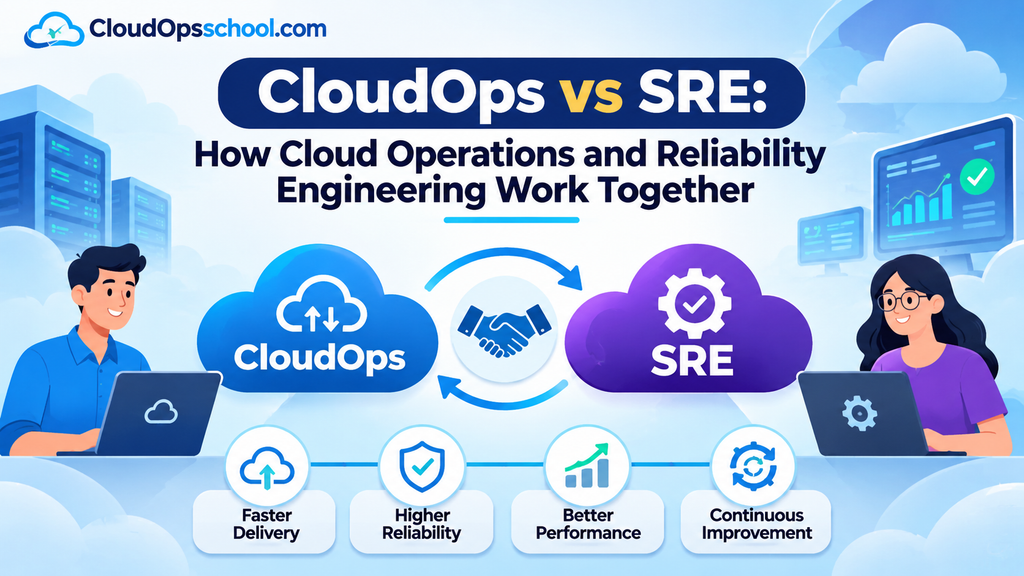
Organizations often combine or pair these responsibilities depending on team size, architectural complexity, and operating maturity. Understanding CloudOps vs SRE helps teams see how these disciplines differ, where their practices overlap, and how they work together rather than competing with one another.
What Is CloudOps?
CloudOps is the operational discipline responsible for provisioning, managing, monitoring, securing, and optimizing cloud infrastructure, platforms, and services. While it covers day-to-day execution, CloudOps is broader than routine server upkeep or initial provisioning—it spans governance, resilience, capacity, and resource efficiency across cloud environments.
Primary Objectives of CloudOps
- Infrastructure availability: Keeping compute, network, storage, and managed cloud services accessible and operational.
- Cloud resource management: Organizing accounts, environments, and cloud resources cleanly across teams.
- Operational stability: Maintaining predictable system behavior through controlled changes and standard configurations.
- Security and governance: Enforcing identity controls, network boundaries, encryption, compliance baselines, and organizational policies.
- Performance monitoring: Tracking infrastructure metrics and service health to spot bottlenecks or faults early.
- Resource optimization: Aligning capacity and instance sizing with workload needs and cost awareness.
- Infrastructure automation: Replacing manual setup and repetitive operations with repeatable, automated workflows.
Main Responsibilities of CloudOps
- Cloud infrastructure provisioning: Creating virtual machines, clusters, databases, and managed cloud services.
- Virtual machine and container management: Maintaining host images, runtimes, node pools, and underlying platform components.
- Cloud networking and storage: Configuring virtual networks, subnets, load balancers, DNS, block/object storage, and routing.
- Identity and access management (IAM): Applying least-privilege access roles, policies, and credentials.
- Configuration and patch management: Keeping operating systems, agents, and platform configurations updated and consistent.
- Backup and disaster recovery: Managing snapshots, replication, failover readiness, and recovery workflows.
- Incident response: Detecting, diagnosing, and resolving infrastructure disruptions and service impairments.
- Cloud resource scaling: Adjusting capacity up or down to match workload demand and maintain responsiveness.
- Cloud cost management: Monitoring resource utilization, idle capacity, and spending patterns to support cost-conscious operations.
Multi-Environment Support and Practical Example
CloudOps supports public, private, hybrid, and multi-cloud environments, adapting operational guardrails and automation to each environment’s architecture.
For example, suppose an organization runs a customer portal across two cloud regions with managed relational databases and container clusters. CloudOps provisions the virtual networks, IAM roles, load balancers, and database replicas using templates, monitors disk and network health, automates OS patching and snapshots, scales worker nodes during peak hours, and leads infrastructure recovery if a region experiences an impairment.
What Is Site Reliability Engineering (SRE)?
Site Reliability Engineering (SRE) is an engineering discipline that applies software engineering principles, automation, and quantitative measurement to operational problems. Rather than treating reliability as an informal expectation or manual firefighting task, SRE treats reliability as a core engineering target. Although SRE originated in large-scale production environments, its practices are not limited to public cloud—they can be applied across cloud, hybrid, and on-premises infrastructure models.
Primary Objectives of SRE
- Service availability: Ensuring user-facing services meet defined uptime expectations over time.
- Reliability: Delivering consistent, dependable service behavior across normal load and partial failures.
- Performance and latency: Keeping response times within acceptable bounds for users and dependent services.
- Scalability: Helping systems handle growth and traffic shifts without reliability degradation.
- Resilience: Designing and validating systems so faults in one component do not cause cascading outages.
- Automation: Building software and automated workflows to handle recurring operational tasks reliably.
- Operational toil reduction: Minimizing manual, repetitive, interrupt-driven work that does not produce lasting engineering value.
Essential SRE Concepts
- Service Level Indicators (SLIs): Quantitative measures of service behavior—such as request success rate, tail latency, or throughput.
- Service Level Objectives (SLOs): Target reliability levels or thresholds for an SLI over a given window (for example, 99.9% of requests succeeding within 200 ms over 30 days).
- Service Level Agreements (SLAs): External or contractual commitments with customers or stakeholders, often tied to business terms or remedies when missed.
- Error budgets: The allowable amount of unreliability implied by an SLO (for instance, a 99.9% availability target allows 0.1% unavailability over the window), used to balance reliability with release velocity and experimentation.
- Blameless postmortems: Structured incident reviews focused on system causes, contributing factors, and preventive fixes rather than blaming individuals.
- Capacity planning: Modeling future traffic, growth, and resource headroom so services stay reliable under demand changes.
Balancing Reliability with Software Changes
Shipping new features and updates quickly creates risk if changes introduce bugs, latency spikes, or configuration issues. SRE uses SLOs and error budgets to make trade-offs explicit: when error budgets are healthy, teams have room to ship changes and test improvements; when error budget consumption runs high, teams prioritize stability, observability, and reliability fixes before pushing risky changes.
Practical Example of SRE in Action
Consider a payment processing service where checkout requests occasionally time out during peak traffic. An SRE team defines SLIs for checkout availability and p95 latency, sets clear SLOs, and traces slow calls across microservices and database queries. They discover lock contention and retry storms under load, implement request timeouts, rate limiting, and automated circuit-breaking or runbook automation, and track error-budget burn during subsequent releases to verify that latency stays within target.
How CloudOps Works
A typical CloudOps workflow turns workload needs into secure, governed, and well-maintained cloud infrastructure:
- Assess cloud infrastructure and workload requirements: Review compute, memory, storage, network, security, and availability needs.
- Provision cloud resources: Create virtual machines, clusters, storage volumes, and cloud services.
- Configure networking, storage, IAM, and security: Set up VPCs, security groups, access policies, encryption, and compliance rules.
- Deploy and maintain cloud services: Roll out platform components and keep operating systems and configurations current.
- Monitor infrastructure health and performance: Track CPU, memory, disk, network, and service health metrics.
- Manage resource scaling and utilization: Adjust capacity to match demand and avoid sustained over- or under-utilization.
- Respond to cloud infrastructure incidents: Investigate and resolve infrastructure faults, outages, or degraded resources.
- Maintain backups and disaster recovery: Verify backup completion, replication health, and recovery readiness.
- Review security, governance, and operational costs: Audit policy compliance, access controls, and cloud resource spend.
- Continuously improve infrastructure efficiency: Refine templates, automation, and capacity allocations over time.
This workflow keeps cloud environments secure, available, and operationally efficient as workloads evolve.
How SRE Works
A typical SRE workflow uses engineering rigor and measurable reliability targets to keep services dependable:
- Identify critical applications and services: Map core user journeys and high-impact systems that drive business value.
- Understand user expectations and service requirements: Clarify acceptable latency, availability, and data consistency needs.
- Define SLIs and SLOs: Choose accurate reliability indicators and set realistic, measurable objectives.
- Establish reliability targets and error budgets: Translate SLOs into error budgets that guide release and risk decisions.
- Implement monitoring and observability: Instrument metrics, logs, and distributed traces across services and dependencies.
- Detect and investigate service degradation: Use alerts and telemetry to spot symptoms early and pinpoint root causes.
- Automate repetitive operational tasks: Replace recurring manual interventions with scripts, self-healing logic, or automated workflows.
- Respond to incidents and restore services: Coordinate triage, mitigation, and communication to restore user-facing health.
- Conduct blameless postmortems: Document timelines, contributing factors, and action items without individual blame.
- Implement long-term reliability improvements: Code systemic fixes, improve resilience patterns, and update capacity plans.
Through this cycle, SRE turns reliability from an ad-hoc effort into an ongoing engineering practice.
CloudOps vs SRE – Key Differences
Section 6 below presents the 20-row comparison table, followed by practical examples and notes on overlapping roles.
Practical Examples of Key Differences
- High CPU on a host vs. slow user checkout: If a virtual machine runs out of disk space or loses network connectivity, CloudOps addresses the underlying infrastructure fault and restores resource health. If checkout latency rises because a downstream dependency times out or retries pile up, SRE investigates request traces, error rates, and SLO/error-budget impact to fix service resilience.
- Scaling before a campaign: CloudOps provisions extra compute capacity, configures auto-scaling rules, and verifies backups and network bandwidth. SRE models expected request rates and concurrency, sets latency and availability targets, and tunes timeouts, queues, and load shedding so user requests do not fail under pressure.
Responsibility Overlap in Practice
CloudOps and SRE are distinct disciplines, but their responsibilities frequently overlap—especially in smaller engineering organizations where lean teams cannot split every operational role. A single engineer or small team may provision cloud resources, write Infrastructure as Code, manage monitoring, handle incidents, and track reliability targets. What matters most is clarity around who owns which outcomes when systems scale.
Similarities Between CloudOps and SRE
Despite different primary lenses, CloudOps and SRE share core engineering and operational principles:
- Automation of repetitive work: Both use automation to reduce manual errors and speed up routine tasks.
- Infrastructure as Code: Both favor declarative, version-controlled infrastructure definitions over ad-hoc manual changes.
- Monitoring and observability: Both rely on telemetry, alerts, and diagnostic data to understand system behavior.
- Incident response: Both play vital roles in detecting, investigating, and resolving production disruptions.
- Capacity planning: Both evaluate demand and resource headroom to prevent bottlenecks.
- Service availability: Both care deeply about keeping systems accessible and dependable.
- Performance optimization: Both work to eliminate bottlenecks and improve responsiveness.
- Cloud infrastructure knowledge: Both require practical understanding of compute, networking, storage, and cloud services.
- Continuous improvement: Both treat reliability and efficiency as ongoing iterative work.
- Operational efficiency: Both seek sustainable ways to run systems without excessive manual overhead.
- Collaboration across engineering teams: Both depend on clear communication with developers, security, product, and leadership.
These shared habits help organizations build stable and reliable cloud environments.
Roles and Responsibilities of a CloudOps Engineer
A CloudOps Engineer focuses on keeping cloud infrastructure and platform services healthy, secure, and well-managed. Common responsibilities include:
- Provisioning and managing cloud infrastructure: Creating and maintaining compute, storage, network, and platform resources.
- Managing virtual machines, containers, and cloud services: Supporting VMs, container platforms, and managed services across environments.
- Configuring cloud networking and storage: Managing VPCs, subnets, firewalls, load balancers, storage tiers, and data transfer settings.
- Managing IAM and access policies: Implementing roles, permissions, keys, and identity controls.
- Monitoring infrastructure health: Tracking host, cluster, network, and service metrics and alerts.
- Managing cloud security and compliance controls: Enforcing security baselines, patching, encryption, and governance rules.
- Handling infrastructure incidents: Triaging and resolving cloud resource outages, network issues, or service faults.
- Managing backups and disaster recovery: Overseeing snapshots, replication, and recovery procedures.
- Automating cloud operations: Building IaC modules, automation scripts, and repeatable operational workflows.
- Managing capacity and resource utilization: Monitoring usage and scaling resources to match workload needs.
- Reviewing cloud performance and costs: Checking infrastructure efficiency and operational cost trends.
- Maintaining infrastructure availability: Supporting uptime across cloud environments.
To succeed, CloudOps Engineers need strong skills in cloud platforms, networking, systems administration, security, and automation.
Roles and Responsibilities of an SRE Engineer
An SRE Engineer applies software and systems engineering to measure, protect, and improve service reliability. Common responsibilities include:
- Defining SLIs and SLOs: Establishing meaningful reliability indicators and targets for critical services.
- Managing service reliability targets: Tracking reliability performance and guiding release trade-offs.
- Monitoring application performance: Observing latency, errors, saturation, and service dependencies.
- Tracking error budgets: Monitoring reliability budget consumption and helping teams respond when budgets run low.
- Automating operational tasks: Writing code and automation to handle recurring operational actions.
- Reducing repetitive toil: Identifying and eliminating manual, repetitive operational work.
- Troubleshooting production incidents: Investigating complex service degradation and failures across distributed systems.
- Supporting incident response: Coordinating mitigation, diagnosis, and recovery during outages.
- Conducting blameless postmortems: Leading objective reviews and tracking systemic follow-up improvements.
- Performing capacity planning: Forecasting traffic and resource needs to preserve reliability at scale.
- Improving service resilience: Strengthening timeouts, retries, fallbacks, degradation modes, and load handling.
- Designing reliable distributed systems: Partnering with developers on architecture choices that improve fault tolerance.
- Building self-healing capabilities: Creating automated health checks, restarts, or recovery mechanisms where appropriate.
SRE Engineers benefit from strong programming, systems engineering, cloud infrastructure, and observability skills.
Monitoring and Observability – CloudOps vs SRE
Monitoring and observability overlap in tooling and telemetry, yet they answer different questions during daily operations and troubleshooting.
CloudOps Monitoring
- Cloud resource health: Status and availability of instances, managed services, and cloud control planes.
- Virtual machine and container health: Host CPU, memory, disk I/O, container restarts, and node status.
- Network performance: Bandwidth, packet loss, DNS health, load balancer health, and connectivity.
- Storage utilization: Volume capacity, IOPS, throughput, and backup job health.
- Cloud service availability: Uptime and health signals across infrastructure components.
- Infrastructure capacity: Available headroom for compute, storage, and network scaling.
- Security and configuration alerts: Drift detection, policy violations, or anomalous access events.
SRE Observability
- Application availability: Success vs. failure rates for user requests and API calls.
- Request latency: Response time distributions (such as p95 or p99) across endpoints and workflows.
- Error rates: HTTP/gRPC error codes, exceptions, and failed transactions.
- Service dependencies: How upstream and downstream services affect one another.
- Distributed traces: End-to-end request paths across microservices to pinpoint bottlenecks.
- User-facing performance: How real or synthetic user journeys behave in production.
- SLO compliance: Whether services are meeting reliability objectives over time.
- Reliability trends: Long-term patterns in error rates, latency, and error-budget burn.
Combining Infrastructure and Application Signals
Combining infrastructure metrics with application-level observability speeds up root-cause analysis. For example, if API latency spikes, application traces may show slow database queries, while CloudOps host and storage metrics reveal high disk queue depth or memory pressure on the database tier—pointing directly to where action is needed.
Incident Management and Reliability
Production incidents test both operational readiness and reliability engineering. Clear division of focus—paired with smooth coordination—helps teams resolve issues faster.
CloudOps Responsibilities
- Detect infrastructure failures: Spot down instances, network partitions, storage errors, or cloud service issues.
- Investigate cloud service and resource problems: Inspect infrastructure logs, metrics, and cloud status.
- Restore affected infrastructure: Replace unhealthy nodes, fix network/IAM settings, or scale resources.
- Manage network and storage issues: Resolve routing, load balancing, volume, or throughput problems.
- Support backup and recovery: Execute restores or failover steps when data or infrastructure is impacted.
- Coordinate with cloud providers when required: Open and manage provider support cases during upstream issues.
SRE Responsibilities
- Assess user-facing service impact: Determine which features, users, or SLAs/SLOs are affected.
- Investigate application reliability issues: Analyze traces, logs, error rates, and recent deployments or config changes.
- Manage SLO and error-budget implications: Track how the incident affects error budgets and release plans.
- Coordinate incident response: Help organize triage, mitigation steps, and status updates during complex events.
- Identify recurring failure patterns: Spot repeat symptoms across incidents or services.
- Conduct blameless postmortems: Lead structured reviews to uncover systemic root causes.
- Implement engineering improvements: Build code, configuration, or automation changes to prevent recurrence.
Coordinating During a Major Production Outage
During a major outage, CloudOps and SRE can work together cleanly by dividing immediate focus while sharing updates: CloudOps stabilizes underlying infrastructure, networking, storage, and cloud resources, while SRE evaluates user-facing impact, traces application/service behavior, and coordinates mitigation and post-incident follow-ups.
Automation and Infrastructure Management
Both disciplines rely heavily on automation, though their typical targets emphasize different layers of the stack.
CloudOps Automation
- Infrastructure provisioning: Automated creation of networks, compute, storage, and cloud environments.
- Configuration management: Keeping host and service settings consistent across fleets.
- Patch management: Automating OS and runtime updates on defined schedules.
- Backup scheduling: Automating snapshot creation, retention, and replication checks.
- Resource scaling: Automating capacity adjustments based on load or schedules.
- Security policy enforcement: Automating guardrails, IAM checks, and compliance baselines.
- Cloud resource cleanup: Reclaiming unused or orphaned infrastructure safely.
SRE Automation
- Automated incident response: Running safe diagnostic scripts or initial mitigations automatically when triggers fire.
- Alert correlation and routing: Grouping related alerts and routing pages to the right responders to reduce noise.
- Automated remediation: Automatically restarting unhealthy processes, draining bad nodes, or shifting traffic where safe.
- Reliability testing: Running automated checks, load tests, or fault/resilience experiments to verify behavior.
- Service recovery workflows: Automating failover or rollback steps for services.
- Capacity management: Automating scaling policies and capacity checks tied to service demand.
- Operational toil reduction: Replacing recurring manual hand-offs and checks with software automation.
Infrastructure as Code (IaC), scripting, and automation platforms support both teams by making changes repeatable, reviewable, and auditable.
Technologies and Tools Used in CloudOps and SRE
CloudOps Tools and Platforms
- AWS CloudWatch, Azure Monitor & Google Cloud Operations: Native monitoring, logging, and alerting services for cloud infrastructure and resources.
- Terraform & OpenTofu: Declarative Infrastructure as Code tools for provisioning and managing cloud resources.
- Ansible: Automation tool used for configuration management and application/system setup.
- AWS Systems Manager: Operational management capabilities for patch compliance, inventory, and instance actions.
- Kubernetes: Container orchestration platform used to run, schedule, and manage containerized workloads.
- Cloud-native backup and security services: Platform snapshot, disaster recovery, IAM, and policy/security tools.
SRE and Observability Tools
- Prometheus & Alertmanager: Metrics collection and alert routing/grouping widely used in cloud-native environments.
- Grafana: Visualization and dashboarding platform for metrics, logs, and observability data.
- OpenTelemetry: Open standard for collecting traces, metrics, and logs consistently across services.
- Datadog: Observability and monitoring platform covering infrastructure, application performance, logs, and alerts.
- PagerDuty: Incident response and on-call management platform for alerting and escalation.
- Splunk & Elasticsearch: Log search, analysis, and observability platforms for troubleshooting and event investigation.
- Kubernetes: Container orchestration platform shared across both infrastructure operations and reliability engineering.
- Python and Go: Programming languages commonly used to build automation tools, operators, exporters, and reliability utilities.
Shared Tools, Signal Differences, and Operating Models
Tools such as Kubernetes, Grafana, Datadog, and cloud monitoring suites are frequently shared across teams. However, infrastructure monitoring centers on hardware, virtual machines, networks, storage, and platform health, whereas application observability centers on request latency, error rates, traces, and user-facing service behavior.
Cloud automation supports both provisioning and resilient recovery, while incident management tools streamline alerting, escalation, and coordinated response. Still, tools alone do not define an organization’s CloudOps or SRE operating model—clear ownership, workflows, and engineering culture matter just as much.
How CloudOps Supports SRE
CloudOps gives SRE teams the dependable infrastructure foundation needed to focus on service reliability and engineering improvements:
- Reliable cloud infrastructure: Stable compute, storage, and platform services reduce baseline infrastructure noise.
- Standardized resource provisioning: Consistent environments make behavior easier to predict and troubleshoot.
- Secure network configurations: Well-structured VPCs, load balancers, and segmentation protect traffic paths.
- Infrastructure monitoring: Clear visibility into host, network, and cloud service health helps pinpoint faults.
- Backup and disaster recovery: Tested recovery mechanisms protect data and support continuity during severe failures.
- Capacity and resource management: Proper headroom and scaling help prevent resource exhaustion under load.
- Cloud service availability: High infrastructure uptime gives SREs a stronger foundation for meeting service SLOs.
- Infrastructure incident support: Fast resolution of underlying cloud faults lets SREs focus on application reliability.
- Operational visibility: Shared infrastructure context helps SREs understand how platform changes affect services.
When infrastructure is stable and well-governed, SRE teams can spend more energy on resilience engineering, automation, and SLO management.
How SRE Improves CloudOps
SRE practices help CloudOps teams strengthen operations and shift toward proactive engineering:
- Defining measurable reliability targets: Framing uptime and performance around clear SLIs and SLOs rather than vague expectations.
- Improving infrastructure alert quality: Tuning alerts to actionable symptoms so teams face fewer false alarms.
- Automating recurring operational tasks: Turning repetitive manual checks and fixes into reliable automation.
- Reducing manual toil: Freeing engineers from routine interruptions to focus on higher-value improvements.
- Improving incident response procedures: Bringing structured triage, clear roles, and calm coordination to outages.
- Conducting blameless postmortems: Learning systematically from incidents without blaming individuals.
- Using error budgets to guide operational decisions: Helping teams weigh reliability risk against changes and maintenance windows.
- Identifying recurring infrastructure failure patterns: Spotting repeat issues across hosts, networks, or deployments.
- Improving service resilience and recovery: Encouraging designs and runbooks that handle partial failures gracefully.
Together, these practices help CloudOps move from reactive maintenance toward proactive reliability engineering.
Practical Example – E-commerce Application
Consider a fictional e-commerce company, CartPulse, running an online store with product search, cart, checkout, and order services ahead of a major seasonal sale.
CloudOps Contribution
- Provision cloud infrastructure: Provision compute nodes, Kubernetes clusters, caches, queues, and databases for application services.
- Configure networking, IAM, storage, and databases: Set up VPCs, load balancers, least-privilege roles, storage volumes, and database replication.
- Monitor infrastructure health: Track CPU, memory, disk, network, and cluster health across environments.
- Scale cloud resources during seasonal traffic increases: Scale compute and database capacity ahead of and during traffic surges.
- Maintain backup and disaster recovery: Verify database backups, snapshots, and recovery readiness.
- Handle infrastructure-related incidents: Resolve node, network, storage, or cloud service disruptions quickly.
SRE Contribution
- Define availability and latency SLOs: Set targets for storefront availability and checkout response latency during peak shopping.
- Monitor application performance: Track checkout success rates, error rates, p95/p99 latency, and downstream payment/inventory dependencies.
- Track error-budget consumption: Watch reliability trends and error budgets around feature releases and sales traffic.
- Investigate user-facing service degradation: Use traces and logs to diagnose slow checkouts, queue backlogs, or partial failures.
- Automate recovery procedures: Implement automated retries with backoff, circuit breakers, rate limits, or recovery scripts.
- Conduct postmortems after major incidents: Review any service disruptions blamelessly and track follow-up fixes.
- Recommend reliability improvements: Suggest architectural or configuration changes to improve resilience under heavy load.
Before, During, and After a High-Traffic Sales Event
- Before the event: CloudOps provisions scaled capacity, verifies backups and network paths, and tests scaling rules; SRE defines peak SLOs, validates observability dashboards and alerts, and checks load-handling bottlenecks.
- During the event: CloudOps monitors infrastructure health and handles resource/network scaling or faults; SRE tracks live application latency, error rates, and user-facing impact, coordinating rapid mitigation if degradation occurs.
- After the event: CloudOps scales down excess capacity safely and reviews infrastructure metrics; SRE conducts blameless postmortems on any incidents, reviews SLO and error-budget performance, and turns lessons into long-term reliability improvements.
Benefits of CloudOps
Strong CloudOps practices deliver several operational advantages:
- Better cloud infrastructure visibility: Clearer view of cloud resources, health, and utilization.
- Improved infrastructure availability: More consistent uptime across cloud environments.
- Efficient resource management: Cleaner lifecycle handling and allocation of cloud capacity.
- Stronger cloud security and governance: Better IAM, network controls, patching, and compliance alignment.
- Automated operational workflows: Faster, more repeatable infrastructure changes.
- Improved scalability: Better readiness to scale resources with changing demand.
- Better backup and recovery: Stronger protection against data loss and infrastructure outages.
- Faster infrastructure incident response: Quicker detection and resolution of infrastructure faults.
- Better cloud cost awareness: Clearer insight into how infrastructure choices affect spending.
These benefits help organizations maintain stable and efficient cloud environments.
Benefits of SRE
Applying SRE practices brings measurable advantages for reliability and delivery:
- Improved application reliability: More dependable behavior across normal load and partial failures.
- Better service availability: Stronger alignment with user and business uptime expectations.
- Measurable reliability objectives: Clear SLIs, SLOs, and error budgets replacing guesswork.
- Reduced operational toil: Less manual, repetitive work for engineering teams.
- Faster incident detection and response: Better observability and structured incident handling.
- Improved performance: Lower latency and fewer bottlenecks in critical user flows.
- Better capacity planning: Earlier visibility into scaling limits and demand growth.
- More informed release decisions: Data-driven balance between shipping features and protecting stability.
- Continuous reliability improvement: Ongoing learning from telemetry and blameless postmortems.
Together, these outcomes improve customer experience and business continuity.
Challenges of Implementing CloudOps and SRE
CloudOps Challenges
- Multi-cloud complexity: Managing inconsistent tooling, APIs, and governance across cloud providers.
- Cloud security and access management: Maintaining least privilege and compliance across dynamic resources.
- Infrastructure monitoring: Balancing thorough coverage with actionable alerts.
- Resource utilization: Avoiding chronic over-provisioning or under-provisioning as workloads shift.
- Capacity planning: Predicting demand accurately across seasonal and organic growth.
- Configuration drift: Preventing manual or out-of-band changes from diverging from IaC baselines.
- Backup and disaster recovery: Keeping recovery plans accurate and tested as systems evolve.
- Cloud cost management: Controlling infrastructure spend without sacrificing stability or security.
SRE Challenges
- Defining realistic SLOs: Setting targets that reflect real user needs without being impossible or meaningless.
- Building effective observability: Instrumenting distributed systems for clear traces, metrics, and logs.
- Managing on-call responsibilities: Keeping on-call rotation fair, sustainable, and well-supported.
- Handling complex incidents: Diagnosing multi-service failures under pressure.
- Reducing operational toil: Finding time to automate repetitive tasks amid daily operations.
- Balancing reliability and delivery speed: Aligning product and engineering teams around error budgets.
- Maintaining automation: Updating scripts, runbooks, and self-healing logic as architectures change.
Clear ownership, standardized processes, automation, and cross-team collaboration help address these challenges over time. Automation cannot prevent every incident or eliminate the need for human response, so disciplined runbooks, observability, and sound engineering judgment remain essential.
How to Build a Collaborative CloudOps and SRE Model
Organizations can build an effective CloudOps and SRE operating model step by step:
- Assess the current cloud infrastructure and reliability practices: Review existing environments, incidents, tooling, and team workflows.
- Identify critical applications and services: Prioritize core services that affect users and business operations most.
- Define infrastructure and application ownership: Clarify who owns cloud resources, platforms, and service reliability.
- Establish SLIs and SLOs for important services: Start with a few practical availability and latency metrics.
- Standardize cloud provisioning through Infrastructure as Code: Version-control infrastructure templates and apply consistent changes.
- Implement infrastructure and application monitoring: Connect host/network metrics with application traces, logs, and SLIs.
- Establish incident response and escalation procedures: Define severity levels, roles, communication paths, and handoffs.
- Automate repetitive operational tasks: Target high-frequency manual work with scripts or automated workflows.
- Conduct regular reliability and infrastructure reviews: Review incidents, capacity, and SLOs on a steady cadence.
- Use postmortem findings to improve cloud operations: Turn blameless postmortem actions into infrastructure and code updates.
- Review availability, performance, resource utilization, and costs: Evaluate technical health and efficiency together.
- Improve the operating model continuously: Adapt team boundaries and processes as the organization grows.
Shared visibility and clear responsibilities prevent gaps and duplicated effort between teams.
Metrics to Measure Success
CloudOps Metrics
- Cloud infrastructure availability: Uptime and health of underlying cloud infrastructure and services.
- Resource utilization: CPU, memory, storage, and network usage across environments.
- Infrastructure provisioning time: Time required to provision standard cloud resources safely.
- Infrastructure incident frequency: Count of infrastructure-related incidents over a given period.
- Backup success rate: Percentage of scheduled backups completing successfully.
- Recovery time: Time required to restore systems or data during recovery events.
- Configuration compliance: Share of resources conforming to security and configuration baselines.
- Cloud cost trends: Movement of infrastructure spend relative to usage and capacity.
SRE Metrics
- Service availability: Share of successful requests or periods meeting availability criteria.
- Request latency: Response time percentiles (such as p95 or p99) for service operations.
- Error rate: Proportion of failed or errored requests across services.
- SLI and SLO compliance: Whether measured SLIs stay within target SLOs over time.
- Error-budget consumption: How much of the allowed reliability budget has been spent.
- Mean time to detect: Average time from issue onset to alert or detection.
- Mean time to restore service: Average time required to restore normal service behavior after an incident.
- Incident frequency: Rate or count of service-impacting incidents.
- Operational toil: Time spent on manual, repetitive, non-engineering operational tasks.
Combining CloudOps and SRE metrics gives leaders a complete picture of both cloud operational health and application reliability.
CloudOps, SRE, DevOps, and Platform Engineering
Modern engineering organizations often use several complementary practices with distinct focal points:
- CloudOps: Manages, secures, and operates cloud infrastructure, platforms, and services.
- SRE: Applies software engineering practices to measure, protect, and improve service reliability.
- DevOps: Improves collaboration between development and operations to streamline software delivery, CI/CD, and release flow.
- Platform Engineering: Builds internal developer platforms, self-service tooling, and golden paths to simplify how product teams deploy and run software.
These disciplines can work together effectively when their responsibilities are clear rather than treated as interchangeable.
Future of CloudOps and SRE
As cloud-native and distributed applications continue to grow, systems are becoming more dynamic, ephemeral, and interconnected. Infrastructure as Code will remain central to managing complex environments consistently, while automated remediation and self-healing systems will take on more routine recovery tasks—still paired with human oversight for novel or high-impact failures.
AI-assisted monitoring may help teams spot anomalies and correlate signals faster during complex incidents, while platform engineering increasingly packages infrastructure and reliability guardrails into self-service workflows for developers. Strong observability will keep supporting proactive reliability, and multi-cloud governance and resilience will remain key where workloads span multiple environments.
Even as tooling and automation advance, human accountability and engineering judgment remain essential for setting realistic reliability targets, making sound trade-offs, and leading through unexpected incidents.
Frequently Asked Questions
- What is the main difference between CloudOps and SRE? CloudOps focuses on managing, securing, and optimizing cloud infrastructure and services, whereas SRE applies software engineering principles to maintain measurable application and service reliability.
- Are CloudOps and SRE the same? No. They have distinct primary objectives and focal areas, though their practices overlap in areas like automation, monitoring, and incident response.
- Can CloudOps and SRE work together? Yes. CloudOps provides stable, governed cloud infrastructure and operational telemetry, while SRE focuses on SLIs, SLOs, error budgets, resilience, and reducing operational toil.
- Is SRE part of CloudOps? Not necessarily. SRE is an engineering discipline that can work alongside CloudOps or operate independently across cloud, hybrid, or on-premises environments.
- What does a CloudOps Engineer do? A CloudOps Engineer provisions and manages cloud infrastructure, configures networking, storage, and IAM, monitors infrastructure health, handles backups and infrastructure incidents, automates operations, and manages capacity and costs.
- What does an SRE Engineer do? An SRE Engineer defines SLIs and SLOs, tracks error budgets, observes application performance, automates tasks to reduce toil, troubleshoots reliability incidents, leads blameless postmortems, and improves system resilience.
- How does CloudOps support application reliability? CloudOps supports application reliability by providing available, secure, well-scaled, and backed-up cloud infrastructure with clear health visibility.
- What is the role of SLOs in SRE? SLOs define concrete reliability targets for service indicators, helping teams measure service health and use error budgets to balance reliability with new releases.
- Which tools are used in CloudOps and SRE? CloudOps commonly uses AWS CloudWatch, Azure Monitor, Google Cloud Operations, Terraform, OpenTofu, Ansible, AWS Systems Manager, Kubernetes, and cloud backup/security tools; SRE commonly uses Prometheus, Grafana, OpenTelemetry, Datadog, PagerDuty, Alertmanager, Splunk, Elasticsearch, Kubernetes, and Python or Go.
- How do CloudOps and SRE handle production incidents? CloudOps focuses on detecting and restoring underlying infrastructure, network, storage, or cloud service issues, while SRE focuses on user-facing impact, application/service diagnostics, SLO/error-budget context, coordination, and blameless postmortems.
- Can a CloudOps Engineer become an SRE? Yes. CloudOps Engineers already bring strong infrastructure, networking, cloud, and automation skills, and can transition into SRE by building deeper application observability, distributed systems, and software engineering/automation practices.
- What skills are required for CloudOps and SRE? CloudOps relies heavily on cloud platforms, networking, systems administration, security, and automation, while SRE relies heavily on programming, systems engineering, cloud infrastructure, and observability.
- How are CloudOps and SRE different from DevOps? CloudOps manages cloud infrastructure operations, SRE applies software engineering to measurable service reliability, and DevOps focuses on collaboration and practices that improve software delivery and release workflows.
- Can small organizations combine CloudOps and SRE responsibilities? Yes. Smaller organizations often combine CloudOps and SRE responsibilities across shared teams or engineers before splitting roles as scale and complexity grow.
Conclusion
In CloudOps vs SRE, each discipline brings a distinct strength to modern systems: CloudOps manages, secures, and optimizes the cloud infrastructure and operational environment, while SRE applies software engineering principles to maintain measurable service reliability and reduce operational toil.
Rather than competing, both disciplines reinforce one another through automation, monitoring and observability, incident response, and continuous improvement. Sustainable reliability and operational efficiency depend on shared ownership and clear responsibilities across teams.
For more articles and learning resources on cloud operations and reliability practices, explore CloudOpsNow .

