Shopping for a mobile phone plan looks simple on the surface. You spot a low monthly rate, a big block of data, and a label promising fast 5G. Once you join, though, small rules in the fine print can change what you actually get.
A low welcome price might jump after a few months. An “unlimited” data offer might slow way down after a set amount or stop you from sharing internet with a laptop. A deal that works smoothly in a big city might struggle in a smaller town or refuse to run on an older handset.
Taking a few minutes to check the full details keeps you from paying for extras you never use or getting stuck with limits you did not expect. Instead of trusting big ad banners, look at true total cost, plan limits, local signal strength, and how you use your phone each day.
RankeSIM is an independent SIM and eSIM comparison site built around clear, verified facts. It helps people review mobile plans, data buckets, validity windows, and network choices across nine active countries—Australia, Canada, France, Germany, India, Ireland, New Zealand, the United Kingdom, and the United States—while showing official links, check status, and last-reviewed dates instead of guessing missing details.
Learning the Main Types of Mobile Plans
Before you compare individual deals, it helps to see how mobile plans are set up. Two offers with the exact same data size can work very differently when it comes to bills, freedom to leave, and extra perks.
Prepaid Mobile Plans
With a prepaid plan, you pay first before making calls or using data. You buy credit or a bundle that runs for a set number of days, such as 28 days, 30 days, or a few months.
Prepaid plans work nicely if you want firm control over spending, want to avoid credit checks, or only need service for a short stay. Students, newcomers, and people who dislike long lock-in contracts often favor them.
Postpaid Mobile Plans
With a postpaid plan, you use your phone during the month and pay a bill afterward. Depending on the country and provider, postpaid plans may run month-to-month, lock you in for a longer term, or add monthly payments for a new phone.
Postpaid plans suit people who like steady monthly bills, shared family lines, or extra carrier perks. Always check how much notice you need to cancel and whether early exit fees apply before you sign up.
SIM-Only Plans
A SIM-only plan covers mobile service—data, calls, and texts—without bundling a new phone. You keep a handset you already own and put in a plastic SIM card or download an eSIM profile.
SIM-only offers make sense when your current phone still runs well and you want smaller monthly bills or more freedom to change networks. They are especially popular across the UK and Europe.
Pay-As-You-Go Plans
Pay-as-you-go plans bill you only for what you use—per megabyte, minute, or text—or through short add-on packs bought with top-up credit.
This style fits light callers, spare backup phones, or people who stay on Wi-Fi nearly all day. If you stream shows, listen to music, or use maps outdoors, pay-as-you-go rates can use up your balance fast.
Data-Only Plans
Data-only plans give you mobile internet without standard voice calls or text messages. People often put them into tablets, portable Wi-Fi hotspots, cellular laptops, or travel eSIM setups.
If you already talk and message through internet apps and rarely call regular numbers, a data-only plan keeps things clean. Just check that you will not miss standard SMS codes needed for banking or logins.
Bundled Mobile Plans
Bundled plans group phone service together with other items. A provider might pair a mobile line with a new phone, home internet, entertainment apps, or multi-line family savings.
Bundles can feel tidy on one bill, yet they take extra math to judge fairly. Buying a standalone plan and paying for other services separately can sometimes cost less and leave you free to switch.
Important Things to Check Before Choosing a Plan
A low starting price rarely shows the full picture. Two deals with the same headline rate can offer very different value once you look at the rules behind them.
- Monthly or upfront price: Check whether you pay once every calendar month, every four weeks, or in one lump sum for a longer term.
- Effective cost over time: Add up every dollar or pound you will spend—including setup charges, SIM delivery fees, and price jumps after a promo ends—and divide by the full length of service.
- Data allowance: Look at how much fast data is included and what happens once you hit the cap, such as slower speeds, extra charges, or a full pause.
- Validity and renewal rules: Confirm how many days a bundle lasts and whether leftover data rolls over or disappears when the cycle ends.
- Calls and text limits: See whether local calls and texts are unlimited, capped at a set amount, or billed separately from your data pack.
- 4G and 5G access: Check that the plan includes 5G access rather than keeping you on 4G/LTE or capping your top download speed.
- Hotspot and tethering rules: Confirm whether you can share mobile data with a laptop or tablet and whether hotspot use has a smaller separate limit.
- Roaming rules: Check whether your plan works abroad, which places are covered, and how much roaming costs per day or per megabyte.
- SIM and eSIM support: Make sure the plan supports the SIM type your handset uses and that your phone is unlocked and built for local network bands.
- Cancellation and switching rules: Check how easy it is to leave, whether exit fees apply, and how you move your phone number to a new provider.
A cheap starter deal is not a true bargain if the rate doubles after three months or blocks hotspot use when you work away from home. Reading the full terms helps you measure real value rather than falling for flashy ads.
Reviewing Mobile Plan Choices in the United Kingdom
The UK has an active mobile market with major network operators and smaller virtual brands offering short-term and flexible options. Many people look for simple plans they can leave easily without paying off a handset.
When people compare SIM only deals UK, they often weigh rolling 30-day plans against 12-month or 24-month SIM-only terms. Rolling plans make it easy to leave if prices climb or signal disappoints, while longer deals sometimes trade commitment for lower monthly rates or extra perks.
Heavy video watchers and remote workers often check unlimited data SIM only deals UK so they do not have to count gigabytes. Even when a deal says unlimited, read the fair-use rules carefully. Some providers slow speeds during busy evening hours, cap tethering, or set personal-use limits.
People who rarely use mobile data often pick pay as you go SIM deals UK to avoid a fixed monthly charge. Top-up credit and small add-on bundles work nicely for light users, though anyone using data daily usually saves money with a monthly plan.
Before switching in the UK, check signal strength in the towns, rail routes, and buildings you visit most. Also check contract length, mid-contract price rise rules, and any speed caps written into the plan.
Checking Prepaid and 5G Options in the United States
The US market pairs large nationwide carriers with dozens of prepaid brands and virtual providers. Many shoppers choose prepaid plans to skip credit checks, keep monthly bills steady, or switch carriers without paying off a long contract.
When you compare prepaid phone plans USA, look closely at high-speed data caps, billing cycles, and hotspot allowances. Many prepaid plans slow your connection once you cross a set data mark, while others give hotspot sharing its own smaller bucket.
Shoppers also compare 5G mobile plans USA hoping for quicker downloads and smoother browsing. Even though 5G badges appear almost everywhere, real speeds vary widely depending on whether your phone connects to low-band, mid-band, or high-band towers, as well as thick walls and local traffic.
Having a 5G plan does not promise fast speeds in every neighborhood or building. Check coverage maps around your home, workplace, and daily routes, confirm your phone supports the carrier’s 5G frequencies, and check whether taxes and fees sit on top of the listed price.
Comparing Mobile Plan Options in Australia
Australia covers huge distances, from busy coastal cities to regional towns and remote outback roads where towers sit far apart. Because coverage gaps can be wide, strong local reception matters just as much as a low price.
When you compare mobile plans Australia, look closely at data limits, expiry windows, and whether the offer is prepaid or postpaid. Many Australian prepaid recharges run for 28 days or 30 days instead of a full calendar month, which means you pay more than twelve times a year.
People who want fast setup often check prepaid eSIM plans Australia so they can connect right away instead of waiting for a plastic SIM card in the mail. Digital setup saves time, though it only works if your exact phone model supports eSIM and the provider offers eSIM on that plan.
Before buying, check the provider’s current rules on recharge expiry, data rollover, overseas roaming rates, and regional reach. A big data allowance helps very little if it expires too soon or drops out where you travel.
Understanding Prepaid SIM Plans in Germany
Germany has a busy mobile market where major network operators sit alongside many supermarket, discount, and virtual brands. New arrivals, students, and travelers often start with prepaid options while settling in or testing local signal quality.
People looking into prepaid SIM plans Germany usually compare four-week data bundles, included local calls and texts, and easy top-up methods. Many bundles renew every 28 days automatically when your balance covers the cost, while others let you add data packs only when needed.
Germany requires identity verification before turning on a mobile SIM card, so online or in-store sign-ups typically involve an ID check before full service begins. Because verification steps and rules can change, check official provider and regulator guidance before ordering.
Look carefully at data sizes, validity periods, EU roaming terms, and signal strength in your neighborhood and along regional train lines before choosing. Reading current provider terms upfront helps avoid activation delays.
What Matters When Comparing Plans in Canada
Canada spans large cities, suburbs, and vast rural and northern areas where population density varies sharply. Because building towers across huge distances is expensive, plan choices and signal reach are not the same across the country.
When you compare mobile phone plans Canada, look at high-speed data buckets, 5G access, and whether a plan is prepaid or postpaid. Plans often differ in how much fast data you get before speeds slow down, as well as whether phone financing or extra perks come attached.
Watch for extra charges outside the base monthly figure, such as activation fees, connection charges, or steep add-ons if you run out of data. Check whether your plan covers all of Canada or limits full service to certain provincial or local zones.
Never assume prices, promos, or tower reach look the same across every province and territory. Check coverage maps for your exact town or city and read the full plan conditions before signing up.
Physical SIM Cards vs. eSIM Technology
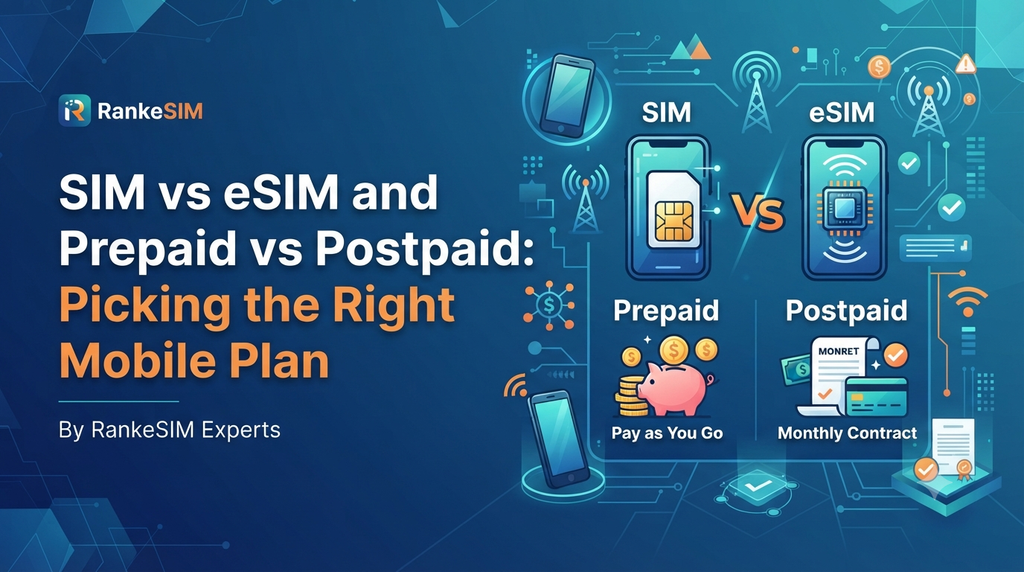
Phones connect to mobile networks using either a removable plastic SIM card—usually a tiny nano-SIM—or an eSIM, which is a digital SIM built directly into compatible handsets. Both hold the details that link your phone to your provider, yet they handle setup and switching differently.
Weighing SIM vs eSIM plans comes down to what your phone supports and how often you change lines or devices. A physical SIM slides into a tray on your phone, while an eSIM downloads over Wi-Fi using a QR code or provider app.
- Device support: Most newer smartphones support eSIM, while older or entry-level models often take only a physical SIM; some regions also sell versions with different SIM trays.
- Setup speed: Physical SIMs require waiting for delivery or visiting a store, whereas eSIMs can often turn on within minutes when your device and plan support them.
- Changing phones or providers: Moving an eSIM to another handset or network can be quick when supported, though some carriers ask you to request a fresh QR code or verify your account first.
- Using two lines at once: Many modern phones store several eSIM profiles and run two numbers together—such as personal and work lines—depending on the handset.
- Travel ease: eSIMs let you add a travel data plan before you fly without handling tiny plastic cards or misplacing your home SIM, as long as your phone is unlocked.
- Possible drawbacks: Not every carrier, discount brand, or prepaid plan supports eSIM yet, and a lost or broken phone can make recovering an eSIM harder if you do not prepare ahead.
- When a physical SIM works best: A physical card stays practical if your phone lacks eSIM hardware, if you move your SIM between spare phones often, or if you want a simple card you can swap by hand.
Whichever option you pick, your phone must be unlocked and compatible with your carrier’s wireless frequencies. Support always depends on your exact phone model, provider, and country.
Why MNOs and MVNOs Work Differently
As you browse mobile deals, you will notice large national networks alongside smaller brands selling plans at lower rates. Knowing how these two types of providers work helps set clear expectations.
A Mobile Network Operator (MNO) owns and runs its own cell towers, core network gear, and licensed radio spectrum. A Mobile Virtual Network Operator (MVNO) does not own cell towers; instead, it buys network access wholesale from an MNO and sells plans under its own brand name.
Because an MVNO runs on a host carrier’s towers, its basic coverage map usually matches that host network in supported spots. Even so, sharing towers does not always mean getting the exact same day-to-day performance.
- Network priority and speeds: During busy hours on a crowded tower, some MVNO plans get lower data priority than direct MNO customers, which can slow speeds temporarily.
- Extra features: Access to certain 5G bands, Wi-Fi calling, visual voicemail, or roaming add-ons can vary based on the MVNO’s agreement.
- Customer service and apps: Billing rules, online account tools, and support quality often differ between big operators and smaller virtual brands.
Neither model is automatically better for every person. Check which host network an MVNO uses, read the plan terms, and see how that network performs where you actually spend time.
A Simple Step-by-Step Way to Compare Mobile Plans
Using a short checklist keeps you focused on what fits your daily routine instead of getting pulled in by loud limited-time ads.
- Check your real monthly data use: Open your phone settings and see how many gigabytes you used over the last two or three months.
- Choose prepaid or postpaid: Pick prepaid if you want upfront spending limits and easy exits, or postpaid if monthly billing and multi-line options fit your household better.
- Verify phone and SIM compatibility: Make sure your phone is unlocked, supports the needed SIM or eSIM format, and works on local 4G or 5G bands.
- Calculate the true effective cost: Add up all recurring payments, setup fees, and post-promo price jumps across the time you plan to keep the service.
- Check validity and renewal cycles: See whether the plan runs 28 days, 30 days, or a full calendar month, and check if unused data rolls over or expires.
- Confirm local network and 5G reach: Check coverage around your home, workplace, and travel routes, keeping in mind that 5G speeds vary by area.
- Read hotspot, roaming, and speed limits: Look for tethering caps, fair-use slowdowns, and overseas roaming charges before you commit.
- Review cancellation and switching terms: Check notice windows, contract lengths, and number-porting rules so leaving later is smooth.
- Check when the plan details were verified: Look for official provider links and recent check dates so you do not rely on old numbers.
- Pick the best overall fit: Choose the plan that brings together reliable local signal, clear rules, and a fair total cost for your real habits.
Why Fresh and Verified Plan Data Matters
Mobile plans shift often. Carriers update prices, adjust data limits, run short promos, and rewrite fair-use or roaming policies without big public notices.
If you rely on an old article or an unverified table, you risk choosing a plan whose rate has risen or whose perks have disappeared. Good comparison habits depend on knowing how current and trustworthy the information really is.
- Official source links: Linking straight to carrier pages lets you verify current terms directly at the source.
- Last-checked dates: Showing when a plan was reviewed helps you separate fresh listings from older records.
- Verification status: Clear labels distinguish details confirmed against official sources from items that still need checking.
- Ageing-data warnings: Notices on older records remind you to double-check current pricing before buying.
- Honest handling of unknowns: Saying clearly when a detail is unknown or unconfirmed is far safer than filling blanks with guesses.
- Reader-reported updates: Letting users flag price shifts or mistakes helps keep plan records accurate as offers change.
A transparent comparison helps you far more than a chart sorted only by cheap starter rates. Seeing what is confirmed, how recently it was checked, and where to verify terms gives you steady confidence before you switch.
How RankeSIM Helps Consumers Compare Mobile Plans
RankeSIM helps people evaluate mobile plans using structured, evidence-based facts rather than promotional spin. It operates strictly as an independent comparison resource—not a mobile carrier, network operator, or seller of phone plans—and does not claim official partnerships or carrier endorsements unless independently confirmed.
Inside its comparison tool, you can weigh plans by personalized plan-fit scores, effective costs, data allowances, validity periods, 5G availability, hotspot limits, and plan styles including prepaid, postpaid, data-only, bundled, and pay-as-you-go options. It also provides country-specific background on local carriers and whether they operate as MNOs or MVNOs.
A personalized plan-fit score shows how closely a plan’s published details match the preferences you enter under RankeSIM’s scoring method. It is a useful guide for narrowing choices—not a guarantee that a plan is best for every person or an independent test of live signal quality.
RankeSIM covers nine active markets—Australia, Canada, France, Germany, India, Ireland, New Zealand, the United Kingdom, and the United States—for local SIM and eSIM comparisons, with a separate travel eSIM comparison mode coming online country by country rather than launching everywhere at once. Because carrier catalogs and verification progress differ across countries and change over time, plan counts and detail depth vary by market, so always confirm final terms on the provider’s site.
Common Mistakes That Cost Mobile Shoppers Money
Even careful buyers fall into a few repeat traps when switching mobile plans. Watching out for these habits saves both money and frustration.
- Looking only at the lowest advertised rate: Cheap welcome prices often leave out activation fees, expire after a few months, or hide strict usage limits.
- Missing shorter validity windows: A 28-day recharge cycle costs you thirteen payments a year instead of twelve calendar-month bills.
- Skipping hotspot and speed fine print: A plan may slow data after a threshold or block laptop tethering even while data remains.
- Thinking all unlimited plans work the same way: Fair-use rules, peak-hour slowdowns, and hotspot caps differ widely across providers.
- Forgetting to check phone compatibility: A great plan will not work properly on a locked phone, the wrong SIM format, or missing local bands.
- Mixing up strong coverage with a good plan fit: Strong signal in your area does not automatically mean the data allowance or price fits your routine.
- Overlooking auto-renewal and exit rules: Automatic top-ups, minimum balances, or notice periods can catch you off guard when switching.
- Trusting outdated comparison pages: Carrier deals shift constantly, so old tables can point you toward expired prices.
- Assuming every plan supports eSIM: eSIM support still depends on the carrier, specific plan tier, country, and phone model.
Making a Smarter Choice for Your Mobile Service
The right mobile plan is the one that fits your real daily habits without hiding surprises in the terms. Spending a few minutes checking effective cost, validity length, data rules, hotspot limits, and local signal reach pays off far more than chasing the loudest discount ad.
Always verify current prices, activation steps, and local coverage directly with the mobile carrier before signing up. When you want to explore country-specific plans side by side with clear source links and check dates, RankeSIM gives you a practical starting point across supported markets.

